Short answer: Replit wins when developers or technical builders want a cloud workspace where Agent builds, tests in a browser and deploys to autoscale, VM, static or scheduled hosting, with SSO and admin policies. Rocket.new wins when the work starts before code: market research, a PRD, competitor tracking, then a Next.js web app or Flutter mobile app.
Search "replit vs rocket.new" and several top results read like ads. Several sit in 'initiatives' sections of news sites; one is on Rocket's own blog. That is a good reason to go back to the docs.
The fair version of the debate goes like this. Rocket.new's case: it knows what you are building because it researches first. Replit's case: it is a real development platform that grows with the app. This page tests both claims against each vendor's documentation, checked in November 2026. Our running example is a meal-kit startup that needs a launch page, a waitlist and a weekly ordering app.
In this comparison:
- Replit and Rocket.new at a glance
- Feature comparison
- Cost model by team size
- Where Replit wins
- Where Rocket.new wins
The verdicts sit after the tables.
Replit and Rocket.new at a glance
Replit is a cloud development platform whose Agent builds, tests and publishes apps from plain-language requests (Replit Agent). Status: active. Agent 4 launched alongside a USD 400M Series D at a USD 9B valuation, combining design and code and running tasks in parallel (Dealroom, Mar 11, 2026). Teams use Workspaces for internal tools, customer-facing apps, dashboards, designs and slide decks (Replit Workspaces).
Rocket.new (Rocket USA Inc.) is active and calls itself a "vibe solutioning" platform (Rocket). Solve validates ideas and writes PRDs, Build plans the architecture and writes the code, and Intelligence monitors competitors (Rocket docs). In 2026 it made Next.js the default for landing pages (February) and for all new web apps, and launched GitHub Sync for Next.js projects (March) (Feb changelog; Mar changelog).
Feature comparison
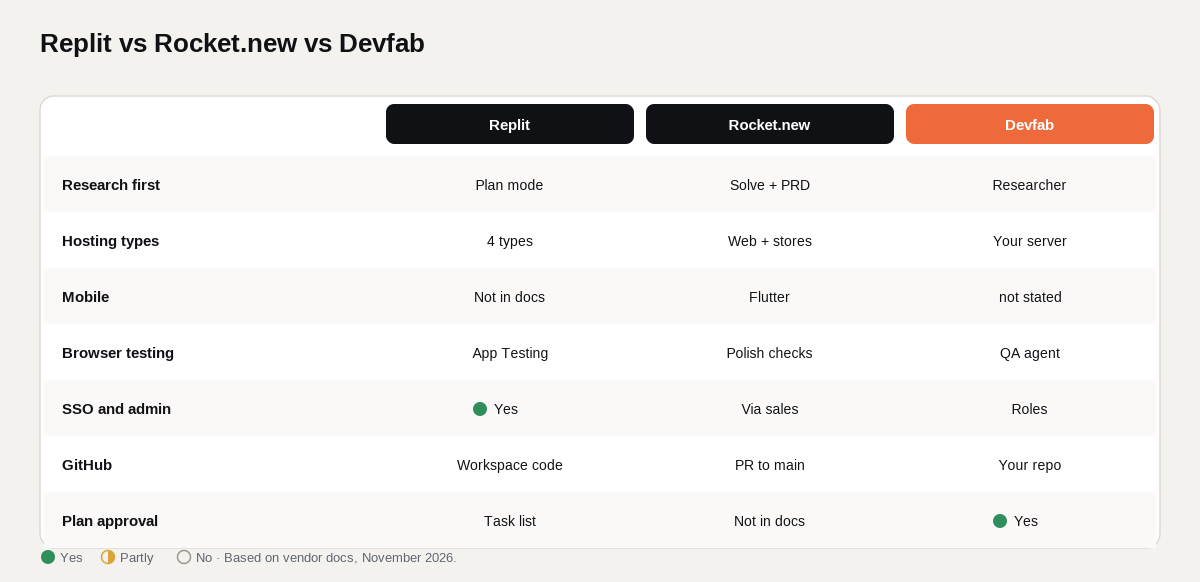
| Aspect | Replit | Rocket.new | Source |
|---|---|---|---|
| Where it runs | Browser cloud workspace | Hosted; Chat, Visual edit, Code editor | Replit Agent; Rocket build docs |
| What it builds | Web apps, internal tools, dashboards, designs, slides | Next.js web apps; Flutter iOS and Android apps | Replit Workspaces; Rocket intro |
| Research and spec | Plan mode: brainstorm and a task list to approve | Solve: market research, PRDs, structured reports | Replit Agent; Rocket intro |
| Agent autonomy | Free Mode, Power, Max; parallel tasks (Core 1, Pro up to 10) | Build plans and codes; Advisor Agent | Replit pricing docs; Rocket build docs |
| Testing | App Testing clicks through the app in a browser (JS full-stack, Streamlit) | Polish: SEO, accessibility, compliance | Replit App Testing; Rocket build docs |
| Deploy and hosting | Autoscale, Reserved VM, Static, Scheduled; custom domains | One-click web launch; APK, Google Play, App Store | Replit publish; Rocket build docs |
| Code ownership | Code in the workspace; checkpoints to roll back | PRs from rocket-update to main; ZIP on Pro+; import Next.js + TS only | Replit Agent; Rocket from GitHub |
| Team and admin | SAML SSO, SCIM, admin policies; Enterprise RBAC, scans, audit logs | Unlimited members on paid plans; SSO via sales | Replit Enterprise; Rocket pricing |
| Model choice | Auto per task; Enterprise model controls | AI model connectors for your app | Replit Agent; Rocket build docs |
| Pricing model | Effort-based; confirmed before paid work | One credit pool across three modes | Replit pricing docs; Rocket pricing |
Cost model by team size
| Team size | Replit | Rocket.new |
|---|---|---|
| 1 person | Starter USD 0; Core USD 20 per month (USD 18 billed annually), USD 20 in credits | Free USD 0 (20 one-time credits); Pro USD 25 per month (100 credits) |
| 5 people | Pro USD 100 per month (USD 90 billed annually), USD 100 in credits, up to 15 collaborators | Rocket USD 50 per month (250 credits), unlimited team members |
| 25 people | Enterprise (custom): SSO, SCIM, audit logs, single-tenant options | Booster USD 250 per month (1,500 credits); SSO via sales |
Prices as of November 2026 from Replit pricing and Rocket pricing (20% off yearly). Neither is stated per user. Replit's Plan mode can incur charges even without changing code (Replit docs); Rocket's credits are shared by research and building, so heavy research leaves fewer for code.
Where Replit wins
- The app will keep growing. A full workspace means developers can take over any file without exporting.
- Hosting needs vary. Always-on VMs for the ordering backend, scheduled jobs for weekly menus, static hosting for the launch page.
- IT governance. SAML SSO, SCIM, admin policies, and on Enterprise private deployments, required security scans, CVE detection and SBOM downloads.
- Browser testing for web apps. App Testing clicks through Full Stack JavaScript and Streamlit apps and fixes issues.
- Parallel work. Pro runs up to ten Agent tasks at once.
Where Rocket.new wins
- You are not sure what to build. Solve's market research and PRD give the meal-kit startup a spec before any code.
- A phone app is required. Flutter iOS and Android, with APK, Google Play and App Store paths.
- Marketing pages matter. 25,000+ landing page templates, plus SEO and accessibility checks in Polish.
- Competitor tracking comes from the same subscription.
- Many people, one plan. Paid plans include unlimited team members.
Switching from one to the other
From Rocket.new to Replit. Turn on GitHub Sync for a Next.js project, or download the ZIP on Pro or above (Rocket code editor). Bring the code into Replit and continue with Agent. Flutter mobile code needs its own toolchain plan.
From Replit to Rocket.new. Push the code to GitHub. Rocket imports only Next.js with TypeScript, only the latest default-branch state, without issues, PRs or history (Rocket from GitHub). Other stacks mean a rebuild. See Replit alternatives and Rocket.new alternatives.
Where Devfab fits
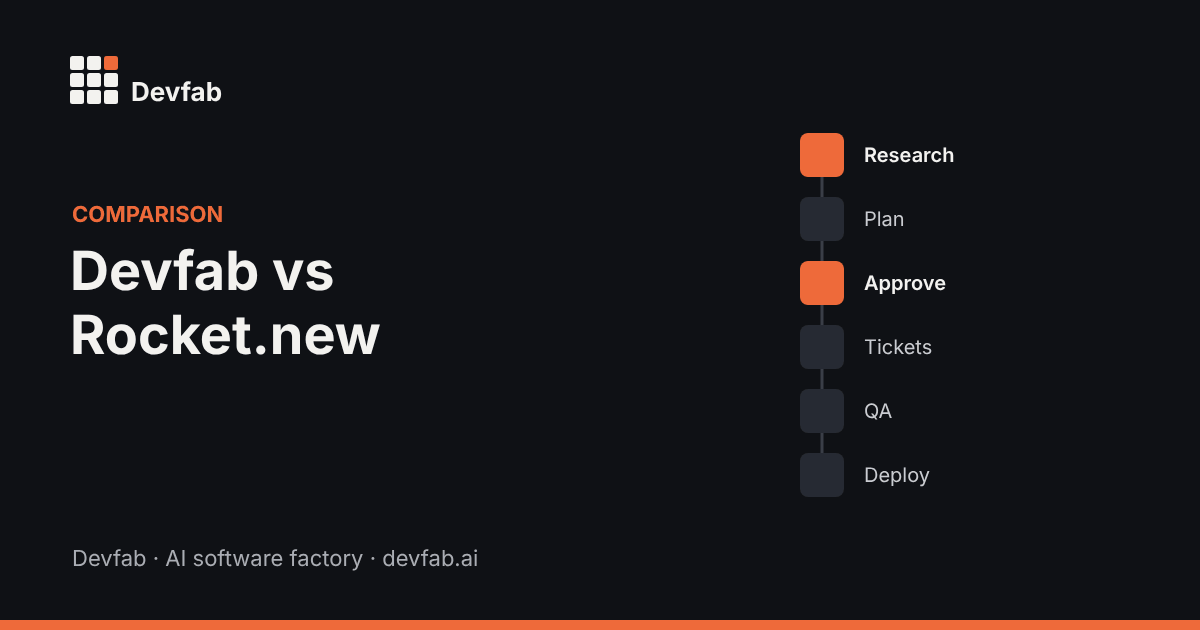
Rocket.new researches before building. Replit gives developers a workspace. Neither covers the whole run from research to tested release with a person approving the plan in between.
Coding agents automate the developer. Devfab automates the development lifecycle. Devfab's Researcher maps key terms, best practices and competitors before the Planner writes a plan, and a person approves it. ChainFlow maps which functions and APIs call each other, so changing checkout shows its impact on payments, inventory, order confirmation and notifications. The QA agent runs UI and flow tests plus logic tests, and Deploy ships to your own server. Devfab is in Beta, has fewer integrations and needs a GitHub account. See Devfab vs Rocket.new.
FAQ
Is Rocket.new better than Replit?
For different jobs. Rocket.new is stronger before the build (market research, PRDs, competitor monitoring) and for Flutter mobile apps. Replit is stronger as a development workspace, with several hosting types, browser testing for supported web apps and enterprise admin controls.
Several articles say Rocket.new has replaced Replit. Are they independent?
Treat them with care. Several top results for this query sit in 'initiatives' sections of news sites, which usually carry promoted content, and one comparison is on Rocket's own blog. This page uses only vendor documentation and a dated funding report.
How do they charge?
Replit uses effort-based pricing for paid Agent work, confirmed before it starts; Core is USD 20 per month as of November 2026. Rocket.new uses one credit pool across Build, Solve and Intelligence; Pro is USD 25 per month and paid plans include unlimited team members.
Can I move a Rocket.new project into Replit?
Yes, through code. Rocket.new can sync Next.js projects to GitHub through pull requests, and paid plans can download a ZIP. You can then bring that code into a Replit project and keep building with Agent.
Read next
- What is an AI software factory?
- AI software factory vs AI coding tools
- Replit alternatives
- Devfab vs Rocket.new
- Replit vs Anything
Research done and code started? Let a factory carry it to release. Try Beta
Sources (checked November 2026): Replit Agent overview; Replit pricing and plans; Replit pricing; Replit App Testing; Replit Enterprise; Replit: Publish your app; Replit Workspaces; Dealroom (Mar 11, 2026); Rocket homepage; Rocket docs: Introduction; Rocket docs: Build overview; Rocket docs: Pricing plans; Rocket docs: From GitHub; Rocket docs: Code editor; Rocket changelog, Feb 2026; Rocket changelog, Mar 2026.
Frequently asked questions
Is Rocket.new better than Replit?
For different jobs. Rocket.new is stronger before the build (market research, PRDs, competitor monitoring) and for Flutter mobile apps. Replit is stronger as a development workspace, with several hosting types, browser testing for supported web apps and enterprise admin controls.
Several articles say Rocket.new has replaced Replit. Are they independent?
Treat them with care. Several top results for this query sit in 'initiatives' sections of news sites, which usually carry promoted content, and one comparison is on Rocket's own blog. This page uses only vendor documentation and a dated funding report.
How do they charge?
Replit uses effort-based pricing for paid Agent work, confirmed before it starts; Core is USD 20 per month as of November 2026. Rocket.new uses one credit pool across Build, Solve and Intelligence; Pro is USD 25 per month and paid plans include unlimited team members.
Can I move a Rocket.new project into Replit?
Yes, through code. Rocket.new can sync Next.js projects to GitHub through pull requests, and paid plans can download a ZIP. You can then bring that code into a Replit project and keep building with Agent.