Short answer: Pick Zed if you want a fast, open-source native editor where AI is optional and you bring any model or agent, even Cursor's own agent through ACP. Pick Cursor if you want an AI-first editor with cloud agents that work in parallel, Bugbot pull request reviews and the full VS Code extension library.
You spend most of your working day in your editor. One camp says Cursor is where AI coding happens. The other says Zed is faster, open and now ships agents too. Both claims hold up, so the real question is which trade-offs your team can live with.
In this comparison:
- Zed and Cursor at a glance
- Feature comparison
- Where Zed wins
- Where Cursor wins
- Switching from one to the other
The rest of this page covers it in order, with sources.
Zed and Cursor at a glance
Status changes in 2026
- Zed shipped version 1.0 on April 29, 2026, together with Zed for Business. On August 12, 2026 the company launched Delta, a separate app for multiplayer agent coding, in private beta.
- Cursor is now owned by SpaceX. The deal was announced on June 16, 2026, and Cursor's August 14 post says the acquisition officially closed. Cursor plans now bundle Grok products.
Zed
Zed calls itself "The world's fastest IDE. Open source. AI optional." It is a native editor written in Rust for macOS, Linux and Windows, with no web version. The code is open source under GPL-3.0-or-later.
Its agent panel takes a task, finds context, edits files and keeps going until done. Changes appear in an editable diff that you accept or reject. Through the Agent Client Protocol (ACP), Zed can also host Claude Agent, Codex, OpenCode and Cursor, several at once. Zeta, its edit-prediction model, is open-weight and open-data.
You can use Zed-hosted models, bring keys from many providers, or run local models through Ollama or LM Studio. Zed also has real-time multiplayer editing, SSH remoting, a debugger and Git built in.
Cursor
Cursor describes itself as "a coding agent for building ambitious software". It is built on VS Code, so it keeps VS Code's interface, keybindings and extensions. Cursor runs as a desktop editor, a CLI, cloud agents, a mobile app and SDKs.
Plan Mode "creates detailed implementation plans before writing any code". Cloud agents run in isolated cloud VMs with full development environments, many in parallel, each on its own branch. Bugbot reviews pull requests for bugs, security issues and code quality, and Autofix can push fixes. Cursor offers models from Anthropic, Google, OpenAI and xAI, plus its own Composer model.
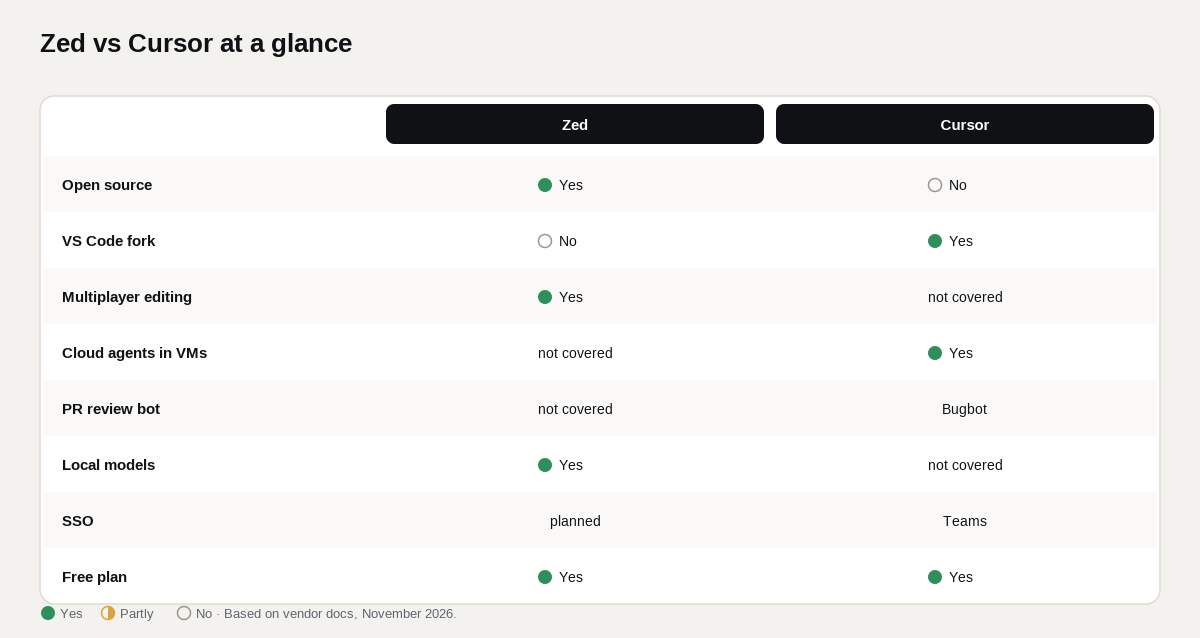
Feature comparison
| Aspect | Zed | Cursor | Source |
|---|---|---|---|
| Where it runs | Native desktop editor on macOS, Linux, Windows; no web version | Desktop editor, CLI, cloud agents, mobile, SDKs | Zed GitHub; Cursor docs |
| Planning / spec | Agent panel; external agents bring their own planning | Plan Mode drafts a plan you edit before building | Zed agentic; Cursor Plan Mode |
| Agent autonomy | Edits shown as an editable diff; granular tool permissions; agents run in parallel | Cloud agents in isolated VMs, many in parallel, each on its own branch | Zed agentic; Cursor cloud agents |
| Code review | Accept or reject each diff in the editor | Bugbot reviews PRs; Autofix pushes fixes | Zed agentic; Cursor Bugbot |
| Deploy / hosting | Editor only; no hosting described | Cloud agents can run on self-hosted machines; no app hosting described | Zed; Cursor cloud agents |
| Code and openness | Open source (GPL-3.0-or-later) | Proprietary; works with GitHub, GitLab, Bitbucket, Azure DevOps | Zed GitHub; Cursor cloud agents |
| Team / admin | Business: AI policies, spend visibility, roles; SSO, SAML, SCIM planned | SSO on Teams; SCIM, audit logs, model and MCP controls on Enterprise | Zed pricing; Cursor enterprise |
| Model choice | Hosted models, your own keys, local models; any ACP agent | Anthropic, Google, OpenAI, xAI models plus Cursor Composer | Zed pricing; Cursor docs |
| Pricing model | Free Personal plan; Pro monthly plus usage at API list price + 10%; Business per seat | Free tier; tiers with a weekly usage pool shared with Grok; Teams per seat | Zed pricing; Cursor pricing |
Cost model by team size
| Team size | Zed | Cursor |
|---|---|---|
| 1 person | Personal is free with your own keys or external agents (no hosted AI); Pro is monthly with unlimited edit predictions and usage-based hosted models | Free tier with limited agent and chat requests; paid tiers include a usage pool that refreshes weekly; cloud agents need Premium or higher |
| 5 people | Business per seat, with org AI policies and spend visibility | Teams per seat, with SAML or OIDC SSO |
| 25 people | Business per seat; check whether you need SSO, which is planned but not yet available | Enterprise (custom) for SCIM, audit logs, model and MCP access controls and group spend limits |
Amounts change, so check Zed's pricing page and Cursor's pricing page. Cursor's entry Plus tier is limited to Grok models. For reference, Devfab (Beta) logs cost after each run, per task and per project.
Where Zed wins
- Speed and a native app matter to you. Zed is built in Rust and is not a VS Code fork.
- You want open source. The editor is GPL-licensed, and Zeta is open-weight and open-data.
- You want model and agent freedom. Bring your own keys, run local models, or host Claude Agent, Codex, OpenCode or Cursor through ACP.
- People code together. Real-time multiplayer editing is built in, and Delta extends this to shared agent threads.
- You want a free option without hosted AI. The Personal plan costs nothing when you bring your own keys.
Where Cursor wins
- You need background agents at scale. Cloud agents run in parallel in isolated VMs and push to their own branches.
- You want AI review on every pull request. Bugbot finds bugs and security issues, and Autofix can push the fix.
- You depend on VS Code extensions. Cursor keeps near-full compatibility; Zed's own comparison page says its extension ecosystem is newer.
- You need enterprise identity today. SSO on Teams, plus SCIM and audit logs on Enterprise.
- You start agents from many places. Slack, GitHub, Linear, mobile or the API can all kick off a cloud agent.
Switching from one to the other
From Cursor to Zed:
- Install Zed and choose the VS Code keymap during onboarding.
- Run "zed: import vs code settings" from the command palette. Zed's docs mention VS Code settings, not Cursor's, so check the result.
- Extensions do not carry over. Find equivalents in Zed's extension directory.
- Keep using Cursor's agent if you like it: connect it to Zed through ACP.
From Zed to Cursor: open the same repository in Cursor, install the VS Code extensions you need, and rebuild your agent setup with Cursor's rules, skills and MCP servers.
Where Devfab fits
Zed and Cursor are both editors for developers who write code by hand. Devfab is not an editor and doesn't try to be one. It runs the work around the code: research, an approved plan, tickets, testing and deployment.
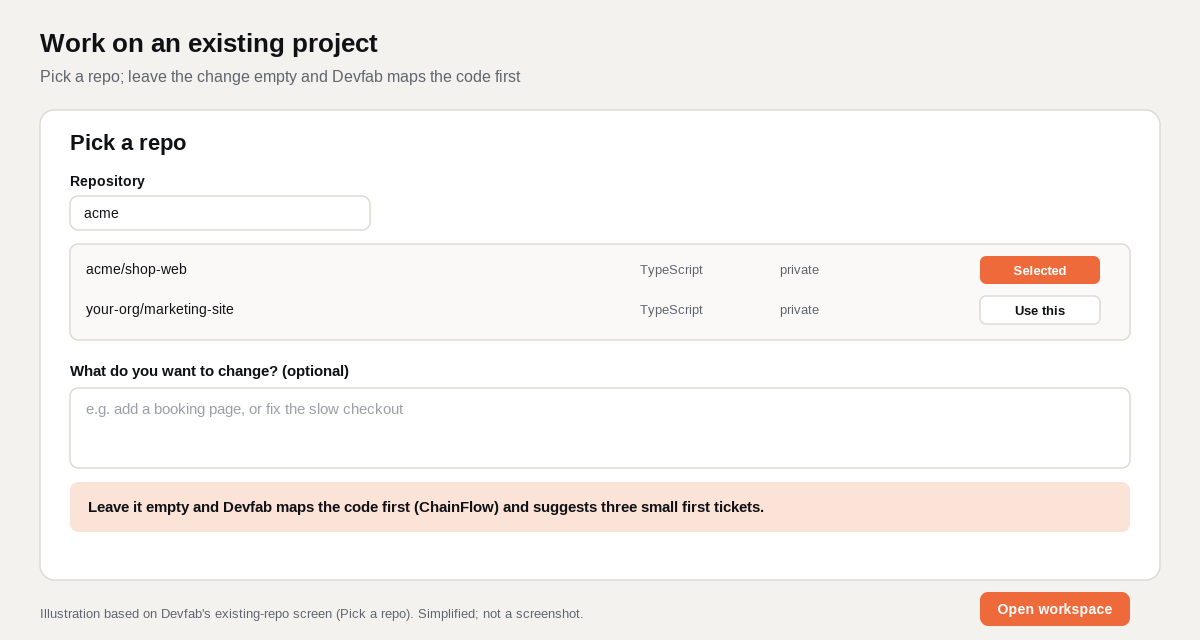
Coding agents automate the developer. Devfab automates the development lifecycle. In Devfab you pick "Work on an existing project", connect your GitHub repo and leave the change box empty. ChainFlow maps which functions and APIs call each other, and Devfab suggests three small first tickets. A person approves the plan, and the QA agent runs UI, flow and logic tests. Your developers keep Zed or Cursor open on the same repository.
Honest limits: Devfab is new and in Beta, with a smaller community and fewer integrations. It needs a GitHub account. Compare directly in Devfab vs Cursor and Devfab vs Zed.
FAQ
Is Zed a fork of VS Code like Cursor?
No. Zed is a native editor written in Rust and is not a VS Code fork. Cursor builds on VS Code, so it keeps VS Code's interface, keybindings and near-full extension compatibility. That is why Cursor has the larger extension library and Zed's is newer.
Can I use Cursor's agent inside Zed?
Yes. Through the Agent Client Protocol, Zed can host outside agents including Claude Agent, Codex, OpenCode and Cursor, and run several in parallel. You keep Zed as the editor and choose the agent per task.
Does Zed have SSO for teams?
Not yet. Zed's pricing page says SSO, SAML and SCIM are planned but not currently available. Its Business plan adds org-wide AI policies, data governance, spend visibility and role-based access. Cursor offers SSO on Teams, with SCIM and audit logs on Enterprise.
Did the SpaceX acquisition change Cursor?
Cursor says it was officially acquired by SpaceX in its August 14, 2026 post and remains a wholly owned subsidiary. Its pricing now bundles Grok products into Cursor plans, and the entry Plus tier is limited to Grok models.
Read next
- What is an AI software factory?
- Devfab vs Cursor: which fits a team that ships client work?
- Devfab vs Zed: which fits a team that ships client work?
- Cursor alternatives for teams that ship to production (2026)
Keep your editor. Add the lifecycle around it. Try Devfab Beta
Sources (checked November 13, 2026): Zed homepage; Zed pricing; Zed agentic editing; Zed is 1.0 (Apr 29, 2026); Introducing Delta (Aug 12, 2026); zed-industries/zed on GitHub; Zed vs Cursor (Zed, updated May 1, 2026); Zed docs: Migrate from VS Code; Cursor docs; Cursor pricing; Cursor Plan Mode; Cursor cloud agents; Cursor Bugbot; Cursor enterprise; Cursor: Joining SpaceX (Aug 14, 2026); The Next Web: SpaceX makes its Cursor takeover official.
Frequently asked questions
Is Zed a fork of VS Code like Cursor?
No. Zed is a native editor written in Rust and is not a VS Code fork. Cursor builds on VS Code, so it keeps VS Code's interface, keybindings and near-full extension compatibility. That is why Cursor has the larger extension library and Zed's is newer.
Can I use Cursor's agent inside Zed?
Yes. Through the Agent Client Protocol, Zed can host outside agents including Claude Agent, Codex, OpenCode and Cursor, and run several in parallel. You keep Zed as the editor and choose the agent per task.
Does Zed have SSO for teams?
Not yet. Zed's pricing page says SSO, SAML and SCIM are planned but not currently available. Its Business plan adds org-wide AI policies, data governance, spend visibility and role-based access. Cursor offers SSO on Teams, with SCIM and audit logs on Enterprise.
Did the SpaceX acquisition change Cursor?
Cursor says it was officially acquired by SpaceX in its August 14, 2026 post and remains a wholly owned subsidiary. Its pricing now bundles Grok products into Cursor plans, and the entry Plus tier is limited to Grok models.