Short answer: Zoho Creator wins when the tool is a real business app: approval workflows, scripting, a test step, native phone apps and a choice of cloud or on-premise hosting. Airtable wins when the work is mostly shared data that non-technical staff edit themselves, with Omni building interfaces and automations on top.
Your sales team quotes from a spreadsheet nobody trusts. Prices live in one tab, discounts in another, approvals in email.
One camp says "just put it in Airtable." Another says "build a proper app in Zoho Creator." Both are cheap to start and hard to undo. This page acts as the referee, with vendor pages checked in November 2026.
In this comparison:
- Zoho Creator and Airtable at a glance
- Feature comparison
- Cost model by team size
- Where Zoho Creator wins
- Where Airtable wins
We use one example throughout: a B2B quote tool for a parts distributor.
Zoho Creator and Airtable at a glance
Airtable has a new owner. Bending Spoons closed its acquisition of Airtable in early September 2026. On October 12, 2026, Airtable announced layoffs of much of the pre-acquisition team and said plans and pricing were unchanged (Airtable newsroom; Airtable community). The product kept shipping: the October 21 Fall Release added Omni 2.0, an open beta of Airtable Canvas, a bigger MCP and agent audit logs (Fall Release).
Airtable is a no-code database and app platform. Its AI assistant, Omni, builds tables, fields, automations, dashboards and interface pages from plain language (Airtable support). It fits teams whose "app" is mostly structured records.
Zoho Creator is active, with no ownership change. It is Zoho's low-code platform for business apps, workflows and AI agents, built with prompts, visual tools or code. Zoho claims 6M+ users and 7M+ apps (Zoho Creator). It fits small and mid-size businesses that want workflow apps at a low per-user price, often next to Zoho CRM or Books.
For the quote tool, the split is clear. Airtable starts from the price list as data. Zoho Creator starts from the quote as a process.
Feature comparison
| Aspect | Zoho Creator | Airtable | Source |
|---|---|---|---|
| Where it runs | Browser builder; apps on Zoho Cloud, AWS, Azure, GCP, on-premise or hybrid | Web app, Mac and Windows apps; Omni chat inside Airtable | Zoho Creator; Airtable community |
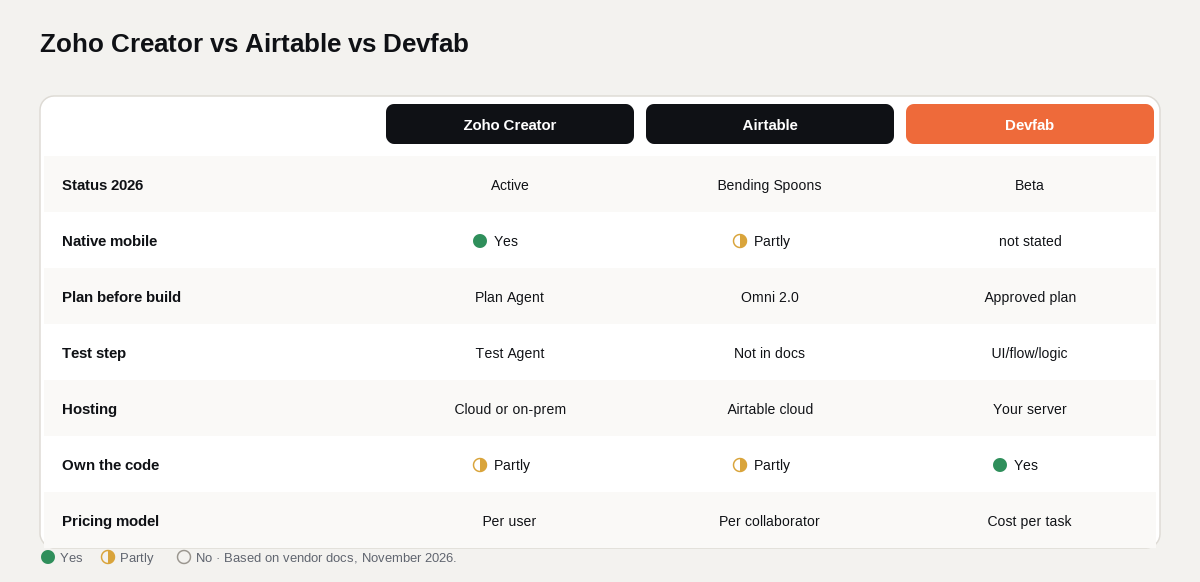
| Mobile | Native iOS and Android versions of every app | Custom elements are not viewable on mobile | Zoho Creator; Airtable community |
| Planning and spec | Plan Agent writes a business requirement document | Omni 2.0 builds data models from spreadsheets, PDFs and images | Zoho Creator; Fall Release |
| Agent autonomy | Build Agent adds modules and workflows, with review of each change | Omni asks before deletions; publishing and turning on automations stay with you | Zoho Creator; Airtable support |
| Testing | Test Agent generates and runs test cases | Not covered in the docs we checked | Zoho Creator |
| Code | Deluge scripting; code options | AI-generated custom elements with source you can edit or download | Capterra; Airtable community |
| Team and admin | Roles, MFA, encryption, audit trail; SAML SSO is an add-on | Org-wide MCP switch; agent audit logs on Enterprise; agent permissions "coming soon" | Zoho pricing; Fall Release |
| Model choice | Zoho's own GenAI, or your own key for OpenAI, Google or Anthropic | Custom elements use Anthropic and OpenAI models only | Zoho Creator; Airtable community |
| Pricing model | Per user per month, three tiers, plus Free Edition and custom Flex | Per billable collaborator, with pooled monthly AI credits | Zoho pricing; Airtable plans |
One Airtable detail matters for budgets. Building apps, agents and bases with Omni does not use AI credits; Q&A does (Airtable AI billing). Zoho caps AI models per plan instead: 20, 100 and 100 custom models across its three tiers (Zoho pricing).
Cost model by team size
| Team size | Zoho Creator | Airtable | Devfab |
|---|---|---|---|
| 1 person | Free Edition, or Standard USD 8 per user per month billed annually (USD 12 monthly); Standard allows one app | Free USD 0, with caps on records per base and automation runs | Cost logged per task and per project (Beta) |
| 5 people | Professional, USD 20 per user per month billed annually (USD 30 monthly), unlimited apps | Team, USD 20 per user per month billed annually | Cost logged per task and per project (Beta) |
| 25 people | Enterprise, USD 25 per user per month billed annually (USD 37 monthly), or custom Flex | Business, USD 45 per user per month billed annually; Enterprise Scale is custom | Cost logged per task and per project (Beta) |
Prices as of November 2026 from Zoho Creator pricing and Airtable pricing. Airtable bills per billable collaborator, and extra AI credit packs are sold on self-serve plans. Devfab is in Beta and offers predictable cost: cost is logged after each run, per task and per project.
Where Zoho Creator wins
- Reps quote from the road. Every Zoho Creator app gets native iOS and Android versions; Airtable's custom elements are not viewable on mobile.
- Quotes need approvals and rules. Plan Agent and Build Agent turn requirements into modules and workflows, with review of each change.
- You want a test step. The Test Agent generates and runs test cases.
- Hosting must be your choice. Zoho lists Zoho Cloud, AWS, Azure, GCP, on-premise and hybrid.
- Model policy is strict. You can use Zoho's own GenAI or bring your own key for OpenAI, Google or Anthropic.
Where Airtable wins
- Staff edit data, not code. Omni builds tables, fields, automations and interface pages, and non-technical people keep changing them.
- You start from files. Omni 2.0 builds data models from spreadsheets, PDFs and images.
- You want guardrails on the AI. Omni asks before deletions, and Canvas asks before adding tables or fields.
- Your AI assistants already live elsewhere. Airtable MCP works with Claude, ChatGPT, Gemini and Cursor.
- You need to show developers the code. Custom element source can be edited in the browser or downloaded.
Both have limits worth reading. Capterra reviewers in 2026 cite a steeper learning curve beyond simple apps and slow-to-learn Deluge scripting for Zoho Creator (Capterra). Omni can't create new views, set up syncs or export data, and Canvas is unavailable for HIPAA-compliant or non-US-data organizations (Airtable support; Fall Release).
Switching from one to the other
Neither vendor documents a direct importer from the other in the pages we checked.
From Airtable to Zoho Creator. Export each table to CSV from your base views, since Omni itself can't export data. Import the files into Zoho Creator, then give the Plan Agent your quote rules so it drafts a requirement document. Let the Build Agent add the approval workflow, and rewrite any Airtable automation scripts in Deluge.
From Zoho Creator to Airtable. Export your Creator data, then use Omni 2.0 to build a data model from the spreadsheets. Rebuild approval steps as automations, and remember you turn automations on yourself. Run both tools on the same week of quotes before you switch off the old one.
Where Devfab fits
The quote tool can outgrow both. Say the distributor wants customers to request quotes in a portal, pull live stock from the ERP and sign online. At that point it is custom software, and the questions become who owns the code and how changes get tested.
Coding agents automate the developer. Devfab automates the development lifecycle. Devfab's Researcher maps quoting terms, best practices and competing products before the Planner writes a plan, and a person approves it. ChainFlow maps which functions and APIs call each other, so a change to discount rules shows its effect on quote totals, approvals and customer emails. The QA agent runs UI and flow tests plus logic tests, and the code lives in your own GitHub account. Devfab is in Beta, with a smaller community and fewer integrations, and it is not a visual builder. See Devfab vs Zoho Creator and Devfab vs Airtable.
FAQ
Who owns Airtable now?
Bending Spoons. Airtable says the acquisition closed in early September 2026. On October 12, 2026 it announced layoffs of much of the earlier team and said plans and pricing stay the same. The product is active and shipped Omni 2.0 on October 21, 2026.
Is Zoho Creator or Airtable better for a sales quote tool?
If quotes need approval steps, PDF output and a phone app for reps, Zoho Creator fits better: it is built for workflows and gives every app native iOS and Android versions. If the quote list is mostly shared data that sales ops edits by hand, Airtable is simpler.
Which one tests the app it builds?
Zoho Creator lists a Test Agent that generates and runs test cases and is described as self-healing. The Airtable pages we checked describe safeguards instead: Omni asks before deletions and leaves publishing and turning on automations to you.
Which is cheaper for 25 people?
At list price, Zoho Creator Enterprise is USD 25 per user per month billed annually and Airtable Team is USD 20 per user per month billed annually, as of November 2026. Airtable Business is USD 45. Check which plan has the limits you need before comparing.
Read next
Quote tool turning into a customer portal? Try Beta
Sources (checked November 2026): Zoho Creator; Zoho Creator pricing; Capterra: Zoho Creator reviews; Airtable newsroom: Back to bases (Oct 12, 2026); Airtable: An update on Airtable's team (Oct 12, 2026); Airtable Fall Release (Oct 21, 2026); Airtable: AI-generated custom elements out of beta; Using Omni AI in Airtable; Airtable AI billing; Airtable plans overview; Airtable pricing.
Frequently asked questions
Who owns Airtable now?
Bending Spoons. Airtable says the acquisition closed in early September 2026. On October 12, 2026 it announced layoffs of much of the earlier team and said plans and pricing stay the same. The product is active and shipped Omni 2.0 on October 21, 2026.
Is Zoho Creator or Airtable better for a sales quote tool?
If quotes need approval steps, PDF output and a phone app for reps, Zoho Creator fits better: it is built for workflows and gives every app native iOS and Android versions. If the quote list is mostly shared data that sales ops edits by hand, Airtable is simpler.
Which one tests the app it builds?
Zoho Creator lists a Test Agent that generates and runs test cases and is described as self-healing. The Airtable pages we checked describe safeguards instead: Omni asks before deletions and leaves publishing and turning on automations to you.
Which is cheaper for 25 people?
At list price, Zoho Creator Enterprise is USD 25 per user per month billed annually and Airtable Team is USD 20 per user per month billed annually, as of November 2026. Airtable Business is USD 45. Check which plan has the limits you need before comparing.