Short answer: Keep your Airtable data and add portals with Softr. Standardized on Microsoft 365? Choose Power Apps. For low per-user cost and native mobile apps, pick Zoho Creator. When the app must become owned code that is tested and deployed to your own server, use Devfab. Regulated teams that must self-host should look at Budibase.
Your team built the whole operation on a base: orders, approvals, client records. It worked until it didn't. Three things push teams to look now. Airtable has a new owner and a smaller team. Per-user prices climb as more people need edit access. And the app has outgrown views and interfaces.
This list compares seven options against one test: can you run it in production with real users? We say where Airtable still wins, too.
In this guide, you'll learn:
- Why teams leave Airtable
- Quick comparison
- The alternatives
- Where Airtable is still the better choice
- How to choose
Pick the section that matches your reason for leaving.
Why teams leave Airtable
Ownership and staffing changed. Bending Spoons closed its acquisition of Airtable in early September 2026. On October 12, Airtable announced layoffs of much of the pre-acquisition team, while stating that plans and pricing were unchanged (Airtable newsroom; Airtable community). The product is active: the October 21 Fall Release added Omni 2.0 and Airtable Canvas in open beta (Fall Release).
Cost grows with collaborators. Team is USD 20 per user per month and Business USD 45 per user per month, both billed annually, as of November 2026 (Airtable pricing). The Free plan caps records per base, automation runs and editors (plans overview).
AI building has gaps. Omni can't create new views, set up syncs, export data, or rebuild elements it didn't create. Gantt and blank layouts and forms in interfaces aren't supported (Airtable support). AI-generated custom elements don't show on mobile, and third-party credentials in an element are visible to all its users (Airtable community).
Some organizations can't use the newest features. Canvas needs Anthropic enabled as the AI provider and is unavailable for HIPAA-compliant or non-US-data organizations (Fall Release).
Quick comparison
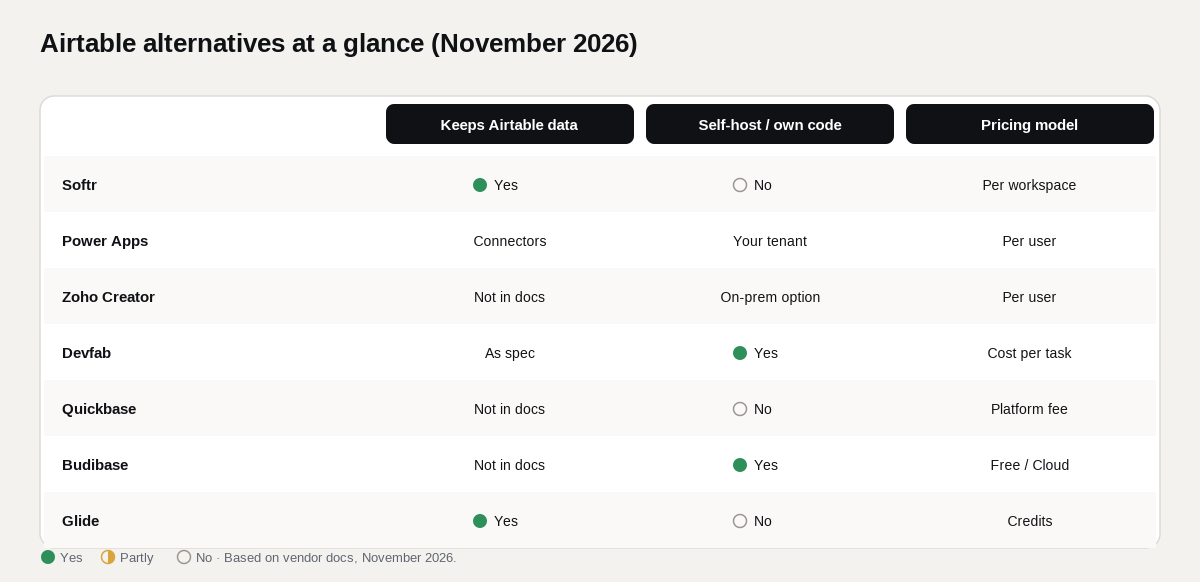
| Tool | Type | Keeps Airtable data? | Self-host or own code | Pricing model (Nov 2026) | Best for |
|---|---|---|---|---|---|
| Softr | No-code app builder | Yes, Airtable on every plan | No (hosted, EU or US) | Workspace plans; see pricing page | Client portals on existing data |
| Microsoft Power Apps | Low-code platform | Via connectors | Runs in your Microsoft tenant | USD 20 per user per month (Premium, yearly) | Microsoft 365 shops |
| Zoho Creator | Low-code platform | Not covered in the pages we checked | Zoho Cloud, AWS, Azure, GCP, on-prem | From USD 8 per user per month (annual) | Low-cost apps with native mobile |
| Devfab | Software Factory | Attach the base schema and screenshots as the spec | Code in your GitHub; deploy to your server | Cost logged per task and per project (Beta) | Apps that must become owned, tested code |
| Quickbase | Low-code platform + Pave | Not covered in the pages we checked | No (hosted) | Platform from USD 500 per month (annual); Pave from USD 20 per month | Ops apps with many users |
| Budibase | Open-source internal-tool builder | Not covered in the pages we checked | Yes: self-host incl. air-gapped | Community free; Cloud from USD 299 per month | Regulated IT teams |
| Glide | AI app builder over spreadsheets | Yes, lists Airtable | No (hosted) | Credit-based; Basic USD 25 per month | Sheet-based ops teams |
The alternatives
1. Softr
Verdict: the smallest step away from Airtable, because it can keep using your base. Best for: client portals and internal tools on data you already keep in Airtable, Google Sheets or Notion. Trade-off: you still build on a hosted platform; app users are capped per plan. Pricing: workspace plans (Free, Basic, Pro, Business, Enterprise); prices did not load on the page we opened, so check Softr pricing.
- Relaunched as "the new Softr" on November 9, 2026: from a description, AI builds the database, roles, permissions, workflows and a custom frontend (Softr blog).
- Airtable, Google Sheets, Notion, Coda, Xano and REST API are on every plan (Softr).
- User groups and record-level restrictions control who sees what; SOC 2 Type II and GDPR, with EU or US hosting.
- A competitor review notes very large Airtable bases can slow Softr apps (Jet Admin, Sep 30, 2026).
2. Microsoft Power Apps
Verdict: the default if your company already lives in Microsoft 365. Best for: line-of-business apps on Dataverse, SharePoint and Dynamics 365 under your tenant's governance. Trade-off: licensing is layered: premium connectors, Dataverse capacity and AI credits add cost. Pricing: Power Apps Premium USD 20 per user per month, paid yearly; Dataverse capacity USD 40 per GB per month, as of November 2026 (Power Apps pricing).
- Users "describe what they need in natural language" and generate apps (Power Apps).
- The September 2026 update made the app-builder skill generally available, letting tools like GitHub Copilot CLI and Claude Code build model-driven apps after a person approves the build plan (Microsoft blog).
- IT can centralize environment, data loss prevention, access and audit policies.
- Premium, on-premises and custom connectors need a standalone license beyond Microsoft 365 seeded rights (licensing FAQ).
3. Zoho Creator
Verdict: the lowest per-user price here, with native mobile apps included. Best for: small and mid-size businesses, especially those already on Zoho CRM or Books. Trade-off: reviewers report a steeper learning curve beyond simple apps and slow-to-learn Deluge scripting (Capterra). Pricing: Standard USD 8, Professional USD 20, Enterprise USD 25 per user per month billed annually, as of November 2026 (Zoho Creator pricing).
- Every app gets native iOS and Android versions (Zoho Creator).
- A Plan Agent writes a business requirement document; a Build Agent adds modules and workflows with review of each change.
- A Test Agent generates and runs test cases.
- Apps can run on Zoho Cloud, AWS, Azure, GCP, on-premise or hybrid.
4. Devfab
Verdict: the pick when the Airtable app has to become real software you own. Best for: agencies and IT teams turning a base-driven workflow into a production app with tests and a deploy target. Trade-off: it is not a spreadsheet; business users won't edit tables the way they do in Airtable. Devfab is in Beta with fewer integrations and a smaller community, and it needs a GitHub account. Pricing: predictable cost: cost is logged after each run, per task and per project.
Coding agents automate the developer. Devfab automates the development lifecycle. You describe the app, or attach the base's schema and screenshots. Devfab's Researcher maps the domain before planning: for a permit tracker, terms like permit types and inspections, common practices and competing products. A person approves the plan. The QA agent runs UI and flow tests, clicking screens, buttons and journeys end to end, plus logic tests, and Deploy ships to your own server. The code lives in your own GitHub account or your organization's.
5. Quickbase
Verdict: strong for operations teams that need many users on one platform price. Best for: field, construction and manufacturing teams running governed data apps. Trade-off: a high platform minimum; specialized integrations sit on higher plans (Blaze review). Pricing: core platform from USD 500 per month billed annually with no limit on users; Pave Launch USD 20 per month for 120 credits, as of November 2026 (Quickbase pricing; Pave pricing).
- Pave, launched April 28, 2026, builds apps from plain-language descriptions (press release).
- Pave includes data model, roles, workflows, hosting with draft and publish, and versioning rollback (Pave).
- Pave API access and white labeling are still "coming soon."
6. Budibase
Verdict: the open-source, self-hostable choice. Best for: regulated organizations that must run on-prem or air-gapped. Trade-off: Cloud actions are hard monthly limits; going over halts work until reset or upgrade (Jet Admin, Sep 2026). Pricing: Community (self-managed) USD 0; Cloud from USD 299 per month; Enterprise custom, as of November 2026 (Budibase pricing).
- Budibase 4.0 launched November 10, 2026, with agents, approval policies and agent audit logs (Budibase blog).
- Core platform is GPL v3, with paid features under the Business Source License (GitHub).
- Self-host via Docker, Kubernetes and others; ISO 27001 listed (Budibase).
7. Glide
Verdict: good if your data really lives in spreadsheets, less so if it lives in Airtable today. Best for: back-office teams in retail, logistics and services running on Excel or Google Sheets. Trade-off: credit costs are hard to predict, per a Glide community thread (Glide community). Pricing: Free USD 0 (can't publish apps); Basic USD 25; Plus USD 50; Pro USD 125 per month; Enterprise custom, as of November 2026 (Glide pricing).
- Relaunched as GlideOS in 2026; the previous product continues as Glide Classic (Glide blog).
- Lists Airtable among about 150 integrations (Glide).
- There is no migration tool from Glide Classic to GlideOS yet.
Where Airtable is still the better choice
- Your "app" is mostly structured data and views that non-technical staff edit every day.
- Omni building is free of credits. Building apps, agents and bases with Omni does not use AI credits; Q&A does (Airtable AI billing).
- You already run operations in bases and want Canvas apps or AI interfaces on that same data.
- You want AI tools to read your data. Airtable MCP works with Claude, ChatGPT, Gemini and Cursor.
How to choose
- Keep the data, change the front end? Softr, then Glide.
- On Microsoft 365? Power Apps.
- Lowest seat price with mobile apps? Zoho Creator.
- Many users, flat platform price? Quickbase.
- Must self-host, open source? Budibase.
- Need owned code, tests and your own server? Devfab.
Before moving, export a copy of every base and list the automations that touch outside systems. Those are what break first.
FAQ
What happened to Airtable in 2026?
Bending Spoons completed its acquisition of Airtable in early September 2026. On October 12 Airtable announced layoffs of much of the pre-acquisition team and said plans and pricing were unchanged. On October 21 it shipped a Fall Release with Omni 2.0 and Airtable Canvas in open beta.
What is the best free Airtable alternative?
For a self-hosted option, Budibase's Community plan is free with unlimited users, apps, agents and automations, though it has one workspace and short automation log retention. Softr, Glide and Zoho Creator also list free plans, with limits such as Glide's Free tier not publishing apps.
Can I keep my Airtable data and change the app layer?
Yes. Softr connects to Airtable on every plan, Glide lists Airtable among its data sources, and Softr can sit on top of an existing base while you build portals and internal tools. This lets you change the front end before you move the data.
When should I move from Airtable to custom code?
When the app needs logic, integrations or user journeys a no-code tool can't express, or when you need to own the code and host it yourself. A software factory like Devfab plans, builds, tests and deploys the app as code in your own GitHub account.
Read next
- What is an AI software factory?
- Devfab vs Airtable
- Airtable vs Softr
- Glide vs Airtable
- How to replace spreadsheets with a custom app
Outgrown your base? Turn it into an app you own, tested and on your own server. Try Beta
Sources (checked November 2026): Airtable newsroom: Back to bases (Oct 12, 2026); Airtable community: An update on Airtable's team; Airtable Fall Release (Oct 21, 2026); Airtable custom elements out of beta; Airtable support: Using Omni; Airtable plans overview; Airtable AI billing; Airtable pricing; Softr; Softr pricing; Softr blog: Beyond building blocks (Nov 9, 2026); Jet Admin: Softr review; Power Apps; Power Apps pricing; Power Platform September 2026 update; Power Apps licensing FAQ; Zoho Creator; Zoho Creator pricing; Capterra: Zoho Creator reviews; Quickbase pricing; Quickbase Pave; Pave pricing; Quickbase Pave press release (Apr 28, 2026); Blaze: Quickbase review; Budibase; Budibase pricing; Budibase 4.0 (Nov 10, 2026); Budibase on GitHub; Jet Admin: Budibase review; Glide; Glide pricing; GlideOS launch recap; Glide community: Pricing issues with GlideOS.
Frequently asked questions
What happened to Airtable in 2026?
Bending Spoons completed its acquisition of Airtable in early September 2026. On October 12 Airtable announced layoffs of much of the pre-acquisition team and said plans and pricing were unchanged. On October 21 it shipped a Fall Release with Omni 2.0 and Airtable Canvas in open beta.
What is the best free Airtable alternative?
For a self-hosted option, Budibase's Community plan is free with unlimited users, apps, agents and automations, though it has one workspace and short automation log retention. Softr, Glide and Zoho Creator also list free plans, with limits such as Glide's Free tier not publishing apps.
Can I keep my Airtable data and change the app layer?
Yes. Softr connects to Airtable on every plan, Glide lists Airtable among its data sources, and Softr can sit on top of an existing base while you build portals and internal tools. This lets you change the front end before you move the data.
When should I move from Airtable to custom code?
When the app needs logic, integrations or user journeys a no-code tool can't express, or when you need to own the code and host it yourself. A software factory like Devfab plans, builds, tests and deploys the app as code in your own GitHub account.