Short answer: If you run on Microsoft 365, Power Apps is the natural move. For data-first apps business users build themselves, pick Airtable. For client portals, pick the new Softr, and for flat pricing with many users, Quickbase. Choose Devfab when the app has outgrown templates and you want custom code you own.
You built your first internal apps in Zoho Creator because it was cheap and fit the Zoho suite. Now one of those apps runs a real part of the business. The template no longer fits, and every change means another Deluge script only one person understands. That is usually when people start looking. This page compares six alternatives, using vendor pages re-checked on November 20, 2026.
In this guide, you'll learn:
- Why teams leave Zoho Creator
- Quick comparison
- The alternatives
- Where Zoho Creator is still the better choice
- How to choose
Start with the reasons, then jump to the tools that match yours.
Why teams leave Zoho Creator
Zoho Creator is active and has added a lot of AI. Zia builds from natural language, a Plan Agent writes a business requirements document, a Build Agent adds modules and workflows with review of each change, and a Test Agent generates and runs test cases (Zoho Creator). People still leave, for reasons like these:
- Learning curve past simple apps. 2026 Capterra reviewers mention a steeper curve beyond simple apps and Deluge scripting that is slow to learn (Capterra).
- Template feel. The same reviews describe a template-based feel for niche or highly custom apps.
- Support. Some reviewers report inconsistent support.
- Plan limits. Standard allows one app; SAML SSO is a paid add-on (Zoho Creator pricing).
- Leaving the suite. If your company is moving off Zoho CRM or Books, the main reason to stay goes away.
Quick comparison
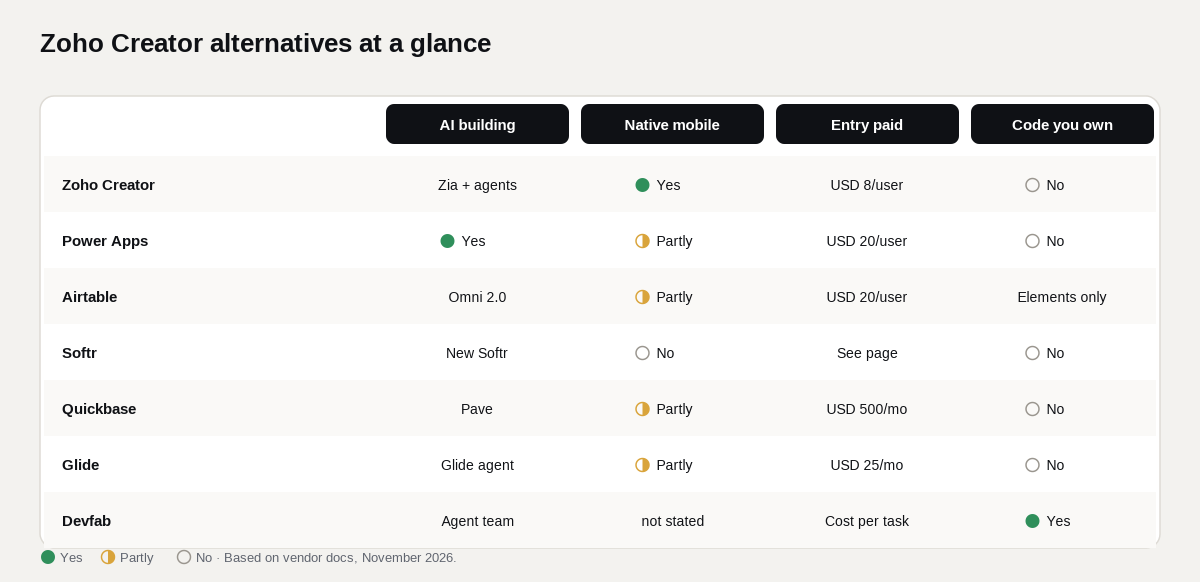
| Tool | Type | AI building | Mobile | Pricing model | Starting paid price (Nov 2026) |
|---|---|---|---|---|---|
| Zoho Creator (baseline) | Low-code platform | Zia, Plan, Build and Test agents | Native iOS and Android for every app | Per user | Standard USD 8 per user per month, annual |
| Microsoft Power Apps | Low-code on Microsoft 365 | Natural language; Plans agents | Power Apps mobile | Per user or per app | Premium USD 20 per user per month, paid yearly |
| Airtable | No-code database and apps | Omni 2.0, Canvas (beta) | Mac and Windows apps; elements not on mobile | Per billable collaborator | Team USD 20 per user per month, annual |
| Softr | No-code portals and internal apps | New Softr builds the whole app | No native app-store publishing | Workspace plans | See pricing page |
| Quickbase | Operations low-code + Pave | Pave from a prompt | Mobile-ready apps | Flat platform price | USD 500 per month, billed annually |
| Glide | AI builder on spreadsheets (GlideOS) | Glide agent; SheetSense | Desktop and phone | Credits | Basic USD 25 per month |
| Devfab | AI software factory | Agents research, plan, build, test, deploy | Not stated | Cost logged per task and per project | Beta |
The alternatives
Microsoft Power Apps
Verdict: the obvious move for companies standardized on Microsoft 365. Best for: business users and IT building together on Dataverse, with central governance. Trade-off: premium connectors, Dataverse capacity and AI credits add cost beyond the seat. Pricing: Developer Plan free; Premium USD 20 per user per month, paid yearly, as of November 2026 (Power Apps pricing).
Power Apps lets users describe an app in plain language, and its Plans workspace uses AI agents as requirements analyst, data modeler and solution architect (The New Stack). Generative pages produce native React code for custom screens. Since September 2026, outside AI coding tools can build model-driven apps, with nothing created until a person approves the build plan (Power Platform blog). Note: since November 15, 2026, new unmanaged developer environments can't be created (Microsoft licensing FAQ).
Airtable
Verdict: the friendliest option when your app is mostly structured data and views. Best for: business teams that want to build and change apps without IT. Trade-off: new ownership; Omni can't create views, set up syncs or export data. Pricing: Free; Team USD 20 per user per month; Business USD 45 per user per month, billed annually, as of November 2026 (Airtable pricing).
Bending Spoons' acquisition of Airtable closed in early September 2026, followed by layoffs on October 12 with plans and pricing stated unchanged (Airtable newsroom). Omni 2.0 builds data models from spreadsheets, PDFs and images, and Canvas (open beta) builds apps on live data (Airtable Fall Release). Omni asks before deletions and leaves publishing to you (Airtable support).
Softr
Verdict: the best fit if your Zoho app is really a client portal. Best for: operations teams building portals and internal apps on Softr's database or existing data. Trade-off: no native App Store or Google Play publishing, per a competitor's review. Pricing: workspace plans (Free, Basic, Pro, Business, Enterprise) with set numbers of builders and app users; prices did not load when we checked, so see Softr pricing.
On November 9, 2026, Softr relaunched as "the new Softr": from a description, AI creates the database, roles and permissions, workflows, integrations and a fully custom front end. Softr's line: "We vibe code your frontend. We don't vibe code your backend." (Softr blog). It connects to Airtable, Google Sheets, Notion and Zoho CRM on every plan, and AI agents can wait for human approval (Softr). Softr MCP is included on every plan (Softr MCP).
Quickbase
Verdict: for operations-heavy companies with many app users. Best for: field, construction and manufacturing teams. Trade-off: a higher entry price than Zoho for a handful of users. Pricing: entry tier USD 500 per month billed annually, platform price with no user limit; Pave Launch USD 20 per month, as of November 2026 (Quickbase pricing; Pave pricing).
Quickbase includes up to 50 custom apps on the entry tier, Automations, Sync, API, customizable roles and a developer sandbox. Pave, launched April 28, 2026, builds data models, roles, workflows and hosting from a prompt, with draft and publish and version rollback (Quickbase Pave).
Glide
Verdict: for teams whose processes live in spreadsheets. Best for: back-office teams in retail, real estate, hospitality and supply chain. Trade-off: users report credit costs are hard to predict. Pricing: Free; Basic USD 25 per month; Plus USD 50 per month; Pro USD 125 per month, as of November 2026 (Glide pricing).
Glide relaunched as GlideOS in 2026; the old product continues as Glide Classic, with no migration tool yet (Glide launch recap). SheetSense scans uploaded spreadsheets for formulas, macros and pivot tables and asks you to confirm before building. Apps are private to the company by default, with AI spend budgets by team and model (Glide). A June 2026 community thread says agent mistakes still use credits (Glide community).
Devfab
Verdict: for the app that has outgrown templates and scripts. Best for: companies and agencies that want a custom app as normal code they own. Trade-off: no visual builder and no native mobile apps stated; in Beta. Pricing: predictable cost; cost is logged after each run, per task and per project.
See Where Devfab fits and the head-to-head in Devfab vs Zoho Creator.
Where Zoho Creator is still the better choice
- Low per-user price for many small apps. Standard starts at USD 8 per user per month, billed annually (Zoho Creator pricing).
- You run Zoho CRM or Books. Apps sit next to the data you already have.
- Native mobile for every app. Every Creator app gets native iOS and Android versions (Zoho Creator).
- Flexible hosting. Apps can run on Zoho Cloud, AWS, Azure, GCP, on-premise or hybrid.
- Model choice. Use Zoho's own GenAI or bring your own key for OpenAI, Google or Anthropic.
Where Devfab fits
Every platform on this list keeps your app inside the platform. When an app becomes core to the business, some teams want it as plain code they control instead. Coding agents automate the developer. Devfab automates the development lifecycle.
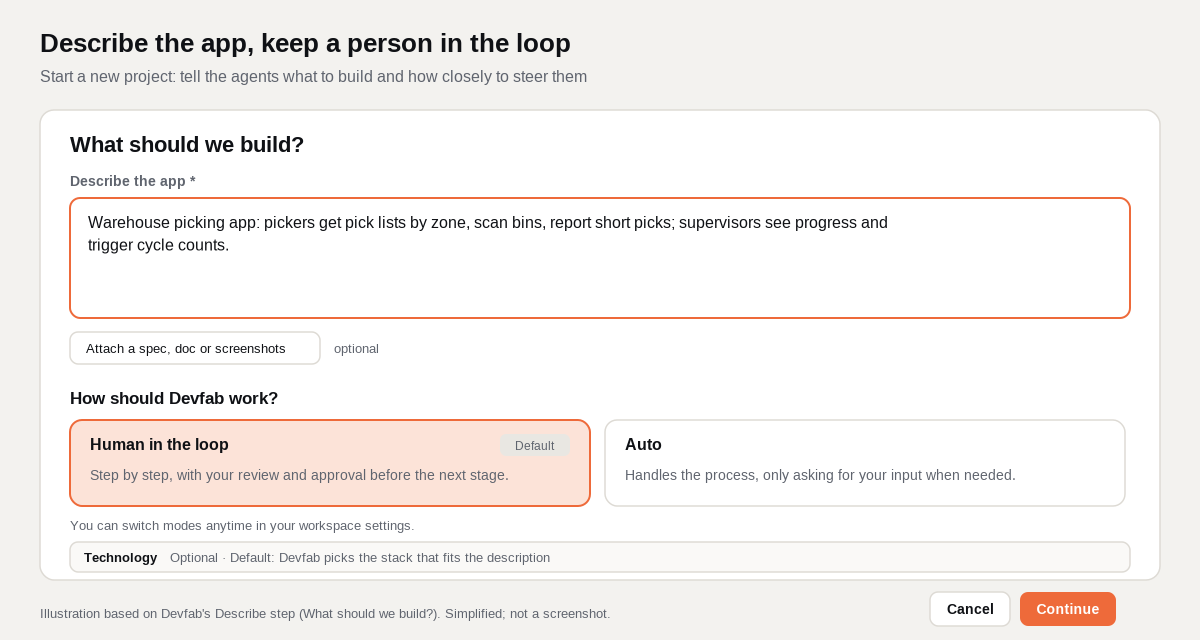
Say your Zoho app handles a warehouse picking process. In Devfab you describe it, or attach your current spec and screenshots. The Researcher maps the domain (pick lists, bin locations, short picks, cycle counts) and suggests a prototype before the Planner writes a plan, which a person approves. The Coordinator creates tickets for developer agents, and ChainFlow shows which functions and APIs depend on each other so a change to picking doesn't break stock counts or shipping. The QA agent runs UI and flow tests (screens and user journeys clicked end to end) plus logic tests. Code lives in your own GitHub account and deploys to your own server.
Honest limits: Devfab is in Beta, has a smaller community and fewer integrations than any platform above, has no drag-and-drop builder, is not an editor for hands-on coding, and needs a GitHub account. You also take on running the server.
How to choose
- Microsoft 365 company: Power Apps.
- Data-first apps that business users own: Airtable.
- Client portal or customer-facing internal app: Softr.
- Many users on one flat price: Quickbase.
- Your process lives in spreadsheets: Glide.
- The app is core and must be custom code you own: Devfab.
- Still on the Zoho suite and the apps are simple: stay on Zoho Creator.
FAQ
Why do people switch from Zoho Creator?
Capterra reviewers in 2026 mention a steeper learning curve beyond simple apps, a template-based feel for highly custom apps, Deluge scripting that is slow to learn, and inconsistent support. Others leave because they are moving off the Zoho suite or need SAML SSO, which is an add-on.
Is Zoho Creator cheaper than Power Apps?
At list price, yes. As of November 2026, Zoho Creator Standard is USD 8 per user per month billed annually and Professional is USD 20, while Power Apps Premium is USD 20 per user per month paid yearly. Check limits too: Zoho's Standard plan allows one app.
Does Zoho Creator have AI agents?
Yes. Zoho Creator's site lists Zia for building from natural language, a Plan Agent that writes a requirements document, a Build Agent that adds modules with review of each change, a Test Agent that runs test cases, and custom AI agents that act on app data.
What is the new Softr?
On November 9, 2026, Softr relaunched so that AI builds the whole app from a description, including the database, user roles, permissions, workflows and a fully custom front end, on Softr's managed backend. Existing apps keep working and block-based building is still available.
Read next
- What is an AI software factory?
- Devfab vs Zoho Creator
- Zoho Creator vs Power Apps
- Airtable vs Softr
- Best no-code app builders
Has your Zoho app become core to the business? Try Beta
Sources (checked November 2026): Zoho Creator; Zoho Creator pricing; Capterra: Zoho Creator reviews; Power Apps; Power Apps pricing; The New Stack: Power Apps Plans; Power Platform September 2026 update; Microsoft Power Platform licensing FAQ; Airtable pricing; Airtable newsroom: Back to bases (Oct 12, 2026); Airtable Fall Release (Oct 21, 2026); Airtable support: Using Omni; Softr; Softr pricing; Softr blog: Beyond building blocks (Nov 9, 2026); Softr MCP; Quickbase pricing; Quickbase Pave; Quickbase Pave pricing; Glide; Glide pricing; Glide: GlideOS launch recap; Glide community: pricing issues with GlideOS.
Frequently asked questions
Why do people switch from Zoho Creator?
Capterra reviewers in 2026 mention a steeper learning curve beyond simple apps, a template-based feel for highly custom apps, Deluge scripting that is slow to learn, and inconsistent support. Others leave because they are moving off the Zoho suite or need SAML SSO, which is an add-on.
Is Zoho Creator cheaper than Power Apps?
At list price, yes. As of November 2026, Zoho Creator Standard is USD 8 per user per month billed annually and Professional is USD 20, while Power Apps Premium is USD 20 per user per month paid yearly. Check limits too: Zoho's Standard plan allows one app.
Does Zoho Creator have AI agents?
Yes. Zoho Creator's site lists Zia for building from natural language, a Plan Agent that writes a requirements document, a Build Agent that adds modules with review of each change, a Test Agent that runs test cases, and custom AI agents that act on app data.
What is the new Softr?
On November 9, 2026, Softr relaunched so that AI builds the whole app from a description, including the database, user roles, permissions, workflows and a fully custom front end, on Softr's managed backend. Existing apps keep working and block-based building is still available.