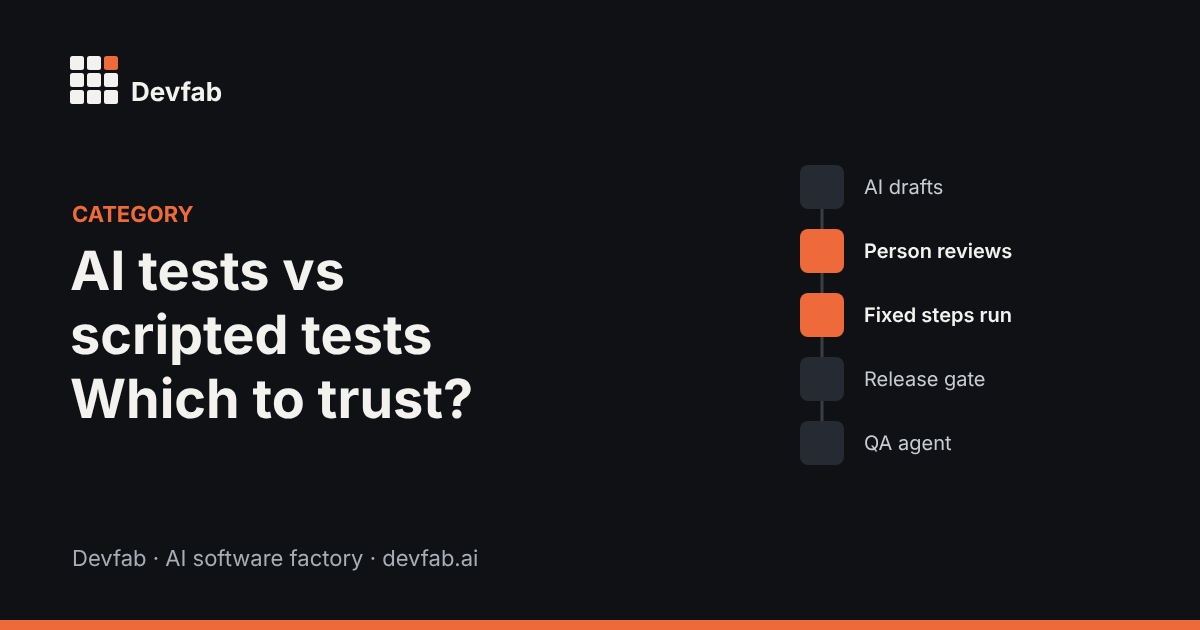
Short answer: Trust scripted test automation for release gates where the same input must always give the same verdict, and where engineers can read every step. Use AI test automation to write tests faster, explore apps nobody has mapped, and cut upkeep when the UI keeps changing. In 2026 the strongest setup mixes both: AI writes, fixed steps run.
You sign off releases for an insurance claims app. A test goes red at the end of the day. Is the app broken, or did the test guess wrong?
That question is the whole debate. Scripted tests never guess, but they break each time a button moves and someone must fix them. AI tests adapt, yet a test that adapts can also adapt past a real bug. Vendors on both sides have changed their products a lot this year, so the old arguments no longer fit. This page compares the two from tool docs checked in November 2026.
In this guide, you'll learn:
- Definitions
- Side by side
- When to choose AI test automation
- When to choose scripted test automation
- Where an AI software factory fits
Use the sections below as a release checklist.
Definitions
Scripted (traditional) test automation means a person writes each step in code: open this page, click that button, expect this text. A framework replays the steps the same way every run. Playwright is a current example. It gives one API for Chromium, Firefox and WebKit, auto-waits and retries assertions, records traces of each step, and is free and open source (Playwright). Cypress is another: its app is MIT-licensed and runs tests in a real browser locally or in CI (Cypress pricing).
AI test automation means models do some of the work a test engineer did. Three jobs are common:
- Writing tests from plain language, requirements or by exploring the app. mabl authors tests from inputs such as Jira requirements (mabl). Momentic's agent Mo explores web, iOS and Android apps to find bugs and writes tests (Momentic).
- Healing broken steps when the UI changes. mabl claims adaptive auto-healing cuts maintenance by 85% (vendor claim, mabl).
- Triage: investigating failures and filing bugs. QA Wolf's agents investigate failures and file bugs to Linear or Jira (QA Wolf pricing).
The line is blurring. Playwright now ships Test Agents: a Planner that explores the app and writes a Markdown plan, a Generator that turns it into test files, and a Healer that repairs failing tests (Playwright Test Agents). Cypress's cy.prompt turns natural-language steps into Cypress commands and moved to beta in version 15.13.0 (cy.prompt docs). So "AI or scripted" is now often "how much AI, and at which step".
Side by side
| Aspect | Scripted test automation | AI test automation | Source |
|---|---|---|---|
| Who writes steps | An engineer, in code | A model, from plain language, requirements or exploration | Playwright; mabl |
| Same input, same verdict | Yes, by design | Depends: some tools fix the steps once written, others decide at run time | Momentic; Applitools |
| UI changes | Locators break until someone edits them | Self-healing repairs steps | mabl; Testim |
| Reading a failure | Trace, screenshots, logs | Same, plus AI summaries and suggested causes | Playwright; Cypress |
| Flaky tests | Engineer fixes waits and selectors | Often retried or healed; QA Wolf retries up to 3 times per run | QA Wolf pricing |
| Coverage of the unknown | Only what someone thought to script | Agents explore and find unscripted paths | Momentic |
| Skills needed | Coding in TypeScript, Python, .NET or Java | Plain language; code optional | Playwright; Testim |
| License cost | Free frameworks (Playwright, Cypress app) | Usage, per run, per page or quote-based | Momentic pricing; Applitools pricing |
| Lock-in | Plain code in your repo | Varies: QA Wolf exports Playwright code; Momentic stores YAML in your repo | QA Wolf pricing; Momentic |
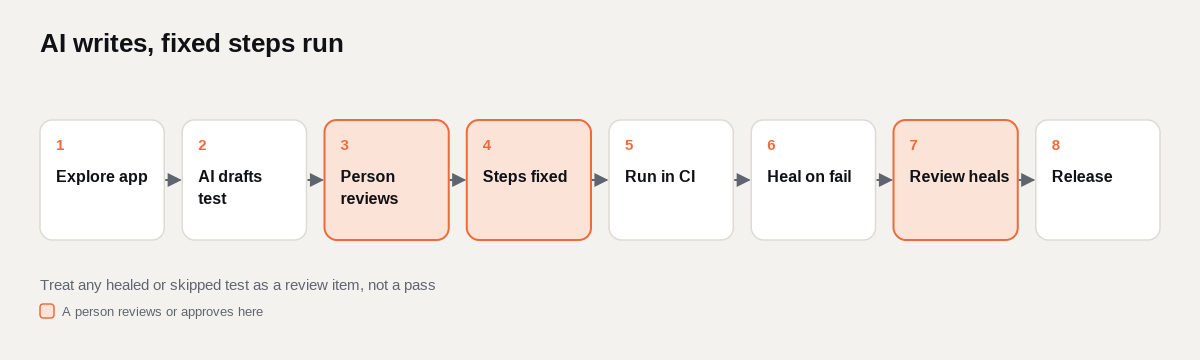
The second row is the one that matters for releases. Look at how 2026 tools answer it:
- Momentic says AI Action V3 "plans the flow up front, caches the resolved steps, and self-heals on failure" (Momentic). The cached steps replay; AI steps in only when they fail.
- Applitools pairs "a Deterministic Language Model (DLM) with mature Visual AI". Large language models help write tests and test data, but runs use its deterministic model (Applitools; Applitools blog).
- Cypress cy.prompt converts plain language into Cypress commands, so the run is ordinary Cypress code (cy.prompt docs).
- Playwright's Healer repairs failing tests, or skips them if it believes the feature is broken (Playwright Test Agents). That last part is worth a policy: a skipped test is not a passed test.
When to choose AI test automation
- Your UI changes every sprint. Self-healing locators and steps save the repair work that scripted suites need after each redesign.
- You have no test engineers. Plain-language authoring (mabl, Testim, Momentic, cy.prompt) lets product and QA staff write tests without code.
- Nobody has mapped the app. Exploring agents such as Momentic's Mo find paths and bugs nobody thought to script.
- Coding agents write much of the code. mabl and QA Wolf both offer MCP servers so coding agents can call testing directly (mabl platform; QA Wolf).
- You test AI features. QA Wolf lists "semantic and non-deterministic assertions" for outputs that vary (QA Wolf); mabl lists validating dynamic outputs of AI apps (mabl).
When to choose scripted test automation
- The test is a legal or money gate. Claims payouts, tax, dosage: the same input must give the same verdict, and an auditor may ask to read the steps.
- You need zero license cost. Playwright is free; the Cypress app is MIT-licensed.
- Your team already writes code daily. Engineers can maintain a scripted suite in the same repo and review it like app code.
- AI features don't cover your case. cy.prompt, for example, doesn't support multi-element assertions, cy.request(), canvas or iframes, and runs on Chromium browsers only (cy.prompt docs).
- You must run in a locked-down network. A framework on your own runners has no outside service in the loop.
A practical mix for most teams: let AI draft tests and propose fixes, have a person review them like code, and run fixed steps as the release gate. Treat any test the AI skipped or healed as a review item, not a pass.
Where an AI software factory fits
Both approaches test an app that already exists. Somebody still has to research, plan, build and ship that app, and testing is only as good as the plan it checks against.
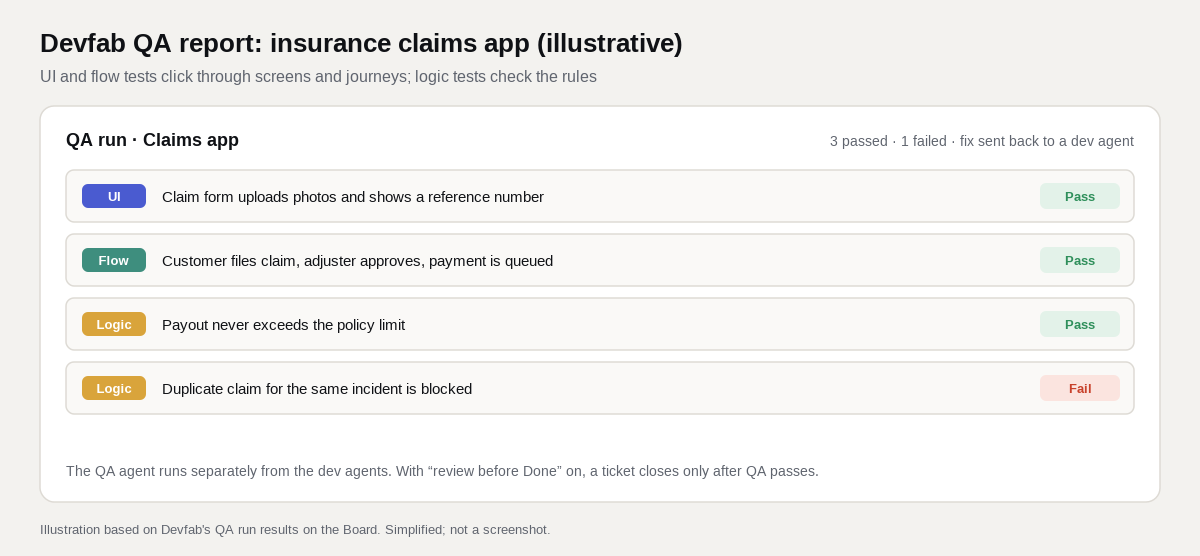
That is the job of an AI software factory. Coding agents automate the developer. Devfab automates the development lifecycle. For the claims app, Devfab's Researcher first maps the domain (claim types, policy limits, adjuster roles, competing claims portals) and suggests a prototype. The Planner writes a plan, and a person approves it. ChainFlow, Devfab's code-intelligence layer, maps which functions and APIs call each other, so a change to payout rules shows its impact on approvals, payments and customer letters. The QA agent then runs UI and flow tests (screens, buttons and user journeys clicked end to end) plus logic tests, as one step of the lifecycle.
Devfab is in Beta, has a smaller community and fewer integrations than mature test platforms, and needs a GitHub account. It doesn't replace a test platform for apps built elsewhere. Code stays in your GitHub, so you can run Playwright, Cypress or any AI tool on the result too.
FAQ
What is the difference between AI test automation and traditional test automation?
Traditional, scripted automation runs steps a person wrote in code, the same way every time. AI test automation uses models to write tests from plain language or by exploring the app, and to repair steps when the UI changes. Scripts are predictable; AI saves writing and upkeep.
Is AI test automation reliable enough for release gates?
It can be, if the run itself is predictable. Several 2026 tools let AI write the test but run it as fixed steps: Cypress cy.prompt turns plain language into Cypress commands, Momentic caches resolved steps, and Applitools runs checks with a deterministic model. Review AI-written tests before they gate a release.
Will AI test automation replace Playwright or Cypress scripts?
Not soon. Many AI tools sit on top of them: Momentic is built on Playwright, QA Wolf exports Playwright and Appium code, and Playwright itself now ships planner, generator and healer agents. The scripts remain the layer that runs.
What does AI test automation cost compared with scripts?
Playwright is free and the Cypress app is MIT-licensed, so scripted tests cost engineering time plus infrastructure. AI tools add usage or contract fees: for example, Momentic bills per step and QA Wolf per test run, as of November 2026. Self-healing reduces upkeep, so compare total cost, not license cost.
Where does Devfab fit between AI and scripted testing?
Devfab is not a test tool. It is an AI software factory that plans, builds, tests and deploys an app. Its QA agent runs UI, flow and logic tests as one step of that lifecycle, after a person has approved the plan.
Read next
- AI testing vs manual testing
- Best end-to-end testing tools
- Playwright vs Cypress
- What is a QA agent?
- What is an AI software factory?
Want tests tied to an approved plan? Try Beta
Sources (checked November 2026): Playwright homepage; Playwright Test Agents docs; Cypress homepage; Cypress pricing; cy.prompt docs; mabl AI test automation; mabl platform; Momentic homepage; Momentic pricing; Applitools homepage; Applitools pricing; Applitools Autonomous and Eyes: new AI features (Aug 7, 2025); Testim product page (Tricentis); QA Wolf homepage; QA Wolf pricing.
Frequently asked questions
What is the difference between AI test automation and traditional test automation?
Traditional, scripted automation runs steps a person wrote in code, the same way every time. AI test automation uses models to write tests from plain language or by exploring the app, and to repair steps when the UI changes. Scripts are predictable; AI saves writing and upkeep.
Is AI test automation reliable enough for release gates?
It can be, if the run itself is predictable. Several 2026 tools let AI write the test but run it as fixed steps: Cypress cy.prompt turns plain language into Cypress commands, Momentic caches resolved steps, and Applitools runs checks with a deterministic model. Review AI-written tests before they gate a release.
Will AI test automation replace Playwright or Cypress scripts?
Not soon. Many AI tools sit on top of them: Momentic is built on Playwright, QA Wolf exports Playwright and Appium code, and Playwright itself now ships planner, generator and healer agents. The scripts remain the layer that runs.
What does AI test automation cost compared with scripts?
Playwright is free and the Cypress app is MIT-licensed, so scripted tests cost engineering time plus infrastructure. AI tools add usage or contract fees: for example, Momentic bills per step and QA Wolf per test run, as of November 2026. Self-healing reduces upkeep, so compare total cost, not license cost.
Where does Devfab fit between AI and scripted testing?
Devfab is not a test tool. It is an AI software factory that plans, builds, tests and deploys an app. Its QA agent runs UI, flow and logic tests as one step of that lifecycle, after a person has approved the plan.