Short answer: Appian wins when the job is a long-running, auditable business process, such as claims or onboarding, with case management, RPA and document AI on one governed platform. OutSystems wins when you need to build and run a portfolio of custom apps and agents, with Mentor generating apps and a context graph tracking dependencies.
You lead IT at an insurer, and the claims backlog has an executive sponsor. The shortlist has two names, and both vendors say they do everything.
They don't do the same thing first. One camp says buy the process engine and build apps on it. The other says buy the app platform and model the process inside. Both arguments hold up in different shops. This page lays out the evidence, checked November 20, 2026.
In this comparison:
- Appian and OutSystems at a glance
- Feature comparison
- Cost model by team size
- Where Appian wins
- Where OutSystems wins
Read it with your RFP criteria next to you.
Appian and OutSystems at a glance
Neither changed owners in 2026, but both rebuilt around agents. Appian shipped release 26.3 in March 2026 with multi-agent communication in Agent Studio, then a July 1 update with an MCP Server and Snowflake support, then release 26.6 with agent cost controls (Appian Q1 2026; Appian Q2 2026; Appian What's New). OutSystems announced "Agentic Systems Engineering" on March 31, 2026, with an Enterprise Context Graph and next-gen Mentor generally available in OutSystems Developer Cloud (ODC) (OutSystems news; OutSystems product update).
Appian is an enterprise low-code platform for process automation, case management and data fabric. It adds AI agents (Agent Studio), AI-assisted app planning (Composer) and document AI (DocCenter).
OutSystems is an enterprise low-code platform for building and running apps and AI agents. It targets banking, healthcare, insurance, manufacturing and government, for teams from pro developers to business users (OutSystems FAQs).
Feature comparison
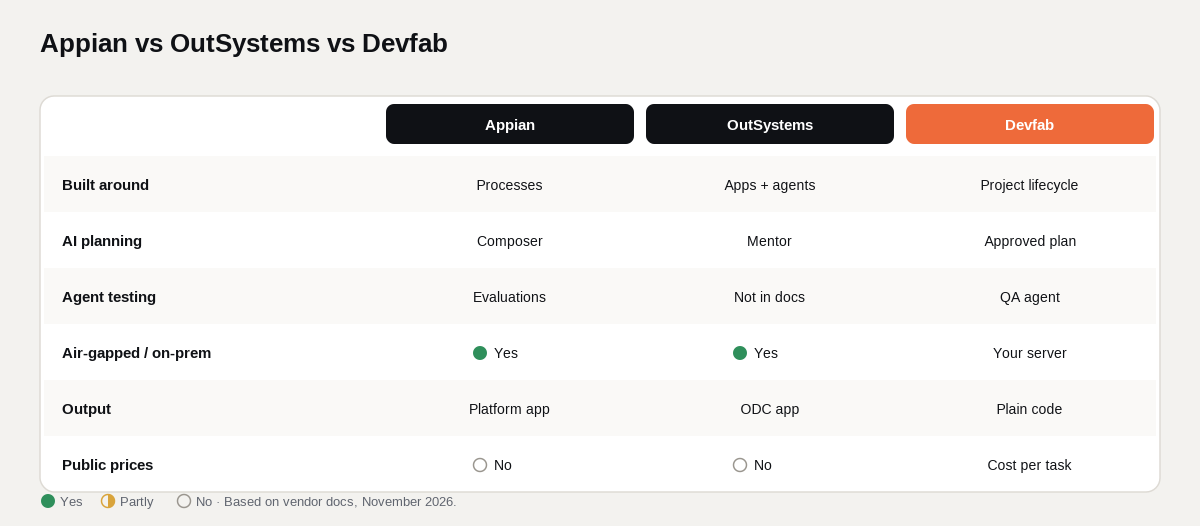
| Aspect | Appian | OutSystems | Source |
|---|---|---|---|
| Where it runs | Appian cloud (SLA 99.8–99.99%) or fully self-managed, including air-gapped AI | ODC, a managed PaaS on AWS; self-hosted runtime option; on-prem, private and sovereign cloud listed | Appian pricing; Appian What's New; ODC; OutSystems pricing |
| Planning and spec | Composer turns requirements and user stories into a visual app plan (preview) | Mentor asks clarifying questions; Mentor in the IDE proposes a plan and applies it after approval | Appian What's New; OutSystems product update |
| Agents | Agent Studio: agents call other agents; audit view of every step; parallel tool calls | Agent Workbench with human-in-the-loop, MCP and an agent marketplace | Appian Q1 2026; The New Stack |
| Testing | Central evaluations to run agent test cases in bulk | Not covered in the pages we checked | Appian Q2 2026 |
| Process and automation | Process HQ, Case Management Studio, RPA bots by plan | Workflows and agents under a shared enterprise context | Appian pricing; OutSystems news |
| Outside AI tools | MCP Server; external assistants such as Claude through a CLI | Claude Code, OpenAI Codex and Cursor | Appian Q2 2026; OutSystems news |
| Model choice | Bring your own Azure OpenAI; custom LLM gateway; disable model families; AI Guardrails | Anthropic, Cohere, Google, IBM, Mistral, OpenAI, Bedrock and more in Agent Workbench | Appian Q2 2026; The New Stack |
| Integrations and compliance | Direct connections to GitHub and Snowflake | 400+ prebuilt connections; HIPAA, PCI DSS, FedRAMP; SOC 2 Type II | Appian Q2 2026; ODC |
| Pricing model | Per user, per month, per app; AI Action quotas by plan | Quote by Application Objects, users and add-ons; you pay LLM tokens directly | Appian pricing; OutSystems FAQs |
Cost model by team size
| Team size | Appian | OutSystems | Devfab |
|---|---|---|---|
| 1 person | Free Community Edition instance | Free Personal Edition (development only, up to 100 internal users, no uptime guarantee) | Cost logged per task and per project (Beta) |
| 5 people | Standard plan: per user, per month, per app; 200K AI Actions a month; no AI Agents or Composer | Agentic Systems Platform by quote, starting with 100 internal users and dev, test and prod runtimes | Cost logged per task and per project (Beta) |
| 25 people | Advanced (500K AI Actions, Process HQ, Case Management Studio) or Premium (1M AI Actions, no row limits) | Same platform, sized by Application Objects (about 150 for a typical medium app) plus add-ons | Cost logged per task and per project (Beta) |
Pricing models as of November 2026 from Appian pricing and OutSystems pricing. Neither page shows dollar amounts; ask each vendor for a quote. Devfab is in Beta and offers predictable cost: cost is logged after each run, per task and per project.
A note on sizing. Appian charges per app as well as per user, so a growing app count raises cost. OutSystems sizes by Application Objects (screens, tables and API methods), so bigger apps raise cost. Model your next three apps both ways before you sign.
Where Appian wins
- Process is the product. Claims, onboarding and approvals run on process models with Case Management Studio and RPA.
- Agents need audit. Agent Studio shows the exact steps an agent took, and evaluations test agents in bulk.
- AI must stay inside your walls. AI can run self-managed on air-gapped infrastructure.
- Model governance is strict. Bring your own Azure OpenAI, route through your gateway, and screen for prompt injection and PII leaks.
- Documents drive the work. DocCenter adds compliance-check agents in release 26.6.
Where OutSystems wins
- You build many custom apps. Mentor generates data model, logic and UI, and the output is standard ODC apps.
- Dependencies are the risk. The Enterprise Context Graph shows apps, agents, workflows, data and dependencies.
- Your developers already use coding agents. Claude Code, Codex and Cursor work against the platform.
- You need wide connectivity. 400+ prebuilt connections and a private gateway to on-prem systems.
- Compliance paperwork matters. HIPAA, PCI DSS and FedRAMP requirements are listed, plus SOC 2 Type II.
Each has a known weak spot. A competitor review of Appian (Blaze, February 2026) cites high per-user pricing for smaller firms and a steep learning curve (Blaze). OutSystems warns that some third-party Forge components may need rebuilding for ODC (ODC).
Switching from one to the other
There is no documented migration path between the two platforms in the pages we checked. Both store apps as platform models, not plain code. A switch is a rebuild: export the requirements and user stories, then feed them to the other platform's planner. Appian's Composer turns user stories into an app plan; OutSystems Mentor asks clarifying questions and builds data model, logic and UI. Keep both systems running until the new one passes your acceptance tests.
Where Devfab fits
Appian and OutSystems are platforms you build on for years, with vendor support and attestations. Some projects don't need a platform. They need one custom app, delivered as plain code the client owns.
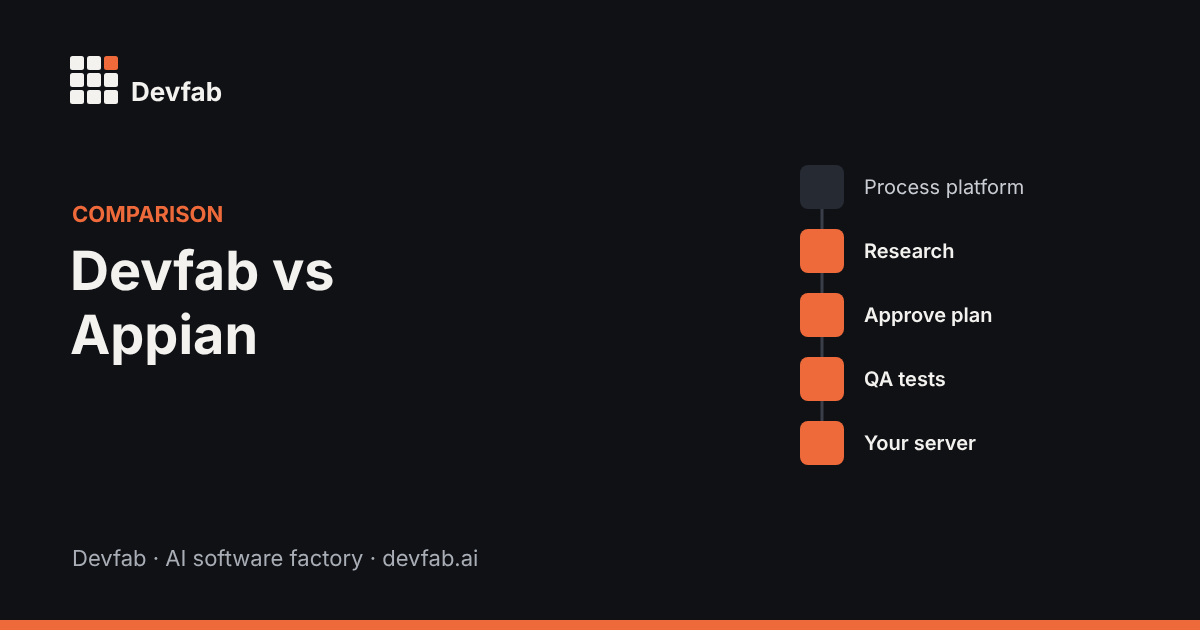
Coding agents automate the developer. Devfab automates the development lifecycle. Its Researcher maps claims terms, best practices and competing products before the Planner writes the plan, and a person approves it. The QA agent runs UI, flow and logic tests, and Deploy ships to your own server, with code in your own GitHub account. Devfab is in Beta, with a smaller community, fewer integrations than these mature platforms, and no compliance attestations to point to. See Devfab vs Appian.
FAQ
What is the main difference between Appian and OutSystems?
Appian centers on business processes: process models, case management, RPA, document AI and agents that run inside those processes. OutSystems centers on building applications and agents: Mentor generates apps from natural language, and the Enterprise Context Graph tracks apps, agents and dependencies across a portfolio.
Do Appian and OutSystems publish their prices?
No. As of November 2026, Appian's pricing page lists Standard, Advanced and Premium plans priced per user, per month, per app, with no dollar amounts. OutSystems sells its Agentic Systems Platform by quote, sized by Application Objects, users and add-ons. Both offer a free edition.
Can I use Claude Code or Cursor with Appian or OutSystems?
Yes, with limits. Appian says developers can use external coding assistants such as Claude through a CLI, and its MCP Server exposes data fabric and process models to outside agents. OutSystems announced support for Claude Code, OpenAI Codex and Cursor in March 2026.
Which one can run fully on-premises?
Both offer options. Appian says its AI capabilities can run fully self-managed on air-gapped infrastructure. OutSystems lists managed cloud, on-premises, private cloud and sovereign cloud, and a self-hosted model where apps run in your infrastructure.
Read next
- What is an AI software factory?
- Appian alternatives
- OutSystems alternatives
- OutSystems vs Mendix
- Best low-code platforms for enterprises
Need one app as code you own, not another platform? Try Beta
Sources (checked November 2026): Appian pricing; Appian What's New; Appian Q1 2026 release highlights; Appian Q2 2026 product highlights; Blaze: Appian reviews (competitor, Feb 2026); OutSystems: Agentic Systems Engineering (Mar 31, 2026); OutSystems: Next-gen Mentor in ODC; OutSystems Developer Cloud; OutSystems pricing and editions; OutSystems FAQs; The New Stack: OutSystems Agent Workbench (Sep 2025).
Frequently asked questions
What is the main difference between Appian and OutSystems?
Appian centers on business processes: process models, case management, RPA, document AI and agents that run inside those processes. OutSystems centers on building applications and agents: Mentor generates apps from natural language, and the Enterprise Context Graph tracks apps, agents and dependencies across a portfolio.
Do Appian and OutSystems publish their prices?
No. As of November 2026, Appian's pricing page lists Standard, Advanced and Premium plans priced per user, per month, per app, with no dollar amounts. OutSystems sells its Agentic Systems Platform by quote, sized by Application Objects, users and add-ons. Both offer a free edition.
Can I use Claude Code or Cursor with Appian or OutSystems?
Yes, with limits. Appian says developers can use external coding assistants such as Claude through a CLI, and its MCP Server exposes data fabric and process models to outside agents. OutSystems announced support for Claude Code, OpenAI Codex and Cursor in March 2026.
Which one can run fully on-premises?
Both offer options. Appian says its AI capabilities can run fully self-managed on air-gapped infrastructure. OutSystems lists managed cloud, on-premises, private cloud and sovereign cloud, and a self-hosted model where apps run in your infrastructure.