Short answer: Use AI testing for the checks you must repeat on every change: known user journeys, regressions across browsers and devices, and visual breaks. Use manual testing for what no script anticipates: confusing screens, wrong business rules and odd edge cases found by exploring. Most teams need both, with AI doing the repetition.
Your team ships faster than ever, and your tester is the bottleneck. Every release means clicking through the same booking flow, the same login, the same invoice screen. Then a bug slips through anyway, in a part of the app nobody thought to check.
AI test agents promise to take that load. Some say they replace manual QA. Others say they only move the work. This page sets out what each approach actually catches, based on tool docs and testing guidance checked in November 2026.
In this guide, you'll learn:
- Definitions
- What each catches
- When to choose AI testing
- When to choose manual testing
- Where an AI software factory fits
The examples use a field-service app: technicians, jobs, parts and customer sign-off.
Definitions
Manual testing means a person runs the app and checks it: following a test script, or exploring freely. Atlassian's testing guide is blunt about the scripted kind. It is "very expensive since it requires someone to setup an environment and execute the tests themselves," and "it can be prone to human error as the tester might make typos or omit steps in the test script" (Atlassian). The same guide says "there's still value in doing some manual testing with what is called exploratory testing," which is best "to uncover non-obvious errors."
Automated testing means scripts run the checks. Atlassian says automated tests are more reliable than manual ones, with one catch: "the quality of your automated tests depends on how well your test scripts have been written." End-to-end tests are "very useful, but they're expensive to perform and can be hard to maintain when they're automated" (same source).
AI testing is automated testing where AI agents do the parts people used to do by hand: deciding what to test, writing the tests, running them, and fixing them when the app changes. Examples from current tools:
- Playwright Test Agents. Planner explores the app and writes a Markdown test plan, Generator turns it into test files, and Healer runs the suite and repairs failing tests (Playwright docs).
- QA Wolf. Agents plan coverage, write tests, select the tests each pull request needs, investigate failures and file bugs, and broken tests "are fixed automatically as your app changes" (QA Wolf pricing).
- mabl. Agents author tests from inputs such as Jira requirements, investigate failures and heal broken steps, and mabl promises "an independent verdict before every release" (mabl).
- Momentic. Its agent "Mo" explores web, iOS and Android apps to find bugs, turns approved flows into YAML tests and opens a pull request (Momentic).
- Applitools. Visual AI checks whether an app "works and looks right," using a deterministic model at run time (Applitools).
So AI testing removes most of the cost Atlassian lists: writing and maintaining the scripts. It does not remove the need to decide what "correct" means.
What each catches
| What can go wrong | AI testing | Manual testing | Why |
|---|---|---|---|
| A known journey breaks after a change (job assignment, sign-off) | Catches it on every run | Catches it if the tester re-checks that journey | AI suites run on each PR; QA Wolf selects tests per PR |
| A layout breaks on one browser or device | Catches it with visual AI and cross-browser runs | Often missed unless that device is tested | Applitools Eyes, Playwright on Chromium, Firefox and WebKit |
| A test breaks because a button moved | Self-heals | Not a problem; people adapt | mabl, Testim and QA Wolf heal tests |
| The app does something wrong that no test asks about | Misses it | Often catches it while exploring | AI tests check what the plan says matters |
| The screen works but confuses a technician | Misses it | Catches it | Needs human judgment about meaning |
| A business rule in the spec is wrong | Misses it; tests follow the spec | Can catch it if the tester knows the trade | Tests verify the spec, not whether it is right |
| An AI feature gives a wrong but plausible answer | Partly; some tools use semantic assertions | Catches obvious cases | QA Wolf supports semantic, non-deterministic assertions |
| Steps skipped or mistyped under deadline pressure | Rare; runs are repeatable | Common | Atlassian notes typos and omitted steps |
| Cost grows as the suite grows | Usage or per-run billing scales with size and frequency | Staff time scales the same way | QA Wolf bills per run; Momentic bills per step |
Two cautions from the vendors themselves. First, self-healing can hide a real bug if nobody looks: Playwright's Healer repairs failing tests, "or skips them if it believes the feature is broken" (Playwright docs). Second, retries are not fixes: QA Wolf retries flakes up to three times rather than eliminating them (QA Wolf pricing). AI code review has the same limit. Anthropic notes that a review with no findings "doesn't mean your code is error-free or secure" (Claude Code docs).
When to choose AI testing
- You release often. A suite that runs on every pull request catches regressions a person would never have time to re-check.
- The app has many journeys. A field-service app has dispatch, job updates, parts, photos and sign-off. AI agents can cover them all in parallel; QA Wolf advertises fully parallel runs (QA Wolf).
- You support many browsers and devices. Playwright runs one API across Chromium, Firefox and WebKit (Playwright), and several tools cover iOS and Android.
- Test maintenance is eating your time. Healing locators and agents that update tests cut the work Atlassian calls "hard to maintain."
- Coding agents write much of your code. mabl, QA Wolf and Momentic all offer MCP servers so a coding agent can call the tester directly (mabl platform; Momentic docs).
- You want tests you own. QA Wolf exports tests as open-source Playwright and Appium code, and Momentic stores them as YAML in your repo.
When to choose manual testing
- The feature is new and the spec is unsettled. Exploratory testing finds what nobody thought to write down.
- Usability matters. Only a person can say that the sign-off screen is confusing for a technician standing in the rain.
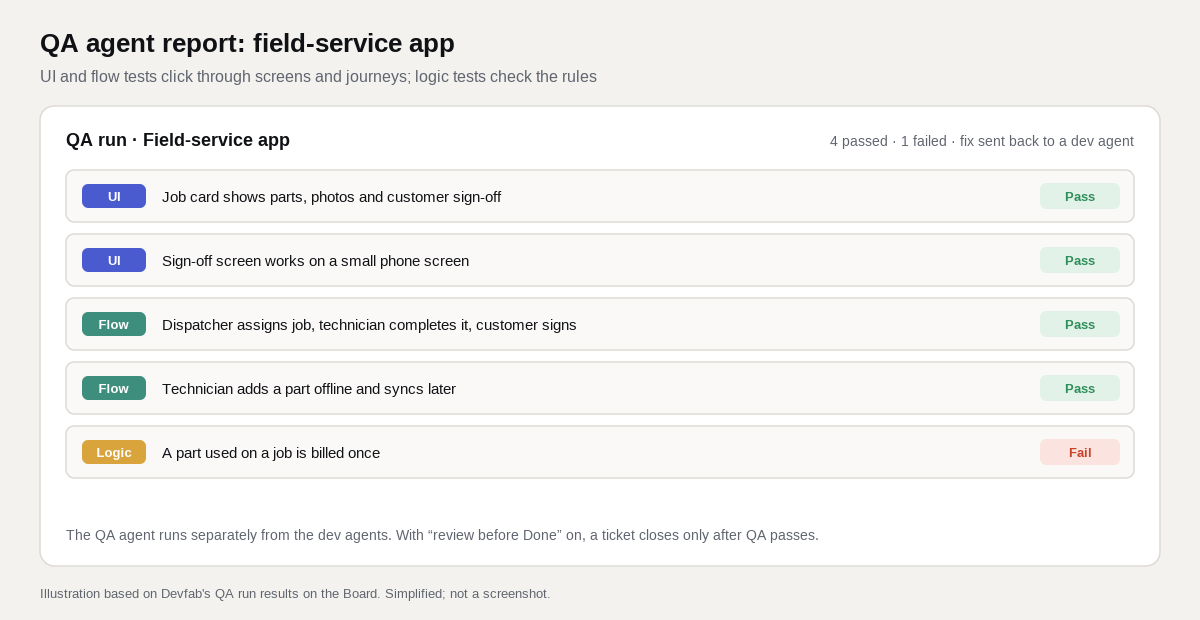
- The domain has rules a spec can miss. A tester who knows field service will notice that a part was billed twice, even if the test plan never mentions it.
- You are about to release to a client or the public. A short exploratory pass before release is cheap insurance on top of automated checks.
- An AI test was skipped or healed. A person should confirm the feature still works before trusting the green result.
Where an AI software factory fits
Testing tools check software that someone else built. An AI software factory puts testing inside the build process itself, next to the plan and the code.
Coding agents automate the developer. Devfab automates the development lifecycle. Devfab's Researcher maps the domain before the Planner writes the plan, so key terms and best practices for, say, a field-service app are in the plan the tests will check. A person approves that plan. Then the QA agent runs UI and flow tests, clicking screens, buttons and user journeys end to end, plus logic tests. You can turn on "QA agent · review before Done" in the workspace so tickets close only after that review. ChainFlow maps which functions and APIs call each other, so when one area changes, dev agents see the connected features that a test should cover.
That covers the repetitive half of the table. It does not replace the human half. Devfab is in Beta, and teams should still run exploratory checks with real users before a release. Read more in what a QA agent is and AI code review vs QA agent.
FAQ
Will AI testing replace manual testers?
Not fully. AI test agents now plan, write, run and repair end-to-end tests, which takes over most repeated regression checks. But Atlassian still recommends exploratory testing to uncover non-obvious errors, and judging whether a screen makes sense to a real user is still a human job.
What does AI testing catch that manual testing misses?
Regressions in journeys nobody had time to re-check. AI agents can run a full suite on every pull request, in parallel, across browsers and devices, and some select the tests each change needs. A person clicking through by hand cannot repeat that on every change without typos or skipped steps.
What does manual testing catch that AI testing misses?
Problems no test was written for: confusing wording, a flow that works but feels wrong, a business rule the spec got wrong, and edge cases found by poking around. Exploratory testing is built for these, and AI tests only check what someone told them matters.
Can self-healing AI tests hide real bugs?
They can if nobody reviews the repairs. Playwright's own docs say its Healer agent repairs failing tests or skips them if it believes the feature is broken. A skipped test is a signal a person should look at, not a green light.
How does Devfab test the apps it builds?
Devfab's QA agent runs UI and flow tests, clicking screens, buttons and user journeys end to end, plus logic tests. You can turn on QA agent review before Done in the workspace. A person still approves the plan, and teams can add their own exploratory testing before release.
Read next
- What is an AI software factory?
- Best AI testing tools for AI-generated code
- Unit tests vs end-to-end tests for AI-generated code
Let agents repeat the checks. Keep your people for the judgment calls. Try Beta
Sources (checked November 2026): Atlassian: The different types of software testing; Playwright; Playwright Test Agents; QA Wolf; QA Wolf pricing; mabl AI test automation; mabl platform; Momentic; Momentic docs index; Applitools; Tricentis Testim; Claude Code docs: Code Review.
Frequently asked questions
Will AI testing replace manual testers?
Not fully. AI test agents now plan, write, run and repair end-to-end tests, which takes over most repeated regression checks. But Atlassian still recommends exploratory testing to uncover non-obvious errors, and judging whether a screen makes sense to a real user is still a human job.
What does AI testing catch that manual testing misses?
Regressions in journeys nobody had time to re-check. AI agents can run a full suite on every pull request, in parallel, across browsers and devices, and some select the tests each change needs. A person clicking through by hand cannot repeat that on every change without typos or skipped steps.
What does manual testing catch that AI testing misses?
Problems no test was written for: confusing wording, a flow that works but feels wrong, a business rule the spec got wrong, and edge cases found by poking around. Exploratory testing is built for these, and AI tests only check what someone told them matters.
Can self-healing AI tests hide real bugs?
They can if nobody reviews the repairs. Playwright's own docs say its Healer agent repairs failing tests or skips them if it believes the feature is broken. A skipped test is a signal a person should look at, not a green light.
How does Devfab test the apps it builds?
Devfab's QA agent runs UI and flow tests, clicking screens, buttons and user journeys end to end, plus logic tests. You can turn on QA agent review before Done in the workspace. A person still approves the plan, and teams can add their own exploratory testing before release.