Short answer: Appian wins when the work is a governed business process, such as deviations, claims or approvals, with case management, RPA and strict AI guardrails. Mendix wins when you need many custom apps with flexible deployment, from SAP BTP to Kubernetes to your own servers, and close ties to Siemens industrial software.
You run digital programs at a manufacturer, and the plant maintenance app keeps getting rescoped. Quality wants audit trails. Engineering wants apps that talk to Siemens tools.
Appian fans say start from the process and its controls. Mendix fans say start from a flexible app platform and add process later. Both have shipped a lot of AI in 2026. This page puts the claims side by side, from vendor pages checked on November 20, 2026.
In this comparison:
- Appian and Mendix at a glance
- Feature comparison
- Cost model by team size
- Where Appian wins
- Where Mendix wins
The rest of this page covers it in order.
Appian and Mendix at a glance
Mendix released its first long-term support version since 10.24. Mendix 11.12 LTS shipped June 30, 2026, with Agents Kit 2.0 and Mendix Cloud MCP (Mendix 11.12). In July, Siemens positioned Mendix as a core part of its Intelligence Center X platform (Verdantix).
Appian rebuilt its agent tooling in three releases. Release 26.3 (March 30) added multi-agent communication and an audit view (Appian Q1 2026). The July 1 update added an MCP Server, GitHub and Snowflake connections, and bulk agent evaluations (Appian Q2 2026). Release 26.6 added agent cost controls and prompt caching (Appian What's New).
Appian is an enterprise low-code platform for process automation, case management and data fabric, with AI agents (Agent Studio), app planning (Composer) and document AI (DocCenter).
Mendix is a Siemens-owned enterprise low-code platform. Developers build in the Studio Pro desktop IDE with an AI assistant, Maia, and can bring their own agents through MCP (Mendix docs).
Feature comparison
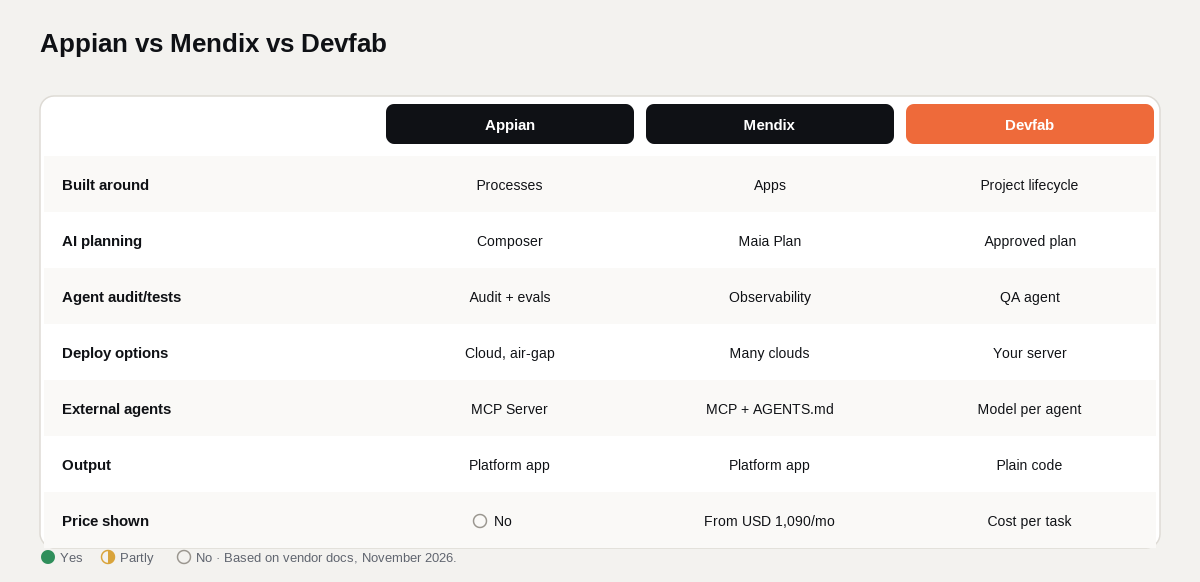
| Aspect | Appian | Mendix | Source |
|---|---|---|---|
| Where it runs | Appian cloud (SLA 99.8–99.99%) or fully self-managed, including air-gapped AI | Mendix Cloud, Mendix on Azure, Kubernetes, SAP BTP, StackIT, own servers, Cloud Dedicated (Premium) | Appian pricing; Appian What's New; Mendix pricing |
| Planning and spec | Composer turns requirements and user stories into a visual app plan (preview) | Maia Plan turns ideas and user stories into app plans and suggests approved Marketplace components | Appian What's New; Mendix 11.10 |
| AI building | Composer then builds the implementation | Maia generates domain models, pages, workflows and OQL | Appian What's New; Mendix 11.0 |
| Agents in apps | Agent Studio: agents call other agents, parallel tool calls, audit view | Agents Kit 2.0 with Agent Editor; chat and task agents | Appian Q1 2026; Mendix 11.12 |
| Testing | Central evaluations run agent test cases in bulk | Agent observability and traceability with token-cost visibility | Appian Q2 2026; Verdantix |
| External coding agents | MCP Server; assistants such as Claude through a CLI | Studio Pro MCP server; Mendix Cloud MCP for Claude Code and GitHub Copilot; AGENTS.md | Appian Q2 2026; Mendix docs |
| Model choice | Own Azure OpenAI account, custom LLM gateway, disable model families, AI Guardrails | Claude Haiku, Sonnet and Opus; Maia Make can use any OpenAI-compatible model (beta) | Appian Q2 2026; Mendix 11.12 |
| Process and automation | Process HQ, Case Management Studio, RPA bots by plan | Workflows generated by Maia | Appian pricing; Mendix 11.0 |
| Pricing model | Per user, per month, per app; AI Action quotas | By number of apps and users; developers and anonymous users free; cloud compute billed separately | Appian pricing; Mendix pricing |
Cost model by team size
| Team size | Appian | Mendix | Devfab |
|---|---|---|---|
| 1 person | Free Community Edition instance | Free (Mendix Cloud only, no uptime guarantee or support) | Cost logged per task and per project (Beta) |
| 5 people | Standard: per user, per month, per app; one data source; 200K AI Actions; no AI Agents or Composer | Standard One App, starting at USD 1,090 per month | Cost logged per task and per project (Beta) |
| 25 people | Advanced or Premium (500K or 1M AI Actions; Process HQ; Case Management Studio) | Standard Unlimited Apps, starting at USD 2,725 per month, or Premium by quote | Cost logged per task and per project (Beta) |
As of November 2026 from Appian pricing and Mendix pricing. Appian shows no dollar amounts. Mendix per-user figures are not shown, and external-agent usage is billed by your own LLM provider. Devfab is in Beta and offers predictable cost: cost is logged after each run, per task and per project.
Where Appian wins
- The process needs proof. Agent Studio's audit view shows the exact steps an agent took.
- You test agents like software. Central evaluations run agent test cases in bulk.
- AI rules are strict. Route requests through your own gateway, disable model families per environment, and screen for prompt injection, toxic content and PII.
- Case work and RPA are core. Case Management Studio and up to unlimited RPA bots on Premium.
- AI must run air-gapped. Appian says its AI capabilities can run fully self-managed.
Where Mendix wins
- You deploy in many places. SAP BTP, Kubernetes, sovereign clouds and your own servers under one license.
- You run Siemens software. Mendix is part of Siemens' industrial platform push.
- Developers bring their own agents. Studio Pro works as an MCP server, and Mendix Cloud MCP links Claude Code and GitHub Copilot.
- You reuse approved components. Maia Plan recommends only company-approved Marketplace components when that is set.
- Builders are not billed. Developers and anonymous users are not charged on Mendix plans.
Each has gaps. A competitor review of Appian (Blaze, February 2026) cites a steep learning curve and coding still needed for some integrations (Blaze). Mendix says the Studio Pro MCP server in 11.10 cannot generate pages, and its 11.12 policies "bring visibility, but no enforcement" (Mendix docs; Mendix 11.12).
Switching from one to the other
No migration tool between Appian and Mendix appears in the pages we checked. Plan a rebuild. Gather the user stories and process maps from the current system, then give them to the new platform's planner: Mendix Maia Plan or Appian Composer. Move data through your own export and import. Run both systems side by side until users sign off on the new one. If you move to Mendix, note that the React client is the default for new projects and the Dojo client will be removed in Mendix 12 (Mendix 11.0).
Where Devfab fits
Both platforms suit long-lived app portfolios under one vendor. Some projects are smaller: one app for one plant, owned outright by the client.
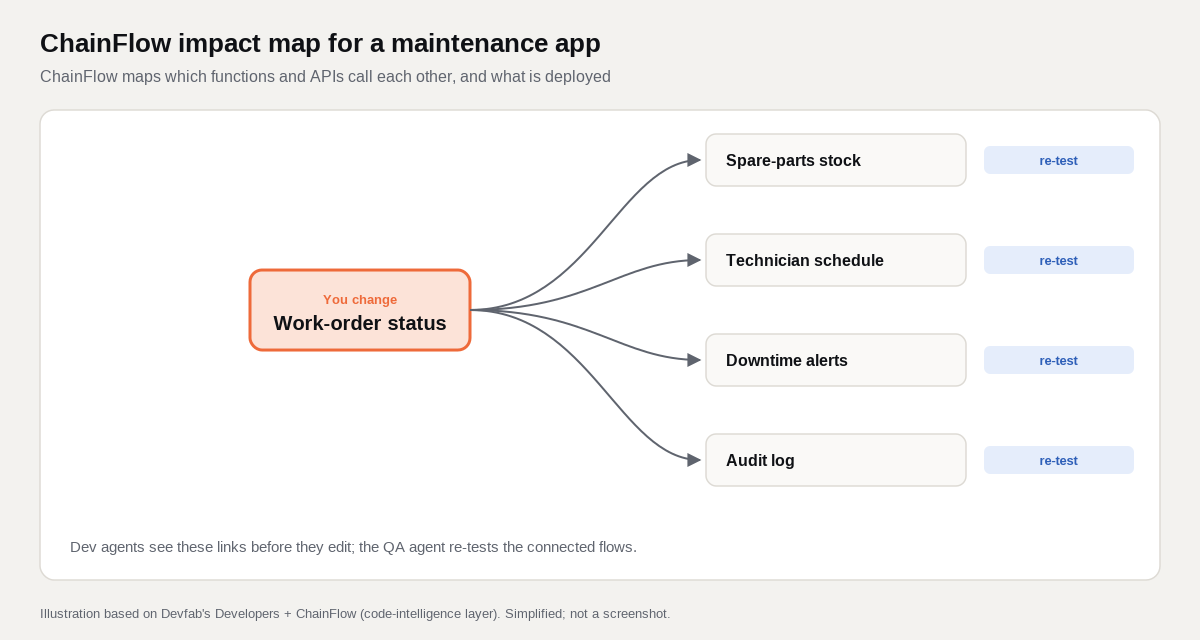
Coding agents automate the developer. Devfab automates the development lifecycle. Its Researcher maps maintenance terms, best practices and similar products before the Planner writes a plan, and a person approves it. ChainFlow maps which functions and APIs call each other, so a change to work-order status shows its effect on spare-parts stock, technician schedules and alerts. The output is plain code in your own GitHub account, deployed to your own server.
Devfab is in Beta, with a smaller community, fewer integrations than either platform, and no Siemens connectors. See Devfab vs Appian.
FAQ
Is Appian or Mendix better for manufacturing?
Mendix usually fits better when the apps sit close to Siemens tools. Siemens owns Mendix and positions it as a core part of its Intelligence Center X platform. Appian fits better when the main need is governed process and case work, such as quality deviations with audit trails.
How much do Appian and Mendix cost?
As of November 2026, Mendix lists Free, Standard One App starting at USD 1,090 per month, Standard Unlimited Apps starting at USD 2,725 per month, and Premium by quote. Appian shows no dollar amounts: Standard, Advanced and Premium are priced per user, per month, per app.
Can external AI coding agents work with Appian and Mendix?
Yes. Mendix Studio Pro acts as an MCP server so external agents can use Maia tools, and Mendix Cloud MCP connects assistants such as Claude Code and GitHub Copilot. Appian's MCP Server exposes data fabric, process models and expression rules to outside agents.
Which has stronger AI governance?
Appian documents more controls: bring your own Azure OpenAI account, a custom LLM gateway, per-environment model blocking and an AI Guardrails tab. Mendix says its 11.12 policies for external agents bring visibility but no enforcement yet.
Read next
One plant, one app, code you own? Try Beta
Sources (checked November 2026): Appian pricing; Appian What's New; Appian Q1 2026 release highlights; Appian Q2 2026 product highlights; Blaze: Appian reviews (competitor, Feb 2026); Mendix pricing; Mendix 11.0 release; Mendix 11.10 release; Mendix 11.12 release; Mendix docs: Maia with external agents; Verdantix: Siemens Realize LIVE Europe 2026.
Frequently asked questions
Is Appian or Mendix better for manufacturing?
Mendix usually fits better when the apps sit close to Siemens tools. Siemens owns Mendix and positions it as a core part of its Intelligence Center X platform. Appian fits better when the main need is governed process and case work, such as quality deviations with audit trails.
How much do Appian and Mendix cost?
As of November 2026, Mendix lists Free, Standard One App starting at USD 1,090 per month, Standard Unlimited Apps starting at USD 2,725 per month, and Premium by quote. Appian shows no dollar amounts: Standard, Advanced and Premium are priced per user, per month, per app.
Can external AI coding agents work with Appian and Mendix?
Yes. Mendix Studio Pro acts as an MCP server so external agents can use Maia tools, and Mendix Cloud MCP connects assistants such as Claude Code and GitHub Copilot. Appian's MCP Server exposes data fabric, process models and expression rules to outside agents.
Which has stronger AI governance?
Appian documents more controls: bring your own Azure OpenAI account, a custom LLM gateway, per-environment model blocking and an AI Guardrails tab. Mendix says its 11.12 policies for external agents bring visibility but no enforcement yet.