Short answer: Vibe coding works for throwaway prototypes, demos and personal tools, where nobody reads the code and a bug costs little. Traditional development works for software people rely on: shared data, payments, logins, customers. For most business apps, the answer sits between them: AI writes the code, while plans, reviews and tests stay.
A founder shows you an app built over a weekend of prompting. It works, and it looks great. Your lead developer frowns and asks who will maintain it. Both of them are right, and that is why the debate never ends. One side sees speed. The other sees a codebase nobody understands. The trick is knowing which kind of software you are building before you choose how to build it.
In this guide, you'll learn:
- Definitions
- Side by side
- When to choose vibe coding
- When to choose traditional development
- Where an AI software factory fits
Each section gives you a test you can apply to your own project.
Definitions
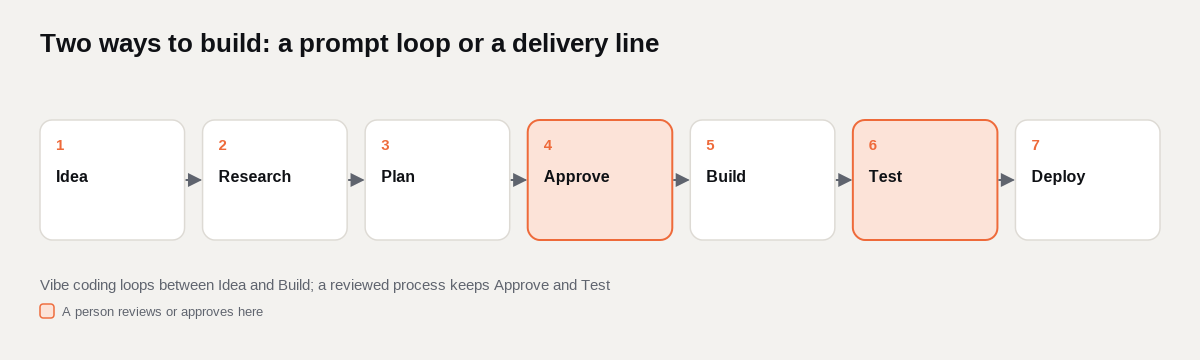
Vibe coding. Andrej Karpathy coined the term in a February 2025 post on X: "There's a new kind of coding I call 'vibe coding'," where you "forget that the code even exists" (Martin Fowler, May 2026). Fowler defines it as "building a software application by prompting an LLM," trying the result and prompting for changes without reviewing the generated code. It can be done without programming knowledge (same source).
The Open Source Security Foundation is stricter. Its glossary calls vibe coding "the process of generating and accepting AI-generated code without reviewing it or understanding it," relying "entirely on results and follow-up prompts to guide changes" (OpenSSF glossary). It adds a useful line: "If there is human review of the AI-generated code, then it is not vibe coding" (same source).
Traditional development. By traditional development we mean the familiar lifecycle: requirements, a plan or design, code that people write or review, tests, and a controlled release. The defining trait is not "no AI." It is that someone understands and owns each change. Many teams now use AI inside this process. Fowler calls the reviewed, AI-heavy version "agentic engineering" and keeps it apart from vibe coding (Martin Fowler).
Spec-driven development is a newer middle path. GitHub's open-source Spec Kit runs four phases, Specify, Plan, Tasks and Implement, and treats the spec as "a contract for how your code should behave" (GitHub blog, Sep 2025). Birgitta Böckeler warns that agents did not always follow the spec, which can give "a false sense of control" (martinfowler.com, Oct 2025). A spec helps, but only if something checks the result.
Side by side
| Aspect | Vibe coding | Traditional development |
|---|---|---|
| Who reads the code | Nobody, by definition | Developers write or review every change |
| Starting point | A prompt and a feeling for the result | Requirements and a plan |
| How you know it works | You try it in the browser | Tests, reviews and acceptance criteria |
| Speed to first version | Very fast | Slower to start |
| Cost of the next change | Rises as the code gets messy; Fowler says low-quality code gets hard to change, even for an LLM | Stays steadier when the code is clean and tested |
| Security | OpenSSF warns of "highly vulnerable code"; Fowler names exposed data and credentials | Reviews, scans and access controls are part of the process |
| Skills needed | Few; no programming required | Engineering skills, or a team that has them |
| Best for | Disposable tools, demos, learning | Apps people depend on for work, money or data |
The market is already moving toward the middle. Platforms now sell guardrails for vibe-coded apps. Retool lets teams import apps from tools like Lovable, Replit and Claude Code, and applies central authentication, role-based access and data policies to them (Retool newsroom, Jun 2026). Microsoft added guidance for converting "a vibe app to a code app" in Power Apps (Power Platform blog, Sep 2026). And the new Softr, relaunched on November 9, 2026, put the split in one line: "We vibe code your frontend. We don't vibe code your backend" (Softr blog).
When to choose vibe coding
- The software is disposable. Fowler says vibe coding suits "disposable software written for a limited audience." A one-off data cleanup page or a party sign-up form qualifies.
- You are testing an idea, not running a business on it. A clickable demo for a sales call or an investor meeting is fine, as long as it never gets real customer data.
- You are learning. Prompting, trying and reading what broke is a fast way to see what software can do.
- Only you will use it, and losing it would cost you nothing but a rebuild.
- The front end is the risky part, not the data. Softr's split, vibe-coded screens on a governed backend, shows one safe way to do this.
When to choose traditional development
- Other people depend on it. If staff or customers use the app for daily work, someone must understand the code when it breaks.
- It touches money, health or personal data. Payments, patient records and logins are exactly where OpenSSF's warning about vulnerable code bites.
- It must change often. Fowler notes that low-quality code becomes hard to change later. A codebase you expect to grow for years needs structure from the start.
- It connects to other systems. One change can ripple into billing, stock or notifications. Without tests, you find out from users.
- A client or auditor will ask how it was built. Plans, review records and test results are the evidence.
A quick test: ask what happens if the app is wrong for a day. If the answer is "nothing much," vibe away. If the answer involves money, data or a client, use a reviewed process, with or without AI.
Where an AI software factory fits
Most business apps sit in the middle. You want the speed of AI writing the code. You also need the controls of traditional development: a plan someone agreed to, tests that prove the main journeys work, and code you own.
Coding agents automate the developer. Devfab automates the development lifecycle. It keeps the traditional checkpoints and gives each one to an agent, with people at the decision points.
Take a B2B quote tool for a parts distributor. Devfab's Researcher first maps the domain: price lists, volume discounts, quote approval and how competing quote tools work. Then it suggests a prototype you can click. The Planner writes the plan, and a person approves it before any ticket exists. Dev agents build with ChainFlow, which maps which functions and APIs call each other, so a change to discount rules shows its effect on totals, PDFs and approval emails. The QA agent clicks through screens and journeys end to end, such as build a quote, apply a discount and send for approval, and runs logic tests. Deploy ships to your own server, and the code lives in your own GitHub account.
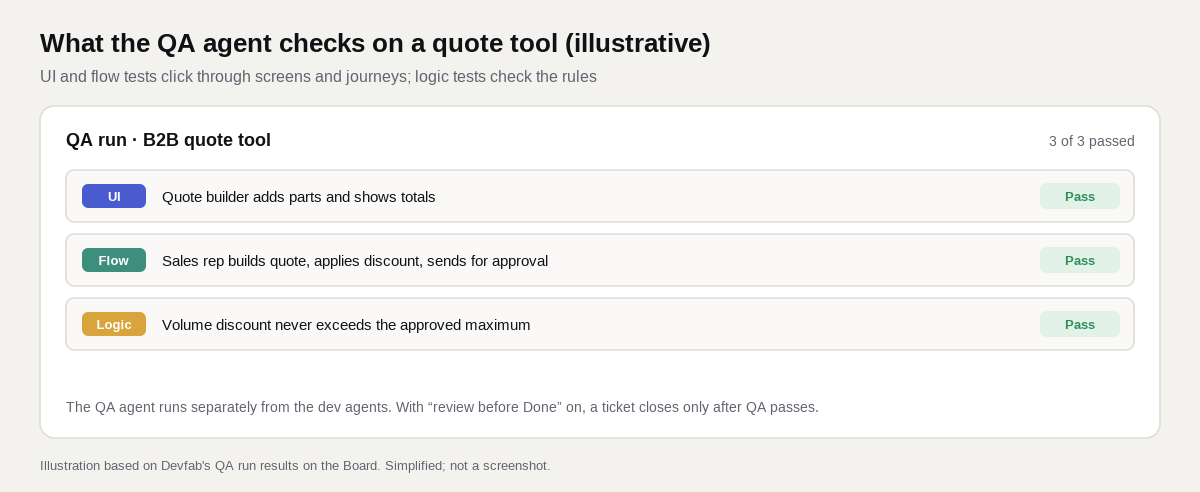
That is not vibe coding: the plan is reviewed and the result is tested. It is also not hand-written code. Cost is logged after each run, per task and per project, so the cost stays predictable. Devfab's limits: it is in Beta, with a smaller community and fewer integrations than mature platforms. It is not an editor for hands-on coding, and it needs a GitHub account.
If you already have a vibe-coded prototype, the move is the same. Put the code in GitHub, choose "Work on an existing project," and let ChainFlow map it before any change. Our guide to what vibe coding is and when it stops working covers the warning signs.
FAQ
What is the difference between vibe coding and traditional development?
In vibe coding you prompt an AI, try the result and prompt again, without reading the code. In traditional development people write or review every change, against a plan, with tests and a release process. The first is fast for throwaway work; the second is built for software people depend on.
Can vibe-coded apps go to production?
They can, but the risk is real. Martin Fowler says vibe-coded software often has problems with maintainability, correctness and security, and the OpenSSF glossary warns it risks deploying highly vulnerable code. Before production, someone has to review the code, test it and own it.
Is using AI to write code always vibe coding?
No. The OpenSSF glossary says that if a person reviews the AI-generated code, it is not vibe coding. Fowler calls the reviewed approach agentic engineering. You can use AI heavily and still keep the controls of traditional development.
Who coined the term vibe coding?
Andrej Karpathy, in a post on X in February 2025. He described it as fully giving in to the vibes and forgetting that the code even exists.
Read next
- What is an AI software factory?
- What is vibe coding, and when does it stop working?
- Spec-driven development vs vibe coding
- Prototype vs MVP vs production app
- Best vibe coding tools for teams
Keep the speed, add the plan and the tests. Try Beta
Sources (checked November 2026): Martin Fowler: Vibe Coding (May 21, 2026); OpenSSF glossary: Vibe coding; GitHub blog: Spec-driven development with AI (Sep 2, 2025); martinfowler.com: Understanding spec-driven development (Oct 15, 2025); Retool: extends enterprise governance to vibe-coded apps (Jun 2026); Power Platform: September 2026 feature update; Softr: Beyond building blocks (Nov 9, 2026).
Frequently asked questions
What is the difference between vibe coding and traditional development?
In vibe coding you prompt an AI, try the result and prompt again, without reading the code. In traditional development people write or review every change, against a plan, with tests and a release process. The first is fast for throwaway work; the second is built for software people depend on.
Can vibe-coded apps go to production?
They can, but the risk is real. Martin Fowler says vibe-coded software often has problems with maintainability, correctness and security, and the OpenSSF glossary warns it risks deploying highly vulnerable code. Before production, someone has to review the code, test it and own it.
Is using AI to write code always vibe coding?
No. The OpenSSF glossary says that if a person reviews the AI-generated code, it is not vibe coding. Fowler calls the reviewed approach agentic engineering. You can use AI heavily and still keep the controls of traditional development.
Who coined the term vibe coding?
Andrej Karpathy, in a post on X in February 2025. He described it as fully giving in to the vibes and forgetting that the code even exists.