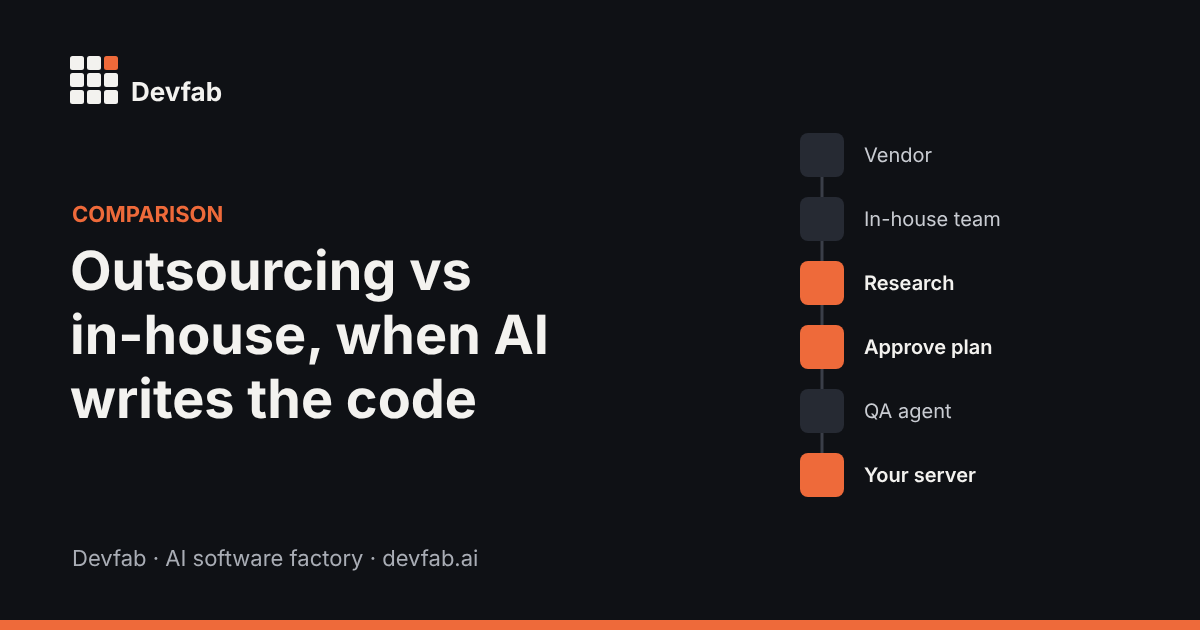
Short answer: Keep in-house developers on architecture, ambiguous requirements, security, code review and accountability for production. Give AI agents well-scoped, verifiable work: tickets with clear completion criteria, tests, migrations, documentation and first-pass review. The research does not support replacing developers; it supports a split, with people approving what agents do.
You run a team, and someone asked whether agents can replace a hire. Vendors say agents write, run and test code. Your developers say the output still needs fixing. Both are describing real experience. What you need is a clear split of the work, based on evidence rather than demos.
In this guide, you'll learn:
- Definitions
- What the evidence says
- When to choose in-house developers
- When to choose AI agents
- Where an AI software factory fits
This page uses no productivity numbers of our own, only published research.
Definitions
In-house developers are engineers you employ. They know your product, your users and your history, and they answer for the system when it breaks.
AI agents, in software, are tools that take a task and carry it out: read code, edit files, run commands and tests, and open pull requests. Devin describes itself as "an autonomous AI software engineer that can write, run and test code". GitHub Copilot's cloud agent can research a repository, "create an implementation plan" and open a pull request. Claude Code works across the terminal, IDEs and the browser. Some products, such as AI software factories, chain several agents into a full delivery process.
What the evidence says
Three sources are worth reading before you decide.
- DORA 2025 surveyed nearly 5,000 technology professionals. It found a positive relationship between AI adoption and both delivery throughput and product performance, but AI adoption "does continue to have a negative relationship with software delivery stability". Its summary: "AI doesn't fix a team; it amplifies what's already there."
- Stack Overflow's 2025 survey (more than 49,000 responses) found 46% of developers don't trust the accuracy of AI output, up from 31% the year before. A majority either don't use AI agents or stick to simpler AI tools.
- METR's 2025 randomized trial gave 16 experienced open-source developers 246 real issues. With AI allowed, tasks took 19% longer, yet the developers believed AI had sped them up. The authors stress this is a snapshot of specific tools and conditions, not proof that AI never helps.
The vendors are candid too. GitHub warns Copilot "can produce incorrect or suboptimal code, including code that contains security vulnerabilities". Anthropic says a Claude Code review with no findings "doesn't mean your code is error-free or secure", and its Code Review never approves or blocks a pull request. Cognition says Devin results depend on clear prompts with explicit completion criteria.
The takeaway: agents add capacity, and people keep the judgment.
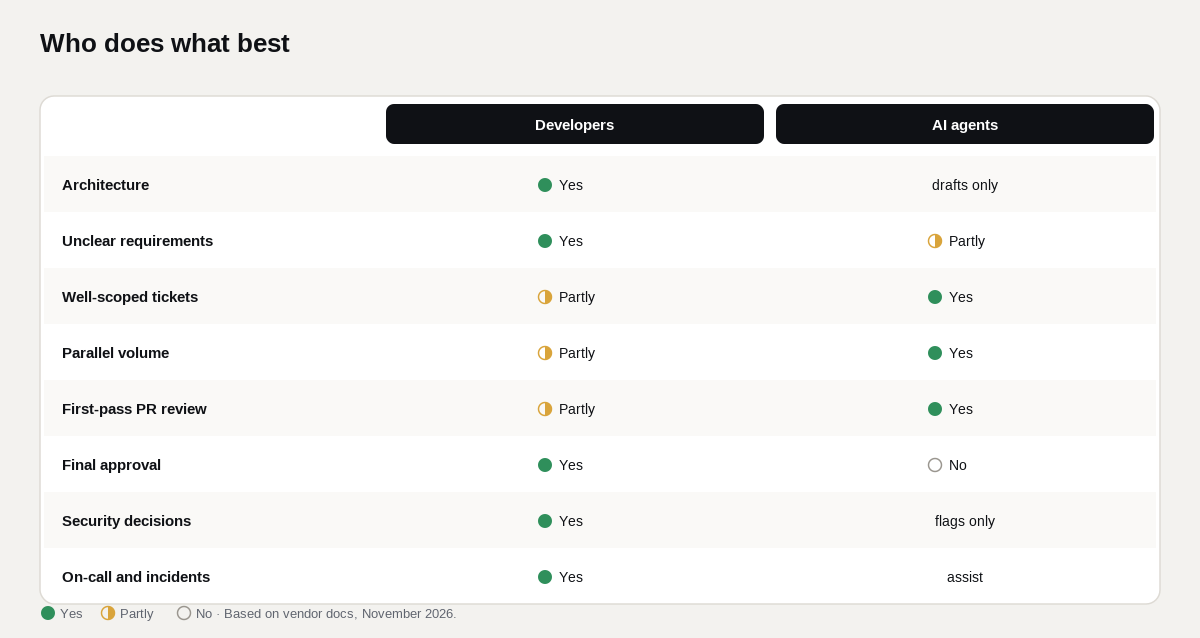
Who does what best
| Work | In-house developers | AI agents |
|---|---|---|
| Architecture and trade-offs | Best fit: needs context and accountability | Can draft options; a person decides |
| Unclear requirements | Best fit: talk to users and stakeholders | Ask clarifying questions in plan modes (Cursor) |
| Well-scoped tickets | Can do them, at the cost of focus | Good fit: bugs, tests, migrations, docs (Devin's list) |
| Volume and parallel work | Limited by headcount | Many tasks in parallel, each on a branch |
| Code review | Final approval and accountability | First pass: Copilot review, Claude Code Code Review, Cursor Bugbot |
| Security | Owns the decisions | Can flag issues; vendors warn output may contain vulnerabilities |
| Production incidents | On call, answers for the system | Can help investigate; doesn't carry responsibility |
| Knowledge of the business | Builds up over years | Starts from what you write down (rules files, AGENTS.md, specs) |
When to choose in-house developers
Developers are the better choice, and agents are no substitute, when:
- The work is a decision, not a task. Architecture, data models, build-versus-buy and trade-offs between speed and safety need someone who will live with the result. Augment's own description of its software factory says "humans retain ownership of consequential decisions."
- Requirements are vague. Developers can walk over to a user, notice what isn't said and push back. Agents work from what you give them.
- The code is high-risk. Payments, personal data, permissions and anything audited need a person who understands the threat model. GitHub's own warning about vulnerable output applies.
- Someone must be accountable. On-call duty, incident response and explaining a failure to a client are human jobs.
- Your process is weak. DORA's finding that AI amplifies what's already there means agents on a struggling team tend to make problems bigger. Fix the foundations with people first.
- You need knowledge to stay in the company. People learn your system over time and teach the next hire.
When to choose AI agents
Agents are the better choice when:
- You have a backlog of well-scoped tickets. Cognition lists parallel tickets from Linear or Jira, migrations, refactors, PR review, codebase Q&A, bug reproduction, unit tests and documentation as good fits for Devin.
- The result is easy to check. Tasks with explicit completion criteria and tests are where agents do best, by their vendors' own guidance.
- You need volume in parallel. Cursor cloud agents run many tasks at once, each on its own branch; Copilot's cloud agent opens one pull request per task.
- You want a first reviewer on every pull request. Copilot code review, Claude Code's Code Review and Cursor's Bugbot comment on PRs before a person approves.
- You need a prototype or internal tool that a developer would otherwise squeeze between priorities.
- Your developers are stuck on chores. Moving tests, docs and dependency updates to agents frees people for the decisions above.
A simple way to start
- List last quarter's tickets and mark which had clear completion criteria and tests.
- Give only those to an agent for a few sprints, and have a developer review every pull request.
- Track what you already track: lead time, failed changes and rework. DORA's stability finding is the one to watch.
- Keep or widen the split based on your own numbers, not a vendor's.
Where an AI software factory fits
A single agent takes a task. An AI software factory takes a project, with people at the checkpoints. Coding agents automate the developer. Devfab automates the development lifecycle.
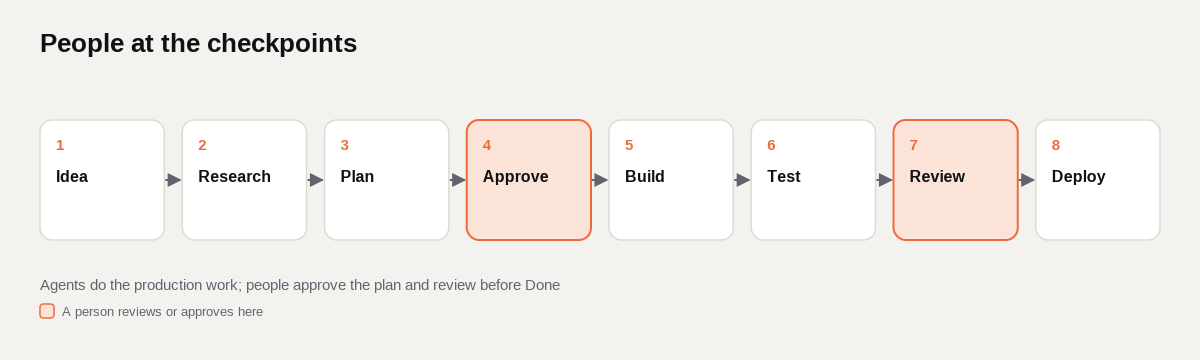
Devfab's seven agents (Researcher, Planner, Coordinator, Developers, Blueprint, QA agent and Deploy) do the production work, and your developers keep the judgment:
- A person approves the plan before the Coordinator creates any tickets. Human in the loop is the default mode.
- Research before the plan. The Researcher maps the domain, best practices and competitors, so the plan doesn't inherit gaps from a one-line request.
- ChainFlow shows dev agents which functions and APIs a change touches, so they don't break connected features your developers built.
- QA agent runs UI and flow tests plus logic tests, separate from the agents that wrote the code. Turn on "QA agent · review before Done" to keep a person in the final check.
- Same repo, your tools. Code lives in your own GitHub account (or your organization's), so developers review and edit it with whatever editor they like.
Devfab is built using Devfab. That's the model: people owning decisions, agents doing the production work. Honest limits: Devfab is new and in Beta, with a smaller community and fewer integrations. It is not an editor for hands-on coding, and it needs a GitHub account. Cost is predictable: logged after each run, per task and per project.
FAQ
Can AI agents replace in-house developers?
Not on the evidence available. Vendors themselves say their agents work best on well-scoped tasks and can produce incorrect code, and surveys show many developers don't trust AI output. Agents can take on a growing share of the work, but someone still has to own architecture, review changes and answer for production.
Do AI agents make developers more productive?
It depends on the team and the task. DORA's 2025 research links AI adoption to higher delivery throughput but lower delivery stability. A 2025 METR study found experienced open-source developers took longer on tasks with AI allowed, while believing they were faster. Measure your own results instead of assuming a gain.
What work should I give AI agents first?
Well-scoped tasks with clear completion criteria: bug fixes with a reproduction, unit tests, small migrations, documentation and first-pass code review. Keep architecture, security decisions and anything ambiguous with your developers.
How many developers do I need if I use AI agents?
There's no reliable ratio, and we won't invent one. You need at least one person who can describe the work, approve plans and review what agents produce.
Read next
- What is an AI software factory?
- AI software factory vs AI coding tools: which does your team need?
- How to measure AI developer productivity
- Human-in-the-loop software development: where people must stay
- How to review a plan written by an AI agent
- AI pair programmer vs autonomous coding agent
Keep your developers on the decisions. Let agents do the production work. Try Beta
Sources (checked November 13, 2026): Announcing the 2025 DORA report (Google Cloud); Stack Overflow 2025 developer survey coverage (InfoWorld); AI coding tools make developers slower, study finds (The Register, Jul 11, 2025); Introducing Devin; About Copilot cloud agent; GitHub Copilot plans; Claude Code overview; Claude Code Code Review; Cursor Plan Mode; Cursor cloud agents; Cursor Bugbot; Beyond AI coding agents (Augment, Sep 2026).
Frequently asked questions
Can AI agents replace in-house developers?
Not on the evidence available. Vendors themselves say their agents work best on well-scoped tasks and can produce incorrect code, and surveys show many developers don't trust AI output. Agents can take on a growing share of the work, but someone still has to own architecture, review changes and answer for production.
Do AI agents make developers more productive?
It depends on the team and the task. DORA's 2025 research links AI adoption to higher delivery throughput but lower delivery stability. A 2025 METR study found experienced open-source developers took longer on tasks with AI allowed, while believing they were faster. Measure your own results instead of assuming a gain.
What work should I give AI agents first?
Well-scoped tasks with clear completion criteria: bug fixes with a reproduction, unit tests, small migrations, documentation and first-pass code review. Keep architecture, security decisions and anything ambiguous with your developers.
How many developers do I need if I use AI agents?
There's no reliable ratio, and we won't invent one. You need at least one person who can describe the work, approve plans and review what agents produce.