Short answer: For managed end-to-end coverage, QA Wolf. For a QA platform across web, mobile and API, mabl. For tests as files in your repo, Momentic or free Playwright. For visual bugs, Applitools. For pull request review, CodeRabbit or Qodo. Devfab fits when you want testing built into the whole build process.
Your coding agents write more code than your team can read. Pull requests pile up. Each one looks fine on its own, yet something breaks in a flow nobody touched.
The problem isn't the agents. It's that testing didn't grow when output did. Code review catches some bugs; end-to-end tests catch others; visual checks catch a third kind. Most teams need two of the three.
In this guide, you'll learn:
- How we picked and compared
- Nine tools in one table
- Each tool's best use and limits
- Where a dedicated tool beats a software factory
- How to choose
Here's how each one compares.
How we picked and compared
We picked tools that position themselves for testing or checking AI-generated code, and checked each vendor's own pages in November 2026. We did not run hands-on tests for this article. We compared on:
- What it checks. Code (review), running app behavior (end-to-end), or appearance (visual).
- How tests are made. Agents, recording, natural language or code.
- Where tests live. In your repo as code, or in the vendor's platform.
- Coding-agent hook. Whether a coding agent can call it, for example through MCP.
- Pricing model. Per run, per usage, per seat or by quote.
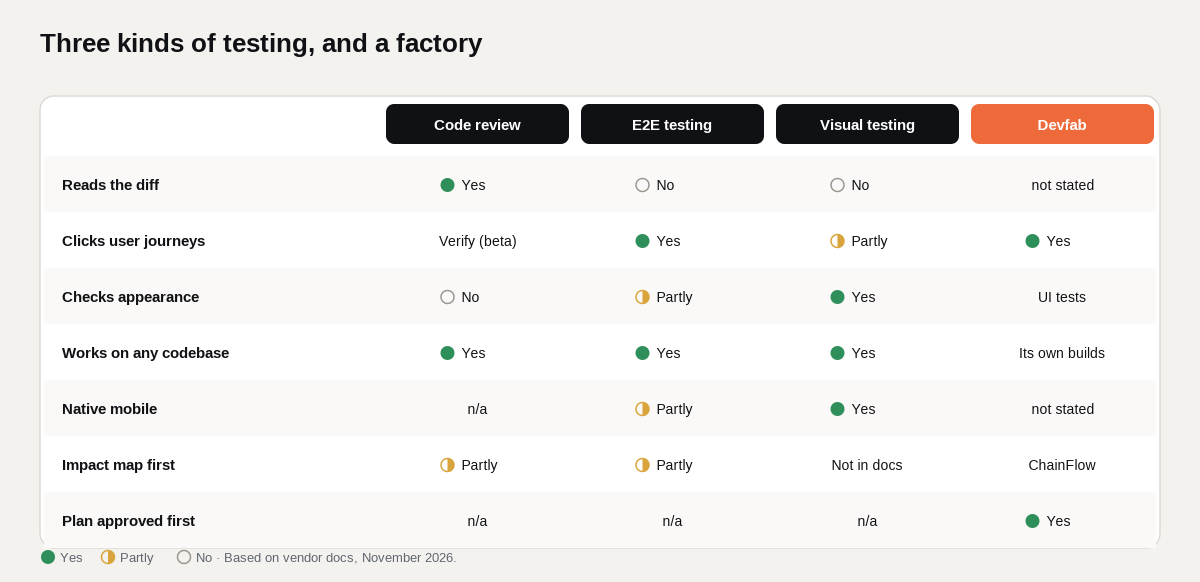
The tools fall into three groups. End-to-end testing (QA Wolf, mabl, Momentic, Playwright, Testim) runs the app the way a user would. Visual testing (Applitools) checks how it looks. Code review (CodeRabbit, Qodo) reads the change before merge. Devfab is a different kind of product, and we include it with its limits.
Quick comparison table
| Tool | Checks | Tests live | Agent hook | Pricing model |
|---|---|---|---|---|
| QA Wolf | End-to-end: web, iOS, Android, Windows | Exportable Playwright and Appium code | MCP server | Per test run; managed tiers by quote |
| mabl | End-to-end: web, mobile, API, AI apps | mabl platform | MCP server | Quote-based, credits for cloud runs |
| Momentic | End-to-end: web, iOS, Android | YAML files in your repo | MCP server, Claude Code plugin | Usage-based, no seats |
| Playwright | End-to-end: Chromium, Firefox, WebKit | Test code in your repo | MCP server, CLI, test agents | Free, open source |
| Applitools | Visual plus functional and API | Applitools platform; SDKs | MCP server listed | Per page (checkpoint); no public prices |
| Tricentis Testim | UI: web, mobile, Salesforce | Testim platform | No Testim MCP documented | No public prices; free trial |
| CodeRabbit | Code review; Verify (beta) runs web apps | PR comments | CLI works with coding agents | Per user per month |
| Qodo | Multi-agent code review and governance | PR comments | Agentic Toolbox CLI | Credits, pooled per team |
| Devfab | UI, flow and logic tests inside a full build | Your GitHub repo | Part of its own agent team | Cost logged per task and per project (Beta) |
The tools one by one
QA Wolf
QA Wolf calls itself an AI testing platform that combines agents, infrastructure and human experts. Its agents plan coverage, write tests, pick the tests each pull request needs, investigate failures and file bugs to Linear or Jira. It covers web, iOS, Android and Windows, including real iPhone and iPad devices. Tests are "open-source Playwright and Appium code you can export anytime." An MCP server lets Claude Code, Codex or Cursor call it. For teams that want people involved, Coverage-as-a-Service has QA Wolf engineers write, run and maintain the suite.
Pricing: USD 1 per web test run and USD 2 per mobile or desktop run, with retries included and no seat fees, as of November 2026. Managed tiers are quoted by sales.
Best for teams whose agents ship faster than anyone can review, and who want end-to-end coverage without hiring a QA team. Limits: per-run billing grows with suite size and run frequency; flaky tests are retried rather than eliminated; coverage guarantees apply only to the managed tiers.
mabl
mabl is an agentic test automation platform for web, iOS, Android, API and AI apps in one suite. Its agents author tests from inputs such as Jira requirements, investigate failures and heal broken steps, and it promises "an independent verdict before every release." On October 22, 2026 it announced an agentic testing harness with a knowledge graph that maps a change to its tests and highlights coverage gaps (SD Times). It connects through an MCP server, GitHub and GitLab checks, Jenkins, Jira and Slack, and holds SOC 2 Type II.
Pricing: quote-based with no public prices; cloud runs use credits, while local and CI runner runs don't. Free trial available.
Best for QA teams covering web, mobile and API regression for existing apps, and enterprises using TestRail, Xray or Zephyr. Limits: no public pricing; desktop testing was "coming soon" as of the October announcement.
Momentic
Momentic's agent, "Mo," explores web, iOS and Android apps to find bugs, then writes, runs and maintains tests in plain English stored as YAML in your repo. Mo turns an approved flow into a test and opens a pull request. It can test a PR's preview deployment and post a review with a commit check. Self-healing steps are cached and re-resolved on failure. It is built on Playwright, connects to coding agents through an MCP server or a Claude Code plugin, and lists SOC 2 Type 2 and SSO.
Pricing: Free USD 0 per month with USD 50 of usage included; Scale USD 500 per month with USD 500 of usage, as of November 2026. No seat charges.
Best for developer teams that want tests as reviewed files in their own repo, triggered from PRs. Limits: monthly usage doesn't roll over, the Free plan pauses at zero, and mobile session length is capped outside Enterprise.
Playwright
Playwright is Microsoft's free, open-source framework for browser automation and end-to-end tests across Chromium, Firefox and WebKit, in TypeScript, Python, .NET and Java. It ships three test agents: a Planner that explores the app and writes a Markdown test plan, a Generator that turns the plan into tests, and a Healer that repairs failing tests or skips them if it believes the feature is broken. Playwright MCP drives the browser through accessibility snapshots, so no vision model is needed. Playwright notes that its CLI is often more token-efficient than MCP for coding agents. Momentic runs on it and QA Wolf exports to it.
Pricing: free and open source.
Best for engineering teams that want full control of tests as code, and teams whose coding agents should write and heal browser tests. Limits: it's a framework, not a service; you host runs, CI and maintenance yourself.
Applitools
Applitools pairs Eyes, its Visual AI for checking that apps look right, with Autonomous, which creates and runs functional, visual and API tests. Its homepage says it gives "coding agents the eyes to fix UI issues themselves" and lists an MCP server. Runs use a proprietary deterministic model rather than an LLM. It has SDKs for Java, Python, JavaScript, C#, Ruby and more, works with Selenium, Playwright, Appium and Cypress, and can run as SaaS, a dedicated cloud or on-prem. It is ISO 27001 and SOC 2 Type II compliant.
Pricing: priced per page (a unique validation); no public prices. A free account includes one user and a monthly checkpoint allowance.
Best for teams whose main risk is visual regressions in AI-written UI, and regulated teams that need on-prem testing. Limits: contracts run one year; the Starter plan is public-cloud only.
Tricentis Testim
Testim, owned by Tricentis since 2022, builds UI tests by recording or by description, with AI-powered self-healing locators. It covers cross-browser web, native and hybrid mobile, and Salesforce, where metadata-based locators handle dynamic Lightning pages. Testim Copilot generates JavaScript custom steps from a description. Failed tests come with highlighted screenshots and console and network logs. It runs locally, on Testim's grid or on any Selenium grid, and sends bugs to Jira, Trello or GitHub.
Pricing: no prices on the product pages; free trial and an Enterprise edition through sales.
Best for QA teams needing low-code UI regression, Salesforce orgs, and companies already on Tricentis. Limits: no public pricing, and no Testim-specific MCP server documented; Tricentis tied its 2025 MCP announcement to other products.
CodeRabbit
CodeRabbit is an AI code reviewer for GitHub, GitLab, Azure DevOps and Bitbucket, plus IDE extensions and a CLI that "works with Claude Code, Cursor, Codex, Gemini, and more." Features include PR summaries, autofix, "slop detection," pre-merge checks and security scanning. Its newer Verify agent "tests how your application behaves," running the app in a sandbox and reporting bugs with screenshots and recordings. It raised a USD 143M Series C on August 12, 2026.
Pricing: Essentials USD 24, Team USD 48 and Advanced USD 72 per user per month, as of November 2026; Enterprise custom. Verify is free during its beta.
Best for teams that want an automated review gate on every PR and review in the IDE before push. Limits: mainly a reviewer; Verify is beta and web-only; SSO and self-hosting need Enterprise.
Qodo
Qodo (formerly CodiumAI) runs multiple review agents on each pull request against a team's rules and the wider codebase. Cross Repo Review flags changes that could break downstream repositories, and Software Map shows how repos, services and contracts connect. The Agentic Toolbox CLI adds a quality layer for coding agents. It supports bring-your-own-key models, on-prem or air-gapped deployment, zero data retention and SOC 2 Type II. It raised a USD 70M Series B on March 30, 2026.
Pricing: Pro Team is USD 0.015 per credit, pooled across the team, as of November 2026; Enterprise is custom for 30+ users. No permanent free tier.
Best for multi-repo organizations worried about cross-service breakage, and regulated teams needing on-prem review. Limits: it reviews and governs code; it doesn't run the app or test user journeys. Credits expire each month. See Devfab vs Qodo and Qodo vs GitHub Copilot.
Devfab
Devfab isn't a testing tool you add to code built elsewhere. It's an AI software factory where testing is one stage. Its QA agent runs UI and flow tests (screens, buttons and user journeys clicked end to end) plus logic tests on the work its developer agents produce. A workspace switch, "QA agent · review before Done," keeps work from being marked Done until it's reviewed.
Two other parts reduce what testing has to catch. ChainFlow maps which functions and APIs call each other and what is deployed, so a change to checkout shows its effect on payments, inventory, order confirmation and notifications before code is written. And a person approves the plan before any tickets exist.
Coding agents automate the developer. Devfab automates the development lifecycle.
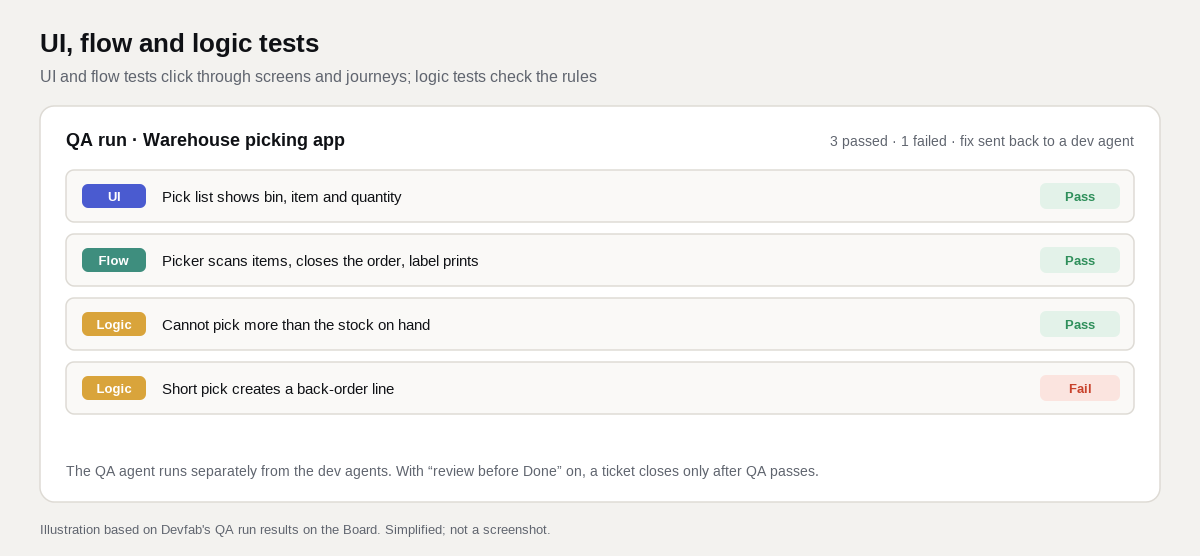
Pricing: predictable cost: cost is logged after each run, per task and per project.
Best for teams building new apps or changing existing repos who want testing tied to the plan and the build. Honest limits: Devfab is in Beta with a smaller community and fewer integrations; it doesn't test code you build in other tools; it doesn't list mobile, desktop or visual-regression testing; it isn't an editor for hands-on coding; and it needs a GitHub account.
Where a dedicated testing tool is the better choice
- You already have code and a build process. QA Wolf, mabl, Momentic or Playwright add a test layer without changing how you build.
- Native mobile or desktop apps. QA Wolf covers iOS, Android and Windows; mabl and Momentic cover mobile.
- Visual regressions are your main risk. Applitools is built for it.
- Every PR needs a review gate. CodeRabbit and Qodo review code from any author, human or agent.
- You want humans to own coverage. QA Wolf's managed tier does that.
How to choose
- Agents ship faster than you can review? Start with a PR reviewer (CodeRabbit or Qodo) and add end-to-end tests.
- Want end-to-end coverage without maintaining it? QA Wolf.
- QA team, many app types? mabl.
- Tests as code in your repo? Momentic, or Playwright for free.
- UI must look right everywhere? Applitools.
- Salesforce? Testim.
- Want testing built into how the app is planned and built? Devfab. Read AI code review vs QA agent for how the two layers differ.
FAQ
What is the best AI tool for testing AI-generated code?
It depends on the gap. For end-to-end coverage you don't want to maintain, QA Wolf. For a low-code QA platform across web, mobile and API, mabl. For tests as files in your repo, Momentic or Playwright. For pull request review, CodeRabbit or Qodo. For visual bugs, Applitools.
Is code review enough to catch bugs in AI-generated code?
No. Review reads the code; it doesn't click through the app. Many bugs in AI-written code only show up when a user journey runs end to end, such as a checkout that charges the wrong total. Pair a reviewer with end-to-end tests.
Can coding agents use these testing tools directly?
Many can. QA Wolf, mabl, Momentic and Applitools list MCP servers, and Playwright ships an MCP server and test agents that work with Claude Code, Codex and VS Code. That lets a coding agent write or run tests as part of its own loop.
Is there a free AI testing tool?
Playwright is free and open source, including its MCP server and test agents. Momentic has a free plan with included usage, CodeRabbit offers free reviews in the IDE, and Applitools has a free account with a monthly checkpoint limit.
How is Devfab's QA agent different from a testing tool?
Devfab's QA agent is one part of a software factory that also researches, plans, builds and deploys the app. It runs UI, flow and logic tests on the work its developer agents produce. A testing tool adds a test layer to code built anywhere.
Read next
- What is an AI software factory?
- AI code review vs QA agent
- Unit tests vs end-to-end tests for AI-generated code
- What is a QA agent?
Want tests that follow the plan, not just the diff? See Devfab's QA agent on your own app. Try the Devfab Beta
Sources (checked November 2026): QA Wolf; QA Wolf pricing; mabl AI test automation; mabl platform; mabl pricing; SD Times: mabl agentic testing harness (Oct 2026); Momentic; Momentic pricing; Momentic docs index; Playwright; Playwright Test Agents; Playwright MCP; Applitools; Applitools pricing; Applitools FAQ; Tricentis Testim; Testim Copilot; Tricentis acquires Testim; Tricentis agentic AI news (Jun 2025); CodeRabbit docs; CodeRabbit Verify; CodeRabbit pricing; CodeRabbit Series C (Aug 12, 2026); Qodo; Qodo pricing; Globes: Qodo raises USD 70M (Mar 30, 2026).
Frequently asked questions
What is the best AI tool for testing AI-generated code?
It depends on the gap. For end-to-end coverage you don't want to maintain, QA Wolf. For a low-code QA platform across web, mobile and API, mabl. For tests as files in your repo, Momentic or Playwright. For pull request review, CodeRabbit or Qodo. For visual bugs, Applitools.
Is code review enough to catch bugs in AI-generated code?
No. Review reads the code; it doesn't click through the app. Many bugs in AI-written code only show up when a user journey runs end to end, such as a checkout that charges the wrong total. Pair a reviewer with end-to-end tests.
Can coding agents use these testing tools directly?
Many can. QA Wolf, mabl, Momentic and Applitools list MCP servers, and Playwright ships an MCP server and test agents that work with Claude Code, Codex and VS Code. That lets a coding agent write or run tests as part of its own loop.
Is there a free AI testing tool?
Playwright is free and open source, including its MCP server and test agents. Momentic has a free plan with included usage, CodeRabbit offers free reviews in the IDE, and Applitools has a free account with a monthly checkpoint limit.
How is Devfab's QA agent different from a testing tool?
Devfab's QA agent is one part of a software factory that also researches, plans, builds and deploys the app. It runs UI, flow and logic tests on the work its developer agents produce. A testing tool adds a test layer to code built anywhere.