Short answer: Use AI code review on every pull request to catch defects, risky patterns, leaked secrets and rule violations in the changed lines. Use human review for intent: whether the change solves the right problem, matches business rules and fits the design. A 2026 study found people adopt human suggestions far more often, so keep a person as the merge gate.
You maintain a building permit tracker for a county. A pull request changes how permit fees are calculated. The AI reviewer leaves nine comments: a null check, a variable name, a missing test. Not one asks whether the new fee matches the ordinance the county passed last month. Your senior engineer asks that in one line.
That gap is the whole debate. AI review is fast, tireless and broad. Human review is slow, costly and asks the question that matters. The evidence on who catches what is finally good enough to split the work properly.
In this guide, you'll learn:
- Definitions
- What each catches
- When to choose AI code review
- When to choose human code review
- Where an AI software factory fits
Each claim below links to the study or vendor doc behind it.
Definitions
AI code review is an automated reviewer that reads a pull request and comments on it. Products such as CodeRabbit, Qodo and GitHub Copilot code review summarize changes, flag bugs, check security issues and enforce team rules. Some go further. CodeRabbit offers blast-radius analysis on its Advanced plan and a beta agent, Verify, that runs the app (CodeRabbit pricing; Verify docs). Qodo's Cross Repo Review flags changes that could break downstream repositories (Qodo).
Human code review is a teammate reading the change, asking questions and approving or blocking the merge. In most teams it is also where knowledge moves: juniors learn the codebase, and seniors learn what changed.
The two are not equal in the merge process. GitHub's docs say that by default "Copilot leaves a 'Comment' review, not an 'Approve' review," so its reviews "do not count toward required approvals" (GitHub Docs). The approval still belongs to a person unless you change that setting.
What each catches
The best evidence we found is a 2026 study from Queen's University by Zhong, Noei, Zou and Adams. It analyzed 278,790 inline review conversations from 300 mature open-source GitHub projects, covering 2022 to November 2025, with 16 AI review bots in the data (arXiv 2603.15911). Its main findings:
- Focus. Over 95% of AI review comments fall under code improvement or defect detection. Human comments spread across understanding, testing, knowledge transfer and social feedback. Understanding made up 31% of human comments on human-written code.
- Volume. AI comments average 29.6 tokens per line of code, against 4.1 for humans. AI says more, about narrower things.
- Follow-up. Between 85.2% and 86.7% of AI-started reviews end at the AI's first comment, with no reply.
- Adoption. Developers adopted 16.6% of AI suggestions and 56.5% of human ones. Of the AI suggestions not adopted, 28.7% were incorrect.
- Side effects. Adopted AI suggestions increased code size and complexity more than human suggestions did.
- Outcome. Threads that ended on an AI response had a 15.6% average rejection rate, against 7.8% for threads ending on a human response.
Put plainly: AI review is a wide net with a lot of noise. Human review is a narrow net that asks better questions.
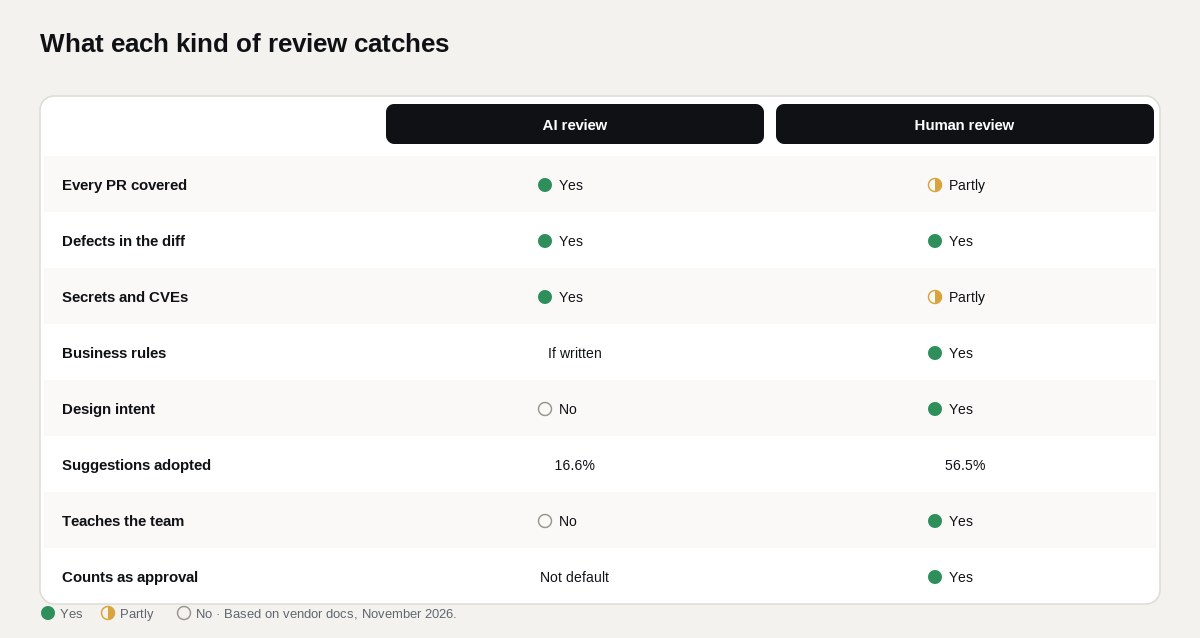
| Aspect | AI code review | Human code review |
|---|---|---|
| Covers every pull request | Yes, automatically | Only if people have time |
| Main focus | Defects and code improvements (95%+ of comments) | Understanding, design, testing, knowledge transfer |
| Suggestions adopted | 16.6% | 56.5% |
| Security and secrets scans | Yes, in tools like CodeRabbit Security | Depends on the reviewer |
| Checks the business rule | Only if the rule is written down for it | Yes, when the reviewer knows the domain |
| Cross-repo impact | Some tools (Qodo Cross Repo Review, CodeRabbit Advanced) | Depends on what the reviewer knows |
| Counts as approval on GitHub | Not by default for Copilot | Yes |
| Teaches the team | Rarely | Yes |
Study figures from Zhong et al., 2026. Tool features from vendor docs listed in Sources.
When to choose AI code review
- Every pull request, as a first pass. AI review never skips a PR because someone is on leave. It clears mechanical issues before a person looks.
- Agent-written code at volume. When coding agents open more pull requests than people can read, AI review is the only layer that scales. The study found humans exchange 11.8% more rounds when reviewing agent-written code, so a first pass saves real effort.
- Security hygiene. Scans for vulnerabilities, leaked secrets and vulnerable dependencies are tedious for people and routine for tools (CodeRabbit docs).
- Enforcing written rules. Qodo turns engineering practices into standards checked on each PR. Copilot reads rules from
.github/copilot-instructions.md,AGENTS.mdandREVIEW.md(GitHub Docs). - Changes that ripple across repos, if your tool checks beyond the diff.
When to choose human code review
- Business rules and intent. Does the permit fee match the ordinance? Should a demolition permit need a second inspection? AI can't check a rule nobody wrote down.
- Design decisions. Whether a new table, service or API is the right shape is a judgment call about the future.
- The merge gate. With 28.7% of unadopted AI suggestions judged incorrect, a person should own the final yes.
- Teaching. Knowledge transfer and understanding questions are where human review earns its cost.
- Pushing back on AI suggestions. Adopted AI suggestions grew code size and complexity more than human ones. Someone needs to ask whether the extra code is worth it.
Where an AI software factory fits
Both kinds of review happen late. By the time someone reviews the permit fee change, the wrong rule is already in the code. The cheaper place to catch it is before the code exists.
Coding agents automate the developer. Devfab automates the development lifecycle. Devfab moves the human check earlier and adds machine checks around it:
- Research before the plan. The Researcher maps key terms, best practices and similar products for the domain (permit types, inspection stages, fee schedules) before the Planner writes anything.
- A person approves the plan. That is the review that catches "wrong rule" before code is written. See how to review a plan written by an AI agent.
- ChainFlow maps impact. It maps which functions and APIs call each other and what is deployed, so a fee change shows its effect on invoices, receipts and the inspection schedule.
- The QA agent tests behavior. UI and flow tests click screens, buttons and journeys end to end, plus logic tests. That checks what review can't: whether the app works when used.
Devfab doesn't replace code review on a team that writes its own code; a reviewer like CodeRabbit or Qodo fits there. Devfab is in Beta, has a smaller community and fewer integrations, is not an editor, and needs a GitHub account. For more on the testing side, read AI code review vs QA agent.
FAQ
Can AI code review replace human reviewers?
Not on current evidence. A 2026 study of 278,790 review conversations found developers adopted 16.6% of AI reviewers' code suggestions against 56.5% of human suggestions, and 28.7% of unadopted AI suggestions were incorrect. The authors conclude human oversight is still needed. GitHub's Copilot review also does not count toward required approvals by default.
What does AI code review catch best?
Defects and code improvements in the changed lines. In the same study, over 95% of AI review comments were about code improvement or defect detection. Commercial reviewers add security scans, leaked-secret checks, rule enforcement and, in some tools, checks for changes that can break other repositories.
What do human reviewers catch that AI misses?
Intent and context. Human comments in the study spread across understanding, testing, knowledge transfer and social feedback, and questions about understanding drove the most discussion. People ask why a change exists, whether it matches the business rule, and whether the design will hold up.
Should AI review run before or after human review?
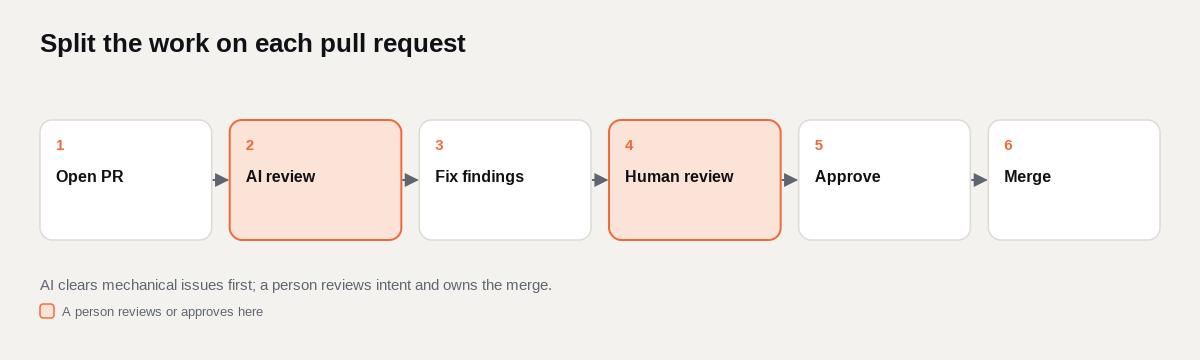
Before. Let the AI reviewer clear mechanical defects, style and security findings first, then ask a person to review intent, design and business rules. Keep the human approval as the merge gate, since AI suggestions are adopted far less often and AI-ended threads are rejected more often.
Read next
- What is an AI software factory?
- AI-generated code vs human-written code
- CodeRabbit vs Qodo
- CodeRabbit vs GitHub Copilot
Catch the wrong rule at the plan, not in the pull request. Try Beta
Sources (checked November 2026): Zhong, Noei, Zou and Adams, "Human-AI Synergy in Agentic Code Review" (arXiv 2603.15911, 2026); GitHub Docs: Using Copilot code review; CodeRabbit docs; CodeRabbit pricing; CodeRabbit Verify docs; Qodo homepage.
Frequently asked questions
Can AI code review replace human reviewers?
Not on current evidence. A 2026 study of 278,790 review conversations found developers adopted 16.6% of AI reviewers' code suggestions against 56.5% of human suggestions, and 28.7% of unadopted AI suggestions were incorrect. The authors conclude human oversight is still needed. GitHub's Copilot review also does not count toward required approvals by default.
What does AI code review catch best?
Defects and code improvements in the changed lines. In the same study, over 95% of AI review comments were about code improvement or defect detection. Commercial reviewers add security scans, leaked-secret checks, rule enforcement and, in some tools, checks for changes that can break other repositories.
What do human reviewers catch that AI misses?
Intent and context. Human comments in the study spread across understanding, testing, knowledge transfer and social feedback, and questions about understanding drove the most discussion. People ask why a change exists, whether it matches the business rule, and whether the design will hold up.
Should AI review run before or after human review?
Before. Let the AI reviewer clear mechanical defects, style and security findings first, then ask a person to review intent, design and business rules. Keep the human approval as the merge gate, since AI suggestions are adopted far less often and AI-ended threads are rejected more often.