Short answer: Qodo wins when you need an independent review and governance layer on every pull request, across GitHub, GitLab, Bitbucket and Azure DevOps, with on-prem or air-gapped options. GitHub Copilot wins when you want one assistant that writes code, runs a cloud agent and reviews pull requests inside GitHub at a per-seat price.
Your team ships more code than ever, and review is the new bottleneck. One camp says Copilot already reviews pull requests, so why add a tool. The other says the tool that wrote the code should not grade its own work. Both have a point. Qodo and Copilot overlap only on review, so this page compares them where they meet and says where each one belongs.
In this comparison:
- Qodo and GitHub Copilot at a glance
- Feature comparison
- Cost model by team size
- Where Qodo wins and where GitHub Copilot wins
- Where Devfab fits
Read it in order, or jump to your question.
Qodo and GitHub Copilot at a glance
Status changes in 2026. Qodo, formerly CodiumAI, raised a USD 70 million Series B on March 30, 2026 (Globes). Its site now leads with "Multi Agent Code Review" and a "Rules & Skills Lifecycle", and marks Software Map and Agentic Toolbox as new; the older names Qodo Gen and Qodo Merge are no longer the headline products (Qodo). GitHub moved Copilot plans to AI credits and added a Max tier; request-based billing is now legacy (GitHub Docs: plans). Enterprise AI Controls and the agent control plane became generally available on February 26, 2026 (GitHub changelog).
Qodo is an AI code review and governance platform. Its headline is "Code review for agents. Governance for humans." Several review agents check each pull request against a team's rules and the wider codebase, including code written by other AI agents (Qodo). Cross Repo Review flags changes that could break downstream repositories. Wisdom Base pulls in codebase knowledge, PR history and requirements.
GitHub Copilot is an AI assistant in GitHub.com, IDEs, the terminal and a desktop app (GitHub Docs: features). It offers completions, chat, agent mode in the IDE, a cloud agent that opens pull requests, and pull request code review on paid plans (Copilot plans).
Feature comparison
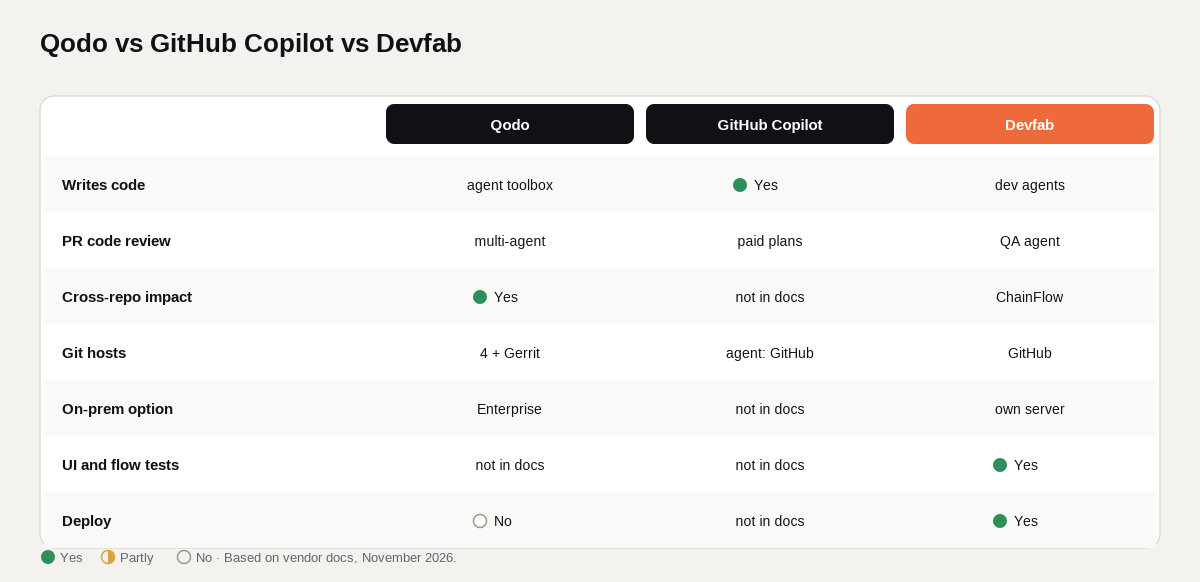
| Aspect | Qodo | GitHub Copilot | Source |
|---|---|---|---|
| Where it runs | Git providers, IDE plugins (VS Code, JetBrains, Visual Studio), CLI Agentic Toolbox | GitHub.com, Mobile, many IDEs, Copilot CLI, desktop app | Qodo; Copilot features |
| Main job | Review and govern code, including AI-written code | Write code, run agents, review PRs | Qodo; Copilot features |
| Review depth | Multi-agent review; logic errors, cross-file and architecture rules; impact across repos and history | PR review in GitHub; file diff review in editors; REVIEW.md instructions on GitHub.com | Globes; Copilot instructions |
| Writing code | CLI quality layer for agents such as Codex, Claude and Kiro | Completions, chat, agent mode, cloud agent | Qodo; Copilot features |
| Git hosts | GitHub, GitLab, Bitbucket, Azure DevOps; Gerrit on Enterprise | Cloud agent only on GitHub-hosted repos | Qodo; Copilot cloud agent |
| Deployment | SaaS, single-tenant, on-prem or air-gapped; zero data retention | GitHub cloud; Actions-based or cloud sandbox for the agent | Qodo pricing; Copilot cloud agent |
| Team and admin | SSO/SAML, audit logs, governance dashboard, SOC 2 Type II | Policies, usage data, file exclusions, audit logs on Enterprise | Qodo pricing; Copilot features |
| Model choice | BYOK with OpenAI, Anthropic, Azure OpenAI; self-hosted models on Enterprise | Models from OpenAI, Anthropic, Google, Microsoft, Moonshot AI and xAI | Qodo; Copilot models |
| Pricing model | Pooled team credits; no permanent free tier; Enterprise for 30+ users | Free tier; per-user or per-seat plans with AI credits | Qodo pricing; Copilot plans |
Cost model by team size
| Team size | Qodo | GitHub Copilot | Devfab |
|---|---|---|---|
| 1 person | No free tier; 14-day trial; Pro Team at USD 0.015 a credit, smallest pack 2,000 credits (about 14 reviews a month) | Free (no PR review); Pro USD 10 with code review and the cloud agent | Cost logged per task and per project (Beta) |
| 5 people | Pro Team, pooled: 4,000 credits (about 29 reviews) or 16,000 (about 114), or an unlimited option | Business USD 19 per seat with 1,900 AI credits per user, pooled | Cost logged per task and per project (Beta) |
| 25 people | Pro Team, or Enterprise for 30+ users with on-prem and air-gapped options | Business, or Enterprise USD 39 per seat with 3,900 AI credits per user | Cost logged per task and per project (Beta) |
Prices as of November 2026 from Qodo pricing, Copilot plans and GitHub Docs: plans. Qodo's page does not list pack prices; by our arithmetic, 2,000 credits at USD 0.015 is USD 30, roughly USD 2 per review. Qodo credits expire at the end of each monthly cycle. Devfab is in Beta and offers predictable cost: cost is logged after each run, per task and per project.
Where Qodo wins
- The reviewer should be independent of the writer. Qodo reviews code from any source, including other AI agents.
- Breakage crosses repositories. Cross Repo Review and Software Map track the blast radius of a change across repos and services.
- You use several Git hosts. GitHub, GitLab, Bitbucket and Azure DevOps are all supported, including self-managed and Data Center editions.
- Data cannot leave your network. Enterprise offers on-prem and air-gapped deployment with zero data retention.
- Rules should evolve. The Rules and Skills Lifecycle turns PR history into team standards.
Where GitHub Copilot wins
- You want one tool for writing and reviewing. Completions, chat, agent mode and PR review come in one subscription.
- Price per seat matters. Business is USD 19 per seat with pooled credits, and Pro is USD 10 for individuals.
- Everything is on GitHub already. Issues, Actions, PRs and review live in one place.
- You want a free start. Copilot Free includes completions; Qodo has a trial only.
- Agent governance at scale. The agent control plane adds an AI administrator role and agent activity in audit logs.
Switching from one to the other
Adding Qodo next to Copilot. Connect Qodo to your Git provider and start the 14-day trial on a few active repositories. Keep Copilot for writing. Qodo pools credits across the team, so watch how many reviews your PR volume uses before picking a pack.
From Qodo to Copilot review. Move your review rules into .github/copilot-instructions.md and, for review on GitHub.com, into REVIEW.md (GitHub Docs: custom instructions). Check that every repository is on GitHub, since the cloud agent works only there, and that your plan includes code review.
Where Devfab fits
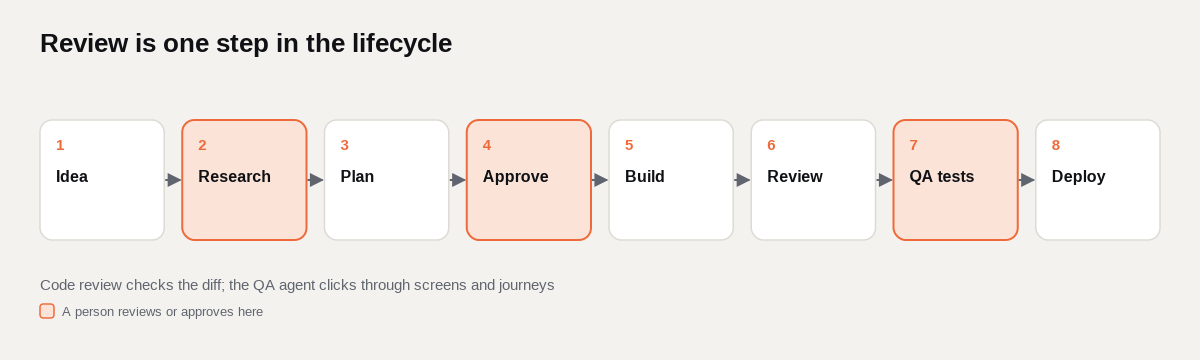
Qodo and Copilot both review code diffs. In the docs we checked, neither clicks through your app's screens and user journeys as a separate QA step, researches the domain before a plan, or deploys the app.
Coding agents automate the developer. Devfab automates the development lifecycle. A person approves the plan before dev agents start. ChainFlow maps which functions and APIs call each other, so an agent sees that a checkout change touches payments, inventory and notifications. The QA agent then runs UI and flow tests, clicking screens, buttons and journeys end to end, plus logic tests, before Deploy ships to your own server. The guide AI code review vs a QA agent explains why both layers matter.
Honest limits: Devfab is new and in Beta, with fewer integrations and a smaller community. It is not a code review product you can drop onto any Git host, and it needs a GitHub account. See Devfab vs Qodo and Devfab vs GitHub Copilot.
FAQ
Is Qodo a replacement for GitHub Copilot?
Mostly not. Qodo's homepage leads with multi-agent code review and governance, and it gives coding agents such as Codex, Claude and Kiro a CLI quality layer. Copilot writes code with completions, chat and a cloud agent, and also reviews pull requests. The real overlap is pull request review.
Does Qodo have a free plan?
No permanent free tier as of November 2026. Qodo offers a 14-day trial with no credit card, and qualifying open-source projects can apply for free access. Copilot has a Free plan, but it does not include pull request code review.
Which works with GitLab, Bitbucket or Azure DevOps?
Qodo lists GitHub (cloud and Enterprise Server), GitLab (cloud and self-managed), Bitbucket (Cloud and Data Center) and Azure DevOps, plus Gerrit on Enterprise. Copilot's cloud agent only works with repositories hosted on GitHub.
Can I run Qodo and Copilot on the same pull requests?
Nothing in the docs we checked prevents it. One option is to let Copilot or another agent write the code and let Qodo review it against team rules, so the reviewer is not the same product as the writer.
Read next
Want UI and flow tests on top of code review? Try Beta
Sources (checked November 13, 2026): Qodo homepage; Qodo pricing; Globes: Qodo raises USD 70m (Mar 30, 2026); GitHub Copilot plans; GitHub Docs: Plans for GitHub Copilot; GitHub Docs: Copilot features; GitHub Docs: About Copilot cloud agent; GitHub Docs: Supported AI models; GitHub Docs: Custom instructions support; GitHub Changelog: Enterprise AI Controls GA (Feb 26, 2026).
Frequently asked questions
Is Qodo a replacement for GitHub Copilot?
Mostly not. Qodo's homepage leads with multi-agent code review and governance, and it gives coding agents such as Codex, Claude and Kiro a CLI quality layer. Copilot writes code with completions, chat and a cloud agent, and also reviews pull requests. The real overlap is pull request review.
Does Qodo have a free plan?
No permanent free tier as of November 2026. Qodo offers a 14-day trial with no credit card, and qualifying open-source projects can apply for free access. Copilot has a Free plan, but it does not include pull request code review.
Which works with GitLab, Bitbucket or Azure DevOps?
Qodo lists GitHub (cloud and Enterprise Server), GitLab (cloud and self-managed), Bitbucket (Cloud and Data Center) and Azure DevOps, plus Gerrit on Enterprise. Copilot's cloud agent only works with repositories hosted on GitHub.
Can I run Qodo and Copilot on the same pull requests?
Nothing in the docs we checked prevents it. One option is to let Copilot or another agent write the code and let Qodo review it against team rules, so the reviewer is not the same product as the writer.