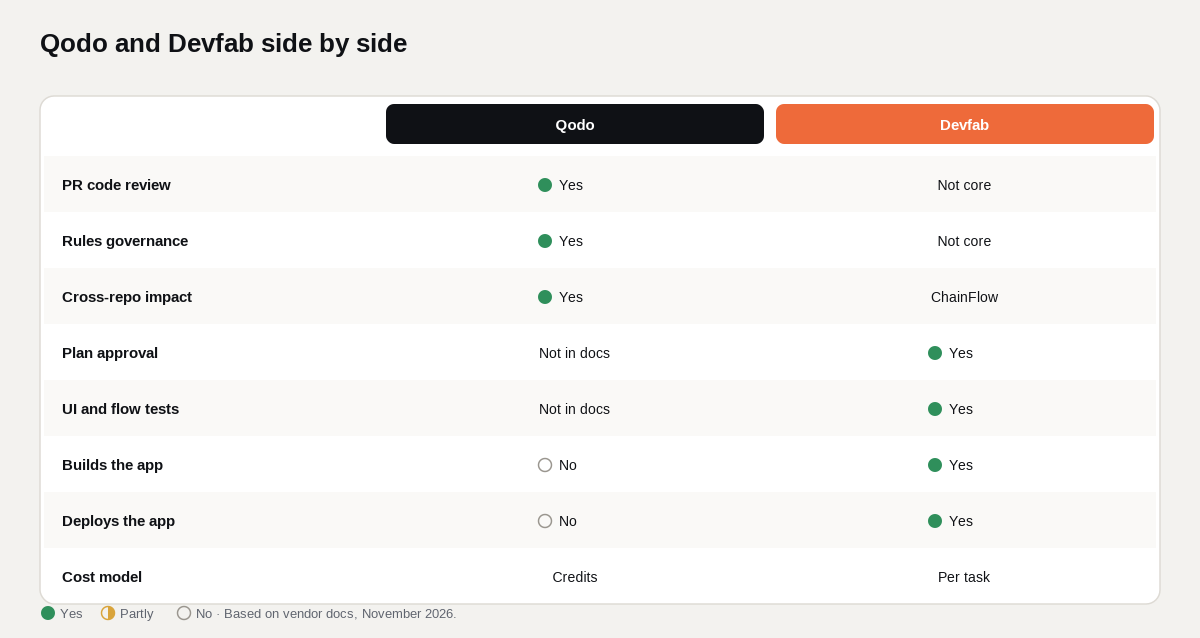
Short answer: Qodo wins when your team already writes code, by hand or with agents, and needs an independent review and governance layer on every pull request, including on-prem. Devfab wins when you need the code built in the first place: research, an approved plan, dev agents, UI and flow tests, deployment to your server and cost per project.
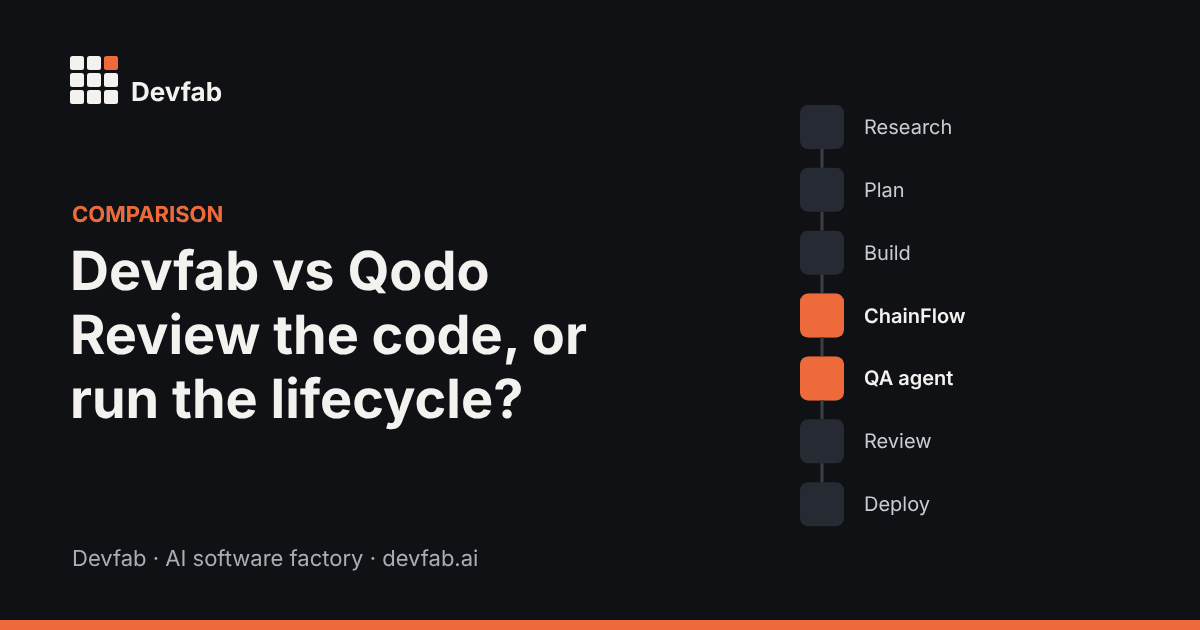
Your developers now ship more AI-written code than anyone can read. Review has become the bottleneck. Qodo exists for exactly that problem. But a clean review doesn't tell a client whether the booking form actually books.
Review vendors say quality starts at the pull request. Lifecycle tools say it starts before the first line of code. This page sets out where each one sits, and where they stack.
In this comparison:
- What each tool is built for
- Switching triggers
- Cost model by team size
- Where Qodo is the better choice
- Where Devfab is the better choice
The short version: many teams will want both.
What each tool is built for
Qodo
Qodo, formerly CodiumAI, is an AI code review and code-quality governance platform. Its headline is "Code review for agents. Governance for humans." (Qodo). Status, November 2026: active, after a Series B round led by Qumra Capital on March 30, 2026 (Globes). The homepage now leads with multi-agent code review, and older names such as Qodo Gen and Qodo Merge are no longer the headline products (Qodo).
What it does:
- Multi-agent PR review that enforces your organization's standards on every pull request (Qodo).
- Beyond the diff: it looks for logic errors, cross-file inconsistencies and architectural rule violations, and assesses impact across repositories and history (Globes).
- Cross Repo Review flags changes that could break downstream repos; Software Map shows how repos, services and contracts connect (Qodo).
- Agentic Toolbox: a CLI quality layer for coding agents such as Codex, Claude and Kiro (Qodo).
- Where it runs: GitHub, GitLab, Bitbucket and Azure DevOps (Gerrit on Enterprise), plus plugins for VS Code, JetBrains IDEs and Visual Studio (Qodo).
- Security and admin: SSO/SAML, audit logs, single-tenant SaaS or on-prem and air-gapped deployment, zero data retention and SOC 2 Type II (Qodo pricing).
Qodo's main user is an engineering organization that must review and govern code at volume. It reviews code; it does not build, host or deploy apps (Qodo).
Devfab
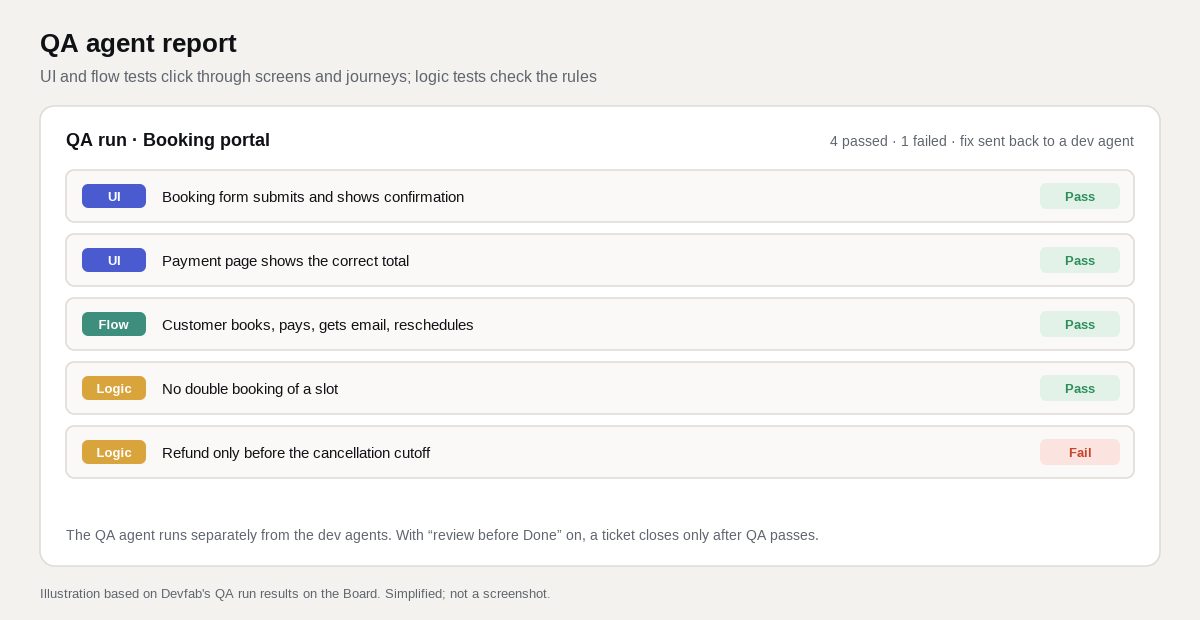
Devfab is an AI software factory. It produces the code, then proves it works. The Researcher maps the domain before planning. The Planner publishes a plan that a person approves. The Coordinator creates tickets for Developers, who use ChainFlow to see which functions, APIs and deployed parts a change touches while they build. The QA agent runs UI, flow and logic tests, and Deploy ships to your own server.
Coding agents automate the developer. Devfab automates the development lifecycle.
Switching triggers
These are the reasons a Qodo customer looks at Devfab, usually to add it rather than replace Qodo.
| Trigger | Qodo | Devfab | Source |
|---|---|---|---|
| Problems show up only at review time | Reviews each pull request against rules and the wider codebase | Research and a plan a person approves come before any code | Qodo |
| Need proof the app works, not just clean code | Code review is the core focus | QA agent clicks through screens and journeys, plus logic tests | Qodo |
| Someone still has to build and ship the app | Reviews and governs code; doesn't build, host or deploy | Dev agents build; Deploy ships to your own server | Qodo |
| Unused credits are lost | "Credits expire at the end of each monthly cycle" | Cost logged after each run, per task and per project | Qodo pricing |
| No free tier to keep for small projects | No permanent free tier; 14-day trial | Devfab is in Beta | Qodo pricing |
Cost model by team size
| Team size | Qodo | Devfab |
|---|---|---|
| 1 person | No permanent free tier; 14-day trial with no credit card; free program for qualifying open-source projects; then Pro Team | Cost logged per task and per project (Beta) |
| 5 people | Pro Team: a shared monthly credit pool, with smaller PRs using fewer credits; developers don't need their own Qodo accounts; overage per credit up to a spending cap | Cost logged per task and per project (Beta) |
| 25 people | Pro Team (Enterprise is custom-priced for 30+ users and adds SSO, BYOK and on-prem) | Cost logged per task and per project (Beta) |
Qodo's pricing model as of November 2026, from Qodo's pricing page. Check it for current credit packs. Devfab: predictable cost; cost is logged after each run, per task and per project; Devfab is in Beta.
Moving from Qodo to Devfab
Most teams don't move off Qodo. They add Devfab upstream of it.
- Use a GitHub repository. Qodo supports several Git hosts; Devfab needs a repo in your own GitHub account or your organization's.
- In Devfab, choose "Work on an existing project" and pick the repository.
- Leave the change box empty. ChainFlow maps the code first and suggests three small first tickets.
- Approve the plan. The Coordinator creates tickets and assigns dev agents after a person approves.
- Let the QA agent test each ticket with UI, flow and logic tests, and turn on "QA agent · review before Done".
- Keep Qodo on the same repository if you want its rules-based review as a second check.
Where Qodo is the better choice
- You already produce lots of code, by hand or with other agents, and need an independent review layer on every PR.
- Governance is the requirement: rules that evolve, audit logs and analytics across teams.
- Regulated or security-sensitive work needs on-prem or air-gapped review with zero data retention.
- Many repos and services where cross-repo breakage is the main risk.
- Mixed Git hosts, including GitLab, Bitbucket, Azure DevOps or Gerrit.
Where Devfab is the better choice
- You need the app built, not only reviewed. Dev agents work tickets from an approved plan.
- Research before the plan so the app fits the client's domain from the start.
- Impact awareness during the build. ChainFlow guides dev agents before a change reaches review.
- Tests that run the app. The QA agent checks screens, buttons and user journeys end to end.
- Delivery to the client's server, with code in your GitHub account or theirs, plus blueprints and user manuals.
- Cost per project, logged after each run, per task and per project.
Devfab's honest limits: it is new and in Beta, with a smaller community and fewer integrations than Qodo. It is not a dedicated code review or governance product, so it does not replace rules-based review across many repos. It is not an editor, and it needs a GitHub account.
FAQ
Is Qodo a competitor to Devfab or a complement?
Mostly a complement. Qodo reviews and governs code on every pull request, including code written by other agents. Devfab researches, plans, builds, tests and deploys the app. Because Devfab's code lives in your own GitHub account, you can keep Qodo connected to the same repository.
What is the difference between Qodo's code review and Devfab's QA agent?
Qodo's review agents read the change and check it against your rules, the wider codebase and other repositories, catching logic errors and cross-file inconsistencies. Devfab's QA agent runs the app: UI and flow tests click through screens, buttons and user journeys end to end, and logic tests check the rules. One reads code; the other uses the app.
Qodo has Cross Repo Review and Software Map. How does ChainFlow compare?
Qodo's Cross Repo Review flags changes that could break downstream repos, and Software Map shows how repos, services and contracts connect. Devfab's ChainFlow maps which functions and APIs call each other and what is deployed, and Devfab's dev agents use that map while they build, before the change is reviewed.
Does Qodo have a free plan?
Qodo's pricing page says there is no permanent free tier. It offers a 14-day trial with no credit card, and qualifying open-source projects can apply to a free program. Pro Team is credit-based, and Enterprise is custom-priced for 30 or more users.
Read next
- What is an AI software factory?
- AI code review vs QA agent: what each one catches
- Qodo vs GitHub Copilot: which should your team use in 2026?
- How to stop AI coding agents from breaking existing code
See what the QA agent checks on your own app. Book a Devfab demo
Sources (checked November 13, 2026): Qodo homepage; Qodo pricing; Israeli AI code review co Qodo raises funding (Globes, Mar 30, 2026); Qodo funding announcement, formerly CodiumAI (Qodo blog, Sep 30, 2024).
Frequently asked questions
Is Qodo a competitor to Devfab or a complement?
Mostly a complement. Qodo reviews and governs code on every pull request, including code written by other agents. Devfab researches, plans, builds, tests and deploys the app. Because Devfab's code lives in your own GitHub account, you can keep Qodo connected to the same repository.
What is the difference between Qodo's code review and Devfab's QA agent?
Qodo's review agents read the change and check it against your rules, the wider codebase and other repositories, catching logic errors and cross-file inconsistencies. Devfab's QA agent runs the app: UI and flow tests click through screens, buttons and user journeys end to end, and logic tests check the rules. One reads code; the other uses the app.
Qodo has Cross Repo Review and Software Map. How does ChainFlow compare?
Qodo's Cross Repo Review flags changes that could break downstream repos, and Software Map shows how repos, services and contracts connect. Devfab's ChainFlow maps which functions and APIs call each other and what is deployed, and Devfab's dev agents use that map while they build, before the change is reviewed.
Does Qodo have a free plan?
Qodo's pricing page says there is no permanent free tier. It offers a 14-day trial with no credit card, and qualifying open-source projects can apply to a free program. Pro Team is credit-based, and Enterprise is custom-priced for 30 or more users.