Short answer: For Java, .NET or C++ upgrades headed to Azure, pick GitHub Copilot modernization. For large ports between languages, Claude Code has the most detailed public playbook. For the same change across many repos, use recipe tools: OpenRewrite or Codemod. Devin suits parallel migration tickets, and Devfab suits upgrades that need a plan, impact map and UI tests.
You own an app that works but can't be upgraded. The framework is out of support, a security scan flags old libraries, and nobody wants to touch the login code.
Vendors promise that AI will translate it all. The teams that have actually done it say something else: the AI is the easy part; proving the new code behaves like the old code is the hard part. This list ranks tools on that second point, using sources checked in November 2026.
In this guide, you'll learn:
- How we picked and compared
- Quick comparison table
- The tools, one by one
- Devfab, with honest limits
- How to choose
First, three tools you should not start a new migration with.
Status changes to know first
- Amazon Q Developer's code transformation is ending. AWS says Q Developer IDE plugins and paid subscriptions reach end of support on April 30, 2027, and the Java upgrade and .NET porting transformations stop then too. New subscriptions and new Free Tier accounts have been blocked since May 15, 2026, and AWS points users to Kiro (AWS blog).
- Google Jules shuts down on December 31, 2026, and stopped accepting new tasks on November 11, 2026 (Jules changelog).
- Roo Code and Continue are discontinued. Roo Code's "Architect" mode once covered planning and migrations; Kilo Code published a Roo-to-Kilo migration path after Roo shut down (Kilo blog). Continue was acquired by Cursor in June 2026 and discontinued (Continue).
If a migration plan still names one of these, update it before work starts.
How we picked and compared
We looked for tools that help with upgrades (a newer version of the same language or framework), ports (a different language or framework) and mass changes (the same edit across many files or repos). This is a different list from our legacy modernization roundup, which covers mainframe and COBOL work.
We compared each tool on five questions:
- How does it find what to change? Static analysis, recipes, or an agent reading the code.
- How does it make the change? Deterministic rules, AI generation, or both.
- How does it prove the change is right? Builds, tests, parity checks, or nothing built in.
- Who approves? A person per change, per plan, or not at all.
- What does it cost? List price from the official page, or the pricing model.
All facts come from vendor docs, repos and dated articles opened in November 2026. We did not run hands-on tests.
Quick comparison table
| Tool | Best for | How it changes code | How it checks the result | Pricing (as of November 2026) |
|---|---|---|---|---|
| Claude Code | Large ports between languages | Agent loops: implement, review, fix | Test "judge" plus parity checks, per Anthropic's guide | Included in paid Claude plans; Pro USD 20 per month |
| GitHub Copilot modernization | Java, .NET and C++ upgrades; moves to Azure | OpenRewrite recipes plus agent tasks | Fixes build problems, runs tests, scans for CVEs | Licensing not stated on the overview page |
| OpenRewrite and Moderne | Same change across many repos | Deterministic recipes on lossless semantic trees | Minimal diffs; your build and tests | OpenRewrite open source; Moderne commercial |
| Codemod | JavaScript and TypeScript framework moves | AST codemods, workflows, AI via MCP | Manual approval gates in workflows; your tests | CLI Apache-2.0; Platform on its pricing page |
| Devin | Many scoped migration tickets in parallel | Autonomous agent in its own workspace, PRs | Runs and tests code in its workspace; you review PRs | Pro USD 20 per month; Teams USD 80 team fee plus USD 40 per seat |
| Konveyor AI | Java app modernization with rules | 2,400 migration rules plus LLM suggestions | Static analysis issues; solved-example history | Open source (Apache 2.0); bring your own model |
| OpenAI Codex | Refactors with parallel agents | Agent in CLI, IDE or cloud | Checks its own work with computer and browser tools | Included in ChatGPT plans; Plus USD 20 per month |
| Devfab | Upgrades that touch connected features | Plan approved by a person, then tickets to dev agents | QA agent: UI, flow and logic tests | Cost logged per task and per project (Beta) |
The tools, one by one
Claude Code
Best for: large language or framework ports where you can build a test harness first.
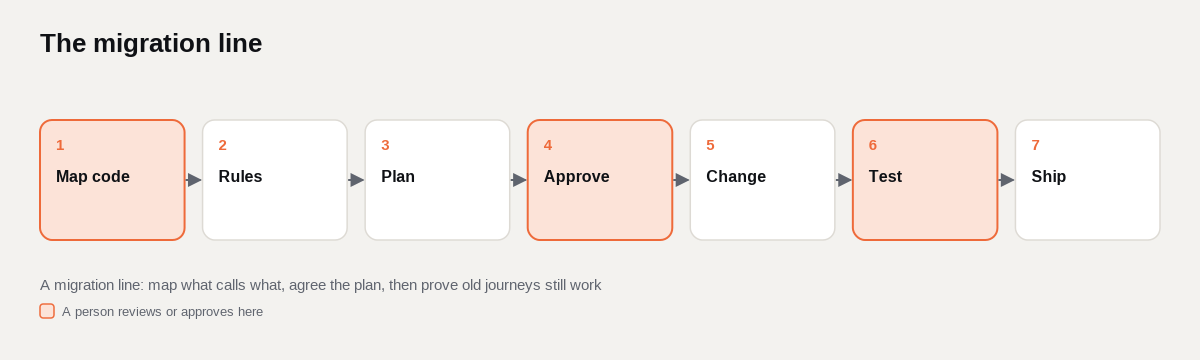
Anthropic published how it runs big migrations with Claude Code in July 2026 (Anthropic). The guide is the most useful public source on this topic, whichever tool you pick:
- Build a "strong judge" first. Tests that run against both the original and the target code, validated against working and deliberately broken code.
- Write a rulebook, dependency map and gap inventory before translating, then run a small "shakedown" translation and throw the output away.
- Translate in an implement, review and fix loop. Smaller models implement; larger models review. A batch script tracks progress from files on disk, so the run can resume.
- Named examples. Bun was moved from Zig to Rust, with all existing tests passing in CI before merge. A Python codebase was ported to about 165,000 lines of TypeScript with phase gates, adversarial review rounds and a parity check.
- Real cost is high on big jobs. Anthropic puts Bun's migration at roughly USD 165,000 at API pricing.
Claude Code runs in the terminal, IDEs, a desktop app and the web, and opens pull requests (Claude Code docs). Pricing: included in paid Claude plans; Pro is USD 20 per month and Team Standard USD 25 per user per month (USD 20 annual), as of November 2026 (Claude pricing).
Limits: the guide warns its starter kit is a template, "not what these specific ports ran on." Claude Code uses Claude models only, and long agent runs use more of your plan's limits (Claude Code costs).
GitHub Copilot modernization
Best for: Java, .NET and C++ upgrades, especially when the target is Azure.
Microsoft describes it as an agentic, end-to-end way to analyze and upgrade apps and migrate them to Azure (Microsoft Learn):
- Two layers. A Modernization agent CLI for architects runs assessment and planning across many apps; an IDE experience lets developers run the changes.
- Generally available for language, framework and toolset upgrades in .NET, Java and C++, and for .NET and Java migration scenarios.
- Uses OpenRewrite for API replacements and dependency updates, plus predefined Azure tasks such as secret management and identity. Git commits can become reusable migration patterns through custom skills.
- Checks the result. It resolves build problems, runs test validations, migrates unit tests, and scans for CVEs after upgrades.
- Deploys. It generates infrastructure-as-code and CI/CD setup for App Service, Azure Container Apps or AKS.
Limits: the overview page does not state supported versions, IDEs or which Copilot plans are needed. The deploy steps are Azure-specific. Copilot plans start at Pro USD 10 per user per month, as of November 2026 (GitHub Copilot plans).
OpenRewrite and Moderne
Best for: the same well-understood change across many files or repositories.
OpenRewrite is "an open-source automated refactoring ecosystem for source code" (OpenRewrite docs):
- Recipes, not prompts. Prepackaged recipes handle framework migrations, security fixes and style.
- Lossless semantic trees. Changes are made on a full model of the code, then printed back with the original formatting preserved.
- Build plugins. Maven and Gradle plugins run recipes one repository at a time.
- Moderne is the commercial platform that runs the recipe catalog across many repositories, with mass commits and impact analysis.
- Used inside AI tools. GitHub Copilot modernization calls OpenRewrite for its API replacements (Microsoft Learn).
Limits: Java is the original focus; other languages are being added. The docs page describes no AI features of its own, so changes outside the catalog need custom recipes or another tool.
Codemod
Best for: JavaScript and TypeScript framework moves across many repos.
Codemod calls itself "the AI-powered, community-led platform" for migrations, framework upgrades and large-scale changes (Codemod on GitHub):
- CLI to scaffold, test and run codemods locally or in CI.
- Workflow engine for multi-step migrations in YAML, with matrix runs and manual approval gates.
- JSSG, a JavaScript ast-grep layer, to write AST transformations in TypeScript or JavaScript.
- Registry of community codemods, and Codemod MCP that gives AI-powered IDEs tools to analyze code and create codemods.
- Platform adds dashboards and orchestration across many repositories. The CLI is Apache-2.0.
Limits: the repo page doesn't list supported languages beyond JavaScript and TypeScript examples, and we didn't open its pricing page, so check it.
Devin
Best for: a backlog of scoped migration tickets you want worked in parallel.
Cognition lists "migrations and refactors" among Devin's good fits (Devin docs):
- Its own workspace. Each session has a shell, IDE and browser; you can watch and take over.
- Parallel work. Devin takes tickets from Linear or Jira and can split long tasks across subagents, each opening its own PRs (Devin Desktop).
- Built-in Devin Review for pull requests (same source).
- Enterprise deployment options include a single-tenant VPC; each session runs on its own isolated machine (Devin enterprise).
- Status: since June 2, 2026, Windsurf is part of the Devin family as Devin Desktop (Devin Desktop FAQ).
Pricing: Free; Pro USD 20 per month; Max USD 200 per month; Teams USD 80 per month team fee plus USD 40 per dev seat, as of November 2026 (Devin pricing).
Limits: Cognition says results depend on clear prompts with explicit completion criteria, and harder work should be split into scoped steps. Devin's "brain" always runs in Cognition's cloud (Devin docs; Devin enterprise).
Konveyor AI
Best for: Java teams that want rule-driven modernization suggestions in the IDE, on an open-source stack.
Konveyor AI ("Kai") combines static code analysis with generative AI (Red Hat blog, Apr 2025):
- Rules first. The 0.1 release shipped 2,400 predefined migration rules, and you can add your own.
- Learns from past fixes. Retrieval adds solved migration examples to prompts; the repo includes an MCP server for storing and retrieving them (Konveyor AI on GitHub).
- No fine-tuning and no fixed model. Red Hat says it is model-agnostic.
- In the editor. A VS Code extension shows suggested changes.
- Open source under Apache 2.0.
Limits: the public pages we opened don't list supported migration paths, and the newest talks listed in the repo date from April 2025. Expect more setup than a commercial product.
OpenAI Codex
Best for: teams on ChatGPT plans who want parallel agents for refactors and upgrade tasks.
OpenAI highlights Codex for refactoring, testing and code review (OpenAI Codex):
- Parallel agents that check their own work with computer and browser tools.
- Runs everywhere: ChatGPT desktop, CLI, IDE extension, cloud environments and a GitHub integration (Codex docs).
- Configuration and safety: AGENTS.md, MCP, sandboxing and agent approvals are documented (same source).
- Cloud tasks keep running after you close your laptop (OpenAI Codex).
- Open-source CLI under Apache-2.0 (openai/codex).
Pricing: included in ChatGPT plans; Plus USD 20 per month; Business USD 20 per user per month billed annually, as of November 2026 (Codex pricing).
Limits: OpenAI's usage estimates "are not fixed message limits," and with an API key, cloud features such as GitHub code review aren't available (same source). There is no migration-specific workflow in the pages we checked.
Devfab, with honest limits
Coding agents automate the developer. Devfab automates the development lifecycle. For migrations, that means the upgrade is run as a planned project, not a single long prompt.
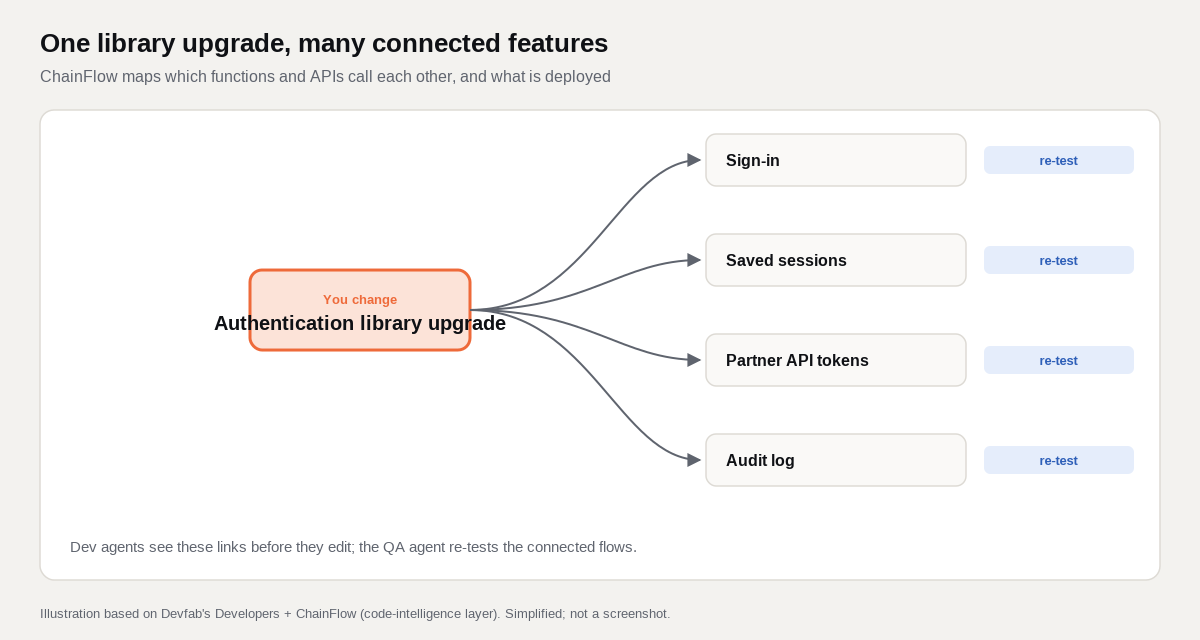
How it works on an existing repo. Choose "Work on an existing project," connect the GitHub repo and leave the change box empty. ChainFlow, Devfab's code-intelligence layer, maps which functions and APIs call each other and what is deployed, then suggests three small first tickets. When you describe the upgrade, the Planner publishes a plan and a person approves it before the Coordinator creates tickets.
Why the impact map matters here. Upgrades break things far from the line you changed. Take a B2B order portal moving to a new authentication library. ChainFlow shows dev agents that the change also touches sign-in, saved sessions, API tokens for partners and the audit log. That list becomes part of the plan, not a surprise in production.
How the result is checked. The QA agent runs UI and flow tests (screens, buttons and user journeys clicked end to end) plus logic tests, so a person can see that the old journeys still work after the upgrade. The Researcher also runs before the plan on new work, mapping domain terms, best practices and competitors.
Ownership and cost. Code stays in your own GitHub account, and you deploy to your own server. You can choose the model for each agent or keep Devfab's default. Cost is logged after each run, per task and per project.
Honest limits:
- Devfab is new and in Beta, with a smaller community.
- It has no migration recipe catalog like OpenRewrite or Codemod, and fewer integrations than mature platforms.
- It is not an editor for hands-on coding.
- It needs a GitHub account.
- For a pure API rename across hundreds of repos, a recipe tool is the better fit.
How to choose
- Name the migration type. Version upgrade, language port, or the same change everywhere. Each points to a different tool.
- Build the judge before the translator. If you can't run the same tests on old and new code, start there. This advice holds for every tool on this list.
- Use recipes for what's repeatable. OpenRewrite or Codemod for renames and dependency bumps; agents for the rest.
- Match the tool to your platform. Azure and .NET or Java: Copilot modernization. JavaScript estates: Codemod. Mixed backlogs: Devin or Codex.
- Decide where a person approves. Per PR (Devin, Codex), per plan (Devfab), or per workflow gate (Codemod).
- Check status before you commit. Amazon Q Developer transformations end April 30, 2027.
Read our step-by-step guide on how to modernize a legacy system for the process around any of these tools.
FAQ
What is the best AI tool for code migration?
It depends on the migration. For Java, .NET or C++ upgrades headed to Azure, GitHub Copilot modernization is the most complete package. For large language ports, Claude Code with a strong test harness has the best public playbook. For repeatable changes across many repos, OpenRewrite or Codemod recipes are safer than free-form AI.
Is Amazon Q Developer still a good choice for Java upgrades?
Not for new projects. AWS says Amazon Q Developer reaches end of support on April 30, 2027, and its Java upgrade and .NET porting transformations stop on that date. New subscriptions have been blocked since May 15, 2026, and AWS points users to Kiro.
Can AI migrate code without tests?
Not safely. Anthropic's own migration guide says to build a strong judge first: tests that run against both the original and the target code. If there are no tests, it suggests having the AI build them, using the original codebase as the ground truth.
Should I use deterministic recipes or an AI agent?
Both. Recipes such as OpenRewrite make the same change the same way every time, which suits API renames and dependency bumps. AI agents handle the parts no recipe covers. GitHub Copilot modernization combines the two: it uses OpenRewrite for API replacements and adds agent steps around it.
Is Devfab a code migration tool?
Not a dedicated one. Devfab is an AI software factory. On an existing repo, ChainFlow maps what calls what, a person approves the plan, dev agents make the changes as tickets, and the QA agent runs UI, flow and logic tests. It is in Beta and has no migration recipe catalog.
Read next
- What is an AI software factory?
- Best AI tools for legacy system modernization
- How to modernize a legacy system
- Devfab vs Claude Code
- Devfab vs Devin
Planning an upgrade that touches everything? Try Beta
Sources (checked November 2026): Anthropic: How Anthropic runs large-scale code migrations with Claude Code (Jul 2026); Claude Code docs; Claude Code costs; Claude pricing; Microsoft Learn: GitHub Copilot modernization overview; GitHub Copilot plans; OpenRewrite docs; Codemod on GitHub; Devin docs; Devin Desktop; Devin enterprise deployment; Devin Desktop FAQ; Devin pricing; Red Hat: Konveyor AI updates (Apr 2025); Konveyor AI on GitHub; OpenAI Codex; Codex docs; Codex pricing; openai/codex on GitHub; AWS: Amazon Q Developer end of support; Kilo blog: Thank you, Roo; Jules changelog; Continue.
Frequently asked questions
What is the best AI tool for code migration?
It depends on the migration. For Java, .NET or C++ upgrades headed to Azure, GitHub Copilot modernization is the most complete package. For large language ports, Claude Code with a strong test harness has the best public playbook. For repeatable changes across many repos, OpenRewrite or Codemod recipes are safer than free-form AI.
Is Amazon Q Developer still a good choice for Java upgrades?
Not for new projects. AWS says Amazon Q Developer reaches end of support on April 30, 2027, and its Java upgrade and .NET porting transformations stop on that date. New subscriptions have been blocked since May 15, 2026, and AWS points users to Kiro.
Can AI migrate code without tests?
Not safely. Anthropic's own migration guide says to build a strong judge first: tests that run against both the original and the target code. If there are no tests, it suggests having the AI build them, using the original codebase as the ground truth.
Should I use deterministic recipes or an AI agent?
Both. Recipes such as OpenRewrite make the same change the same way every time, which suits API renames and dependency bumps. AI agents handle the parts no recipe covers. GitHub Copilot modernization combines the two: it uses OpenRewrite for API replacements and adds agent steps around it.
Is Devfab a code migration tool?
Not a dedicated one. Devfab is an AI software factory. On an existing repo, ChainFlow maps what calls what, a person approves the plan, dev agents make the changes as tickets, and the QA agent runs UI, flow and logic tests. It is in Beta and has no migration recipe catalog.