Short answer: For data your team edits itself, Airtable is the easiest start. For low-cost portals with unlimited users, pick Knack; for HIPAA work, Caspio. Zoho Creator fits Zoho shops, Quickbase fits operations teams, and Noloco fits client portals on existing data. Choose Devfab when the app needs custom code you own.
Your equipment rental business runs on one shared spreadsheet. Customers, units, deposits and return dates all live in tabs. Two people edit it at once, and a rented excavator shows as available on the wrong day.
You don't need a database administrator. You need an online database that gives each person the right view, form and permission. This list compares seven options, from no-code tables to custom code, using vendor pages checked on November 23, 2026.
In this guide, you'll learn:
The tools are ordered by how much setup they ask of you, lightest first.
How we picked and compared
We looked for hosted tools where a business can model its data in tables, add forms and views, set roles, and share apps with staff or outside users. We left out raw cloud databases that need a developer to build any screen.
For each tool we opened the official product and pricing pages in November 2026, plus dated reviews where available. We did not run hands-on tests, so no claims here come from our own trials. Prices appear only as the official pricing page states them. We checked five things for each: data model, AI building, user and permission model, compliance, and pricing model.
Two status notes matter. Airtable is now owned by Bending Spoons, which closed the deal in early September 2026 (Airtable newsroom). Quickbase launched an AI app builder called Pave on April 28, 2026 (Quickbase press release).
Quick comparison
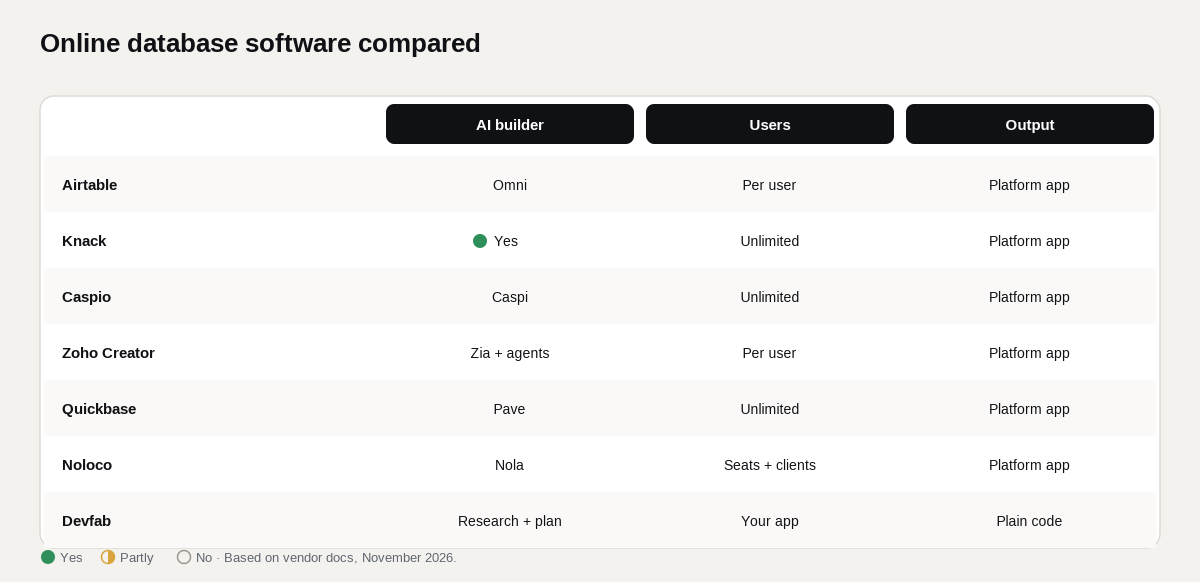
| Tool | Best for | AI building | Users | Compliance noted | Starting paid price (Nov 2026) |
|---|---|---|---|---|---|
| Airtable | Teams that edit data themselves | Omni 2.0; Canvas (open beta) | Per billable collaborator | Agent audit logs on Enterprise | Team USD 20 per user per month, annual |
| Knack | Low-cost portals and database apps | AI app builder on all plans | Unlimited | HIPAA, GDPR, SOC 2 Type II cited | Starter USD 59 per month (USD 49 annual) |
| Caspio | Regulated data apps | Caspi builder | Unlimited app users | HIPAA, SOC 2 Type II, GDPR; FERPA | Team USD 300 per month (USD 270 annual) |
| Zoho Creator | Zoho users; native mobile | Zia; Plan, Build and Test agents | Per user | Audit trail; SAML SSO add-on | Standard USD 8 per user per month, annual |
| Quickbase | Operations apps under IT oversight | Pave | No user limit | Pave: data never trains the AI | USD 500 per month, billed annually |
| Noloco | Client portals on existing data | Nola | Seats plus active clients | ISO/IEC 27001 audit stated | Build USD 79 per month (USD 65 annual) |
| Devfab | Custom apps as code you own | Agents research, plan, build, test, deploy | Your app, your rules | Not stated | Beta; cost logged per task |
The best online database software
Airtable
Best for: business teams whose app is mostly structured data, views and simple workflows they want to change themselves.
Airtable's Omni assistant creates tables, fields, records, automations, dashboards and interface pages from prompts (Airtable support). Omni 2.0, released on all plans in October 2026, builds data models from spreadsheets, PDFs and images, and Airtable Canvas (open beta) builds apps on live base data (Airtable Fall Release). Omni asks before deletions and leaves publishing to you. Building apps with Omni does not use AI credits; questions do (Airtable AI billing). Pricing: Free; Team USD 20 per user per month; Business USD 45 per user per month, billed annually, as of November 2026 (Airtable pricing).
Limits: Omni can't create views, set up syncs or export data. Canvas needs Anthropic enabled and is unavailable for HIPAA or non-US-data organizations. Layoffs followed the acquisition on October 12, 2026, though plans and prices were stated unchanged.
Knack
Best for: small organizations and agencies that need a database app or branded portal for many users at a low price.
Knack's database is relational, with one-to-many and many-to-many links, custom fields and validation (Knack). Its AI app builder creates a first version from a chat prompt, and Knack Flows connects to OpenAI, Perplexity, Anthropic Claude and Google Gemini on all plans (Knack pricing). Portals include secure login, Stripe and PayPal payments, roles and SSO. A new Knack MCP Server lets AI tools connect to its backend. Pricing: Starter USD 59 per month (USD 49 billed annually); Pro USD 130 per month (USD 110 billed annually); Corporate from USD 300 per month, as of November 2026, with unlimited users.
Limits: Starter caps 20,000 records, 2 GB, 3 apps and 1,000 API calls a day. HIPAA and GovCloud options are Enterprise or the separate Knack Health plan.
Caspio
Best for: healthcare, education and government teams that need compliance paperwork without running infrastructure.
Caspio runs on a SQL Server core and now calls itself "the Compliant AI App Builder" (Caspio). Its Caspi builder creates the data model, interface and roles from a description, and the result stays editable. A Chat AI Agent answers signed-in users' questions about app data while respecting roles and field-level security. Caspio says it is certified annually for HIPAA, SOC 2 Type II and GDPR, supports FERPA and WCAG, and runs HIPAA-eligible AI features under signed BAAs. Apps can be fully hosted or embedded into websites and portals. Pricing: Team USD 300 per month (USD 270 billed annually); Business USD 600 per month (USD 540 billed annually); HIPAA Compliance Edition USD 500 per month on a one-year term, as of November 2026 (Caspio pricing).
Limits: Team allows only 5 app authors, 250K records and 500 task runs a month. No permanent free plan. Bring-your-own AI license is Enterprise only.
Zoho Creator
Best for: small and mid-size businesses on Zoho CRM or Books, and teams that want a native phone app for every database app.
Every Zoho Creator app gets native iOS and Android versions, and apps can run on Zoho Cloud, AWS, Azure, GCP, on-premise or hybrid (Zoho Creator). Zia builds from natural language; a Plan Agent writes a business requirements document, a Build Agent adds modules with review of each change, and a Test Agent generates and runs test cases. You can use Zoho's own GenAI or bring your own key for OpenAI, Google or Anthropic. Pricing: Standard USD 8, Professional USD 20 and Enterprise USD 25 per user per month, billed annually, as of November 2026 (Zoho Creator pricing).
Limits: Standard allows one app; SAML SSO is an add-on. 2026 Capterra reviewers cite a steeper learning curve past simple apps and slow-to-learn Deluge scripting (Capterra).
Quickbase
Best for: operations teams in field service, construction and manufacturing that run many connected apps.
Quickbase's entry tier includes up to 50 custom apps, Automations, Sync, API, customizable roles, a developer sandbox and IP filtering, with no limit on users (Quickbase pricing). Pave builds the data model, roles, workflows and hosting from a prompt, with draft and publish, version rollback and 350+ connectors (Pave). Identity integrates with Okta, OneLogin, LDAP or SAML. Pricing: core platform USD 500 per month, billed annually; Pave Free, or Launch USD 20 per month for 120 credits, as of November 2026 (Pave pricing).
Limits: audit logs are a paid add-on; Pave custom agents, API access and white labeling are "coming soon." A competitor review cites the platform minimum and integrations reserved for higher plans (Blaze).
Noloco
Best for: service firms that need a client portal on data already in Airtable, Google Sheets or Postgres.
Noloco calls itself "the AI portal builder for teams running complex operations" (Noloco). Its Nola builder sets up tables, pages, permissions and workflows from plain language. It works on Noloco Tables plus Airtable, Google Sheets, Postgres and SmartSuite, with more sources on paid plans (Noloco pricing). Permissions go down to role, table, page, record and field. Data is hosted on AWS in Ireland, and Noloco says it is audited against ISO/IEC 27001. Pricing: Free; Build USD 79 per month (USD 65 billed annually) with 10 seats, then USD 5 per extra seat, as of November 2026.
Limits: Free caps 2,000 records and 50 active clients; Build caps records at 250,000 even with add-ons. SSO is Enterprise only.
Devfab
Best for: businesses and agencies whose "database app" has grown into a real product with rules no template covers.
Devfab is not a database builder. It is a Software Factory: agents research, plan, build, test and deploy a custom app, and the database is part of the code you own. Coding agents automate the developer. Devfab automates the development lifecycle.
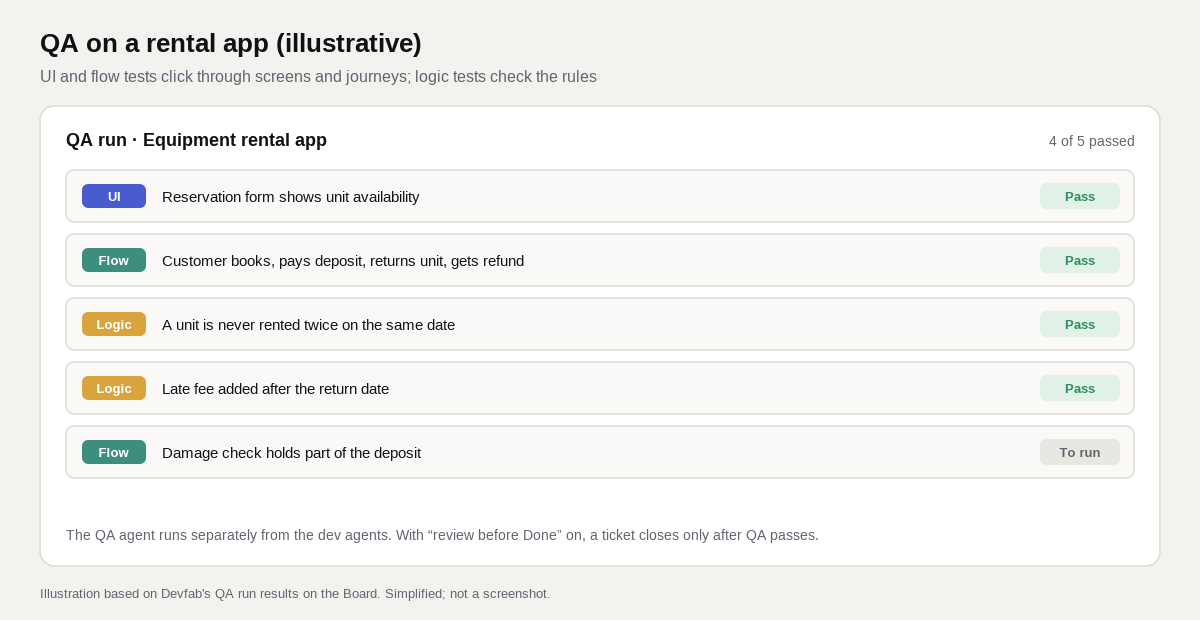
For the rental business, you describe the app in "What should we build?" The Researcher maps the domain first: units, reservations, deposits, damage checks, late fees and competing rental systems. It suggests a prototype before the Planner writes a plan, and a person approves the plan. The QA agent runs UI and flow tests, booking a unit through to its return, plus logic tests, such as never renting one unit twice on the same date. ChainFlow shows what a change touches, so a new deposit rule doesn't break invoicing or availability. Code goes to your own GitHub account, and Deploy ships to your own server. Cost is logged after each run, per task and per project.
Limits: Devfab is in Beta, with a smaller community and fewer integrations than the platforms above. There is no drag-and-drop table editor, it is not an editor for hands-on coding, and it needs a GitHub account. You run the server, and compliance certifications are not stated.
How to choose
- Your team wants to build and edit the data itself: Airtable.
- Many outside users, small budget, payments: Knack.
- Health or student records and a BAA: Caspio.
- Already on Zoho, or every app needs a phone version: Zoho Creator.
- Operations apps with sandboxes, rollback and enterprise identity: Quickbase.
- A client portal on data you already keep elsewhere: Noloco.
- Rules are complex, limits keep biting, or you want the code: Devfab.
One more test before you buy: estimate your record count a year from now. Record caps (20,000 on Knack Starter, 250,000 on Noloco Build, 250K on Caspio Team) decide your real plan more often than features do.
FAQ
What is online database software?
It is a hosted database you build and use in the browser, with forms, views, permissions and often portals on top, so you don't run a database server yourself. Most tools in this category now add an AI builder that creates tables, screens and roles from a plain-language description.
Which online database software has unlimited users?
Several, as of November 2026. Knack includes unlimited app users on all plans, Caspio's flat plans include unlimited app users, and Quickbase's entry tier is a platform price with no limit on users. Airtable and Zoho Creator charge per user, and Noloco includes a set number of team seats plus active clients.
What is the best online database for HIPAA data?
Caspio is the most direct fit in this list: it says it is HIPAA, SOC 2 Type II and GDPR certified annually, and HIPAA-eligible AI features run under signed BAAs, with a HIPAA Compliance Edition at USD 500 per month on a one-year term. Knack offers HIPAA through Enterprise or its Knack Health plan.
Is Airtable still a safe choice after the Bending Spoons acquisition?
Airtable is active and its plans and pricing were stated as unchanged after Bending Spoons closed the acquisition in early September 2026. The company announced layoffs on October 12 and shipped Omni 2.0 and Canvas on October 21. Teams with long contracts should watch the roadmap.
When should a business move from an online database to a custom app?
When the rules get complex, record limits keep pushing you to higher plans, or the business wants the code and data on its own servers. At that point a custom app, built and tested as code you own, can fit better than another platform plan.
Read next
- What is an AI software factory?
- Knack vs Quickbase
- Caspio vs Knack
- Devfab vs Airtable
- How to replace spreadsheets with a custom app
Has your database app become the business? Try Beta
Sources (checked November 2026): Airtable pricing; Airtable newsroom: Back to bases (Oct 12, 2026); Airtable Fall Release (Oct 21, 2026); Airtable support: Using Omni; Airtable AI billing; Knack; Knack pricing; Caspio; Caspio pricing; Zoho Creator; Zoho Creator pricing; Capterra: Zoho Creator reviews; Quickbase pricing; Quickbase Pave; Quickbase Pave pricing; Quickbase introduces Pave (Apr 28, 2026); Blaze: Quickbase review (competitor, Sep 2026); Noloco; Noloco pricing.
Frequently asked questions
What is online database software?
It is a hosted database you build and use in the browser, with forms, views, permissions and often portals on top, so you don't run a database server yourself. Most tools in this category now add an AI builder that creates tables, screens and roles from a plain-language description.
Which online database software has unlimited users?
Several, as of November 2026. Knack includes unlimited app users on all plans, Caspio's flat plans include unlimited app users, and Quickbase's entry tier is a platform price with no limit on users. Airtable and Zoho Creator charge per user, and Noloco includes a set number of team seats plus active clients.
What is the best online database for HIPAA data?
Caspio is the most direct fit in this list: it says it is HIPAA, SOC 2 Type II and GDPR certified annually, and HIPAA-eligible AI features run under signed BAAs, with a HIPAA Compliance Edition at USD 500 per month on a one-year term. Knack offers HIPAA through Enterprise or its Knack Health plan.
Is Airtable still a safe choice after the Bending Spoons acquisition?
Airtable is active and its plans and pricing were stated as unchanged after Bending Spoons closed the acquisition in early September 2026. The company announced layoffs on October 12 and shipped Omni 2.0 and Canvas on October 21. Teams with long contracts should watch the roadmap.
When should a business move from an online database to a custom app?
When the rules get complex, record limits keep pushing you to higher plans, or the business wants the code and data on its own servers. At that point a custom app, built and tested as code you own, can fit better than another platform plan.