Short answer: For most people, Lovable is the easiest full-stack builder and Replit the most complete cloud workspace. Pick Bolt.new or Emergent if you also need mobile, v0 for Next.js on Vercel, and Dyad to keep everything local. Choose Devfab when a team needs research, an approved plan, tests and deployment to its own server.
You want a real app, not a pretty mockup. That means a database, logins, server code and somewhere to host it. Almost every AI builder now says "full-stack," but what you get behind the screen varies a lot. Some include a managed database. Some only connect to one. Some host your app; others hand you code and wish you luck. This list shows what each one actually includes, based on vendor docs re-checked on November 20, 2026.
In this guide, you'll learn:
Skim the table, then read the two or three blocks that match your project.
How we picked and compared
We included tools that generate a front end and a back end with data storage from a prompt, and that were active in November 2026. We compared what the docs say about the stack, the backend, testing, hosting, code export, team features and pricing. We did not run hands-on tests for this page. Prices come only from each official pricing page.
One former favorite is out. Firebase Studio is sunsetting: Google announced it on March 19, 2026, disabled new workspaces and sign-ups on June 22, 2026, and will shut it down on March 22, 2027, deleting remaining data (Firebase Studio migration). Google points users to Google AI Studio, which is on this list.
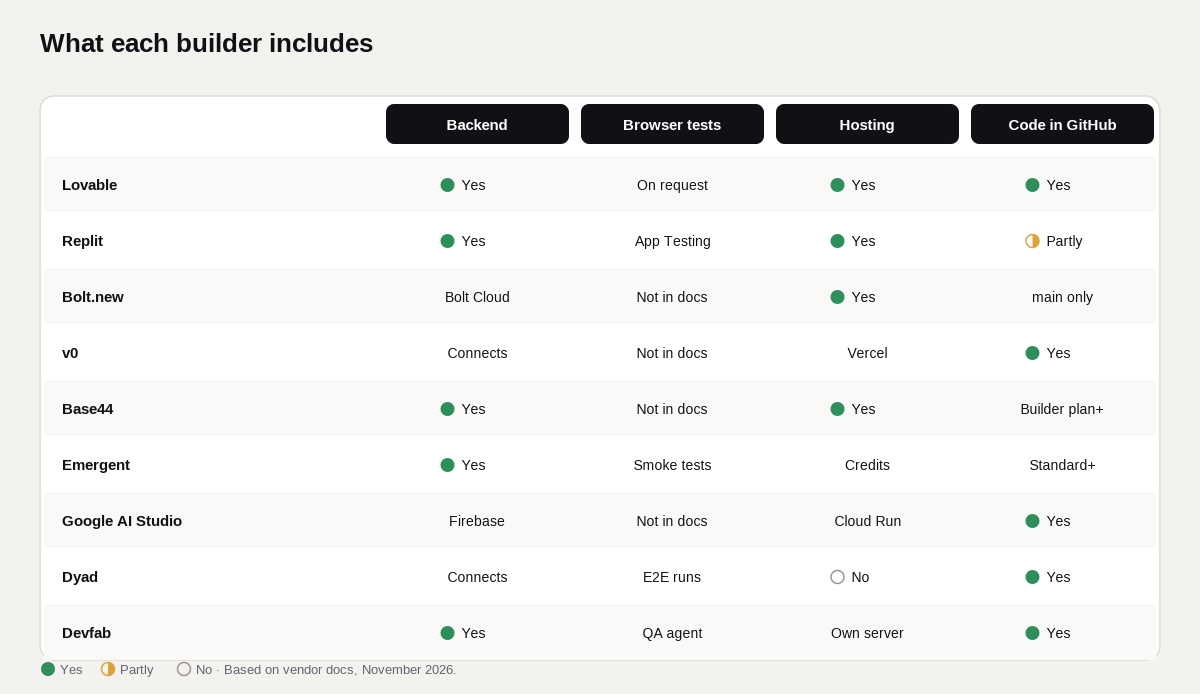
Quick comparison table
| Tool | Stack | Backend included | Testing | Hosting | Code export | Starting paid price (Nov 2026) |
|---|---|---|---|---|---|---|
| Lovable | TanStack Start (web only) | Managed PostgreSQL, login, storage | Browser tests on request; security scan on publish | Yes, custom domains on paid plans | GitHub, GitLab, Bitbucket sync; ZIP on paid plans | Pro USD 25 per month |
| Replit | Varies by app | Yes, with database rollback on Pro | App Testing in a real browser | Autoscale, Reserved VM, Static, Scheduled | Workspace code | Core USD 20 per month |
| Bolt.new | Web, plus mobile via Expo | Bolt Cloud databases, auth, storage, functions | Not covered in docs we checked | bolt.host subdomain or custom domain | GitHub, auto-commits on main | Pro USD 25 per month |
| v0 | Next.js, React, Tailwind, shadcn/ui | Server code and database connections | Not covered in docs we checked | Vercel | GitHub branches and PRs | Plus USD 30 per user per month |
| Base44 | Web, responsive | Managed backend, database, auth, email, payments | Not covered in docs we checked | Yes, custom domains | Two-way GitHub sync from Builder plan | Starter USD 16 per month, billed annually |
| Emergent | React/Next.js; React Native for mobile; FastAPI or Next.js APIs; MongoDB Atlas | Yes | Unit, integration and smoke tests during build | emergent.host, billed monthly in credits | Save to GitHub from Standard | Standard USD 20 per month |
| Google AI Studio | React, Next.js or Angular; Kotlin for Android | Firestore and Firebase Auth after approval | Not covered in docs we checked | Cloud Run | Two-way GitHub sync; ZIP | Pay per token (Gemini API) |
| Dyad | Next.js, runs on your computer | Supabase or Neon connection | Parallel E2E test runs; security scan | None (deploy to Vercel or your cloud) | Standard code, "zero lock-in" | Pro USD 20 per month; free with your own keys |
| Devfab | Picks the stack that fits, or you choose | Built as part of the app | QA agent: UI, flow and logic tests | Your own server | Code in your own GitHub account | Cost logged per task and per project (Beta) |
The builders, one by one
Lovable
Lovable is a browser-based builder that generates and hosts full-stack web apps from prompts. It has Build mode, Plan mode (a plan for approval first) and Chat mode. Apps created since May 13, 2026 use TanStack Start with server rendering, and the built-in backend includes managed PostgreSQL, login and file storage, or you can use Supabase (Lovable FAQ). A quick security scan runs on every publish. It holds SOC 2 Type II and ISO 27001:2022. Pricing is by credits, not seats: Free, Pro USD 25 per month and Business USD 50 per month, as of November 2026 (Lovable pricing).
Best for: non-developers and founders who want a polished web app with hosting in one place. Limits: web apps only; "Lovable does not offer a choice of framework or database"; you can't pick the model. Git sync always creates a new repository (Lovable GitHub). It is not HIPAA-compliant, and from September 9, 2026 Free and Pro data may be used for training unless you opt out.
Replit
Replit is a cloud development platform whose Agent builds, tests and publishes apps; the current version is Agent 4 (Replit Agent). Plan mode produces a task list to approve, and checkpoints let you roll back. App Testing has the agent click through your app in a real browser, for full-stack JavaScript and Streamlit apps (Replit App Testing). Deployments include Autoscale, Reserved VM, Static and Scheduled (Replit publishing). Enterprise adds SAML SSO, SCIM, private deployments and audit log streaming. Core is USD 20 per month and Pro USD 100 per month, as of November 2026 (Replit pricing).
Best for: teams that want building, testing and hosting in one browser workspace. Limits: paid agent work uses effort-based pricing, and Plan mode can incur charges even without changing code (Replit pricing docs).
Bolt.new
Bolt.new runs the whole development environment in the browser on StackBlitz WebContainers (Bolt intro). You can start from an idea, a Figma frame, a GitHub repo or even a Lovable project. Bolt Cloud adds hosting, databases, auth with Google sign-in, file storage, server functions and Stripe payments (Bolt Cloud). Native mobile apps come through Expo. It is SOC 2 Type II. Pro is USD 25 per month and Teams USD 30 per member per month, as of November 2026 (Bolt pricing).
Best for: builders who want web and mobile from one tool with a token-based budget. Limits: a Bolt project stays on main and cannot switch branches (Bolt Git); when hosting usage runs out, the site stops displaying publicly until usage resets.
v0
v0 is Vercel's agent for Next.js apps. It uses Next.js, React, TypeScript, Tailwind and shadcn/ui, and previews run server code, API routes and database connections as in production (v0 FAQ). Design Mode writes visual edits back to code (v0 Design Mode). It imports repos, works on branches with previews, and "never pushes directly to main" (v0 GitHub). Vercel says it doesn't own the code generated. Plus is USD 30 per user per month and Business USD 100 per user per month, as of November 2026 (v0 pricing).
Best for: product and design teams already on Vercel and Next.js. Limits: the full experience needs Vercel; the FAQ warns output "may be incomplete" and failing agents can use credits.
Base44
Base44 is a fully managed builder that generates the front end, backend and database and hosts the app. Wix acquired it in June 2025, and it runs as a standalone product (Base44 guide). Built-ins include auth with field-level access controls, file storage, email, Stripe payments and auto-generated API endpoints. Two-way GitHub sync starts on the Builder plan (Base44 GitHub docs), and you can pick the AI model from Builder up. Starter is USD 16 per month and Builder USD 40 per month, billed annually, as of November 2026 (Base44 pricing).
Best for: solo founders who want the most included in one bill. Limits: no GitHub sync on Free or Starter; SSO only on Enterprise. A competitor's comparison says the database and backend stay on Base44 when you export code (Lovable guide, Jul 2026).
Emergent
Emergent is a chat-driven platform where agents design, code, test and deploy web and mobile apps (Emergent). The typical stack is React or Next.js, React Native with Expo, Python FastAPI or Next.js APIs, and MongoDB Atlas. Agents run unit, integration and basic end-to-end smoke tests during the build, and there is a pre-publish health check (Emergent FAQ). It can submit mobile apps to the App Store and Google Play with your own developer accounts. Standard is USD 20 per month and Pro USD 200 per month, as of November 2026 (Emergent pricing).
Best for: SMBs and agencies that need web plus store-ready mobile apps. Limits: published apps use credits every month while live (Emergent deployment); no ZIP download; data is stored in the US and India, with no self-serve EU-only hosting.
Google AI Studio
Build mode in Google AI Studio creates full-stack web apps and native Android apps in Kotlin and Jetpack Compose (AI Studio Build mode). Since March 18, 2026 it runs on the Antigravity agent, with Firebase backends, multiplayer apps, secrets and Next.js support (Google blog). The agent provisions Firestore and Firebase Auth after your approval. Apps deploy to Cloud Run, and GitHub sync works with new or existing repos. Access is part of the Gemini API free tier; the paid tier bills per token (Gemini API pricing).
Best for: Google Cloud and Workspace shops, and anyone leaving Firebase Studio. Limits: no real-time co-editing, no team or SSO features in the Build mode docs, and apps can be removed for policy violations.
Dyad
Dyad is a free, open-source desktop app for macOS, Windows and Linux that builds web apps on your own computer (Dyad). It connects to Supabase or Neon for data and auth, runs a security scan and parallel end-to-end test runs, and deploys through GitHub to Vercel or your own cloud. It works with OpenAI, Anthropic, Google or local models, including fully offline. The core is Apache 2.0, with a fair-source src/pro folder (Dyad GitHub). Free with your own keys; Pro USD 20 per month; Max USD 79 per month, as of November 2026.
Best for: developers and privacy-minded builders who want no lock-in. Limits: no shared cloud workspace or team admin; it doesn't host apps; a September 2026 review says quality "depends heavily on which model you point it at" (tooldirectory.ai).
Devfab
Devfab is not a prompt-to-app builder in the same sense. It is an AI software factory: a team of agents (Researcher, Planner, Coordinator, Developers, Blueprint, QA agent and Deploy) that runs the whole lifecycle. Coding agents automate the developer. Devfab automates the development lifecycle.
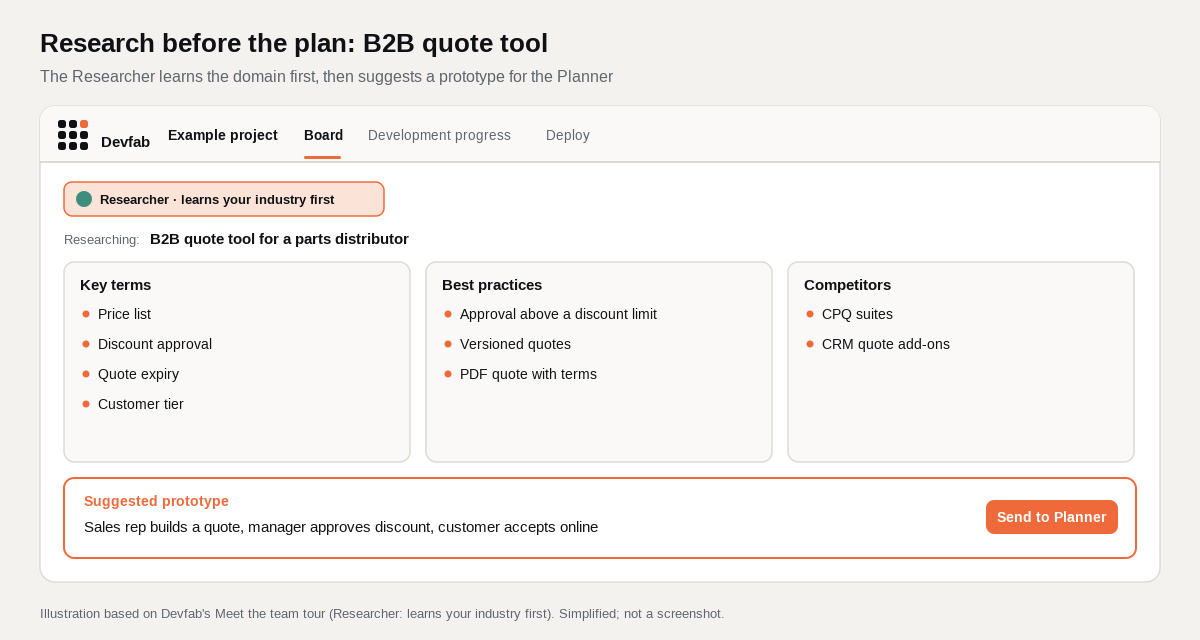
- Research before the plan. For a B2B quote tool, the Researcher maps price lists, discount approvals and quote expiry rules, and suggests a prototype, before the Planner writes a plan.
- A person approves the plan, and the Coordinator then splits it into tickets for dev agents.
- ChainFlow maps which functions and APIs call each other and what is deployed, so a change to quoting doesn't break invoicing or notifications.
- QA agent runs UI and flow tests (screens, buttons and user journeys clicked end to end) plus logic tests.
- Deploy to your own server, with the code in your own GitHub account. Cost is logged after each run, per task and per project.
Best for: agencies and companies that need an app they own, with a reviewable plan and tests. Limits: Devfab is in Beta, has a smaller community and fewer integrations than the builders above, is not an editor for hands-on coding, and needs a GitHub account. You deploy to your own server, so running it is your job.
How to choose
- First app, no developer: Lovable or Base44.
- One workspace that builds, tests and hosts: Replit.
- Web plus mobile: Bolt.new or Emergent; Android only, Google AI Studio.
- Next.js on Vercel with visual editing: v0.
- Local, open source, your own keys: Dyad.
- A team delivering an app it must own and maintain: Devfab.
Before you commit, try one real feature in two tools. Check three things: can you get the code into your own repo, where does the database live, and what happens to the live app if your plan's usage runs out. See Lovable vs Replit, Base44 vs Lovable and AI app builder vs AI coding agent for deeper comparisons.
FAQ
What is an AI full-stack app builder?
It is a tool that turns a plain-language description into a working app with a front end, a back end, a database and usually login and hosting. Examples include Lovable, Replit, Bolt.new and Base44. A front-end-only generator does not count, because the app has nowhere to store data.
Which AI full-stack app builder lets me export the code?
Most do, with limits. Lovable, v0, Bolt.new, Google AI Studio and Base44 (Builder plan and up) sync with GitHub; Dyad runs on your machine and exports standard Next.js code. A competitor's comparison says Base44's database and backend stay on its servers when you export.
Is Firebase Studio still an option?
Not for new projects. Google announced on March 19, 2026 that Firebase Studio is sunsetting; new workspaces and sign-ups were disabled on June 22, 2026, and it shuts down on March 22, 2027. Google points users to Google AI Studio or Google Antigravity.
Which AI app builder is best for a mobile app?
Bolt.new builds native mobile apps through Expo, Emergent builds React Native apps and submits them to the app stores with your own developer accounts, and Google AI Studio builds native Android apps in Kotlin. Lovable is web only.
Can an AI app builder take an app to production?
Several host apps for real users with custom domains, and some add security scans or browser tests. What usually needs extra work is planning, testing user journeys, reviewing changes against the rest of the app, and running it on infrastructure your company controls.
Read next
Need the app planned, tested and running on your own server? Try Beta
Sources (checked November 2026): Lovable pricing; Lovable FAQ; Lovable GitHub integration; Replit pricing; Replit pricing and plans docs; Replit Agent; Replit App Testing; Replit publishing; Bolt pricing; Bolt intro; Bolt Cloud; Bolt Git integration; v0 pricing; v0 FAQ; v0 Design Mode; v0 GitHub; Base44 pricing; What is Base44; Base44 GitHub docs; Lovable: Base44 vs Lovable (competitor, Jul 2026); Emergent; Emergent pricing; Emergent FAQ; Emergent deployment; Google AI Studio Build mode; Google blog: full-stack vibe coding in AI Studio (Mar 2026); Gemini API pricing; Firebase Studio: migrating your project; Dyad; Dyad on GitHub; tooldirectory.ai: Dyad review (Sep 2026).
Frequently asked questions
What is an AI full-stack app builder?
It is a tool that turns a plain-language description into a working app with a front end, a back end, a database and usually login and hosting. Examples include Lovable, Replit, Bolt.new and Base44. A front-end-only generator does not count, because the app has nowhere to store data.
Which AI full-stack app builder lets me export the code?
Most do, with limits. Lovable, v0, Bolt.new, Google AI Studio and Base44 (Builder plan and up) sync with GitHub; Dyad runs on your machine and exports standard Next.js code. A competitor's comparison says Base44's database and backend stay on its servers when you export.
Is Firebase Studio still an option?
Not for new projects. Google announced on March 19, 2026 that Firebase Studio is sunsetting; new workspaces and sign-ups were disabled on June 22, 2026, and it shuts down on March 22, 2027. Google points users to Google AI Studio or Google Antigravity.
Which AI app builder is best for a mobile app?
Bolt.new builds native mobile apps through Expo, Emergent builds React Native apps and submits them to the app stores with your own developer accounts, and Google AI Studio builds native Android apps in Kotlin. Lovable is web only.
Can an AI app builder take an app to production?
Several host apps for real users with custom domains, and some add security scans or browser tests. What usually needs extra work is planning, testing user journeys, reviewing changes against the rest of the app, and running it on infrastructure your company controls.