Short answer: Airtable wins when your own team works inside the data every day and wants Omni, its AI assistant, to build bases, interfaces and automations. Softr wins when people outside the team, such as parents, clients or vendors, need to log in and see only their own records, with user groups and permissions set without code.
Your school office tracks enrollment in a shared base, and parents keep calling to ask for status. You want a portal where each family sees its own forms. Some people say stay in Airtable and build an interface. Others say put Softr on top, because that is what portals are for. Both vendors changed in the past few months. This page compares them as they stand in November 2026.
In this comparison:
- Airtable and Softr at a glance
- Feature comparison
- Cost model by team size
- Where Airtable wins
- Where Softr wins
You can also use both together, so we cover that too.
Airtable and Softr at a glance
Airtable has a new owner. Bending Spoons' acquisition closed in early September 2026. On October 12, 2026, Airtable announced layoffs of much of the pre-acquisition team and said plans and pricing were unchanged (Airtable newsroom; Airtable community). The October 21 Fall Release brought Omni 2.0 to all plans, Airtable Canvas in open beta, a bigger MCP and agent audit logs (Fall Release).
Airtable is a no-code database and app platform. Omni builds tables, fields, records, automations, dashboards and interface pages from plain-language prompts (Airtable support).
Softr relaunched on November 9, 2026. The "new Softr" has AI build the whole app from a description: database, roles, permissions, workflows, integrations and a custom frontend. "We vibe code your frontend. We don't vibe code your backend." Existing apps keep working, and no pricing changes were described (Softr blog). Softr is a no-code builder for client portals and internal apps on Softr Databases or existing data such as Airtable (Softr).
Feature comparison
| Aspect | Airtable | Softr | Source |
|---|---|---|---|
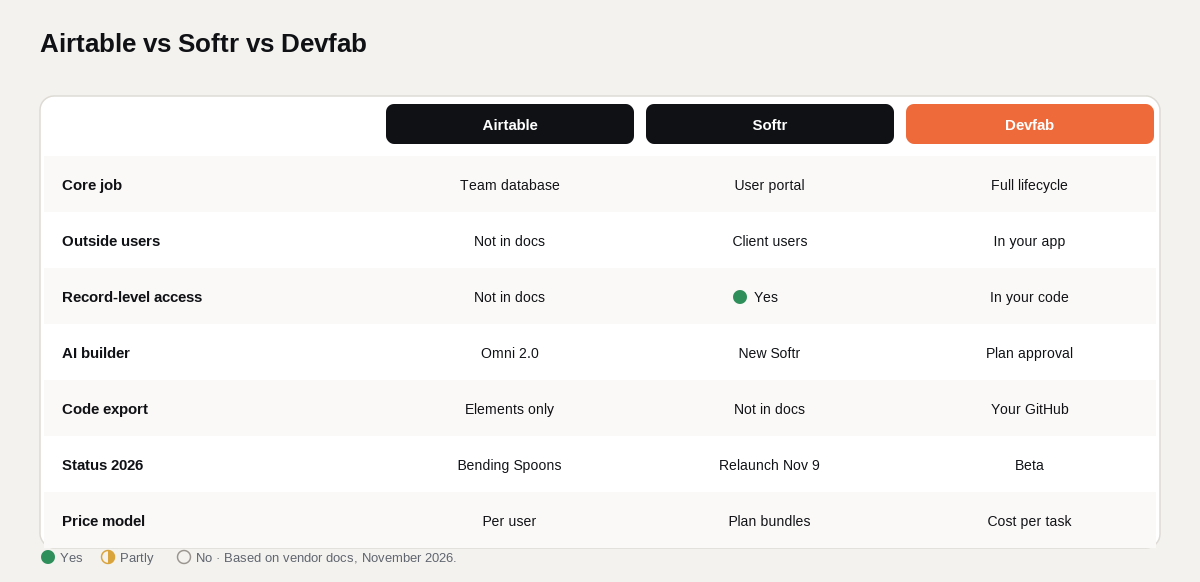
| Core job | Database and apps for your team | Portals and internal apps for logged-in users | Airtable; Softr |
| AI building | Omni builds bases, interfaces, automations; Omni 2.0 builds data models from spreadsheets, PDFs and images | AI generates pages, database, permissions, workflows and a custom frontend | Fall Release; Softr AI |
| Safeguards | Omni confirms before deletions; you publish interfaces and turn on automations | AI agents can wait for human approval before acting | Airtable support; Softr |
| Permissions | Omni respects user permissions; agent permissions "coming soon" | User groups, record-level restrictions, preview as any user | Fall Release; Softr |
| Data sources | Airtable bases | Softr Databases plus 21+ sources, including Airtable | Softr |
| Custom code | AI-generated custom elements, editable or downloadable; Interface Extensions SDK on paid plans | Vibe-coding block for custom logic and design | Airtable community; Softr AI |
| Outside AI agents | Airtable MCP for Claude, ChatGPT, Gemini and Cursor | Softr MCP on every plan, no AI credits used | Fall Release; Softr MCP |
| Admin and compliance | Org-wide MCP controls; agent audit logs on Enterprise | SOC 2 Type II, GDPR, EU or US hosting; SSO and SCIM on Enterprise | Fall Release; Softr |
| Pricing model | Per billable collaborator, plus pooled AI credits | Workspace plans with set builders and app users, plus AI credits | Airtable plans; Softr docs |
Cost model by team size
| Team size | Airtable | Softr | Devfab |
|---|---|---|---|
| 1 person | Free (capped records, automation runs and collaborators) | Free plan; paid plans add a custom domain (see pricing page) | Cost logged per task and per project (Beta) |
| 5 people | Team USD 20 per user per month, or Business USD 45 per user per month | Basic, Pro or Business, by builders and app users needed | Cost logged per task and per project (Beta) |
| 25 people | Business per user, or Enterprise Scale (custom) | Business or custom Enterprise, with add-on users and builders | Cost logged per task and per project (Beta) |
Airtable prices as of November 2026 from Airtable pricing, billed annually. Softr plan prices did not load in our capture of Softr pricing, so we describe the model from Softr docs. The key difference: Airtable bills each collaborator, while Softr plans include a set number of app users split into team and client users. Devfab is in Beta and offers predictable cost: cost is logged after each run, per task and per project.
Where Airtable wins
- Your team lives in the data. Grid views, records and automations are the daily workspace.
- You want AI to model the data. Omni 2.0 builds data models from spreadsheets, PDFs and images, and building with Omni doesn't consume AI credits.
- You need custom interface elements. AI-generated elements with editable source code, plus an SDK for IDE builds.
- You want live dashboards or presentations on base data. Airtable Canvas (open beta) builds them and asks before adding tables or fields.
Airtable limits to know: Omni can't create new views, set up syncs or export data. Custom elements aren't viewable on mobile, and Canvas is unavailable for HIPAA-compliant or non-US-data organizations (Airtable support; Fall Release).
Where Softr wins
- Outside users need to log in. Client portals are Softr's most common starting point.
- Each user should see only their own records. Record-level restrictions and user groups, with preview as any user.
- Your data is spread out. Airtable, Google Sheets, Notion, Xano, REST API and, on higher tiers, Salesforce and SQL.
- You need EU hosting or SCIM for the portal.
- Seat costs worry you. App users come in plan bundles instead of per-collaborator billing.
Switching from one to the other
Adding Softr to Airtable. You often don't switch at all. Connect your Airtable base as a Softr data source, describe the portal, and set user groups. Keep staff working in Airtable.
Moving off Airtable into Softr. Import the data into Softr Databases, rebuild automations as Softr workflows, and retire the base once records match. Note that Omni can't export data, so use Airtable's standard export instead.
Where Devfab fits
Airtable and Softr both keep your app on their platforms, and both now let AI build most of it. When an enrollment portal grows its own rules, such as sibling priority, waitlists and fee waivers, teams start to want a real codebase with tests.
App builders automate the first version. Devfab automates the development lifecycle. The Researcher learns enrollment terms and practices and looks at competing products before the Planner writes a plan, and a person approves it. ChainFlow maps which functions and APIs call each other, so changing the waitlist rule shows what it affects in notifications and reports. Code lives in your own GitHub account and deploys to your own server. Devfab is in Beta, has a smaller community, and is not a spreadsheet-style editor. See Devfab vs Airtable and Devfab vs Softr.
FAQ
Who owns Airtable now?
Bending Spoons. Its acquisition of Airtable closed in early September 2026. On October 12, 2026, Airtable announced layoffs of much of the pre-acquisition team and said plans and pricing were unchanged. The Fall Release with Omni 2.0 and Airtable Canvas followed on October 21.
Can I use Softr on top of Airtable?
Yes. Softr lists Airtable as a data source on every plan, along with Google Sheets, Notion and others. You can keep the data in Airtable and use Softr for the portal. Softr's competitor Jet Admin notes that very large Airtable bases can slow Softr apps.
Which is better for a client portal?
Softr. It calls client portals its most common starting point and offers user groups, record-level data restrictions and preview-as-any-user. Airtable bills per collaborator, and portals for outside users are not covered in the Airtable pages we checked.
Do Airtable and Softr charge for AI?
Both include monthly AI credits. Airtable says building apps, agents and bases with Omni does not consume credits, but Q&A does. Softr includes monthly AI credits that do not roll over, and its MCP server does not use Softr AI credits.
Read next
When the portal's rules outgrow the base, own the code. Try Beta
Sources (checked November 2026): Airtable newsroom: Back to bases (Oct 12, 2026); Airtable community: An update on Airtable's team (Oct 12, 2026); Airtable Fall Release (Oct 21, 2026); Airtable: AI-generated custom elements out of beta; Using Omni AI in Airtable; Airtable AI billing; Airtable plans overview; Airtable pricing; The AI-Native Airtable (Jun 24, 2025); Softr homepage; Softr AI App Builder; Softr MCP; Softr pricing; Softr docs: Pricing and plans; Softr blog: Beyond building blocks (Nov 9, 2026); Jet Admin: Softr review (Sep 30, 2026).
Frequently asked questions
Who owns Airtable now?
Bending Spoons. Its acquisition of Airtable closed in early September 2026. On October 12, 2026, Airtable announced layoffs of much of the pre-acquisition team and said plans and pricing were unchanged. The Fall Release with Omni 2.0 and Airtable Canvas followed on October 21.
Can I use Softr on top of Airtable?
Yes. Softr lists Airtable as a data source on every plan, along with Google Sheets, Notion and others. You can keep the data in Airtable and use Softr for the portal. Softr's competitor Jet Admin notes that very large Airtable bases can slow Softr apps.
Which is better for a client portal?
Softr. It calls client portals its most common starting point and offers user groups, record-level data restrictions and preview-as-any-user. Airtable bills per collaborator, and portals for outside users are not covered in the Airtable pages we checked.
Do Airtable and Softr charge for AI?
Both include monthly AI credits. Airtable says building apps, agents and bases with Omni does not consume credits, but Q&A does. Softr includes monthly AI credits that do not roll over, and its MCP server does not use Softr AI credits.