Short answer: Softr wins when you need a client portal or internal app on Airtable, Google Sheets or Softr Databases, with record-level permissions and separate Team and Client users. Glide wins when your operations run on Excel or Google Sheets and you want an agent to read those sheets, formulas included, and build the app for you.
You run operations, not engineering. Your data lives in spreadsheets, and you need an app your team or clients can use. Softr and Glide both promise that without code. Most comparisons online still describe the old Glide. In 2026 Glide rebuilt itself around an AI agent, and the choice changed. Here is the fair referee's view.
In this comparison:
- Softr and Glide at a glance
- Feature comparison
- Cost model by team size
- Where Softr wins and where Glide wins
- Switching from one to the other
Each claim links to the page it came from.
Softr and Glide at a glance
Changes in 2026
- Glide announced "an entirely new version of our product, built from the ground up for the AI age" on March 5, 2026. Staff said on June 4, 2026, "we're now live with the new platform," and the GlideOS launch event followed on August 3. The previous product continues as Glide Classic, with no stated sunset date.
- Softr added Softr MCP, so Claude, ChatGPT, Cursor and Codex can build and manage Softr apps.
Softr
Softr builds client portals and internal business apps on top of Softr Databases or data you already have. From a prompt, "Softr generates the pages, database, permissions and workflows," and you can refine visually or with AI. Airtable, Google Sheets, Notion, Coda, SmartSuite, Xano, Zoho CRM and REST APIs work on every plan; HubSpot, Salesforce, Snowflake, BigQuery and SQL come on higher tiers. Workflows run from buttons, forms, schedules or record changes, and AI agents can wait for human approval. Softr lists SOC 2 Type II, GDPR, and EU or US hosting.
Glide
GlideOS turns the spreadsheets a business runs on into internal apps, workflows and AI agents. SheetSense scans uploaded spreadsheets for formulas, macros, pivot tables and charts, then asks you to confirm before building. Glide's second-generation agent builds the app and can then operate it, query data and run code. Unlike Classic, GlideOS gives agents direct access to full-stack application code. Glide targets back-office teams in supply chain, manufacturing, retail, real estate, hospitality and professional services. Apps run on desktop and phone and are private to the company by default.
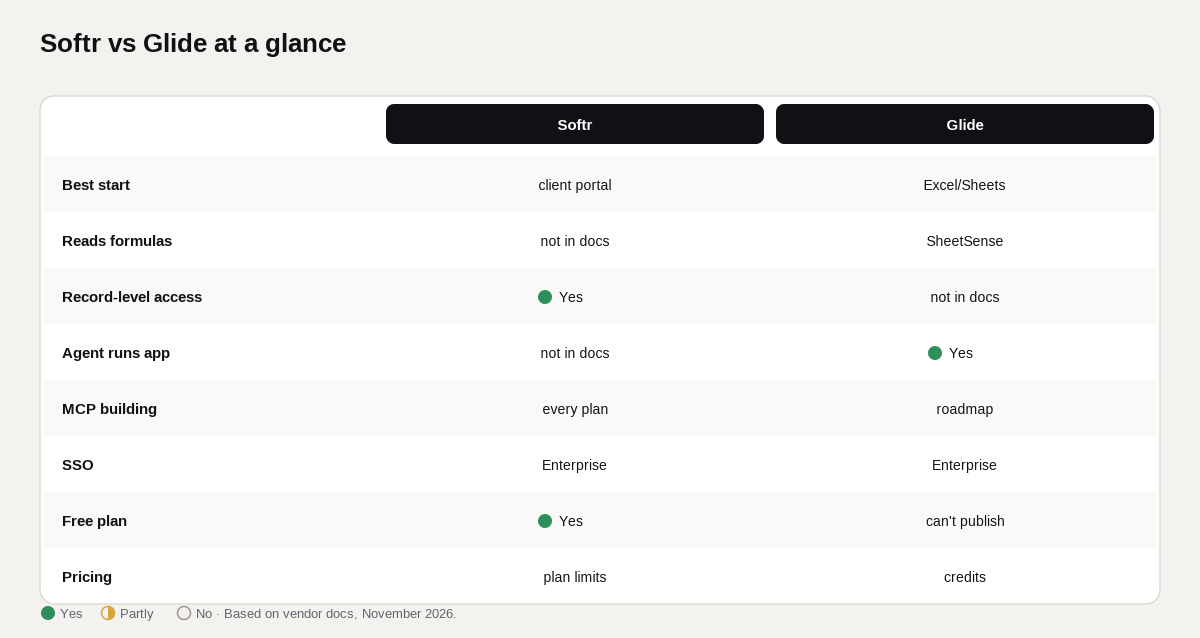
Feature comparison
| Aspect | Softr | Glide | Source |
|---|---|---|---|
| Where it runs | Hosted web apps from a browser editor | Hosted apps for desktop and phone | Softr; Glide |
| How it builds | Prompt generates pages, database, permissions, workflows; refine visually | SheetSense reads your spreadsheet; agent builds, then operates the app | Softr AI builder; GlideOS recap |
| Data | Softr Databases plus 21+ external sources | Excel, Google Sheets, Airtable, Notion, Snowflake; about 150 integrations shown | Softr; Glide |
| Permissions | User groups per page, block and button; record-level restrictions; preview as any user | Apps private to the company by default | Softr; Glide |
| Agents | Workflow agents can wait for human approval | Ask Glide answers and acts on live data; Glide Agents "coming soon" | Softr; Glide |
| Outside AI tools | Softr MCP on every plan, no AI credits used | MCP named on homepage; Build with MCP was a Q3 roadmap item at launch | Softr MCP; GlideOS recap |
| Team / admin | SAML/OpenID SSO and SCIM on Enterprise | AI spend budgets by team and model; SSO on Enterprise | Softr; Glide pricing |
| Model choice | Not covered in the docs we checked | Approved models only; Enterprise can choose its LLM provider | Glide |
| Pricing model | Workspace plans with set builders and app users; workflow and AI credit limits | Credits that meter LLM tokens; Pro scales by seat | Softr plans; Glide pricing |
Cost model by team size
| Team size | Softr | Glide |
|---|---|---|
| 1 person | Free plan; 7-day trial of paid plans | Free plan, but it cannot publish apps |
| 5 people | Basic or Pro: set builders and app users (Team and Client), custom domain, monthly workflow and AI credit limits | Basic or Plus: caps on team members, published apps and enabled workflows; extra credits on paid plans |
| 25 people | Business, with paid add-on users and builders; Enterprise for SSO and SCIM | Pro scales by seat with credits per member; Enterprise for SSO and LLM provider choice |
Check Softr's plans page and Glide's pricing page for amounts as of November 2026. Softr's AI credits do not roll over, and it offers 50% off for nonprofits and education. On Glide, a community thread (June 2026) reports that agent mistakes still consume credits. For reference, Devfab (Beta) logs cost after each run, per task and per project.
Where Softr wins
- Client portals. Softr calls them its most common starting point, with Team and Client users on each plan.
- Fine-grained access. Record-level data restrictions and per-button visibility, without code.
- Airtable-first teams. Airtable, Sheets and Notion work on every plan.
- Building from outside AI tools today. Softr MCP is live on every plan and doesn't spend AI credits.
Softr's limits, per Jet Admin (a competitor, September 2026): no native App Store or Google Play publishing, design flexibility below Webflow-class tools, and very large Airtable bases can slow apps.
Where Glide wins
- Your business runs in Excel. SheetSense reads formulas, macros and pivot tables before building.
- You want the AI to run the app too. Glide's agent can operate the app and query data after building it.
- Ready-made systems. An App Store of multi-app templates, free to copy.
- AI spend controls. Budgets by team and model, approved models only.
Switching from one to the other
Both tools read Google Sheets and Airtable, which makes switching easier than with most builders. Keep your data in one of those sources, connect the other tool to it, and rebuild the screens. If your Softr app uses Softr Databases, or your Glide app was built from an uploaded Excel file, move that data into a shared Google Sheet or Airtable base first.
A direct app export between the two was not covered in the docs we checked.
Where Devfab fits
Softr and Glide are the right call when non-engineers will build and maintain the app themselves. Some portals grow past that: custom business rules, payments, integrations, or a client who wants the code and the server.
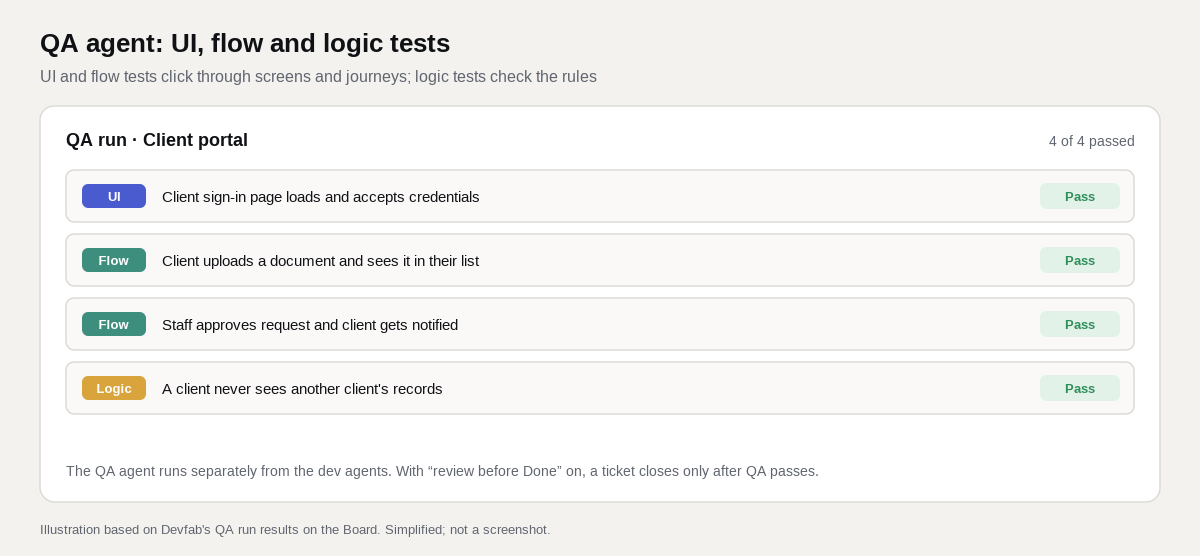
App builders automate the first version. Devfab automates the development lifecycle. Devfab's Researcher maps the domain first: key terms, best practices and competitors. A person approves the plan. The QA agent runs UI and flow tests (screens, buttons and user journeys clicked end to end) plus logic tests. Code goes to your own GitHub account (or your organization's), and Deploy ships to your own server.
Devfab's honest limits: it is new and in Beta, with a smaller community and fewer integrations. It is not a spreadsheet-first builder or an editor for hands-on coding, and it needs a GitHub account. For a portal on an Airtable base that ops will maintain, Softr or Glide is simpler. See Devfab vs Softr and Devfab vs Glide.
FAQ
Is Glide still a no-code app builder?
Glide relaunched in 2026 as GlideOS, an AI app builder whose agent builds apps from your spreadsheets and can then operate them. The beta was announced in March 2026, the new platform went live in June, and the launch event was on August 3, 2026. The previous product continues as Glide Classic, with no stated sunset date.
Which is better for a client portal?
Softr. Softr says client portals are its most common starting point. It splits app users into Team and Client users, controls which pages and buttons each user group sees, and restricts data down to the record.
Can I build Softr or Glide apps with Claude or ChatGPT?
Softr MCP lets Claude, ChatGPT, Cursor and Codex create databases, pages, workflows and user groups; it is on every plan, including Free, and does not use Softr AI credits. Glide's homepage says you can connect Claude, Gemini or ChatGPT over MCP, though at the August 2026 launch Build with MCP was still a roadmap item.
Which has more predictable pricing?
Softr's plans meter users, builders, workflow runs and AI credits, but most limits are fixed per plan. Glide is credit-based, with credits metering LLM token usage. A Glide community thread from June 2026 reports credit costs are hard to predict, and Glide staff called credit transparency one of the biggest pieces of feedback.
Read next
- What is an AI software factory?
- Softr alternatives
- Glide alternatives
- Devfab vs Softr
- No-code vs AI app builders
Portal outgrowing the spreadsheet? Try Devfab Beta
Sources (checked November 13, 2026): Softr homepage; Softr AI App Builder; Softr MCP; Softr pricing and plans (docs); Jet Admin: Softr review (competitor, Sep 30, 2026); Glide homepage; Glide pricing; GlideOS launch recap (Aug 4, 2026); Glide Classic; Introducing a new Glide (Mar 5, 2026); Pricing issues with GlideOS (community, Jun 2026).
Frequently asked questions
Is Glide still a no-code app builder?
Glide relaunched in 2026 as GlideOS, an AI app builder whose agent builds apps from your spreadsheets and can then operate them. The beta was announced in March 2026, the new platform went live in June, and the launch event was on August 3, 2026. The previous product continues as Glide Classic, with no stated sunset date.
Which is better for a client portal?
Softr. Softr says client portals are its most common starting point. It splits app users into Team and Client users, controls which pages and buttons each user group sees, and restricts data down to the record.
Can I build Softr or Glide apps with Claude or ChatGPT?
Softr MCP lets Claude, ChatGPT, Cursor and Codex create databases, pages, workflows and user groups; it is on every plan, including Free, and does not use Softr AI credits. Glide's homepage says you can connect Claude, Gemini or ChatGPT over MCP, though at the August 2026 launch Build with MCP was still a roadmap item.
Which has more predictable pricing?
Softr's plans meter users, builders, workflow runs and AI credits, but most limits are fixed per plan. Glide is credit-based, with credits metering LLM token usage. A Glide community thread from June 2026 reports credit costs are hard to predict, and Glide staff called credit transparency one of the biggest pieces of feedback.