Short answer: Claude Code wins when you want deep customization, scheduled cloud tasks and inference that can run in your own cloud account through Bedrock, Google Cloud or Foundry. OpenAI Codex wins when your team already pays for ChatGPT, wants an open-source CLI, and needs a coding agent on every plan from Free to Enterprise.
Developers argue about which agent writes better code. That argument rarely settles anything, because both tools change every month. Two steadier questions usually decide it. Which subscription does your team already pay for? And where must inference run? Codex also moved house in 2026: its desktop app is now part of the ChatGPT desktop app. This page referees both questions with sourced facts.
In this comparison:
- Claude Code and OpenAI Codex at a glance
- Feature comparison
- Cost model by team size
- Where Claude Code wins
- Where OpenAI Codex wins
The answers follow in that order.
Claude Code and OpenAI Codex at a glance
Claude Code is Anthropic's agentic coding tool. It reads your codebase, edits files, runs commands and opens pull requests, in the terminal, IDEs, a desktop app, the web and mobile (Claude Code docs). In 2026, "routines" were renamed cloud scheduled tasks, and Remote Control, Dispatch and claude --teleport let you move sessions between devices (same source). It is built for developers and engineering organizations.
OpenAI Codex: now inside the ChatGPT desktop app. On July 9, 2026, OpenAI folded the Codex desktop app into a broader ChatGPT desktop app alongside Chat and Work; Codex "remains focused on software development" with inline diff editing, PR review and multi-repo projects (The New Stack). Codex docs now live under ChatGPT docs (ChatGPT + Codex docs), and OpenAI's cloud environment page is now labeled "Codex Cloud (Legacy)" (OpenAI). Codex serves engineering teams and individual builders (OpenAI Codex).
Feature comparison
| Aspect | Claude Code | OpenAI Codex | Source |
|---|---|---|---|
| Where it runs | Terminal, VS Code and Cursor extension, JetBrains plugin, desktop app, web, iOS and Android | ChatGPT desktop, web and mobile, Codex CLI, IDE extension, cloud environments, GitHub integration and Action, Slack | Claude Code overview; Codex docs |
| Planning | Plan mode explores the codebase and proposes an approach for approval | Agent approvals and permissions documented; a separate plan mode not covered in the pages we checked | Claude Code costs; Codex docs |
| Agent autonomy | Subagents, a lead agent for parallel agents, background agents; cloud scheduled tasks run when your computer is off | Parallel agents; cloud tasks keep running after you close your laptop; scheduled tasks documented | Claude Code overview; OpenAI Codex |
| Testing and review | Code Review runs several agents per GitHub PR and verifies findings; it reads code without running it | Checks its own work with computer and browser tools; automatic PR review | Code Review; OpenAI Codex |
| Deploy and hosting | Not covered in the docs we checked | Not covered in the docs we checked | — |
| Open source | Not covered in the docs we checked | Codex CLI is public under Apache-2.0 | openai/codex |
| Team and admin | Team: admin tools, SSO; Enterprise: role-based permissions, compliance API; managed permissions | Business: SAML SSO, MFA; Enterprise: SCIM, EKM, RBAC, audit logs, retention and residency | Enterprise deployment; Codex pricing |
| Model choice | Claude models only; inference via Anthropic, Bedrock, Google Cloud or Foundry | OpenAI GPT models only; or your own API key | Claude Code costs; Codex pricing |
| Pricing model | In paid Claude plans; five-hour rolling and weekly limits; usage credits at API rates | In all ChatGPT plans; limits vary by model and task; credits after limits | Claude pricing; Codex pricing |
Cost model by team size
| Team size | Claude Code | OpenAI Codex | Devfab |
|---|---|---|---|
| 1 person | Pro USD 20/month (USD 17 billed annually); Max USD 100/month | Free; Go USD 8; Plus USD 20; Pro from USD 100 per month | Cost logged per task and per project (Beta) |
| 5 people | Team Standard seat USD 25/month (USD 20 annually); Premium seat USD 125 (USD 100 annually) | Business USD 25 per user/month (USD 20 annually, 2-user minimum) | Cost logged per task and per project (Beta) |
| 25 people | Team, or Enterprise USD 20 per seat/month billed annually (20-seat minimum) plus usage at API rates | Business, or Enterprise through sales with flexible, credit-based pricing | Cost logged per task and per project (Beta) |
Prices as of November 2026 from Claude pricing and ChatGPT + Codex pricing. OpenAI says its per-plan usage estimates "are not fixed message limits." Devfab is in Beta and offers predictable cost: cost is logged after each run, per task and per project.
Where Claude Code wins
- Inference must stay in your cloud account. Claude Code supports Amazon Bedrock, Claude Platform on AWS, Google Cloud and Microsoft Foundry, plus LLM gateways and proxies.
- You want to shape the agent. CLAUDE.md, auto memory, skills, hooks and MCP servers, with managed permissions that local config cannot override.
- Work should trigger itself. Cloud scheduled tasks run when your computer is off and can fire on API calls or GitHub events.
- You want fewer false alarms in review. Code Review verifies findings before posting severity-ranked comments.
- Finance wants visibility. Org spend limits, an analytics dashboard, OpenTelemetry export and per-user reporting.
Where OpenAI Codex wins
- Your team already pays for ChatGPT. Codex is included in every plan, from Free and Go to Business and Enterprise.
- You want an open-source CLI you can inspect and run with your own API key.
- The agent should check its own work with computer and browser tools before you review.
- Coding sits next to everything else. Codex shares the ChatGPT desktop app with Chat and Work.
- Heavy individual users. OpenAI says the Pro plan currently has no five-hour limit.
Switching from one to the other
From Claude Code to Codex. Codex reads AGENTS.md (Codex docs), and Claude Code reads CLAUDE.md or AGENTS.md (Claude Code docs), so keep shared instructions in AGENTS.md. Both support MCP servers. Sign in with a ChatGPT plan rather than an API key if you need GitHub code review or Slack, which are unavailable with an API key.
From Codex to Claude Code. Your AGENTS.md carries over. Add a CLAUDE.md only for instructions specific to Claude. Replace the Codex GitHub Action with Claude Code's GitHub Actions integration. Managed Code Review needs a Team or Enterprise plan and works on GitHub only.
Where Devfab fits
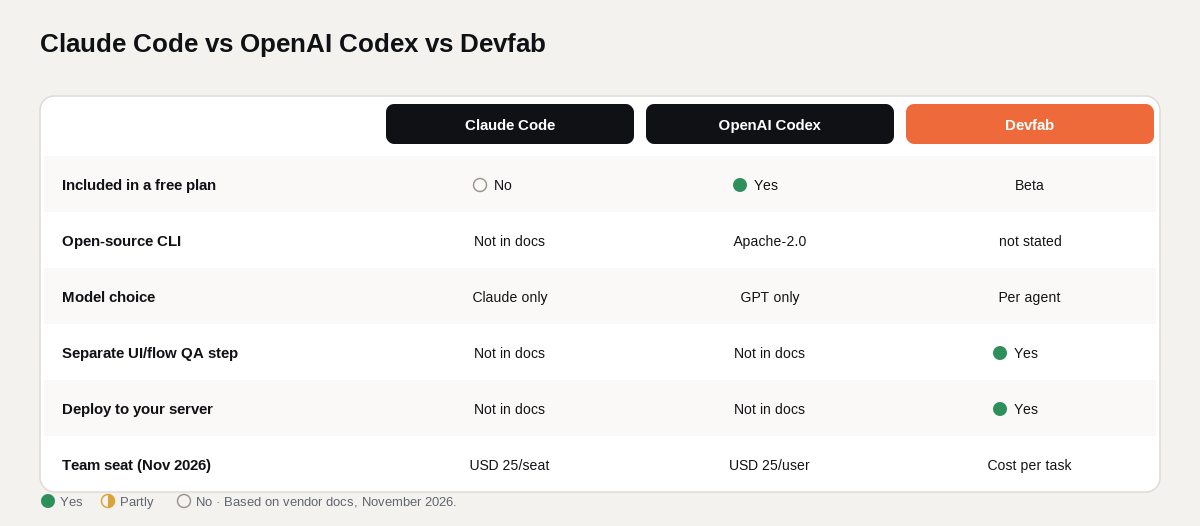
Both tools are strong coding agents for a developer who directs the work. In the docs we checked, neither researches the domain before planning, asks a person to approve a project plan, runs a separate QA step on screens and user journeys, or deploys the app to your server.
Coding agents automate the developer. Devfab automates the development lifecycle. Devfab's Researcher maps terms, best practices and competitors first; the Planner's plan goes to a person for approval; dev agents work with ChainFlow so they see what a change affects; the QA agent runs UI, flow and logic tests; and Deploy ships to your own server. You can choose the model for each agent or keep Devfab's default. Devfab is in Beta, with fewer integrations, and it is not a terminal or editor tool. See Devfab vs Claude Code.
FAQ
Is OpenAI Codex free?
Codex is included in every ChatGPT plan, including Free and Go, with usage limits that vary by model, task size and whether work runs locally or in the cloud. Claude Code is not included in Claude's Free plan; it needs Pro, Max, Team or Enterprise.
What happened to the Codex desktop app?
On July 9, 2026, OpenAI folded the Codex desktop app into a combined ChatGPT desktop app alongside Chat and Work. Codex is still the coding product, with inline diff editing, pull request review and multi-repo projects, and its docs moved to learn.chatgpt.com.
Can I run either agent with my own API key?
Yes. Claude Code can use Anthropic's API pay-as-you-go or run inference through Amazon Bedrock, Google Cloud or Microsoft Foundry. Codex can use an OpenAI API key billed at API rates, but cloud features such as GitHub code review and the Slack integration are then not available.
Which one is better for a regulated company?
Both offer enterprise controls: Claude Code has SSO, role-based permissions, a compliance API and managed settings; Codex Enterprise has SCIM, EKM, role-based access, audit logs and data residency controls. The deciding question is often where inference must run, and Claude Code can run it inside your own cloud account.
Read next
- What is an AI software factory?
- Claude Code alternatives
- Cursor vs OpenAI Codex: which should your team use in 2026?
- Cloud coding agents vs local coding agents: pros and cons
Want a plan your client approves and a QA report before deploy? Try Beta
Sources (checked November 13, 2026): Claude Code docs: Overview; Claude Code docs: Enterprise deployment; Claude Code docs: Code Review; Claude Code docs: Manage costs; Claude pricing; OpenAI Codex; ChatGPT + Codex docs; ChatGPT + Codex docs: Pricing; ChatGPT + Codex docs: Cloud environment; GitHub: openai/codex; The New Stack: Codex joins ChatGPT desktop app (Jul 9, 2026).
Frequently asked questions
Is OpenAI Codex free?
Codex is included in every ChatGPT plan, including Free and Go, with usage limits that vary by model, task size and whether work runs locally or in the cloud. Claude Code is not included in Claude's Free plan; it needs Pro, Max, Team or Enterprise.
What happened to the Codex desktop app?
On July 9, 2026, OpenAI folded the Codex desktop app into a combined ChatGPT desktop app alongside Chat and Work. Codex is still the coding product, with inline diff editing, pull request review and multi-repo projects, and its docs moved to learn.chatgpt.com.
Can I run either agent with my own API key?
Yes. Claude Code can use Anthropic's API pay-as-you-go or run inference through Amazon Bedrock, Google Cloud or Microsoft Foundry. Codex can use an OpenAI API key billed at API rates, but cloud features such as GitHub code review and the Slack integration are then not available.
Which one is better for a regulated company?
Both offer enterprise controls: Claude Code has SSO, role-based permissions, a compliance API and managed settings; Codex Enterprise has SCIM, EKM, role-based access, audit logs and data residency controls. The deciding question is often where inference must run, and Claude Code can run it inside your own cloud account.