Short answer: GitHub Copilot wins when your team works on GitHub and wants completions, a cloud agent, PR review and admin controls in one per-seat plan, with models from several vendors. OpenAI Codex wins when your team already pays for ChatGPT, wants an open-source CLI, and wants an agent that checks its own work with browser tools.
Your engineers have Copilot. Your whole company has ChatGPT. Now someone asks why you pay for both. Copilot fans point to GitHub integration; Codex fans point to the agent that already comes with ChatGPT. The twist: Codex can run inside Copilot on some plans. So the real choice is about which seat, which surface and which bill. This page referees it with facts and verified prices.
In this comparison:
- GitHub Copilot and OpenAI Codex at a glance
- Feature comparison
- Cost model by team size
- Where GitHub Copilot wins
- Where OpenAI Codex wins
Each section ends with a clear pick.
GitHub Copilot and OpenAI Codex at a glance
GitHub Copilot: new cloud experience, credit billing. Copilot is AI built into GitHub.com, IDEs, the terminal and a desktop app, with a cloud agent that takes assigned work and opens pull requests (GitHub Docs). A new "Copilot in the cloud" experience reached paid plans on October 28, 2026; Free users stay on the older Copilot Chat experience (GitHub Docs). Plans are now described in GitHub AI Credits, with a new Max tier above Pro+ (GitHub Docs).
OpenAI Codex: now part of the ChatGPT desktop app. On July 9, 2026, OpenAI folded the Codex desktop app into a combined ChatGPT desktop app alongside Chat and Work; Codex remains focused on software development, with inline diff editing, PR review and multi-repo projects (The New Stack). Codex docs moved under ChatGPT docs (ChatGPT + Codex docs), and OpenAI's cloud environment page is now labeled "Codex Cloud (Legacy)" (OpenAI). "Codex is included in your ChatGPT plan" (Codex pricing).
Feature comparison
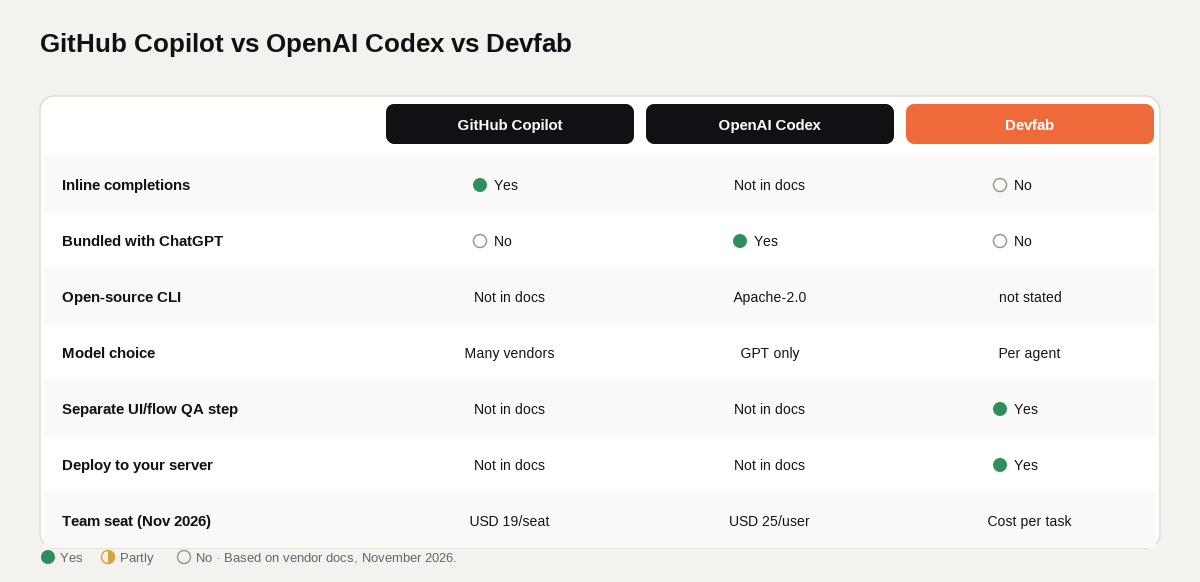
| Aspect | GitHub Copilot | OpenAI Codex | Source |
|---|---|---|---|
| Where it runs | GitHub.com, GitHub Mobile, IDEs, Copilot CLI, Windows Terminal, desktop app, GitHub Desktop | ChatGPT desktop, web and mobile, Codex CLI, IDE extension, cloud environments, GitHub integration and Action, Slack | Copilot features; Codex docs |
| Planning | Cloud agent can research a repo and create an implementation plan | Agent approvals and permissions documented; a separate plan mode not covered in the pages we checked | Copilot features; Codex docs |
| Agent autonomy | IDE agent mode asks before changes and commands; Actions-based cloud sessions: one repo, one PR, 59-minute max | Parallel agents; cloud tasks keep running after you close your laptop | Copilot cloud agent; OpenAI Codex |
| Review and testing | PR code review on paid plans | Automatic PR review; checks its own work with computer and browser tools | Copilot plans; OpenAI Codex |
| Deploy and hosting | Not covered in the docs we checked | Not covered in the docs we checked | — |
| Git hosts | Cloud agent works only with repositories hosted on GitHub | GitHub integration and GitHub Action documented | Copilot cloud agent; Codex docs |
| Open source | Not covered in the docs we checked | Codex CLI is public under Apache-2.0 | openai/codex |
| Team and admin | Policies, usage data, file exclusions; audit logs and AI Controls on Enterprise | Business: SAML SSO, MFA; Enterprise: SCIM, EKM, RBAC, audit logs, data residency | Copilot features; Codex pricing |
| Model choice | OpenAI, Anthropic, Google, Microsoft, Moonshot AI, xAI; Claude and Codex agents on Pro+ and Max | OpenAI GPT models | Copilot models; Codex pricing |
| Pricing model | AI credits; per-seat Business and Enterprise with pooled credits | Included in ChatGPT plans; credits after included limits; or API key | Copilot plans; Codex pricing |
Cost model by team size
| Team size | GitHub Copilot | OpenAI Codex (ChatGPT plans) | Devfab |
|---|---|---|---|
| 1 person | Free (2,000 completions/month); Pro USD 10; Pro+ USD 39; Max USD 100 per month | Free; Go USD 8; Plus USD 20; Pro from USD 100 per month | Cost logged per task and per project (Beta) |
| 5 people | Business USD 19 per seat/month, 1,900 AI credits per user, pooled | Business USD 25 per user/month (USD 20 billed annually, 2-user minimum) | Cost logged per task and per project (Beta) |
| 25 people | Business, or Enterprise USD 39 per seat/month; usage beyond the pool at USD 0.01 per credit | Business, or Enterprise through sales with flexible, credit-based pricing | Cost logged per task and per project (Beta) |
Prices as of November 2026 from GitHub Copilot plans, GitHub Docs: Plans and ChatGPT + Codex pricing. OpenAI notes its usage estimates "are not fixed message limits." Devfab is in Beta and offers predictable cost: cost is logged after each run, per task and per project.
Where GitHub Copilot wins
- You want suggestions as you type. Paid plans include unlimited completions and next edit suggestions, which don't consume credits.
- Your work starts on GitHub. Assign agent tasks from issues, pull requests, the Agents tab or code scanning alerts.
- You want several model vendors and agents under one bill, including Codex itself as a third-party agent on Pro+ and Max.
- You govern AI across a large enterprise. AI Controls add an AI administrator role and agent activity in audit logs.
- Developers use many editors, plus Copilot CLI, Windows Terminal and GitHub Desktop.
Where OpenAI Codex wins
- Everyone already has ChatGPT. Codex is included in every plan from Free to Enterprise, so there may be no new seat to buy.
- You want an open-source CLI you can inspect and run locally with your own API key.
- The agent should test its own changes with computer and browser tools before you review.
- Work continues across devices. Cloud tasks keep running after you close your laptop and can be picked up on mobile.
- Your team works in Slack and the ChatGPT app, where Codex sits next to Chat and Work.
Switching from one to the other
From Copilot to Codex. Codex reads AGENTS.md (Codex docs). Copilot cloud agent, Copilot CLI and Copilot Chat in VS Code read it too (GitHub Docs), so move instructions from .github/copilot-instructions.md into AGENTS.md and both tools share one file during the switch. Install the Codex IDE extension or CLI and connect the GitHub integration. Sign in with a ChatGPT plan: with an API key, GitHub code review and Slack are unavailable.
From Codex to Copilot. Your AGENTS.md carries over. On Pro+ or Max you can keep Codex as a third-party agent inside Copilot. The cloud agent needs repositories hosted on GitHub, and branch protection rules can block it from opening pull requests unless it has a bypass.
Where Devfab fits
Both tools help developers write and review code faster. In the docs we checked, neither researches the domain before planning, asks a person to approve a project plan, runs a separate QA step on screens and user journeys, or deploys the finished app.
Coding agents automate the developer. Devfab automates the development lifecycle. Devfab's Researcher maps the domain first; the Planner's plan goes to a person for approval; the Coordinator assigns tickets to dev agents that work with ChainFlow; the QA agent runs UI, flow and logic tests; and Deploy ships to your own server. Devfab is in Beta, with fewer integrations, and it is not an editor. See Devfab vs GitHub Copilot.
FAQ
Can I use Codex inside GitHub Copilot?
Yes, on some plans. GitHub's plans page lists Claude and Codex as third-party agents on Copilot Pro+ and Max. That puts Codex inside GitHub's workflow and billing. Codex features tied to ChatGPT, such as the desktop app and Slack integration, still need a ChatGPT plan.
Which is cheaper for a small team?
As of November 2026, Copilot Business is USD 19 per seat per month. ChatGPT Business, which includes Codex, is USD 25 per user per month, or USD 20 billed annually with at least two users. ChatGPT Business also covers chat and other ChatGPT tools, so compare what each seat includes.
Do both tools review pull requests?
Yes. Copilot offers pull request code review on paid plans, not on Free. Codex offers automatic pull request review, but not when you use it with an API key. Neither replaces UI and flow tests of the running app; Devfab's QA agent runs those, plus logic tests.
What changed for Copilot and Codex in 2026?
Copilot moved its plans to AI credits, added a Max tier and launched a new Copilot in the cloud experience for paid plans on October 28, 2026. OpenAI folded the Codex desktop app into the ChatGPT desktop app on July 9, 2026, and moved Codex docs under ChatGPT docs.
Read next
- What is an AI software factory?
- GitHub Copilot alternatives
- Cursor vs OpenAI Codex: which should your team use in 2026?
- AI code review vs QA agent: what each one catches
Want a QA agent that tests the running app, not just the diff? Try Beta
Sources (checked November 13, 2026): GitHub Copilot plans; GitHub Docs: Plans for GitHub Copilot; GitHub Docs: Copilot features; GitHub Docs: About Copilot cloud agent; GitHub Docs: Supported AI models; GitHub Docs: Custom instructions support; OpenAI Codex; ChatGPT + Codex docs; ChatGPT + Codex docs: Pricing; ChatGPT + Codex docs: Cloud environment; GitHub: openai/codex; The New Stack: Codex joins ChatGPT desktop app (Jul 9, 2026).
Frequently asked questions
Can I use Codex inside GitHub Copilot?
Yes, on some plans. GitHub's plans page lists Claude and Codex as third-party agents on Copilot Pro+ and Max. That puts Codex inside GitHub's workflow and billing. Codex features tied to ChatGPT, such as the desktop app and Slack integration, still need a ChatGPT plan.
Which is cheaper for a small team?
As of November 2026, Copilot Business is USD 19 per seat per month. ChatGPT Business, which includes Codex, is USD 25 per user per month, or USD 20 billed annually with at least two users. ChatGPT Business also covers chat and other ChatGPT tools, so compare what each seat includes.
Do both tools review pull requests?
Yes. Copilot offers pull request code review on paid plans, not on Free. Codex offers automatic pull request review, but not when you use it with an API key. Neither replaces UI and flow tests of the running app; Devfab's QA agent runs those, plus logic tests.
What changed for Copilot and Codex in 2026?
Copilot moved its plans to AI credits, added a Max tier and launched a new Copilot in the cloud experience for paid plans on October 28, 2026. OpenAI folded the Codex desktop app into the ChatGPT desktop app on July 9, 2026, and moved Codex docs under ChatGPT docs.