Short answer: Choose a cloud coding agent (Copilot cloud agent, Codex cloud, Cursor cloud agents, Devin) to hand off well-scoped tasks in parallel and get pull requests back while your laptop is closed. Choose a local coding agent (Claude Code CLI, Cline, Aider) when the work needs your machine, your network or local models, and you want to steer in real time.
You want the agent to work while you don't. But the task needs a local database, a VPN, or code your security team won't send anywhere. The cloud camp sells parallel agents and pull requests by morning. The local camp sells control. The first thing to settle is that "local" and "cloud" are two questions, not one.
In this guide, you'll learn:
- Definitions
- Side by side
- When to choose a cloud coding agent
- When to choose a local coding agent
- Where an AI software factory fits
The rest of this page covers it in order.
Definitions
Cloud coding agent. The agent runs in an environment the vendor provides, not on your computer. GitHub's Copilot cloud agent works "in a cloud development environment, rather than your local IDE", in a GitHub Actions-based environment scoped to one repository, and opens one pull request per task. OpenAI's Codex cloud tasks create a container, check out your repo at a chosen branch or commit, run a setup script and run the agent with internet access "off by default", ending with a diff or PR. Cursor's cloud agents "run in isolated VMs in the cloud with full development environments". Devin gives each session its own isolated machine with a shell, IDE and browser.
Local coding agent. The agent runs on your machine, in your editor or terminal. Claude Code's CLI reads your codebase, edits files and runs commands locally. Cline runs in VS Code, JetBrains or the terminal and asks for approval on every action. Aider edits files in your local git repo and commits them. Tempo's background agents "use your Tempo identity and your machine", and "nothing runs while Tempo isn't running".
Two questions, not one:
- Where do the agent's tools run? On your machine (local) or in a vendor sandbox (cloud).
- Where does the model run? At a model provider, in your own cloud account, or on your own hardware.
A local agent calling a hosted model still sends code to that provider as context. A cloud agent can run on your own infrastructure. Keep both questions in mind as you read the table.
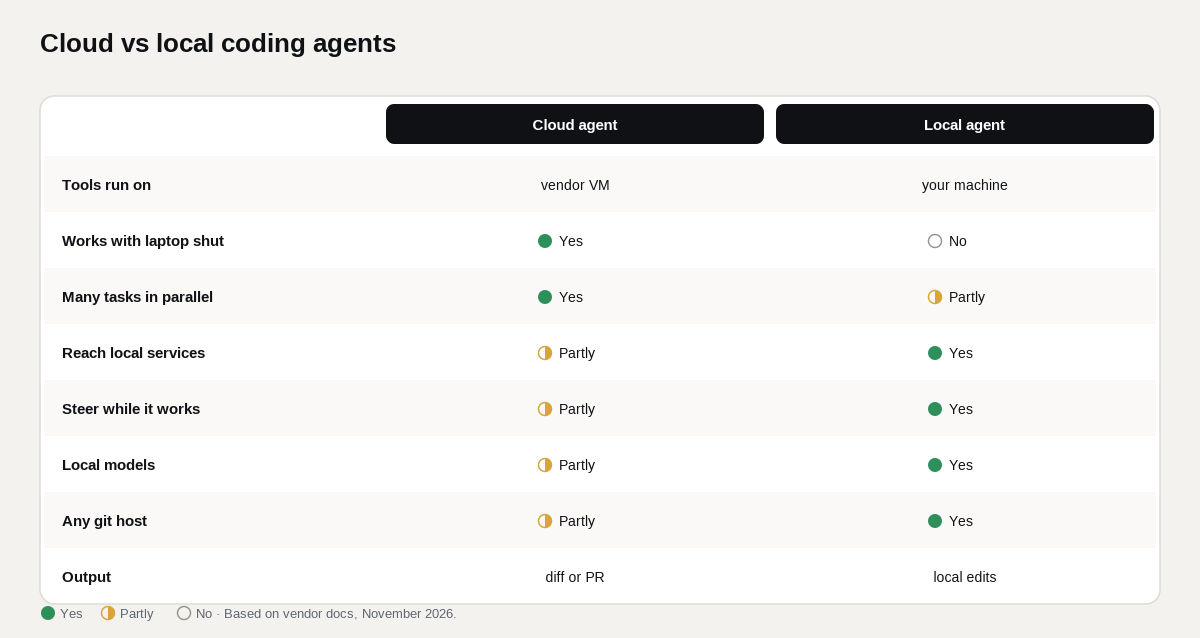
Side by side
| Aspect | Cloud coding agent | Local coding agent |
|---|---|---|
| Where tools run | Vendor sandbox or VM (Copilot, Codex, Cursor, Devin) | Your laptop or server (Claude Code CLI, Cline, Aider) |
| Laptop closed | Keeps working; Codex tasks can be picked up from another device | Stops; Tempo: "nothing runs while Tempo isn't running" |
| Parallel work | Many tasks at once, each on its own branch (Cursor) | Limited by your machine; some run parallel agents locally |
| Access to local services | Only what the sandbox can reach; Codex internet off by default | Your files, databases, VPN and hardware |
| Steering | Review the result: diff or pull request | Watch and redirect as it works; Cline approves each action |
| Repo host | Often tied to a host: Copilot cloud agent needs GitHub | Any git repo on disk |
| Model location | Vendor's models | Hosted models, your cloud, or local models (Cline, Aider) |
| Plan tier | Often paid: Cursor's Free and Plus plans don't include cloud agents | Often free tools plus your inference cost |
| Self-hosted option | Cursor Self-Hosted Machines, Claude Code self-hosted cloud environments, OpenHands in your VPC | Built in |
When to choose a cloud coding agent
Cloud agents are the better choice when:
- You have a backlog of well-scoped tasks. Cognition lists parallel tickets, migrations, refactors, unit tests and documentation as good fits for Devin, and says results depend on clear prompts with explicit completion criteria.
- You want work to continue after you log off. Codex cloud tasks keep running after you close your laptop, and Claude Code cloud scheduled tasks run when your computer is off.
- You want a clean, isolated environment per task. Each Cursor cloud agent works on a separate branch in its own VM; each Devin session runs on its own machine.
- You start work from where the team talks. Cursor cloud agents can start from Slack, GitHub or Bitbucket comments, Linear or the API. Copilot's cloud agent can start from issues, the CLI or GitHub Mobile.
- Pull requests are your review point anyway. The output fits branch protection and code review you already have.
Know the limits. Copilot's cloud agent "only works with repositories hosted on GitHub", changes only the one repository named at task start, and has a capped session length. Cursor cloud agents need read-write access to the repo and a paid tier. Devin's core "always runs in Cognition's cloud", even in dedicated deployments.
When to choose a local coding agent
Local agents are the better choice when:
- The task needs your environment. Local databases, internal services behind a VPN, special hardware or a device you can only reach from your desk.
- You want to steer as it works. Cline asks for approval on every action and keeps Checkpoints for rollback. Aider commits each change so you can undo it in git.
- Code must not leave your control. Pair a local agent with a local model: Cline supports local runtimes, Aider supports Ollama and LM Studio, and OpenHands supports open-weight models run locally or in your VPC.
- You don't use GitHub, or not only GitHub. A local agent works on any git repository on disk.
- You want to avoid another paid tier. Cline's extension and Aider are free; you pay for inference, or nothing with a local model.
Know the limits. A local agent stops when your machine sleeps, and parallel work is limited by your hardware.
The continuity question
Cloud agents add one risk that local tools don't: the service can end. Google announced on October 29, 2026 that Jules winds down on December 31, 2026; new sessions ended November 11, 2026. Google notes that code, branches and PRs stay in GitHub, and users can export settings and session history.
The lesson works both ways. Choose agents that put their output in your Git host, so a shutdown costs you a workflow, not your code.
Where an AI software factory fits
Cloud or local, a coding agent finishes a task. Someone still has to plan the project, test user journeys across the app, deploy it and document it. Coding agents automate the developer. Devfab automates the development lifecycle.
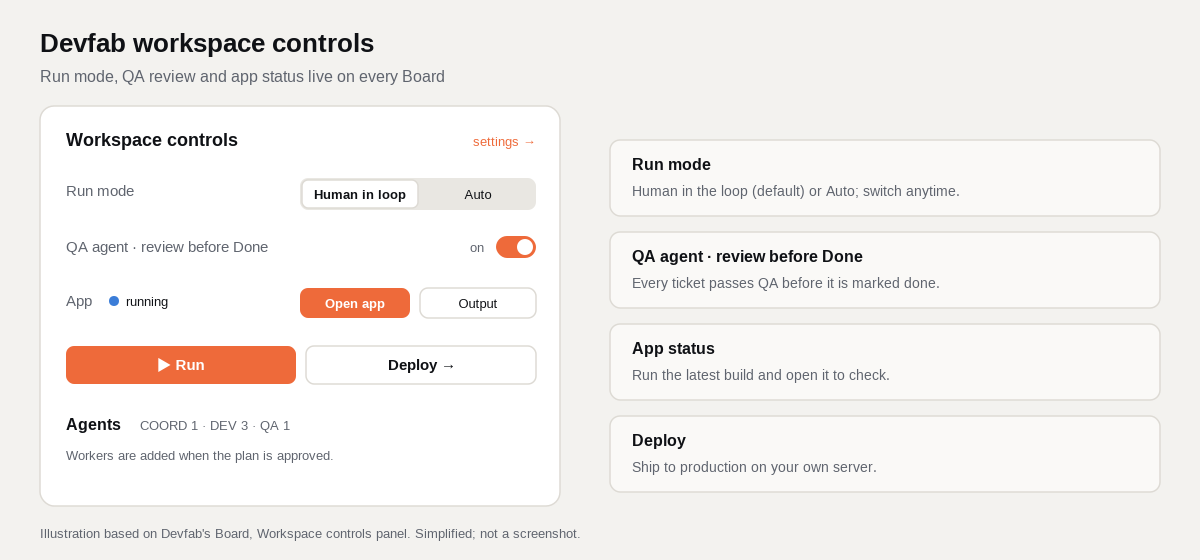
Devfab is an AI software factory. Its agents work on a repository in your own GitHub account (or your organization's), and you deploy to your own server:
- Research before the plan. The Researcher maps the domain (key terms, best practices, competitors) before the Planner writes a plan, and a person approves it.
- ChainFlow maps which functions and APIs call each other and what is deployed, so dev agents see the impact of a change.
- QA agent runs UI and flow tests plus logic tests. With "QA agent · review before Done" on, tickets reach Done only after review.
- Run mode. Human in the loop (step by step, with your approval) is the default; Auto asks only when needed. You can switch anytime.
You can choose the model for each agent or keep Devfab's default. Cost is predictable: logged after each run, per task and per project. Honest limits: Devfab is new and in Beta, with a smaller community and fewer integrations. It is not an editor for hands-on coding, and it needs a GitHub account.
FAQ
What is the difference between a cloud coding agent and a local coding agent?
A cloud coding agent runs in a sandbox or virtual machine the vendor provides: it clones your repo, works on a branch and returns a diff or pull request. A local coding agent runs on your own machine, in your editor or terminal, with access to your files and tools while you watch.
Does a local coding agent keep my code private?
Not by itself. The agent's tools run on your machine, but the model may still run at a cloud provider and receive your code as context. For full local control you need a local model too, which tools such as Cline, Aider and OpenHands support.
Can a cloud coding agent run on my own infrastructure?
Some can. Cursor offers Self-Hosted Machines for cloud-agent tool execution, Claude Code cloud sessions can run on self-hosted environments, and OpenHands can be self-hosted in your VPC. Devin offers a dedicated VPC, but its core still runs in Cognition's cloud.
What happens to my work if a cloud coding agent shuts down?
If the agent worked through your Git host, your code, branches and pull requests stay there. Google Jules is an example: it stopped new tasks on November 11, 2026 and shuts down on December 31, 2026, and Google notes that code, branches and PRs stay in GitHub.
Read next
- What is an AI software factory?
- AI software factory vs AI coding tools: which does your team need?
- Devin vs Claude Code
- Google Jules alternatives
- Devfab vs OpenHands
- How to use AI agents on a large existing codebase
Let agents run the whole project, with a person approving the plan. Try Beta
Sources (checked November 13, 2026): About Copilot coding agent (GitHub Docs); About Copilot cloud agent; Codex cloud environment (OpenAI); OpenAI Codex; Cursor cloud agents; Introducing Devin; Devin enterprise deployment; Jules changelog; Claude Code overview; Claude Code enterprise deployment; Cline docs overview; Cline Plan and Act; Cline pricing; Aider documentation; Aider on GitHub; OpenHands; Introducing Agent Canvas (OpenHands blog); Tempo docs: Agents.
Frequently asked questions
What is the difference between a cloud coding agent and a local coding agent?
A cloud coding agent runs in a sandbox or virtual machine the vendor provides: it clones your repo, works on a branch and returns a diff or pull request. A local coding agent runs on your own machine, in your editor or terminal, with access to your files and tools while you watch.
Does a local coding agent keep my code private?
Not by itself. The agent's tools run on your machine, but the model may still run at a cloud provider and receive your code as context. For full local control you need a local model too, which tools such as Cline, Aider and OpenHands support.
Can a cloud coding agent run on my own infrastructure?
Some can. Cursor offers Self-Hosted Machines for cloud-agent tool execution, Claude Code cloud sessions can run on self-hosted environments, and OpenHands can be self-hosted in your VPC. Devin offers a dedicated VPC, but its core still runs in Cognition's cloud.
What happens to my work if a cloud coding agent shuts down?
If the agent worked through your Git host, your code, branches and pull requests stay there. Google Jules is an example: it stopped new tasks on November 11, 2026 and shuts down on December 31, 2026, and Google notes that code, branches and PRs stay in GitHub.