Short answer: OpenAI Codex wins for teams already paying for ChatGPT who want a coding agent in the CLI, IDE and cloud at no extra seat cost. Devin wins for teams with a backlog of scoped tickets who want a hosted engineer to take them from Slack, Teams, Linear or Jira, with a single-tenant VPC option.
Your backlog is long and your developers are the bottleneck. Two pitches land in your inbox. One says: your ChatGPT plan already includes a coding agent. The other says: hire an AI engineer that picks up tickets on its own. Both promise pull requests. They differ on where the work runs, who starts it and how you pay.
This page referees that debate using OpenAI and Cognition docs re-checked on November 20, 2026.
In this comparison:
- OpenAI Codex and Devin at a glance
- Feature comparison
- Cost model by team size
- Where OpenAI Codex wins
- Where Devin wins
Here's how each one compares.
OpenAI Codex and Devin at a glance
Both changed shape in 2026. On June 2, 2026, Windsurf was renamed Devin Desktop and joined the Devin product line, adding a local IDE and agent command center (Devin Desktop FAQ). Devin also moved to new usage-based self-serve plans in March 2026 (Devin usage docs). On July 9, 2026, OpenAI folded the Codex desktop app into a combined ChatGPT desktop app; Codex "remains focused on software development" (The New Stack).
OpenAI Codex runs in the ChatGPT desktop, web and mobile apps, the Codex CLI, an IDE extension, cloud environments, GitHub and Slack (ChatGPT + Codex docs). It runs agents in parallel and checks its own work with computer and browser tools (Codex). It is built for engineering teams and individual builders.
Devin is "an autonomous AI software engineer that can write, run and test code" (Devin docs). Each session has a shell, IDE and browser that you can watch and take over. You reach it from the web app, Slack, Microsoft Teams, a terminal CLI with /handoff to cloud Devin, or the API. Cognition lists good fits such as parallel tickets from Linear or Jira, migrations, PR review, bug reproduction, unit tests and docs.
Feature comparison
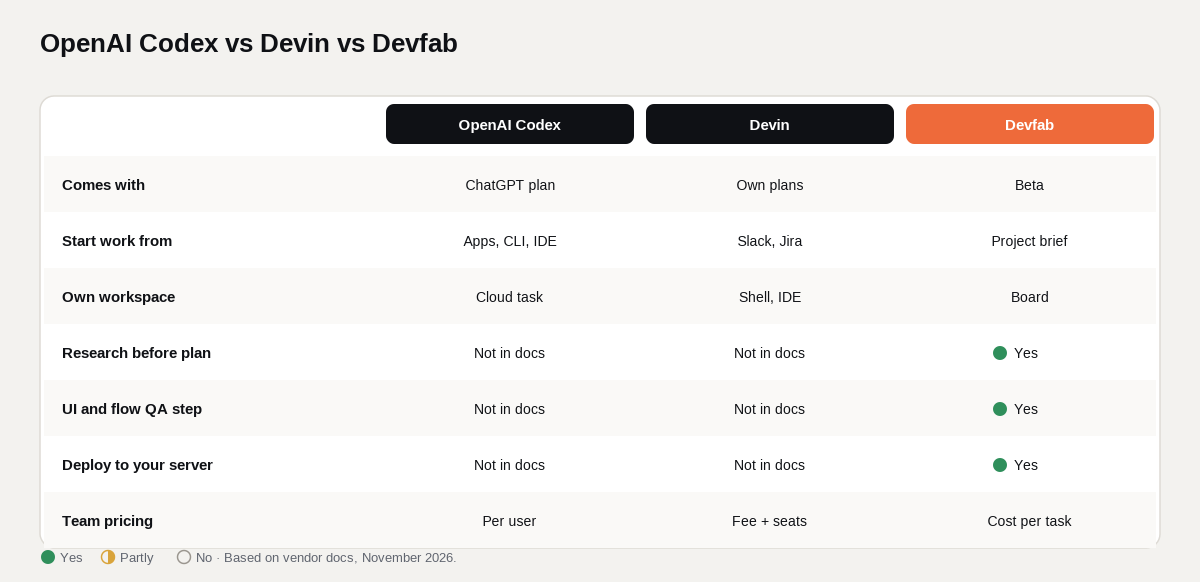
| Aspect | OpenAI Codex | Devin | Source |
|---|---|---|---|
| Where it runs | ChatGPT apps, CLI, IDE extension, cloud, GitHub, Slack | Web app, Slack, Teams, terminal CLI, API, Devin Desktop | ChatGPT + Codex docs; Devin docs |
| Planning | Approvals and permissions documented | Works best with explicit completion criteria; break hard work into scoped steps | ChatGPT + Codex docs; Devin docs |
| Agent autonomy | Parallel agents; cloud tasks continue after you close your laptop | Own workspace per session; subagents that each open PRs | Codex; Devin Desktop |
| Testing and review | Checks its own work with computer and browser tools; automatic PR review | Writes, runs and tests code; built-in Devin Review | Codex; Devin Desktop |
| Deploy and hosting | Not covered in the docs we checked | Not covered in the docs we checked | — |
| Where it executes | Local CLI or OpenAI cloud | Cognition cloud; single-tenant VPC hosted by Cognition; "brain" always in Cognition's cloud | ChatGPT + Codex docs; Devin enterprise |
| Team and admin | Business: SAML SSO, MFA; Enterprise: SCIM, EKM, RBAC, audit logs | Teams: SSO, centralized billing, cost controls; Enterprise: SCIM, RBAC, VPC | Codex pricing docs; Devin pricing |
| Model choice | OpenAI GPT models | Not covered in the docs we checked for cloud Devin | Codex pricing docs |
| Pricing model | Included in ChatGPT plans; credits after limits | Individual tiers; Teams fee plus per-seat fee; Enterprise in ACUs | Codex pricing docs; Devin pricing |
Cost model by team size
| Team size | OpenAI Codex | Devin | Devfab |
|---|---|---|---|
| 1 person | Plus USD 20 per month; Pro from USD 100 per month | Free USD 0 (light quota); Pro USD 20 per month; Max USD 200 per month | Cost logged per task and per project (Beta) |
| 5 people | Business USD 20 per user per month billed annually, or USD 25 billed monthly | Teams USD 80 per month plus USD 40 per month per full dev seat | Cost logged per task and per project (Beta) |
| 25 people | Business, or Enterprise via sales | Teams (up to 100 users), or Enterprise ("Let's talk") with usage in ACUs | Cost logged per task and per project (Beta) |
Prices as of November 2026 from the ChatGPT + Codex pricing docs and Devin pricing. Devin bills extra usage at API rates; Codex offers credits after included limits. Devfab is in Beta and offers predictable cost: cost is logged after each run, per task and per project.
Where OpenAI Codex wins
- You already pay for ChatGPT. Codex comes with the plan at no extra seat cost.
- Developers want the agent locally too. The Codex CLI is open source (Apache 2.0) and runs on your machine.
- You want one tool for chat, work and code inside the ChatGPT desktop app.
- Five-seat cost matters. Business per-user pricing is simple to forecast for a mid-size team.
Where Devin wins
- Tickets should start where people already talk. Tag Devin in Slack or Teams, or send it Linear and Jira tickets in parallel.
- You want to watch and take over. Each session has a shell, IDE and browser you can step into.
- You need a dedicated deployment. Customer Dedicated Deployment runs in a single-tenant VPC with AWS PrivateLink or IPSec (Devin enterprise).
- You came from Windsurf. Devin Desktop keeps your editor and lets you hand local sessions to the cloud.
- Large migrations and refactors are on Cognition's own list of good fits.
Switching from one to the other
From Codex to Devin. Both work on your repo through pull requests, so nothing to export. Keep AGENTS.md for repo rules, connect GitHub and your tracker in Devin, and write each ticket with explicit completion criteria, as Devin's docs advise (Devin docs).
From Devin to Codex. Connect GitHub to Codex, set up a cloud environment with your install steps, and keep AGENTS.md (ChatGPT + Codex docs). Move Slack hand-offs to the Codex Slack integration.
Where Devfab fits
Codex and Devin both take a ticket and return a pull request. Neither decides what the tickets should be. In the docs we checked, neither researches the business domain before planning, sends a project plan to a person for approval, runs a separate QA step on user journeys, or deploys the app to your server.
Coding agents automate the developer. Devfab automates the development lifecycle. For a café chain's loyalty app, Devfab's Researcher maps points, rewards and fraud practices before the Planner writes a plan. A person approves the plan; ChainFlow shows that changing how points are earned also touches receipts, the rewards screen and monthly reports; the QA agent runs UI, flow and logic tests; Deploy ships to your server. Devfab is in Beta, with fewer integrations, and is not an editor. See Devfab vs Devin.
FAQ
What is the main difference between Codex and Devin?
Codex is a coding agent included in ChatGPT plans that you run from the ChatGPT apps, a CLI, an IDE or the cloud. Devin is Cognition's hosted AI engineer: each session gets its own shell, IDE and browser, and you can tag it in Slack, Teams, Linear or Jira to take tickets.
Is Windsurf part of Devin now?
Yes. On June 2, 2026 Windsurf was renamed Devin Desktop and joined the Devin product line. It adds a local IDE and agent command center, with sessions you can hand off from your machine to Devin in the cloud.
Which is cheaper for a team of five?
As of November 2026, Codex on ChatGPT Business is USD 20 per user per month billed annually. Devin Teams is USD 80 per month for the team plus USD 40 per month per full dev seat. Both add usage beyond what is included, so test with real tasks.
Can either one run fully on my own servers?
Not fully. Devin offers a single-tenant VPC deployment hosted by Cognition, but its docs say Devin's brain always runs in Cognition's cloud. The Codex CLI is open source and runs locally, but the models run at OpenAI. Neither is a fully self-hosted product.
Read next
- What is an AI software factory?
- Devin alternatives for teams that ship to production (2026)
- Devin vs Claude Code
- OpenAI Codex vs Google Jules
Want the tickets, the tests and the deploy decided for you, with your approval? Try Beta
Sources (checked November 2026): OpenAI Codex; ChatGPT + Codex docs; ChatGPT + Codex docs: pricing; GitHub: openai/codex; The New Stack: Codex joins ChatGPT desktop app (Jul 9, 2026); Devin docs: Introducing Devin; Devin pricing; Devin docs: enterprise deployment; Devin docs: usage and billing; Devin Desktop FAQ; Devin Desktop.
Frequently asked questions
What is the main difference between Codex and Devin?
Codex is a coding agent included in ChatGPT plans that you run from the ChatGPT apps, a CLI, an IDE or the cloud. Devin is Cognition's hosted AI engineer: each session gets its own shell, IDE and browser, and you can tag it in Slack, Teams, Linear or Jira to take tickets.
Is Windsurf part of Devin now?
Yes. On June 2, 2026 Windsurf was renamed Devin Desktop and joined the Devin product line. It adds a local IDE and agent command center, with sessions you can hand off from your machine to Devin in the cloud.
Which is cheaper for a team of five?
As of November 2026, Codex on ChatGPT Business is USD 20 per user per month billed annually. Devin Teams is USD 80 per month for the team plus USD 40 per month per full dev seat. Both add usage beyond what is included, so test with real tasks.
Can either one run fully on my own servers?
Not fully. Devin offers a single-tenant VPC deployment hosted by Cognition, but its docs say Devin's brain always runs in Cognition's cloud. The Codex CLI is open source and runs locally, but the models run at OpenAI. Neither is a fully self-hosted product.