Short answer: Amazon Q Developer still wins for teams holding Pro seats who need AWS-aware help in their IDE and legacy Java upgrades before end of support on April 30, 2027. Devfab wins when a team ships client projects and needs research, a plan a person approves, UI and flow tests, deployment to its own server and cost per project.
Your agency standardized on Amazon Q Developer. Now AWS has set an end date. You have to move somewhere, and Kiro is the default path. Before you follow it, ask a bigger question: did Q ever cover the parts of a client project that eat your margin? Plans, test evidence and deployments still ran by hand. This page compares Q Developer with Devfab using AWS docs checked on November 20, 2026.
In this comparison:
- What each tool is built for
- Switching triggers
- Cost model by team size
- Moving from Amazon Q Developer to Devfab
- Where Amazon Q Developer is the better choice
The status change comes first, because it shapes every other answer.
What each tool is built for
Amazon Q Developer
Status: being sunset. AWS announced on April 30, 2026 that Q Developer IDE plugins and paid subscriptions reach end of support on April 30, 2027, with Kiro as the migration target (AWS DevOps blog). New subscriptions and new Free Tier accounts have been blocked since May 15, 2026 (same source). On November 5, 2026, the console version was renamed "AWS assistant" (AWS What's New). The Q CLI was already succeeded by Kiro CLI, which keeps the q command working (Kiro: Upgrading from Q CLI).
What Q Developer does today:
- Where it runs: IDE plugins for VS Code, JetBrains IDEs, Visual Studio and Eclipse (preview), a CLI agent, and GitHub and GitLab integrations (Q Developer agentic coding).
- Agent mode: reads and writes local files, plans multi-file features and makes the changes and tests after you approve (same source).
- GitHub: you can assign issues to Q, have it review pull requests and modernize legacy Java apps (same source).
- Security: scans for exposed credentials and log injection, and flags IaC misconfigurations in PR reviews (same source).
- AWS-aware: it can query information about your AWS resources (same source).
Q Developer was built for developers building on AWS, working inside their IDE.
Devfab
Devfab is an AI software factory in the Autonomous Software Lifecycle category. Its unit of work is a project, not an editor session. Seven agents run it: Researcher, Planner, Coordinator, Developers, Blueprint, QA agent and Deploy.
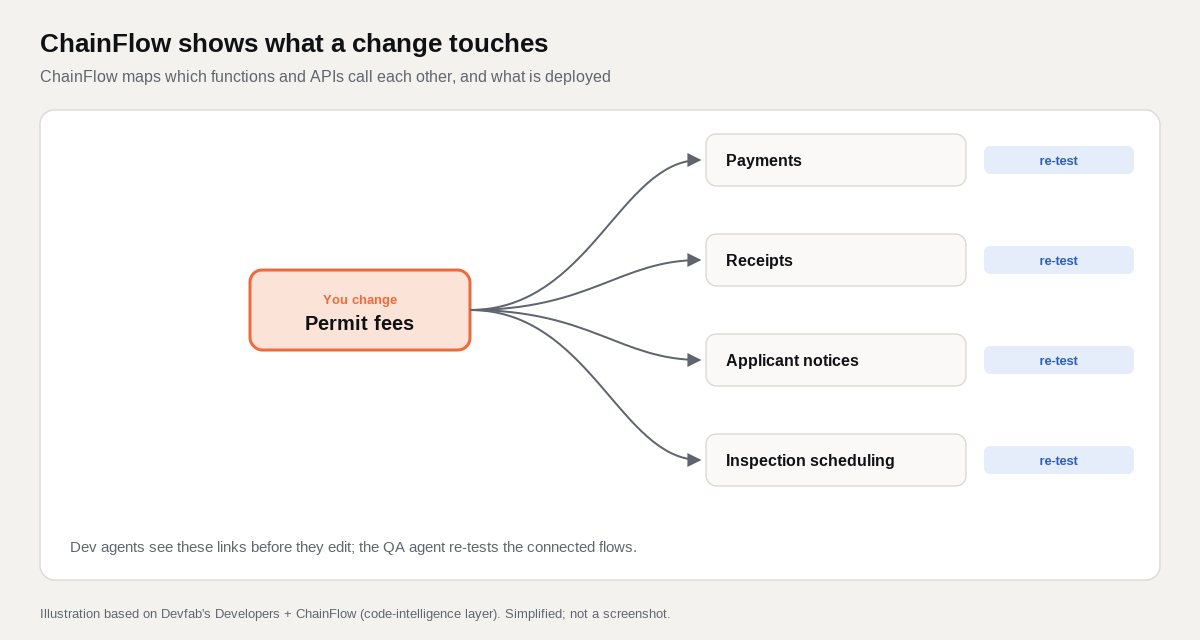
Take a city permit tracker. The Researcher first maps the domain: permit types, review stages, inspection terms and the best practices of similar tools. Then it suggests a prototype. The Planner writes the plan, and a person approves it. The Coordinator turns it into tickets for dev agents. ChainFlow, Devfab's code-intelligence layer, maps which functions and APIs call each other and what is deployed. So a change to fee calculation shows its impact on payments, receipts and applicant notices before it breaks them. The QA agent clicks through screens and journeys, such as submit, review and approve, and runs logic tests. Deploy ships to your own server.
Coding agents automate the developer. Devfab automates the development lifecycle.
Switching triggers
| Trigger | Amazon Q Developer | Devfab | Source |
|---|---|---|---|
| The product has an end date | IDE plugins and paid subscriptions end April 30, 2027 | In Beta and active | AWS DevOps blog |
| New staff can't get seats | New subscriptions and Free Tier accounts blocked since May 15, 2026; existing Pro subscriptions can still add users | Workspace roles and permissions | AWS DevOps blog |
| You want the newest coding models | Newest models are only in Kiro; one model was removed from Q Pro on May 29, 2026 | Choose the model for each agent or keep Devfab's default | AWS DevOps blog |
| Your editor is Visual Studio or Eclipse | Kiro, the successor, has no native plugin for either | Not an editor; works on your GitHub repo | Kiro: Migrating from Q Developer |
| Java and .NET transformations | Both stop on April 30, 2027 | Not a code-transformation service | AWS DevOps blog |
| Clients want a plan and test evidence | Plans multi-file changes inside the IDE | Project plan a person approves; QA agent runs UI, flow and logic tests | Q Developer agentic coding |
| Deployment is still manual | Deploy step not covered in the docs we checked | Deploy ships to your own server, optional custom domain | Q Developer agentic coding |
Cost model by team size
| Team size | Amazon Q Developer | Devfab |
|---|---|---|
| 1 person | Free Tier USD 0 with 50 agentic requests per month, but new Free Tier accounts are blocked | Cost logged per task and per project (Beta) |
| 5 people | Pro Tier USD 19 per user per month, only for existing Pro subscriptions | Cost logged per task and per project (Beta) |
| 25 people | Pro Tier USD 19 per user per month, with admin dashboard and Identity Center; Java transformation lines pooled per account | Cost logged per task and per project (Beta) |
Prices as of November 2026 from Amazon Q Developer pricing. The pricing page itself carries no end-of-support notice, so read it together with the AWS end-of-support post. Devfab offers predictable cost: cost is logged after each run, per task and per project; Devfab is in Beta.
Moving from Amazon Q Developer to Devfab
Q Developer already works inside your own repositories, so there is no code to export.
- Put the repo on GitHub. Devfab works with a repository in your own GitHub account or your organization's. If the code sits in GitLab or CodeCommit, mirror it to GitHub first.
- Choose "Work on an existing project" in Devfab, connect GitHub and pick the repo.
- Leave the change box empty. ChainFlow maps the code first, then suggests three small first tickets.
- Approve the plan. The Planner publishes it with a "Your turn" banner; the Coordinator creates tickets after a person approves.
- Let the QA agent test. It runs UI, flow and logic tests on the work, and the workspace switch "QA agent · review before Done" adds a review step.
- Keep AWS help where it lives. Use the AWS assistant in the console, or Kiro, for questions about your AWS resources.
Where Amazon Q Developer is the better choice
- You hold Pro seats and need AWS-aware help in the IDE until the April 2027 cutoff: resource queries, AWS API calls and bash from the CLI agent.
- You have a legacy Java upgrade in flight. The transformation feature still runs, metered in lines of code, until end of support.
- Your developers want an assistant inside Visual Studio or Eclipse for now, since Kiro has no native plugin for either.
- You want IP indemnity and Identity Center controls on a per-user AWS bill, which the Pro tier includes.
- For anything forward-looking, compare Kiro, the successor AWS recommends, rather than Q itself. See Devfab vs Kiro.
Where Devfab is the better choice
- Research before the plan. The Researcher maps the domain, key terms and competitors before any ticket exists.
- A person approves the plan. Clients and project managers sign off on scope they can read.
- Changes don't break connected features. ChainFlow shows the impact of a change across functions, APIs and what is deployed.
- Proof of testing. The QA agent clicks through screens, buttons and user journeys end to end, plus logic tests.
- Deploy and docs. Ship to production on your own server, with blueprints, sequence flows and user manuals.
- Cost per project. Cost is logged after each run, per task and per project, for predictable cost.
Devfab's honest limits: it is in Beta, with a smaller community and fewer integrations than AWS tools. It is not an editor for hands-on coding, it needs a GitHub account, and it does not read your AWS account.
FAQ
Is Amazon Q Developer being discontinued?
Yes, for coding. AWS says Q Developer IDE plugins and paid subscriptions reach end of support on April 30, 2027, and it points users to Kiro. New subscriptions and new Free Tier accounts have been blocked since May 15, 2026. The console assistant was renamed AWS assistant on November 5, 2026.
Should I move from Amazon Q Developer to Kiro or to Devfab?
Move to Kiro if you want the AWS-backed successor for hands-on coding in an IDE or CLI, with AWS identity and billing. Look at Devfab if your work is client projects that need research, an approved plan, separate UI and flow tests, deployment to your own server and cost logged per project.
Can I keep using Amazon Q Developer until April 2027?
AWS says existing Pro subscriptions keep working until end of support and can still add users. Plan the move early: the newest coding models are already only in Kiro, and Java upgrade and .NET porting transformations also stop on April 30, 2027.
Does Devfab work with code on AWS?
Devfab works on a repository in your own GitHub account or your organization's, and Deploy ships to your own server. Devfab does not query your AWS resources the way Q Developer does, so keep AWS-specific help in the AWS console or Kiro.
Read next
- What is an AI software factory?
- Amazon Q Developer alternatives
- Devfab vs Kiro
- Claude Code vs Amazon Q Developer
- Cursor vs Amazon Q Developer
Moving off Q Developer? Try a factory for the next client project. Try Beta
Sources (checked November 2026): Amazon Q Developer end of support announcement (AWS DevOps blog); Amazon Q Developer in console renamed AWS assistant (AWS What's New, Nov 5, 2026); Amazon Q Developer pricing; Amazon Q Developer agentic coding experience; Kiro: Migrating from Q Developer; Kiro: Upgrading from Q CLI.
Frequently asked questions
Is Amazon Q Developer being discontinued?
Yes, for coding. AWS says Q Developer IDE plugins and paid subscriptions reach end of support on April 30, 2027, and it points users to Kiro. New subscriptions and new Free Tier accounts have been blocked since May 15, 2026. The console assistant was renamed AWS assistant on November 5, 2026.
Should I move from Amazon Q Developer to Kiro or to Devfab?
Move to Kiro if you want the AWS-backed successor for hands-on coding in an IDE or CLI, with AWS identity and billing. Look at Devfab if your work is client projects that need research, an approved plan, separate UI and flow tests, deployment to your own server and cost logged per project.
Can I keep using Amazon Q Developer until April 2027?
AWS says existing Pro subscriptions keep working until end of support and can still add users. Plan the move early: the newest coding models are already only in Kiro, and Java upgrade and .NET porting transformations also stop on April 30, 2027.
Does Devfab work with code on AWS?
Devfab works on a repository in your own GitHub account or your organization's, and Deploy ships to your own server. Devfab does not query your AWS resources the way Q Developer does, so keep AWS-specific help in the AWS console or Kiro.