Short answer: CodeRabbit wins when your team, or its coding agents, already writes the code and you need an automated review gate on every pull request, across GitHub, GitLab, Azure DevOps or Bitbucket. Devfab wins when a client project needs research, a plan a person approves, builds, UI and flow tests and deployment run as one line.
You run delivery for a freight forwarder's customs-document portal. Your developers use coding agents, so pull requests arrive faster than anyone can read them. One lead says add an AI reviewer and the problem is solved. Another says review was never the bottleneck: nobody checked that the broker can still upload a commercial invoice and see it on the shipment. Both have a point. This page compares a reviewer with a factory, fairly, using sources checked in November 2026.
In this comparison:
- What each tool is built for
- Switching triggers
- Cost model by team size
- Where CodeRabbit is the better choice
- Where Devfab is the better choice
One framing note runs through the whole page: CodeRabbit tests and reviews code you already have; Devfab runs the lifecycle that produces it.
What each tool is built for
CodeRabbit
Status: active and well funded. CodeRabbit raised a USD 143M Series C at a USD 1.5B valuation on August 12, 2026, co-led by Atomico and Smash Capital, and used the moment to name a new category, "Agentic Change Management" (CodeRabbit newsroom). It reports "20K" customers and "8.5M" repositories, both vendor figures (CodeRabbit JA).
CodeRabbit is an AI code reviewer. It works in GitHub, GitLab, Azure DevOps and Bitbucket, in an IDE extension for VS Code, Cursor, Windsurf and JetBrains, and in a CLI for pre-commit reviews that "Works with Claude Code, Cursor, Codex, Gemini, and more" (CodeRabbit docs). Review features include PR summaries, chat, learnings, autofix, "slop detection", pre-merge checks and security review. Unit test generation starts on Team, and blast-radius and architecture impact analysis come with Advanced (CodeRabbit pricing). CodeRabbit Security scans for vulnerabilities, leaked secrets and vulnerable dependencies (CodeRabbit docs).
The newest piece is Verify, which "tests how your application behaves, not only how its code reads." It generates scenarios for a pull request, runs the app in a sandbox, mostly through a browser, and reports bugs with screenshots and recordings. Verify is in beta, free during the beta, and covers web apps and services only, with no native mobile (CodeRabbit Verify).
Devfab
Devfab is a Software Factory in the Autonomous Software Lifecycle category. It does not start from a pull request. It starts from a description or from your existing GitHub repo. The Researcher maps the domain first: key terms, best practices and competitors, then suggests a prototype. The Planner writes a plan, and a person approves it. The Coordinator splits it into tickets, dev agents build with ChainFlow, the QA agent runs UI and flow tests plus logic tests, and Deploy ships to your own server.
Coding agents automate the developer. Devfab automates the development lifecycle. A reviewer like CodeRabbit sits at one gate of that lifecycle. Devfab's QA agent is also one step of it, not the whole product.
Switching triggers
| Trigger | CodeRabbit | Devfab | Source |
|---|---|---|---|
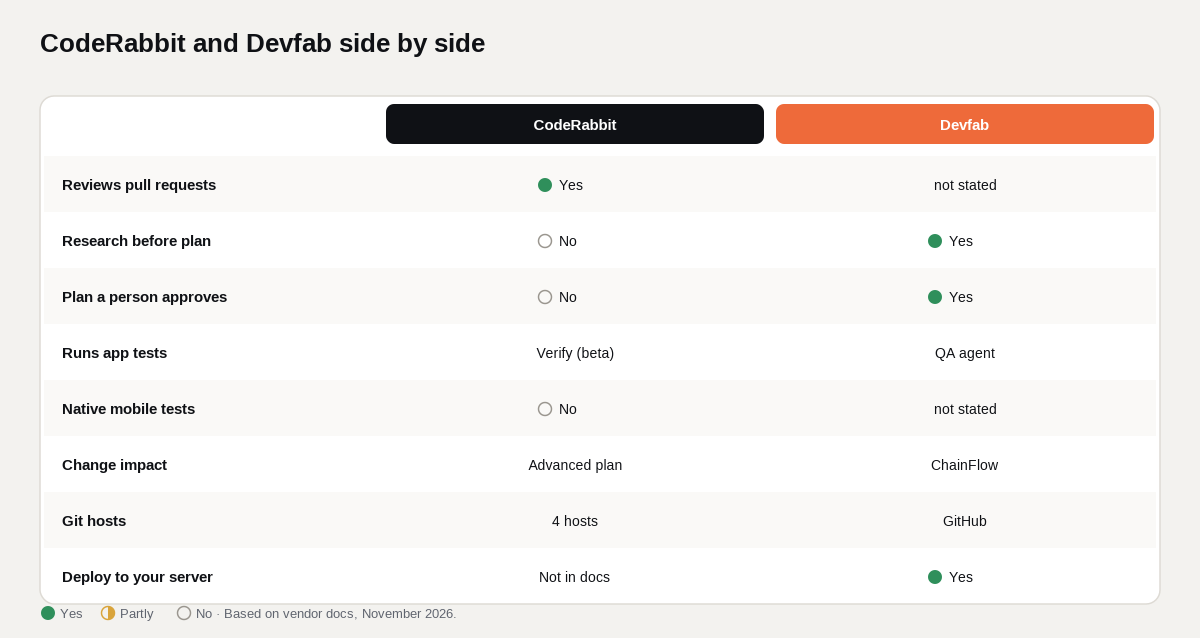
| The code isn't written yet | Reviews and tests code that exists in a PR, IDE or CLI | Research, plan approval, tickets and build come before review | CodeRabbit docs |
| You need proof user journeys work | Verify runs the app in a sandbox; beta, web only | QA agent runs UI, flow and logic tests as a lifecycle step | CodeRabbit Verify |
| Native mobile app | Verify has no native mobile support | Not stated | CodeRabbit Verify |
| Impact of a change across features | Blast-radius analysis on Advanced | ChainFlow maps which functions and APIs call each other | CodeRabbit pricing |
| Busy review days | PR reviews per developer per hour capped under fair use; extra billed | Cost logged per task and per project | CodeRabbit pricing |
| SSO, self-hosting, chosen region | Enterprise only | Not stated | CodeRabbit pricing |
| Deploy to the client's server | Not covered in the docs we checked | Deploy ships to your own server, custom domain optional | CodeRabbit docs |
Cost model by team size
| Team size | CodeRabbit | Devfab |
|---|---|---|
| 1 person | Free reviews in the IDE; Essentials USD 24 per user per month | Cost logged per task and per project (Beta) |
| 5 people | Team USD 48 per user per month (unit test generation included) | Cost logged per task and per project (Beta) |
| 25 people | Advanced USD 72 per user per month, or Enterprise (custom) for SSO and self-hosting | Cost logged per task and per project (Beta) |
CodeRabbit prices as of November 2026 from CodeRabbit pricing; the page shows annual billing at 20% off and a free trial, and the FAQ mentions a free open-source plan (CodeRabbit FAQ). Devfab is in Beta and offers predictable cost: cost is logged after each run, per task and per project.
The two lines don't buy the same thing. CodeRabbit's bill grows with the number of developers. Devfab's log grows with the tasks the factory runs.
Moving from CodeRabbit to Devfab
You don't have to remove CodeRabbit. It reviews the repository; Devfab works on the same repository.
- Get the code into GitHub. CodeRabbit already works where your repo lives. If that is GitLab, Azure DevOps or Bitbucket, you need a copy in your own GitHub account or organization for Devfab.
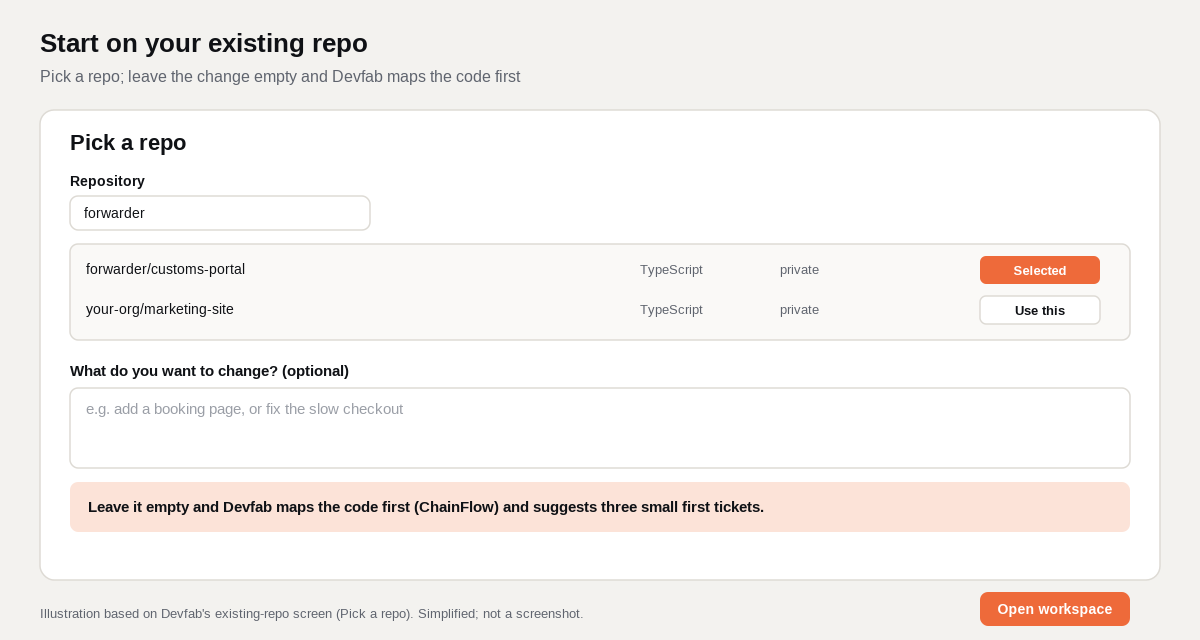
- In Devfab, choose "Work on an existing project" and pick the repository.
- Leave the change box empty. Devfab maps the code first with ChainFlow and suggests three small first tickets.
- Approve the plan. A person reviews it before the Coordinator creates tickets and dispatches dev agents.
- Let the QA agent run UI, flow and logic tests on the result, then deploy to your own server when you are ready.
Where CodeRabbit is the better choice
- Your agents already write the code. If Claude Code, Cursor or Codex produce the pull requests, CodeRabbit adds a review gate without changing how you build.
- Your repos are not on GitHub. CodeRabbit covers GitLab, Azure DevOps and Bitbucket as well.
- Developers want feedback before they push. The IDE extension and CLI review changes locally.
- Security review is the gap. Scans for vulnerabilities, leaked secrets and vulnerable dependencies sit in the same tool.
- You want behavior checks on PRs without a new platform. Verify, while in beta and web only, adds runtime tests to the review you already run.
Where Devfab is the better choice
- The project starts before the code. The Researcher maps the domain, key terms, best practices and competitors before the Planner writes anything, then suggests a prototype.
- A person must sign off the plan. The Planner publishes the plan, and nothing is ticketed until someone approves it.
- Changes ripple. ChainFlow shows dev agents what a change touches. Changing checkout can affect payments, inventory, order confirmation and notifications.
- You need flow tests as part of delivery. The QA agent runs UI and flow tests, with screens, buttons and user journeys clicked end to end, plus logic tests.
- The client wants the app on their server with docs: blueprints, sequence flows, prototypes and user manuals.
- You bill per project. Cost is logged after each run, per task and per project.
Devfab's honest limits: it is in Beta, has a smaller community and fewer integrations than mature platforms, is not an editor for hands-on coding, and needs a GitHub account.
FAQ
Is CodeRabbit a competitor to Devfab?
Only partly. CodeRabbit reviews code you already have: pull requests, IDE changes and CLI diffs. Devfab runs the whole lifecycle, from research and an approved plan to build, QA and deploy, and its QA agent is one step of that line. Many teams could use both, since Devfab's code lives in your own GitHub repository.
Does CodeRabbit test the running app?
It has started to. CodeRabbit Verify generates scenarios for a pull request, runs the app in a sandbox, mostly through a browser, and reports bugs with screenshots and recordings. As of November 2026 it is in beta, free during the beta, and limited to web apps and services on CodeRabbit Cloud.
How much does CodeRabbit cost?
As of November 2026, CodeRabbit lists Essentials at USD 24, Team at USD 48 and Advanced at USD 72 per user per month, with Enterprise custom. Annual billing is 20% off, and PR reviews per developer per hour are capped under a fair-usage policy. Devfab gives no list price; cost is logged per task and per project.
Can Devfab work on a repo hosted on GitLab or Bitbucket?
Devfab works with repositories in your own GitHub account or an organization you belong to. CodeRabbit supports GitHub, GitLab, Azure DevOps and Bitbucket. If your code lives outside GitHub, you would need a GitHub copy of the repo to use Devfab.
Read next
- What is an AI software factory?
- CodeRabbit alternatives
- AI code review vs a QA agent
- CodeRabbit vs Qodo
Want the whole line, not only the review gate? Try Beta
Sources (checked November 2026): CodeRabbit pricing; CodeRabbit docs; CodeRabbit Verify docs; CodeRabbit FAQ; CodeRabbit homepage (JA); CodeRabbit Series C (Aug 12, 2026).
Frequently asked questions
Is CodeRabbit a competitor to Devfab?
Only partly. CodeRabbit reviews code you already have: pull requests, IDE changes and CLI diffs. Devfab runs the whole lifecycle, from research and an approved plan to build, QA and deploy, and its QA agent is one step of that line. Many teams could use both, since Devfab's code lives in your own GitHub repository.
Does CodeRabbit test the running app?
It has started to. CodeRabbit Verify generates scenarios for a pull request, runs the app in a sandbox, mostly through a browser, and reports bugs with screenshots and recordings. As of November 2026 it is in beta, free during the beta, and limited to web apps and services on CodeRabbit Cloud.
How much does CodeRabbit cost?
As of November 2026, CodeRabbit lists Essentials at USD 24, Team at USD 48 and Advanced at USD 72 per user per month, with Enterprise custom. Annual billing is 20% off, and PR reviews per developer per hour are capped under a fair-usage policy. Devfab gives no list price; cost is logged per task and per project.
Can Devfab work on a repo hosted on GitLab or Bitbucket?
Devfab works with repositories in your own GitHub account or an organization you belong to. CodeRabbit supports GitHub, GitLab, Azure DevOps and Bitbucket. If your code lives outside GitHub, you would need a GitHub copy of the repo to use Devfab.