Short answer: Continue still wins if you want to fork its Apache-2.0 code and maintain your own in-editor assistant, since the product itself was discontinued after Cursor bought it in June 2026. Devfab wins when you need a whole project researched, planned, tested and deployed from a GitHub repo, with a person approving the plan.
You built your team's workflow around Continue. Then the homepage changed to one line: "Continue has joined Cursor." Billing stopped, an export deadline came and went, and now you need a plan. Some of your developers just want an editor assistant again. Others ask whether this is the moment to automate more than the typing. This page covers both paths.
In this comparison:
- What each tool is built for
- Switching triggers
- Moving from Continue to Devfab
- Where Continue is the better choice
- Where Devfab is the better choice
The facts on Continue's shutdown come first.
What each tool is built for
Continue
Status: acquired by Cursor and discontinued. Continue's homepage announced the purchase around June 16, 2026, with terms undisclosed, and co-founder Nate Sesti is joining Cursor. The product has been discontinued, recurring billing is disabled, and users had until July 15, 2026 to export data before deletion (The New Stack). The site now reads "Continue was acquired by Cursor" and says the open-source codebase "remains freely available as a foundation for others" (continue.dev).
Before the shutdown, Continue was an open-source AI coding assistant. It ran as a VS Code extension, a JetBrains plugin (community-maintained from February 2026) and a CLI, cn, for the terminal or CI. Its Mission Control dashboard ran cloud agents in parallel and "AI Checks": markdown-defined agents that posted GitHub status checks with suggested diffs on every pull request (Continue blog, Feb 2026). The project had about 34,300 GitHub stars and 4,800 forks when it was acquired. A final 2.0.0 release removed telemetry, and the code stays public under Apache-2.0 (The New Stack).
Devfab
Devfab is an AI software factory in the Autonomous Software Lifecycle category. You start a new project from a description or connect an existing GitHub repo. Seven agents share the work: Researcher, Planner, Coordinator, Developers, Blueprint, QA agent and Deploy. The Researcher maps the domain before any plan. A person approves the plan, and then the Coordinator creates tickets and assigns dev agents. The code lives in your own GitHub account or your organization's, and Deploy ships to your own server.
Switching triggers
| Trigger | Continue | Devfab | Source |
|---|---|---|---|
| The product is gone | Discontinued after the Cursor deal; billing disabled | In Beta and actively offered | The New Stack |
| Hosted data and settings | Export deadline was July 15, 2026, then deletion | Code and plans live in your GitHub repo and Devfab workspace | The New Stack |
| PR checks stopped | Mission Control's AI Checks were part of the hosted product | QA agent runs UI, flow and logic tests on each ticket | Continue blog |
| JetBrains support | Plugin was community-maintained from February 2026 | Not an editor plugin; works on the repo, any IDE stays | Continue blog |
| Who maintains a fork | Your team, under Apache-2.0 | Devfab maintains the platform | continue.dev |
| Work beyond code edits | Editor, CLI and PR checks | Research, approved plan, tickets, QA, deploy, docs | Continue blog |
Cost model by team size
| Team size | Continue | Devfab |
|---|---|---|
| 1 person | No paid plan; billing disabled. A fork is free to use under Apache-2.0, and you supply your own model access | Cost logged per task and per project (Beta) |
| 5 people | Same; your team maintains the fork | Cost logged per task and per project (Beta) |
| 25 people | Same; no vendor support or admin features | Cost logged per task and per project (Beta) |
Continue has no pricing page as of November 2026; continue.dev shows only the acquisition notice (continue.dev). Devfab is in Beta and offers predictable cost: cost is logged after each run, per task and per project. You can choose the model for each agent or keep Devfab's default.
Moving from Continue to Devfab
Continue worked inside your editor on your own repository, so your code is already where it needs to be.
- Confirm the repo is on GitHub. Devfab works with a repository in your own GitHub account or your organization's.
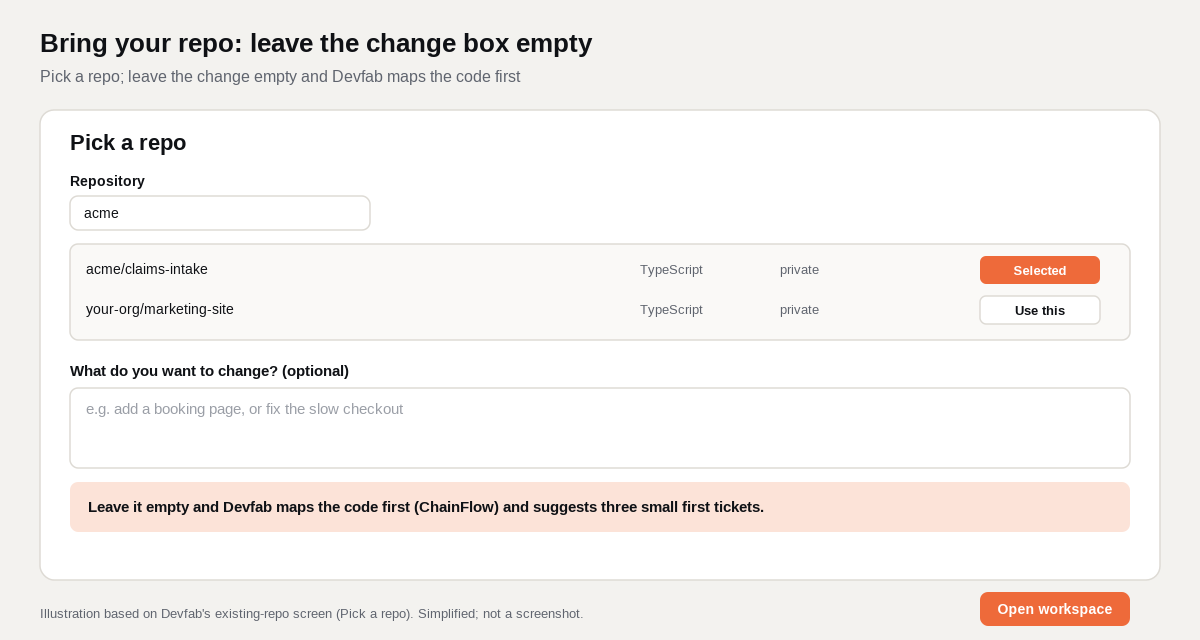
- Choose "Work on an existing project" in Devfab and pick the repo.
- Leave the change box empty. ChainFlow maps the code first: which functions and APIs call each other and what is deployed. Then it suggests three small first tickets.
- Review and approve the plan. The Planner publishes it with a "Your turn" banner, and the Coordinator creates tickets once a person approves.
- Turn on "QA agent · review before Done". The QA agent runs UI, flow and logic tests before a ticket closes, which covers part of what AI Checks did on pull requests.
- Keep an editor assistant for hands-on work. Developers can use any IDE tool on the same repo.
Where Continue is the better choice
- You want to own the assistant's source. The Apache-2.0 code is public, and the final release removed telemetry.
- You need an in-editor helper, not a project pipeline. A fork keeps a VS Code extension and CLI your developers already know.
- You already run
cnin CI. If your team scripted Continue's CLI into pipelines, maintaining a fork may cost less than changing tools. - You want what Continue's team builds next. Its co-founder joined Cursor, so that is where future work will show up.
Where Devfab is the better choice
Coding agents automate the developer. Devfab automates the development lifecycle.
- Research before the plan. Say an insurance broker wants a claims intake portal. The Researcher maps key terms, best practices and competitor products, then suggests a prototype before the Planner writes a plan.
- ChainFlow. Devfab's code-intelligence layer shows the impact of a change. Change the claims form, and it shows what else is touched: document upload, status emails and the adjuster's queue.
- QA agent. It runs UI and flow tests (screens, buttons and user journeys clicked end to end) plus logic tests.
- A person approves the plan. Human in the loop is the default mode; Auto is there when you want it.
- Delivery around the code. Deploy to your own server, blueprints and user manuals, and cost logged per task and per project.
Honest limits: Devfab is new and in Beta. It has a smaller community and fewer integrations than mature tools, it is not an editor for hands-on coding, and it needs a GitHub account.
FAQ
Is Continue still available?
Not as a product. Continue was acquired by Cursor around June 16, 2026 and discontinued. Recurring billing is disabled, and users had until July 15, 2026 to export their data. The Apache-2.0 source code is still public, so anyone can fork and maintain it.
What should Continue users switch to?
It depends on what you used it for. If you want an in-editor assistant, Cursor is where Continue's team went, and open-source agents such as Kilo Code or Cline cover similar ground. If you want a whole project planned, built, tested and deployed, an AI software factory such as Devfab is a different kind of tool.
Can I keep using my own Continue fork?
Yes. The final 2.0.0 release removed telemetry, and the codebase stays public under the Apache-2.0 license. You take on updates, security fixes and model integrations yourself.
Is Devfab a replacement for an IDE assistant like Continue?
No. Devfab is not an editor for hands-on coding. It runs the project lifecycle: research, a plan a person approves, tickets, dev agents, QA tests and deploy. Developers can keep any editor or assistant on the same GitHub repository.
Read next
- What is an AI software factory?
- Continue alternatives for teams that ship to production
- Cursor vs Continue
- AI software factory vs AI coding tools
Moving off Continue? Point Devfab at your repo and see the map first. Try Beta
Sources (checked November 2026): continue.dev ("Continue has joined Cursor"); The New Stack: Cursor acquires Continue (Jun 22, 2026); DEV Community: Cursor acquires Continue and sets a July 15 export deadline (Jun 24, 2026); Continue blog: From Extension to Mission Control (Feb 17, 2026).
Frequently asked questions
Is Continue still available?
Not as a product. Continue was acquired by Cursor around June 16, 2026 and discontinued. Recurring billing is disabled, and users had until July 15, 2026 to export their data. The Apache-2.0 source code is still public, so anyone can fork and maintain it.
What should Continue users switch to?
It depends on what you used it for. If you want an in-editor assistant, Cursor is where Continue's team went, and open-source agents such as Kilo Code or Cline cover similar ground. If you want a whole project planned, built, tested and deployed, an AI software factory such as Devfab is a different kind of tool.
Can I keep using my own Continue fork?
Yes. The final 2.0.0 release removed telemetry, and the codebase stays public under the Apache-2.0 license. You take on updates, security fixes and model integrations yourself.
Is Devfab a replacement for an IDE assistant like Continue?
No. Devfab is not an editor for hands-on coding. It runs the project lifecycle: research, a plan a person approves, tickets, dev agents, QA tests and deploy. Developers can keep any editor or assistant on the same GitHub repository.