Short answer: Choose Devin if you want to assign tickets from Slack, Teams, Linear or Jira to an agent that works in its own hosted machine and returns pull requests. Choose Claude Code if your developers want an agent they can script, run in CI and point at your own cloud account for model inference.
You have read the pitch from each side. Devin's camp says an autonomous engineer should take whole tickets. Claude Code's camp says developers should stay in control and script the agent. Vendor pages make this harder to judge. Devin's own comparison page describes Claude Code as a terminal and IDE tool on your local machine. Anthropic's docs list much more. This page checks both against their own docs, as of November 13, 2026.
In this comparison:
- Devin and Claude Code at a glance
- Feature comparison
- Cost model by team size
- Where Devin wins and where Claude Code wins
- Where Devfab fits
The facts come first, then the verdicts.
Devin and Claude Code at a glance
Devin, from Cognition, is "an autonomous AI software engineer that can write, run and test code". Each session runs on its own isolated machine with a shell, an IDE and a browser. You can watch and take over. Work comes in through the web app, Slack, Microsoft Teams, the Devin for Terminal CLI or the API. Since June 2, 2026, the Devin family also includes Devin Desktop, the IDE formerly called Windsurf.
Claude Code, from Anthropic, is an agentic coding tool that reads your codebase, edits files, runs commands and opens pull requests. It runs in the terminal, VS Code and JetBrains, a desktop app, the web and the Claude mobile apps. Plan mode has Claude explore the codebase and propose an approach for your approval before it edits. Cloud scheduled tasks run when your computer is off.
The fact-check. Devin's comparison page says Claude Code runs "as a CLI tool inside your terminal, or as an extension in VS Code and JetBrains". That is true but incomplete. Anthropic's overview also lists the web, desktop and mobile apps, Slack, GitHub Actions and GitLab CI/CD. Read vendor comparisons, including this one, with the sources open.
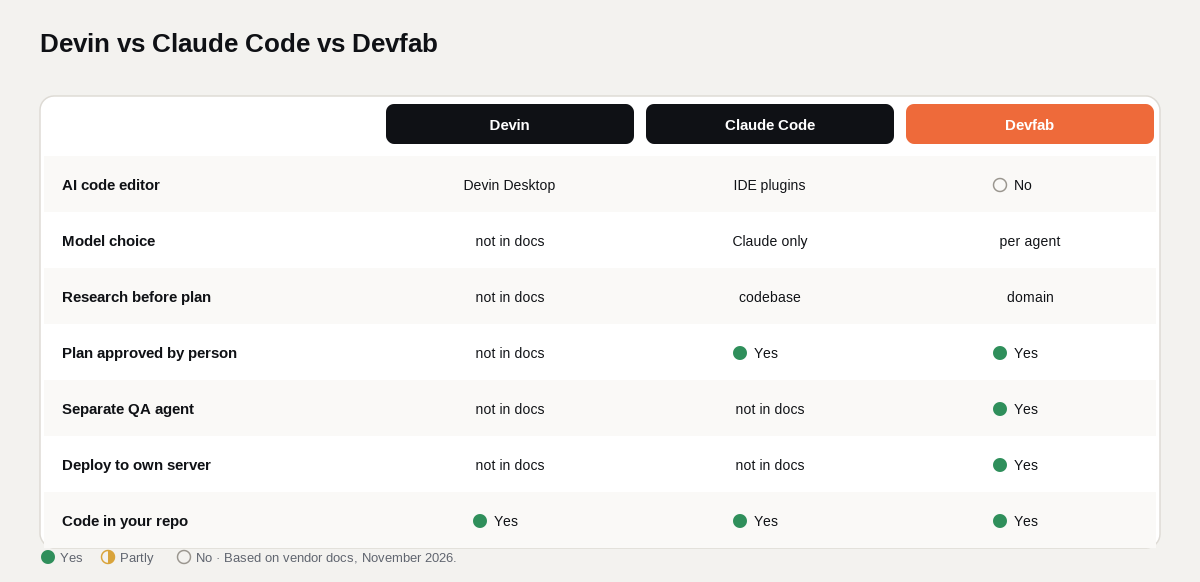
Feature comparison
| Aspect | Devin | Claude Code | Source |
|---|---|---|---|
| Where it runs | Cognition's cloud: web app, Slack, Teams, CLI, API; Devin Desktop IDE | Terminal, VS Code, JetBrains, desktop, web, mobile; GitHub Actions, GitLab CI/CD, Slack | Devin docs; Claude Code overview |
| Planning | Best with clear prompts and explicit completion criteria; split hard work into steps | Plan mode proposes an approach for approval before editing | Devin docs; Claude Code costs |
| Agent autonomy | Isolated machine per session; subagents open their own PRs | Subagents, background agents, experimental agent teams | Devin Desktop; Claude Code overview |
| Testing and review | Writes, runs and tests code; Devin Review | Code Review posts severity-ranked comments; it does not build or run code | Devin docs; Claude Code Review |
| Hosting and data | Multi-tenant, single-tenant VPC or customer-managed keys; brain stays in Cognition's cloud | Inference via Anthropic, Bedrock, Google Cloud or Foundry; self-hosted cloud sessions | Devin deployment; Claude Code enterprise |
| Code ownership | Pull requests to your repos | Commits, branches and pull requests in your repo | Devin docs; Claude Code overview |
| Team and admin | Teams up to 100 users, SSO, multiplayer sessions; Enterprise adds SCIM, RBAC | Team: admin tools, SSO, managed settings; Enterprise: roles, compliance API | Devin pricing; Claude Code enterprise |
| Model choice | Not covered in the docs we checked | Claude models only, switchable with /model | Claude Code costs |
| Pricing model | Free, Pro, Max, Teams (team fee plus seats), Enterprise in ACUs | Included in paid Claude plans; Enterprise seat plus usage at API rates | Devin pricing; Claude pricing |
Cost model by team size
| Team size | Devin | Claude Code | Devfab |
|---|---|---|---|
| 1 person | Free with a light agent quota, or Pro and Max; extra usage at API rates | Pro or Max plan (not Free); limits shared across Claude apps; credits at API rates after that | Cost logged per task and per project (Beta) |
| 5 people | Teams: team fee plus per-seat fee, SSO, cost controls | Team plan with Standard or Premium seats, admin tools and SSO | Cost logged per task and per project (Beta) |
| 25 people | Teams or Enterprise, with usage in Agent Compute Units | Team or Enterprise (seat fee plus usage at API rates), or pay-as-you-go via the API or a cloud provider | Cost logged per task and per project (Beta) |
Pricing models as of November 13, 2026, from Devin's pricing page and Claude's pricing page. Anthropic notes that agent teams use roughly 7x more tokens than standard sessions when teammates run in plan mode. Watch that if you plan to run many agents.
Where Devin wins
- Ticket hand-off. Tag Devin in Slack or Teams, or send it tickets from Linear or Jira, and get pull requests back.
- A full machine per task. Each session has a shell, IDE and browser you can watch and take over.
- Backlog work in parallel. Cognition lists migrations, refactors, bug reproduction, unit tests and PR review as good fits.
- Shared sessions. The Teams plan adds multiplayer sessions for up to 100 users.
Where Claude Code wins
- Scripting and CI. Developers can pipe it, run it in GitHub Actions or GitLab CI/CD, and build their own agents with the Agent SDK, hooks and skills.
- Inference in your own cloud. Bedrock, Google Cloud's Agent Platform or Microsoft Foundry, plus corporate proxies and LLM gateways.
- Admin control over local config. Security teams can set managed permissions that local config cannot override.
- Verified review comments. Code Review runs several agents per pull request and filters false positives before it comments.
- Bundled with Claude plans. If your team already pays for Claude, there may be no new vendor to approve.
Switching from one to the other
Both tools commit to your own repository, so the code moves with you.
- Use AGENTS.md as the shared instruction file. Devin reads AGENTS.md before it starts and includes the first 16 KiB of each file. Claude Code reads CLAUDE.md or AGENTS.md.
- Bring over other rules. Devin's docs offer a migration prompt for rules written for other coding agents.
- Terminal users moving to Devin can start with Devin for Terminal and use
/handoffto pass work to cloud Devin. - Re-add integrations. Reconnect Slack, your tracker and any MCP servers in the new tool.
- Test on one ticket. Run the same scoped ticket through both and compare the pull requests.
Where Devfab fits
Devin and Claude Code both deliver code changes. Neither is built to give a client an approved plan, a QA report and a deployed app as one process.
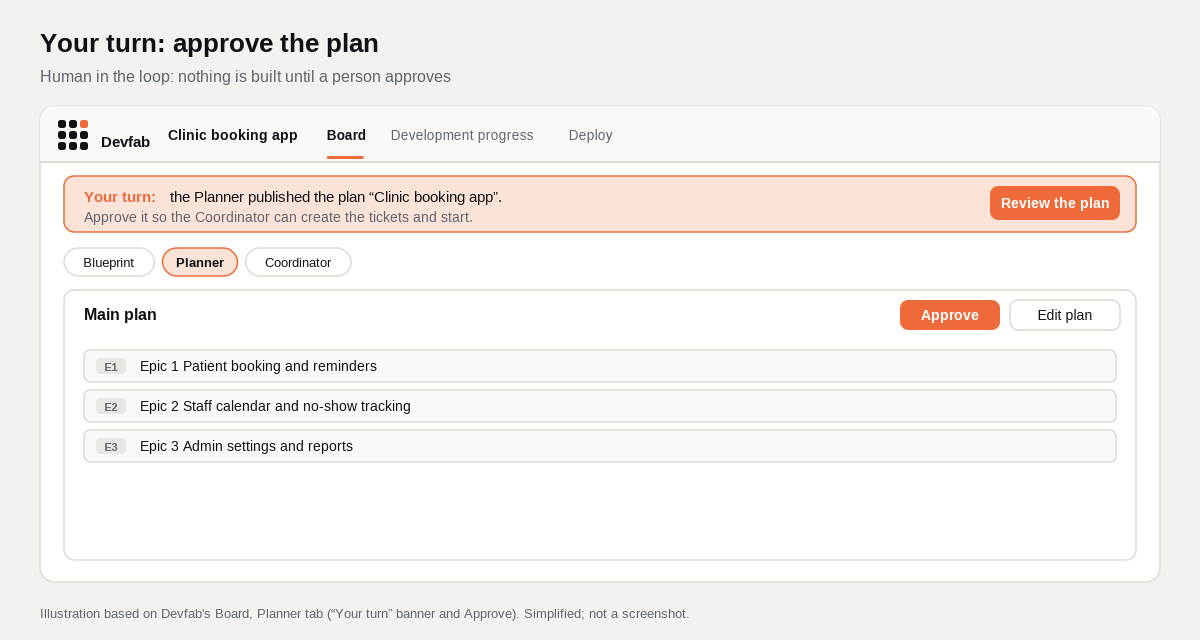
Coding agents automate the developer. Devfab automates the development lifecycle. The Researcher maps the domain first: key terms, best practices and competitors. The Planner writes the plan, and a person approves it before any tickets exist. Dev agents work with ChainFlow, which maps which functions and APIs call each other, so a change to checkout shows its impact on payments and notifications. The QA agent runs UI, flow and logic tests, and the app deploys to your own server.
Honest limits: Devfab is new and in Beta, with a smaller community and fewer integrations. It is not an editor or a scriptable CLI, and it needs a GitHub account. Compare in detail: Devfab vs Devin and Devfab vs Claude Code.
FAQ
Is Claude Code only a terminal tool?
No. Anthropic's docs list a terminal CLI, VS Code and JetBrains extensions, a desktop app, the web at claude.ai/code and the Claude mobile apps. Cloud scheduled tasks can also run when your computer is off. Some vendor comparison pages still describe it as terminal-only.
Can I keep model inference inside my own cloud account?
With Claude Code, yes: Anthropic documents inference through Amazon Bedrock, Google Cloud's Agent Platform or Microsoft Foundry, plus LLM gateways. With Devin, the dedicated option is a single-tenant VPC hosted by Cognition, and its docs say the agent's brain always runs in Cognition's cloud.
Which is easier for non-developers to hand work to?
Devin. You can tag it in a Slack or Microsoft Teams thread, or assign it a ticket, and it returns a pull request. Claude Code also takes requests in Slack, but most of its power is aimed at developers who configure and script it.
Does Claude Code's review test my code?
No. Anthropic says Code Review reads the diff and surrounding code without building or running it, and a review with no findings does not mean the code is error-free or secure. Devin writes, runs and tests code in its own machine before opening a pull request.
Read next
- What is an AI software factory?
- Claude Code alternatives for teams that ship to production (2026)
- Cloud coding agents vs local coding agents: pros and cons
- Devfab vs Devin: which fits a team that ships client work?
- Devfab vs Claude Code: which fits a team that ships client work?
Want a plan your client approves before agents write code? Try Devfab Beta
Sources (checked November 13, 2026): Devin Docs: Introducing Devin; Devin Desktop; Devin Docs: Enterprise deployment; Devin Docs: AGENTS.md; Devin Pricing; Devin vs Claude Code (Cognition); Claude Code Docs: Overview; Claude Code Docs: Enterprise deployment; Claude Code Docs: Code Review; Claude Code Docs: Manage costs; Claude Pricing.
Frequently asked questions
Is Claude Code only a terminal tool?
No. Anthropic's docs list a terminal CLI, VS Code and JetBrains extensions, a desktop app, the web at claude.ai/code and the Claude mobile apps. Cloud scheduled tasks can also run when your computer is off. Some vendor comparison pages still describe it as terminal-only.
Can I keep model inference inside my own cloud account?
With Claude Code, yes: Anthropic documents inference through Amazon Bedrock, Google Cloud's Agent Platform or Microsoft Foundry, plus LLM gateways. With Devin, the dedicated option is a single-tenant VPC hosted by Cognition, and its docs say the agent's brain always runs in Cognition's cloud.
Which is easier for non-developers to hand work to?
Devin. You can tag it in a Slack or Microsoft Teams thread, or assign it a ticket, and it returns a pull request. Claude Code also takes requests in Slack, but most of its power is aimed at developers who configure and script it.
Does Claude Code's review test my code?
No. Anthropic says Code Review reads the diff and surrounding code without building or running it, and a review with no findings does not mean the code is error-free or secure. Devin writes, runs and tests code in its own machine before opening a pull request.