Short answer: OpenHands wins when you need open source, your own model keys and agents that run fully inside your infrastructure, with room to plug in Claude Code or Codex. Devin wins when you want a managed AI engineer that takes scoped tickets from Slack, Teams, Linear or Jira, works in its own cloud workspace and returns pull requests.
You have a backlog of well-scoped tickets and want agents to take some of them. One camp says buy Devin and skip the setup. The other says run OpenHands so the code, the keys and the agent stay on your side. Both changed a lot in 2026, and the answer now turns on one question: where does the agent run? This page compares both fairly, with sources.
In this comparison:
- OpenHands and Devin at a glance
- Feature comparison
- Cost model by team size
- Where OpenHands wins and where Devin wins
- Where Devfab fits
Here is the evidence, section by section.
OpenHands and Devin at a glance
Status changes in 2026. OpenHands introduced Agent Canvas on June 16, 2026 and calls it its main interface going forward (OpenHands blog). Monthly releases followed; the September releases added /plan and /code modes, automation templates, Docker runtimes and repo-installable Apps (OpenHands blog). The GitHub repo now lives at OpenHands/OpenHands (GitHub). For Devin, Cognition introduced usage-based self-serve plans in March 2026 (Devin docs), and on June 2, 2026 Windsurf was renamed Devin Desktop and joined the Devin product family (Devin docs).
OpenHands is an open-source (MIT) platform for running AI coding agents and automations. Agent Canvas is a desktop and web workspace that connects to local machines, Docker, remote VMs, Kubernetes, Modal or enterprise VPCs (OpenHands blog). It serves individuals who self-host for free, engineering teams and enterprises (OpenHands pricing).
Devin is Cognition's "autonomous AI software engineer that can write, run and test code" (Devin docs). Each session has a shell, an IDE and a browser, and you can watch and take over. You reach it from the web app, Slack, Microsoft Teams, the Devin for Terminal CLI or the API.
Feature comparison
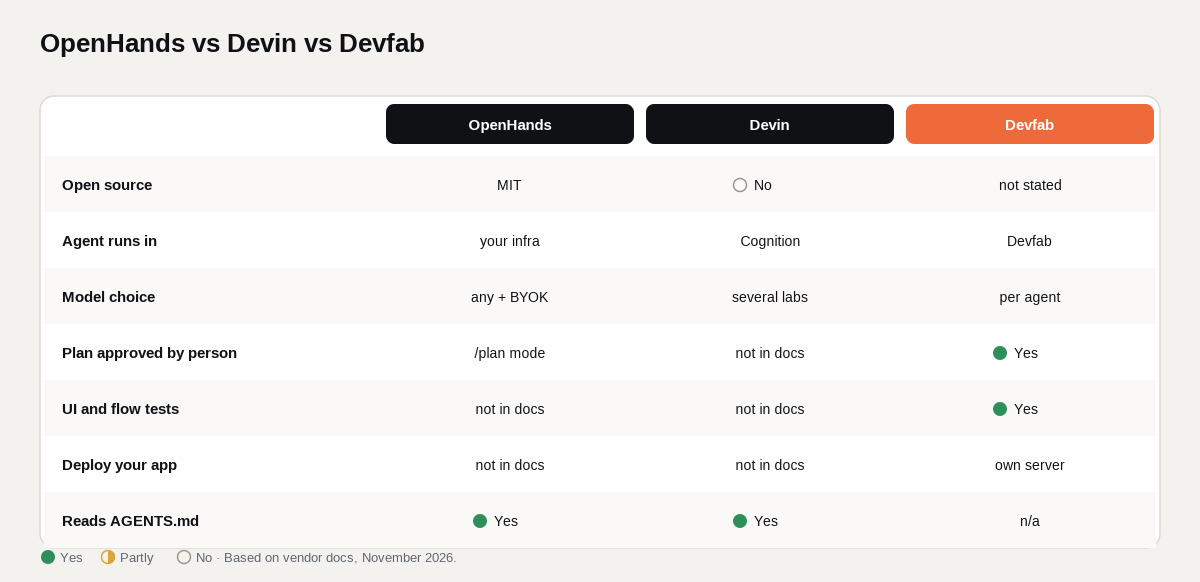
| Aspect | OpenHands | Devin | Source |
|---|---|---|---|
| Where it runs | Agent Canvas on a laptop, VM, Docker, Kubernetes, Modal, VPC or OpenHands Cloud; Python SDK | Cognition's cloud; web app, Slack, Teams, CLI with /handoff, API, Devin Desktop | OpenHands blog; Devin docs |
| Planning | /plan and /code modes | Works best on scoped tasks with explicit completion criteria | OpenHands blog; Devin docs |
| Agent autonomy | Scheduled and event-triggered automations; parallel sessions in one workspace | Subagents split long tasks, each opening its own PRs | OpenHands blog; Devin Desktop |
| Review and testing | PR review automations; optional Docker runtime per conversation | Built-in Devin Review; writes and runs tests in its workspace | OpenHands blog; Devin Desktop |
| Deploy and hosting of your app | Not covered in the docs we checked | Not covered in the docs we checked | — |
| Self-hosting | Free and MIT-licensed; VPC on Enterprise | Single-tenant VPC hosted by Cognition; agent always runs in Cognition's cloud | OpenHands pricing; Devin enterprise |
| Team and admin | Teams: RBAC, SSO/SAML, budgets; Enterprise: audit of every action | Teams: SSO, cost controls, centralized billing; Enterprise: SCIM, RBAC | OpenHands pricing; Devin pricing |
| Model choice | Closed and open-weight models, LLM Profiles, BYOK; Claude Code and Codex harnesses | Frontier models from several labs, open-source models, and your ChatGPT plan on Pro and Max | OpenHands; Devin pricing |
| Pricing model | Free self-hosted; Teams flat fee for 10 users plus seats; Enterprise custom | Free, Pro, Max; Teams base fee plus seats; Enterprise in ACUs | OpenHands pricing; Devin usage |
Cost model by team size
| Team size | OpenHands | Devin | Devfab |
|---|---|---|---|
| 1 person | Free to self-host; pay your model provider | Free with a light quota; Pro USD 20; Max USD 200 | Cost logged per task and per project (Beta) |
| 5 people | Teams USD 500 a month flat for up to 10 users, 5,000 sessions a month, 30-day trial; models extra | Teams USD 80 a month plus USD 40 per seat: USD 280 for five, before extra usage | Cost logged per task and per project (Beta) |
| 25 people | Teams plus USD 50 per extra seat, or custom Enterprise with uncapped sessions | Teams (up to 100 users) or Enterprise, measured in ACUs that include compute | Cost logged per task and per project (Beta) |
Prices per month as of November 2026 from OpenHands pricing and Devin pricing; the five-seat total is our arithmetic. OpenHands Teams has you bring your own LLM, so add model costs. Devfab is in Beta and offers predictable cost: cost is logged after each run, per task and per project.
Where OpenHands wins
- Everything must run in your environment. Agents, sandboxes and keys can all live in your VPC.
- You want open source. MIT license, so you can modify and extend what you build.
- You want to mix harnesses. Run OpenHands' agent, Claude Code or Codex from one workspace.
- Open-weight models matter. Run Kimi, DeepSeek or Qwen locally, in the cloud or in a VPC, and switch per task.
- Your Git host isn't GitHub. Apps install from GitHub, GitLab, Bitbucket, Gitea or Forgejo URLs.
Where Devin wins
- You don't want to run infrastructure. Each session gets its own isolated machine in Cognition's cloud.
- Tickets arrive in chat. Tag Devin in a Slack or Teams thread, or send parallel tickets from Linear or Jira.
- You want to watch and take over. The shell, IDE and browser are visible in real time.
- Five to ten developers on a budget. Before extra usage, Devin Teams costs less than OpenHands' flat Teams fee at that size.
- You want a desktop IDE too. Devin Desktop hands sessions from local to cloud.
Switching from one to the other
From Devin to OpenHands. Devin reads AGENTS.md, so you likely have one. OpenHands' docs build on an AGENTS.md at the repository root (OpenHands docs). Install Agent Canvas via npm or Docker, add your model key, connect GitHub, Slack or Linear, and recreate recurring jobs as automations. Plan who will own updates, sandboxes and keys.
From OpenHands to Devin. Devin looks for AGENTS.md before it starts coding and reads up to 16 KiB from the start of each file (Devin docs), so put critical rules first. For other agents' rules, Cognition offers a migration prompt.
Where Devfab fits
OpenHands and Devin both take tickets and return pull requests. In the docs we checked, neither researches the domain before planning, runs a separate QA step with UI and flow tests, or deploys the finished app.
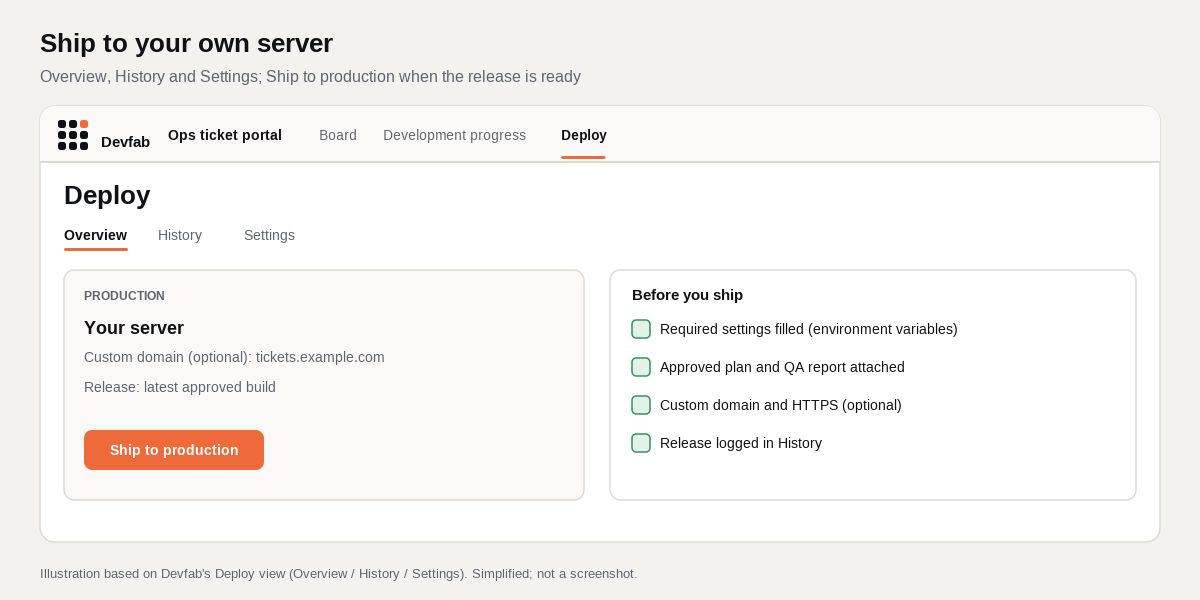
Coding agents automate the developer. Devfab automates the development lifecycle. The Researcher maps the domain before the Planner writes a plan, and a person approves that plan; the Coordinator then turns it into tickets for dev agents. ChainFlow shows each agent which connected features a change can break. The QA agent runs UI, flow and logic tests, and Deploy ships to your own server. Code stays in your own GitHub account.
Honest limits: Devfab is new and in Beta, with fewer integrations and a smaller community. It is not open source, not an IDE, and it needs a GitHub account. See Devfab vs OpenHands and Devfab vs Devin.
FAQ
Can I run Devin entirely on my own infrastructure?
No. Cognition's enterprise docs say Devin's agent always runs in Cognition's cloud, even in the single-tenant Customer Dedicated Deployment, which connects to your systems over AWS PrivateLink or IPSec. OpenHands is MIT-licensed and can run on a laptop, a VM, Docker, Kubernetes or your own VPC.
Which is cheaper for a team of five?
As of November 2026, Devin Teams is USD 80 a month plus USD 40 per developer seat, so five seats come to USD 280 a month before extra usage. OpenHands Teams is USD 500 a month for up to 10 users, and you pay your model provider separately. Self-hosting OpenHands for one person is free apart from model costs.
Can OpenHands run Claude Code or Codex?
Yes. OpenHands says Agent Canvas supports third-party harnesses such as Claude Code and Codex through the Agent Client Protocol, next to its own agent. Devin uses its own agent.
Do both read AGENTS.md?
Yes. Devin looks for AGENTS.md before it starts coding and includes up to 16 KiB from the start of each file. OpenHands' docs ask you to have it create an AGENTS.md at the repository root that summarizes purpose, setup and structure.
Read next
Want an approved plan, QA and deploy around your agents? Try Beta
Sources (checked November 13, 2026): OpenHands homepage; OpenHands pricing; OpenHands on GitHub; OpenHands blog: Introducing Agent Canvas (Jun 16, 2026); OpenHands blog: New in September 2026; OpenHands docs: Repository skills; Devin docs: Introducing Devin; Devin pricing; Devin docs: Enterprise deployment; Devin docs: Usage and billing; Devin docs: Devin Desktop FAQ; Devin docs: AGENTS.md; Devin Desktop.
Frequently asked questions
Can I run Devin entirely on my own infrastructure?
No. Cognition's enterprise docs say Devin's agent always runs in Cognition's cloud, even in the single-tenant Customer Dedicated Deployment, which connects to your systems over AWS PrivateLink or IPSec. OpenHands is MIT-licensed and can run on a laptop, a VM, Docker, Kubernetes or your own VPC.
Which is cheaper for a team of five?
As of November 2026, Devin Teams is USD 80 a month plus USD 40 per developer seat, so five seats come to USD 280 a month before extra usage. OpenHands Teams is USD 500 a month for up to 10 users, and you pay your model provider separately. Self-hosting OpenHands for one person is free apart from model costs.
Can OpenHands run Claude Code or Codex?
Yes. OpenHands says Agent Canvas supports third-party harnesses such as Claude Code and Codex through the Agent Client Protocol, next to its own agent. Devin uses its own agent.
Do both read AGENTS.md?
Yes. Devin looks for AGENTS.md before it starts coding and includes up to 16 KiB from the start of each file. OpenHands' docs ask you to have it create an AGENTS.md at the repository root that summarizes purpose, setup and structure.