Short answer: Claude Code wins when developers want one actively developed agent they can script across terminal, IDE, web and CI, with verified per-seat prices. Augment Code wins when a large organization needs deep context on huge repos, prebuilt agent "Experts" and Harness CI/CD ties, and can wait for Harness to clarify contracts.
You run a platform team with a monorepo nobody fully understands. One side of the room wants Claude Code in every terminal. The other wants Augment's Context Engine indexing everything. Then in October, Augment's core products moved to Harness.
This page treats it as a debate between two real options and acts as the referee. Every fact below comes from vendor pages or dated reports, checked on November 20, 2026.
In this comparison:
- Claude Code and Augment Code at a glance
- Feature comparison
- Where Claude Code wins
- Where Augment Code wins
- Where Devfab fits
Read the ownership news first; it changes the risk on one side.
Claude Code and Augment Code at a glance
Augment Code's core products now belong to Harness. On October 8, 2026, Harness acquired select Augment Code assets: Cosmos, the Auggie CLI, the Code Context Engine and related technology. Cosmos is now called the "Harness Cosmos Software Factory Agent," and the team joins Harness (Harness press release). Augment wrote that "The team behind these products is moving to Harness," with no pricing or migration details (Augment blog). BERI noted that neither company has said what happens to existing contracts, prepaid credits or code indexes, and that the IDE plugins were not named (BERI, Oct 9, 2026).
Augment is built for large engineering organizations. Its products are Cosmos, a software factory that runs agent loops from a ticket, PR or alert through prebuilt Experts; the Auggie CLI; IDE agents for VS Code and JetBrains; and Code Review (Augment docs; Cosmos).
Claude Code is Anthropic's agentic coding tool. It reads your codebase, edits files, runs commands and opens pull requests from the terminal, VS Code, JetBrains, a desktop app, the web and mobile (Claude Code overview). You customize it with CLAUDE.md, skills, hooks and MCP servers, and build your own agents with the Agent SDK.
The core difference: Claude Code gives developers a flexible agent and leaves the workflow to you. Augment sells codebase context and prebuilt workflows on top of it.
Feature comparison
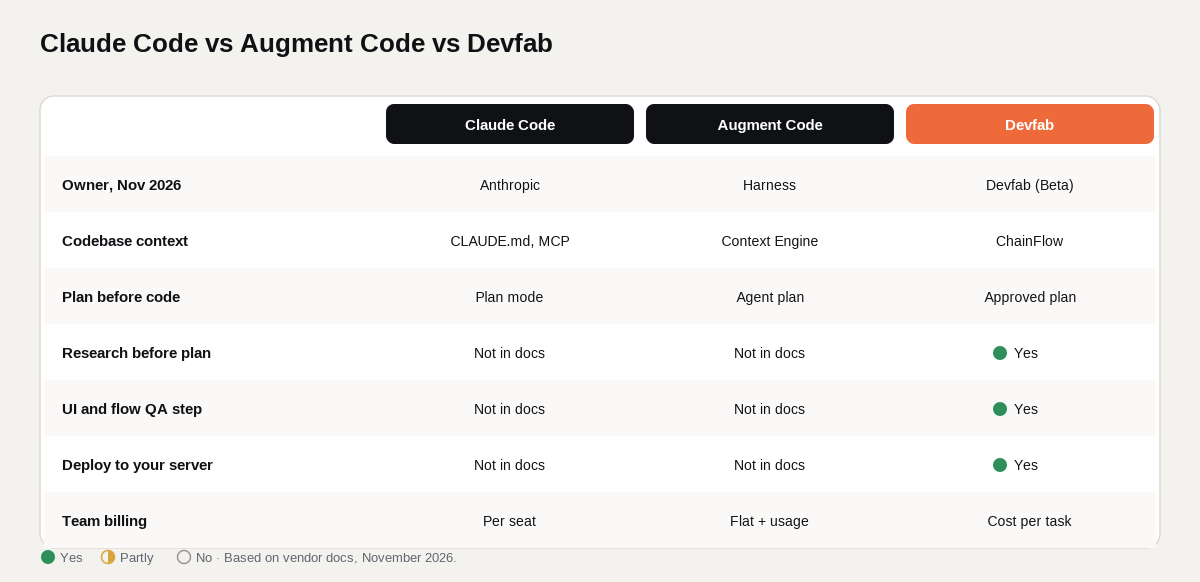
| Aspect | Claude Code | Augment Code | Source |
|---|---|---|---|
| Where it runs | Terminal, VS Code, JetBrains, desktop, web, mobile, GitHub Actions, GitLab CI/CD, Slack | Cosmos, Auggie CLI, VS Code, JetBrains, Cloud Agents, Code Review | Claude Code overview; Augment docs |
| Planning | Plan mode proposes an approach for approval | Augment Agent breaks a request into a plan, with checkpoints | Claude Code costs; Augment Agent |
| Agent autonomy | Subagents, background agents, cloud scheduled tasks | Cosmos loops in isolated VMs with Experts such as Deep Code Reviewer and CI Failure Investigator | Claude Code overview; Cosmos |
| Review and testing | Managed Code Review posts ranked comments; never approves or blocks a PR | Quality gates and human approval checkpoints in Cosmos | Code Review docs; Cosmos |
| Codebase context | CLAUDE.md, auto memory, MCP | Context Engine, also offered as an MCP server and SDK | Claude Code overview; Context Services |
| Deploy and hosting | Not covered in the docs we checked | Not covered in the docs we checked | — |
| Team and admin | Team: SSO, admin tools; Enterprise: role-based permissions, compliance API, spend limits | Enterprise: SSO, OIDC, SCIM, CMEK, SIEM, data residency, audit trails | Enterprise deployment; Augment pricing |
| Model choice | Claude models only | Prism routes each turn to a model | Claude Code costs; Cosmos |
| Pricing model | Included in paid Claude plans; per seat on Team | Flat team plans with no per-seat charge; usage billed in dollars; LLM usage at list price plus a flat 40% service fee | Claude pricing; Augment pricing |
Cost model by team size
| Team size | Claude Code | Augment Code | Devfab |
|---|---|---|---|
| 1 person | Pro USD 20 per month; Max USD 100 per month | Standard USD 20 per month flat, plus usage | Cost logged per task and per project (Beta) |
| 5 people | Team Standard USD 25 per user per month (USD 20 annual) | Business USD 100 per month flat, no per-seat charge, plus usage | Cost logged per task and per project (Beta) |
| 25 people | Team, or Enterprise at USD 20 per seat per month billed annually plus usage at API rates | Business (flat plans cover up to 50 seats) or Enterprise (custom) | Cost logged per task and per project (Beta) |
Prices as of November 2026 from Claude pricing and Augment pricing. Augment lists no free tier, and its pricing page shows no Harness migration notice. Devfab is in Beta and offers predictable cost: cost is logged after each run, per task and per project.
Where Claude Code wins
- You want low vendor risk this quarter. Claude Code is actively developed by Anthropic, with no pending ownership change.
- Developers want to build their own workflows with the Agent SDK, hooks, skills and MCP rather than adopt prebuilt Experts.
- Inference must stay in your cloud account. Claude Code runs through Amazon Bedrock, Google Cloud or Microsoft Foundry, or behind your own LLM gateway.
- You want clear per-seat billing with org spend limits, an analytics dashboard and per-user reporting.
- Your team works across many surfaces: phone, web, desktop and terminal, with sessions you can move between them.
Where Augment Code wins
- Your monorepo is very large and context is the bottleneck. The Context Engine is Augment's core product, and you can plug it into other agents through MCP.
- You already run on Harness and want agent loops tied to its delivery, security testing and cost agents, as SD Times reports Harness plans (SD Times).
- You want prebuilt Experts for code review, CI failures and security triage, triggered by tickets, PRs or alerts.
- You need more than one model family. Prism routes each turn to a model; Claude Code uses Claude models only.
- You want a flat team fee instead of per-seat billing, for teams up to 50 seats.
Switching from one to the other
From Augment to Claude Code. Both work in your existing repository, so there is no code to export. Move rules and guidance into CLAUDE.md, add your MCP servers, and set org spend limits. If you liked Augment's index, you can keep the Context Engine as an MCP server inside Claude Code (Context Services). Ask Harness what happens to prepaid credits first.
From Claude Code to Augment. Install the Auggie CLI or an IDE plugin, connect GitHub or GitLab, and let the Context Engine index the repo. Harness says Cosmos is available at cosmos.augmentcode.com (Harness press release).
Where Devfab fits
Augment now calls Cosmos a software factory, so the line between tools is blurring. The difference is where each starts. Cosmos and Claude Code start from a ticket or a prompt in an existing codebase. Devfab starts from the project: the Researcher maps the domain, the Planner writes the plan, and a person approves the plan before tickets exist.
Coding agents automate the developer. Devfab automates the development lifecycle. On a warehouse picking app, changing pick routes can affect stock counts, shipping labels and reorder alerts. Devfab's ChainFlow maps which functions and APIs call each other and what is deployed, so dev agents see that impact before they change code. The QA agent then runs UI, flow and logic tests. Devfab is in Beta, with fewer integrations than mature platforms, and it needs a GitHub account. See Devfab vs Claude Code and Devfab vs Augment Code.
FAQ
Who owns Augment Code now?
Harness acquired select Augment Code assets on October 8, 2026: Cosmos, the Auggie CLI, the Context Engine and related technology. Cosmos was renamed Harness Cosmos Software Factory Agent, and the team moved to Harness. The augmentcode.com site now carries a Harness copyright line.
Can I use Augment's Context Engine with Claude Code?
Yes. Augment offers the Context Engine as an MCP server that works from Claude Code, Codex and Gemini CLI, and also as a TypeScript or Python SDK. That lets you keep Claude Code as the agent and add Augment's codebase index on top.
Which is cheaper for a team of five?
As of November 2026, Augment's Business plan is USD 100 per month flat with no per-seat charge, plus usage. Claude's Team Standard plan is USD 25 per user per month. Both bill extra usage, so compare your expected volume, not only the base fee.
Are Augment's IDE plugins still supported?
Augment's docs still list a VS Code extension and a JetBrains plugin. A BERI report from October 9, 2026 notes that neither Harness nor Augment named the IDE plugins in the deal announcements, so their future is unstated. Ask Harness before you commit.
Read next
- What is an AI software factory?
- Augment Code alternatives for teams that ship to production (2026)
- AI software factory vs AI coding tools
- Claude Code vs OpenHands
Want the plan, the tests and the deploy in one place? Try Beta
Sources (checked November 2026): Harness: Harness acquires Augment Code (Oct 8, 2026); Augment Code blog: next chapter; Augment Code pricing; Augment Code: Cosmos software factory; Augment docs; Augment docs: Agent; Augment docs: Context Services; SD Times (Oct 8, 2026); BERI (Oct 9, 2026); Claude Code docs: overview; Claude Code docs: manage costs; Claude Code docs: Code Review; Claude Code docs: enterprise deployment; Claude pricing.
Frequently asked questions
Who owns Augment Code now?
Harness acquired select Augment Code assets on October 8, 2026: Cosmos, the Auggie CLI, the Context Engine and related technology. Cosmos was renamed Harness Cosmos Software Factory Agent, and the team moved to Harness. The augmentcode.com site now carries a Harness copyright line.
Can I use Augment's Context Engine with Claude Code?
Yes. Augment offers the Context Engine as an MCP server that works from Claude Code, Codex and Gemini CLI, and also as a TypeScript or Python SDK. That lets you keep Claude Code as the agent and add Augment's codebase index on top.
Which is cheaper for a team of five?
As of November 2026, Augment's Business plan is USD 100 per month flat with no per-seat charge, plus usage. Claude's Team Standard plan is USD 25 per user per month. Both bill extra usage, so compare your expected volume, not only the base fee.
Are Augment's IDE plugins still supported?
Augment's docs still list a VS Code extension and a JetBrains plugin. A BERI report from October 9, 2026 notes that neither Harness nor Augment named the IDE plugins in the deal announcements, so their future is unstated. Ask Harness before you commit.