Short answer: Choose Devin if you want an agent that takes tickets from Slack, Teams, Linear or Jira, works across several repositories and returns pull requests. Choose GitHub Copilot if your code, issues and reviews already live on GitHub and you want completions, chat and a cloud agent inside that workflow at a per-seat price.
Your developers already have Copilot. Now someone wants Devin for the backlog. Is that a second bill for the same job? Not quite. The two tools bill in different units, start work from different places and hit different limits. Copilot's cloud agent has hard limits per session that most reviews skip. Devin's usage is measured in compute units. This page lays out both sides with sources, as of November 13, 2026.
In this comparison:
- Devin and GitHub Copilot at a glance
- Feature comparison
- Cost model by team size
- Where Devin wins and where GitHub Copilot wins
- Where Devfab fits
Start with the section that matches your question.
Devin and GitHub Copilot at a glance
Recent changes. GitHub moved Copilot plans to GitHub AI Credits and added a Copilot Max tier above Pro+. Request-based billing is now listed as legacy. A new "Copilot in the cloud" experience reached paid plans on October 28, 2026. Enterprise AI Controls and the agent control plane went GA on February 26, 2026. On Cognition's side, Windsurf became Devin Desktop on June 2, 2026.
Devin is "an autonomous AI software engineer that can write, run and test code". Each session runs on its own isolated machine with a shell, IDE and browser. You start it from the web app, Slack, Teams, a CLI or the API. It can split long work across subagents, each opening its own pull requests. It suits teams that want to delegate whole tickets.
GitHub Copilot is an AI assistant built into GitHub, IDEs and the terminal. It offers completions, chat and agent mode in the editor, plus a cloud agent that takes assigned work and opens pull requests. The cloud agent can research a repository and "create an implementation plan" first. It suits developers and organizations already on GitHub.
Feature comparison
| Aspect | Devin | GitHub Copilot | Source |
|---|---|---|---|
| Where it runs | Web app, Slack, Teams, Devin for Terminal, API; Devin Desktop IDE | GitHub.com, Mobile, IDEs, Copilot CLI, Copilot desktop app | Devin docs; Copilot features |
| Planning | Best with explicit completion criteria; split hard tasks into steps | Cloud agent can research the repo and create an implementation plan | Devin docs; Copilot features |
| Agent autonomy | Isolated machine per session; subagents with their own PRs | Actions-based sessions: one repo, one branch, one PR, 59-minute maximum; sandboxes can span repos in one org | Devin Desktop; Copilot cloud agent |
| Testing and review | Writes, runs and tests code; Devin Review | PR code review on paid plans; GitHub warns output can include security vulnerabilities | Devin docs; Copilot plans |
| Hosting | Cognition cloud, or single-tenant VPC hosted by Cognition | GitHub Actions environment or a cloud sandbox | Devin deployment; Copilot cloud agent |
| Code ownership | Pull requests to your repos | Cloud agent "only works with repositories hosted on GitHub" | Devin docs; Copilot cloud agent |
| Team and admin | Teams up to 100 users, SSO; Enterprise adds SCIM, RBAC | Policies, usage data, file exclusions; Enterprise audit logs and AI Controls | Devin pricing; GitHub changelog |
| Model choice | Not covered in the docs we checked | OpenAI, Anthropic, Google, Microsoft, Moonshot AI and xAI models; Claude and Codex agents (preview) on paid plans | Copilot models; Copilot plans |
| Pricing model | Free, Pro, Max, Teams (team fee plus seats), Enterprise in ACUs | Free tier; individual tiers with AI credits; Business and Enterprise per seat with pooled credits | Devin pricing; Copilot plans |
Cost model by team size
| Team size | Devin | GitHub Copilot | Devfab |
|---|---|---|---|
| 1 person | Free with a light quota, or Pro and Max with higher quotas and cloud agents | Free tier (no coding agent or PR review), or Pro, Pro+ or Max with a monthly credit allowance | Cost logged per task and per project (Beta) |
| 5 people | Teams: a team fee plus per-seat fees | Business, per granted seat, with pooled credits | Cost logged per task and per project (Beta) |
| 25 people | Teams or Enterprise; usage in Agent Compute Units by contract | Business or Enterprise per seat; usage beyond the pool billed per credit | Cost logged per task and per project (Beta) |
Pricing models as of November 13, 2026, from Devin's pricing page and GitHub's Copilot plans. GitHub prices one AI credit at one US cent. Completions and next edit suggestions do not use credits; chat and agent work do.
Where Devin wins
- Work that spans repositories. Devin says it handles changes across multiple repositories in one task.
- Ticket hand-off from outside GitHub. Tag Devin in Slack or Teams, or route Linear and Jira tickets to it.
- Longer, larger tasks. Devin splits long work across subagents; Copilot's Actions-based sessions have a 59-minute maximum and open one PR.
- Git hosts other than GitHub. Copilot's cloud agent works only with GitHub-hosted repositories.
Where GitHub Copilot wins
- Your team lives on GitHub. Issues, PRs, Actions and reviews are already there, and the agent can start from an issue or a code scanning alert.
- Inline help in many editors. Completions, chat and next edit suggestions in VS Code, JetBrains, Xcode, Eclipse and more.
- Agent governance at scale. Enterprise AI Controls add an AI administrator role, agent activity in audit logs and protection for agent definition files.
- Low entry cost. A free tier and per-seat business plans with pooled credits.
- Several agents in one place. Paid plans list Claude and OpenAI Codex as third-party agents (in preview) next to Copilot's own.
Switching from one to the other
Both tools open pull requests in your repositories, so there is nothing to export.
- Write one AGENTS.md. Devin reads AGENTS.md before it starts. Copilot reads AGENTS.md, CLAUDE.md or GEMINI.md, plus
.github/copilot-instructions.md. - Keep tool-specific notes separate. Copilot path rules go in
.github/instructionsasNAME.instructions.mdfiles. Devin's docs offer a migration prompt for rules from other agents. - Check branch protection. GitHub notes that rulesets can block Copilot from creating or updating PRs unless it gets a bypass.
- Pilot on one ticket in both tools and compare the pull requests.
Where Devfab fits
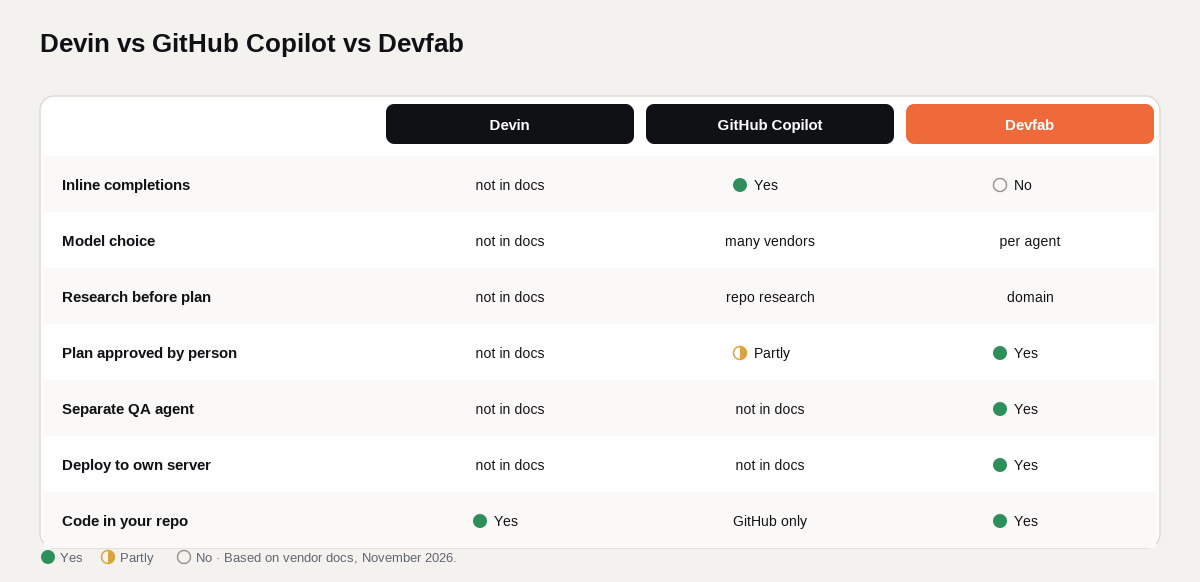
Devin and Copilot both turn tasks into pull requests. Neither is built to run the stages around them: domain research, a plan a client approves, end-to-end UI tests and the deploy.
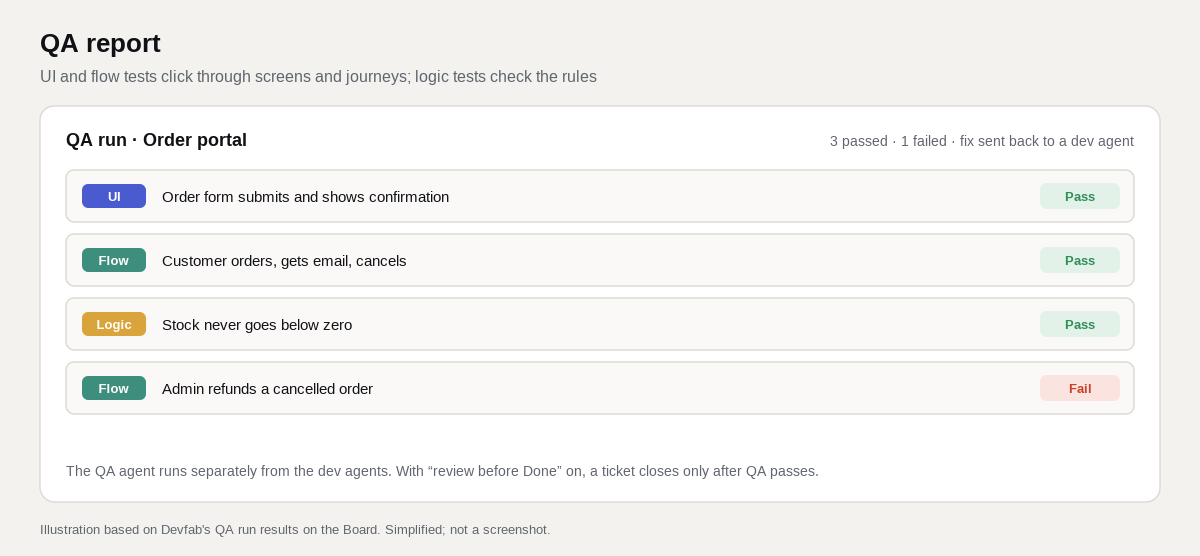
Coding agents automate the developer. Devfab automates the development lifecycle. In Devfab, a person approves the plan, the Coordinator creates tickets, and dev agents build. Then a separate QA agent clicks through screens, buttons and user journeys, and runs logic tests. You can require QA review before a ticket is marked Done. The app deploys to your own server, and cost is logged after each run, per task and per project.
Honest limits: Devfab is new and in Beta, with a smaller community and fewer integrations. It is not an editor, and it needs a GitHub account. Compare in detail: Devfab vs Devin and Devfab vs GitHub Copilot.
FAQ
Can Copilot's cloud agent work across several repositories?
It depends on where it runs. GitHub's docs say an Actions-based session can only change the one repository named at the start, works on one branch and opens one pull request. Cloud sandboxes can work across repositories in one organization. Devin says it handles changes across multiple repositories.
Can I run Devin from inside GitHub Copilot?
Not that we found. GitHub's plans page names Claude and OpenAI Codex as third-party coding agents (in preview) on paid plans and does not mention Devin. Devin connects to your GitHub repositories on its own and opens pull requests there.
How do AI credits and ACUs differ?
Copilot plans now use GitHub AI Credits: chat and agent work consume them, while code completions do not. Devin's Enterprise usage is measured in Agent Compute Units, which include compute and VM costs for cloud agents and code review. Both have included amounts plus paid overage.
Which is safer for an enterprise rollout?
Both have enterprise controls. Copilot Enterprise has GitHub-native agent governance: an AI administrator role, agent activity in audit logs and policy controls. Devin offers SSO, SCIM, RBAC and a single-tenant VPC hosted by Cognition. Pick the one that fits where your code and identity already live.
Read next
- What is an AI software factory?
- GitHub Copilot alternatives for teams that ship to production (2026)
- AI code review vs QA agent: what each one catches
- Devfab vs Devin: which fits a team that ships client work?
- Devfab vs GitHub Copilot: which fits a team that ships client work?
Want UI and flow tests before anything is marked Done? Try Devfab Beta
Sources (checked November 13, 2026): Devin Docs: Introducing Devin; Devin Desktop; Devin Docs: Enterprise deployment; Devin Docs: Usage and billing; Devin Docs: AGENTS.md; Devin vs Claude Code (Cognition); Devin Pricing; GitHub Copilot plans; GitHub Docs: Plans for Copilot; GitHub Docs: Copilot features; GitHub Docs: Copilot cloud agent; GitHub Docs: Supported models; GitHub Docs: Custom instructions; GitHub Changelog: Enterprise AI Controls GA.
Frequently asked questions
Can Copilot's cloud agent work across several repositories?
It depends on where it runs. GitHub's docs say an Actions-based session can only change the one repository named at the start, works on one branch and opens one pull request. Cloud sandboxes can work across repositories in one organization. Devin says it handles changes across multiple repositories.
Can I run Devin from inside GitHub Copilot?
Not that we found. GitHub's plans page names Claude and OpenAI Codex as third-party coding agents (in preview) on paid plans and does not mention Devin. Devin connects to your GitHub repositories on its own and opens pull requests there.
How do AI credits and ACUs differ?
Copilot plans now use GitHub AI Credits: chat and agent work consume them, while code completions do not. Devin's Enterprise usage is measured in Agent Compute Units, which include compute and VM costs for cloud agents and code review. Both have included amounts plus paid overage.
Which is safer for an enterprise rollout?
Both have enterprise controls. Copilot Enterprise has GitHub-native agent governance: an AI administrator role, agent activity in audit logs and policy controls. Devin offers SSO, SCIM, RBAC and a single-tenant VPC hosted by Cognition. Pick the one that fits where your code and identity already live.