Short answer: Hire a freelancer for a small, clear app you can manage yourself. Hire an agency when you need design, development, testing and project management under one accountable company. Use an AI software factory when you want research, a plan you approve, tested code in your own GitHub and deployment to your server, with cost logged per task.
You run a business, and you need an app you can't build yourself. Maybe a booking system for your clinic, a portal for your customers, or a tool your field staff use every day. The old choice was a freelancer or an agency. Now a third option keeps showing up in proposals: AI agents that plan, build and test the app. The wrong pick costs you more than money. It decides who owns the code and who fixes it next year.
In this guide, you'll learn:
- Definitions
- Side by side
- When to choose a freelancer
- When to choose an agency
- Where an AI software factory fits
The rest of this page covers it in order.
Definitions
Freelancer. An independent professional you hire directly. On Upwork, for example, "You communicate directly with the freelancer and manage the contract yourself," and "your payments go straight to them" (Upwork Help). One person usually covers design, code and testing, or hands parts of it back to you.
Agency. A company with a team. Upwork describes agencies as "Teams of freelancers under one profile," where your contact may be "the agency owner, a project manager, or other team members," and "Payments go to the agency." It calls agencies "Ideal if your project needs multiple skill sets or contributors working together" (Upwork Help).
AI software factory. The term is older than AI. In 2004, Microsoft architects described a software factory as "a product line that configures extensible development tools ... with packaged content and guidance, carefully designed for building specific kinds of applications" (Microsoft Learn archive). Today's AI version moves work across requirements, tickets, pull requests and production with specialized agents at each handoff, while people own the consequential decisions (Augment, Sep 2026).
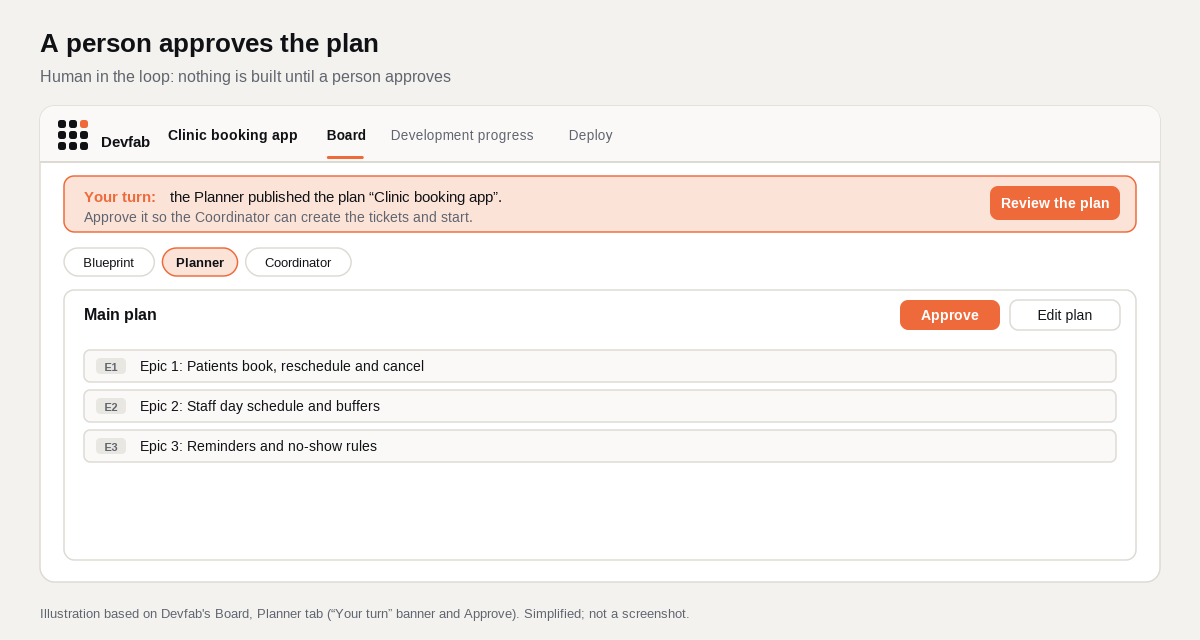
Devfab is one AI software factory. Seven agents run a project: Researcher, Planner, Coordinator, Developers, Blueprint, QA agent and Deploy. A person approves the plan before any tickets are created.
Side by side
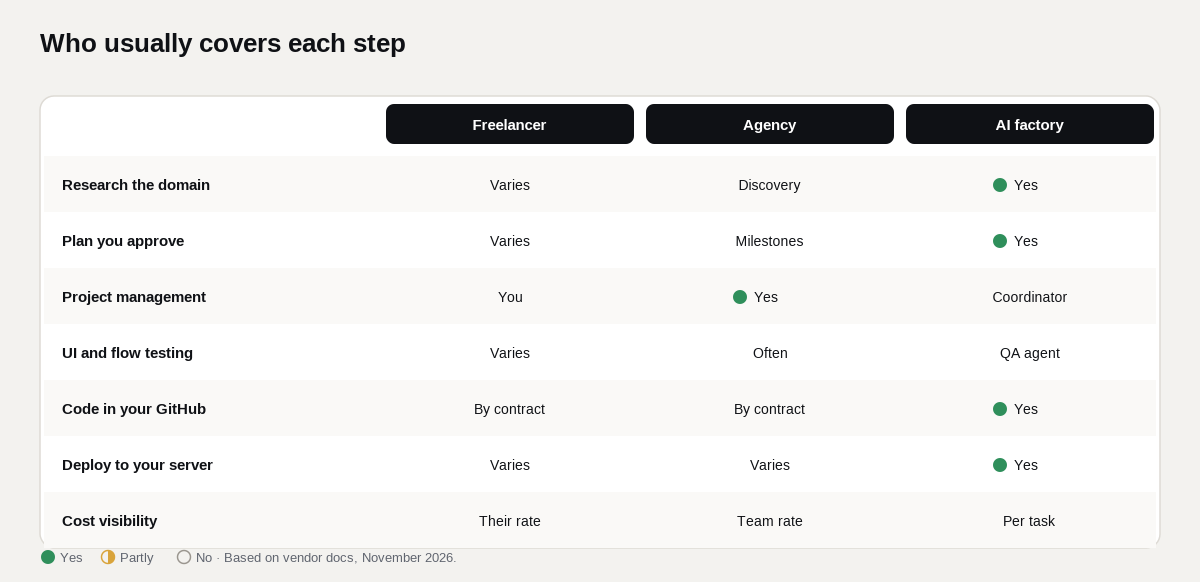
| Aspect | Freelancer | Agency | AI software factory (Devfab) |
|---|---|---|---|
| Who does the work | One person | A team with roles | Seven agents; people approve key steps |
| Who manages it | Usually you | A project manager | The Coordinator splits the approved plan into tickets |
| Research before the plan | Depends on the person | Often a discovery phase | The Researcher maps terms, best practices and competitors |
| Your approval point | Whatever you agree | Milestones in the contract | A person approves the plan |
| Testing | Depends on the person | Often a QA role | QA agent runs UI, flow and logic tests |
| Code ownership | Set by the contract | Set by the contract | Code in your own GitHub account or your organization's |
| Hosting | Varies | Varies | Deploy to your own server |
| Docs after launch | Varies | Varies | Blueprints, sequence flows, prototypes and user manuals |
| Cost model | Rate the freelancer sets | Rate for a team | Cost logged after each run, per task and per project (Beta) |
| Biggest risk | Single point of failure | Higher cost, less direct contact | New, in Beta, fewer integrations |
The freelancer and agency columns describe common patterns, not rules. Read every contract.
When to choose a freelancer
- The app is small and well defined. A booking form, a simple dashboard, a landing page with a sign-up flow.
- You can manage the work yourself. You will write the brief, answer questions and check each delivery.
- You want one direct contact. You talk to the person writing the code, with no account manager in between.
- Budget is the main limit. Freelancers carry little overhead and set their own rates.
- You found someone with proof. They have built this kind of app before and can show it running.
Watch out for: the single point of failure. An agency-written post from 2015 warned that with one freelancer "Your eggs are pretty much in a single basket," since illness or other work can stall the project (Ekreative). That source sells agency services, but the risk is real: ask how the code is stored and how someone else would pick it up.
When to choose an agency
- The app needs several skills at once: design, front end, back end, testing and hosting.
- You want someone accountable for delivery, with a project manager, milestones and a roadmap.
- The app is customer-facing or regulated, and you want a team that has handled reviews, security questions and launch checklists before.
- You need continuity. If one developer leaves, an agency can put someone else on the project.
- You want ongoing support after launch under one contract.
Watch out for: cost and distance. You pay for a team and its overhead, and you may talk to a project manager more than to the people writing the code.
When to choose an AI software factory
- You want to see the plan before anything is built. The Researcher maps your domain first, then the Planner writes a plan and a person approves it.
- You care about tested user journeys, not just code. The QA agent clicks through screens, buttons and flows and runs logic tests.
- You want to own everything. Code lives in your own GitHub account, and Deploy ships to your own server.
- You want to see cost as you go. Cost is logged after each run, per task and per project.
- Your app will change often. ChainFlow maps which functions and APIs call each other and what is deployed, so a change to one feature doesn't quietly break another.
Watch out for: maturity. Devfab is in Beta, with a smaller community and fewer integrations than mature platforms. It is not an editor for hands-on coding, it needs a GitHub account, and you still need someone who understands your business to approve the plan.
Code ownership: the question to settle first
Whichever option you pick, settle who owns the code before work starts. The US Copyright Office says a work made for hire is either made by an employee as part of their job, or a commissioned work that fits one of nine listed categories under a written agreement "signed by all parties" (Copyright Office Circular 30). Computer software is not one of the nine categories. So with a freelancer or an agency, the contract matters. Ask for a signed assignment of the copyright and the repository, and have a lawyer check it.
With Devfab, the repository is created in your own GitHub account or your organization's from the start, and you deploy to your own server. There is no lock-in to export from.
Where an AI software factory fits
Coding agents automate the developer. Devfab automates the development lifecycle. That makes it different from both a freelancer with AI tools and an agency with AI tools: the process itself is the product.
Here is how a project runs, using a clinic booking app as the example:
- Describe what to build. "Patients book, reschedule and cancel; staff see the day's schedule." Attach a spec or screenshots if you have them.
- Research. The Researcher maps terms such as no-shows and buffer times, best practices for booking apps, and similar products, then suggests a prototype.
- Approve the plan. The Planner publishes it. In Human in the loop mode, the default, a person approves the plan before the Coordinator creates tickets.
- Build. Dev agents work on tickets with ChainFlow, so changing the booking rules shows its impact on reminders, the staff calendar and reports.
- Test. The QA agent checks that a patient can book, get a confirmation and cancel, plus rules like no double booking.
- Deploy. Deploy ships to your own server, with an optional custom domain.
This is not either/or. A freelancer or an agency can run their projects through Devfab, keep the client relationship and the judgment calls, and hand over a plan, a test report and docs. If you are an agency weighing this, read Software agency vs AI software factory.
FAQ
Is a freelancer or an agency better for app development?
A freelancer is usually better for a small, well-defined app where you can manage the work yourself. An agency is better when the app needs several skills, such as design, back end, testing and project management, and you want one company accountable for delivery.
Who owns the code when a freelancer builds my app?
Do not assume you do. The US Copyright Office says a commissioned work by a non-employee is a work made for hire only if it fits one of nine listed categories and both sides sign a written agreement; software is not on that list. Get a signed agreement that assigns the copyright to you, and ask a lawyer.
What is an AI software factory?
It is a production line of AI agents that runs the stages of software delivery: research, planning, building, testing and deployment, with people approving key decisions. In Devfab, a person approves the plan, the QA agent tests screens and user journeys, and the code lives in your own GitHub account.
Can an agency or freelancer use an AI software factory?
Yes, and many will. A factory does not replace the judgment of the people who know your business. An agency or freelancer can run a project through a factory to get research, a plan you approve, test reports and deployment, while they handle client conversations and decisions.
Which option has the most predictable cost?
It depends on the contract more than the provider. Freelancers set their own rates, and agencies bill for a team. Devfab offers predictable cost: cost is logged after each run, per task and per project, so you can see what each part of the app cost.
Read next
- What is an AI software factory?
- Software agency vs AI software factory
- Outsourcing vs in-house software development when AI writes the code
- Prototype vs MVP vs production app
See the plan for your app before anyone writes code. Try Beta
Sources (checked November 2026): Upwork Help: Difference between agency and freelancer; U.S. Copyright Office: Circular 30, Works Made for Hire; Ekreative: Agency vs Freelancer (Sep 1, 2015; written by an agency); Microsoft Learn archive: Moving to Software Factories (2004); Augment: Beyond AI coding agents (Sep 2026).
Frequently asked questions
Is a freelancer or an agency better for app development?
A freelancer is usually better for a small, well-defined app where you can manage the work yourself. An agency is better when the app needs several skills, such as design, back end, testing and project management, and you want one company accountable for delivery.
Who owns the code when a freelancer builds my app?
Do not assume you do. The US Copyright Office says a commissioned work by a non-employee is a work made for hire only if it fits one of nine listed categories and both sides sign a written agreement; software is not on that list. Get a signed agreement that assigns the copyright to you, and ask a lawyer.
What is an AI software factory?
It is a production line of AI agents that runs the stages of software delivery: research, planning, building, testing and deployment, with people approving key decisions. In Devfab, a person approves the plan, the QA agent tests screens and user journeys, and the code lives in your own GitHub account.
Can an agency or freelancer use an AI software factory?
Yes, and many will. A factory does not replace the judgment of the people who know your business. An agency or freelancer can run a project through a factory to get research, a plan you approve, test reports and deployment, while they handle client conversations and decisions.
Which option has the most predictable cost?
It depends on the contract more than the provider. Freelancers set their own rates, and agencies bill for a team. Devfab offers predictable cost: cost is logged after each run, per task and per project, so you can see what each part of the app cost.