Short answer: Outsource when the work is a defined project, you lack the skills in-house, and you want a vendor to carry delivery risk. Keep it in-house when the software is core to your business, changes weekly and needs people who know the domain. With AI agents in the mix, a third path appears: your people approve, agents deliver.
You need a claims intake portal for your insurance team, and the board wants a decision. Build a team, or hire a vendor? Most guides on this question were written for a world where every line of code had a person behind it. That world is fading. Your vendor's developers now use AI agents, and so would your own hires.
So the old trade-off moves. The question is less "who writes the code" and more "who decides what to build, who checks it, and who owns the result."
In this guide, you'll learn:
- What outsourcing and in-house mean now
- How they compare side by side
- When to choose outsourcing
- When to choose in-house
- Where an AI software factory fits
Here's the decision, piece by piece.
Definitions
In-house software development means your own employees plan, build, test and run the software. You hire, you manage, and you keep the knowledge. In large firms this can include a Global In-house Center, a captive team in another country.
Outsourcing means a third party does some or all of that work under contract. The two common contract types are fixed price and time and material. Fixed price caps the bill for an agreed scope, so every change means a new negotiation. Time and material bills for the effort actually spent, so scope can move, but the final bill can move too.
What AI changed. Both sides now use AI. Google's 2025 DORA report found 90% of respondents use AI at work and more than 80% believe it raised their productivity. It also found 30% have little or no trust in AI-generated code, and that AI adoption still has "a negative relationship with software delivery stability" (Google Cloud, DORA 2025). On the buyer side, Deloitte's 2024 Global Outsourcing Survey of more than 500 executives found 83% use AI as part of their outsourced services, yet "tangible benefits such as productivity gains or cost reductions have been limited" (Deloitte).
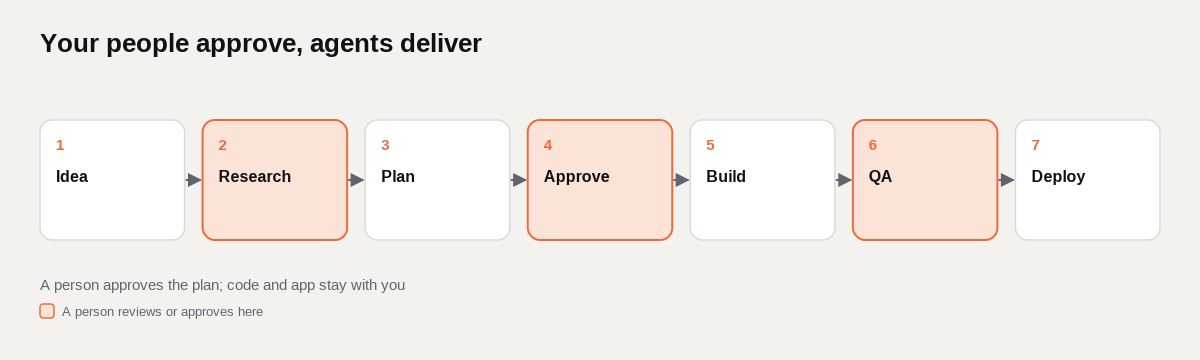
AI software factory is a newer, third model. Agents handle the stages of delivery (research, planning, coding, testing, deployment) while people approve the key decisions. The term "software factory" itself dates back to 2004, when Microsoft architects described a product line of tools and guidance for building specific kinds of apps (Microsoft Learn archive).
Outsourcing vs in-house at a glance
| Aspect | Outsourcing | In-house | AI software factory |
|---|---|---|---|
| Who decides what to build | You and the vendor, through the contract | Your team | Your team approves the plan |
| Who writes the code | Vendor staff, often with AI tools | Your staff, often with AI tools | Agents, with a person approving the plan |
| Cost shape | Contract: fixed price or time and material | Payroll plus tools | Usage; cost logged per task and per project |
| Change requests | Fixed price: renegotiate; T&M: flexible, budget risk | Cheap to ask, competes for team time | New plan or ticket, approved by your team |
| Domain knowledge | Leaves when the contract ends | Stays with your people | Research step maps the domain each project |
| Code ownership | Set by the contract | Yours | Your own GitHub account or organization |
| Testing proof | Whatever the vendor reports | Whatever your team builds | QA agent: UI, flow and logic tests |
| Best fit | Defined projects, missing skills | Core, fast-changing products | Well-scoped business apps |
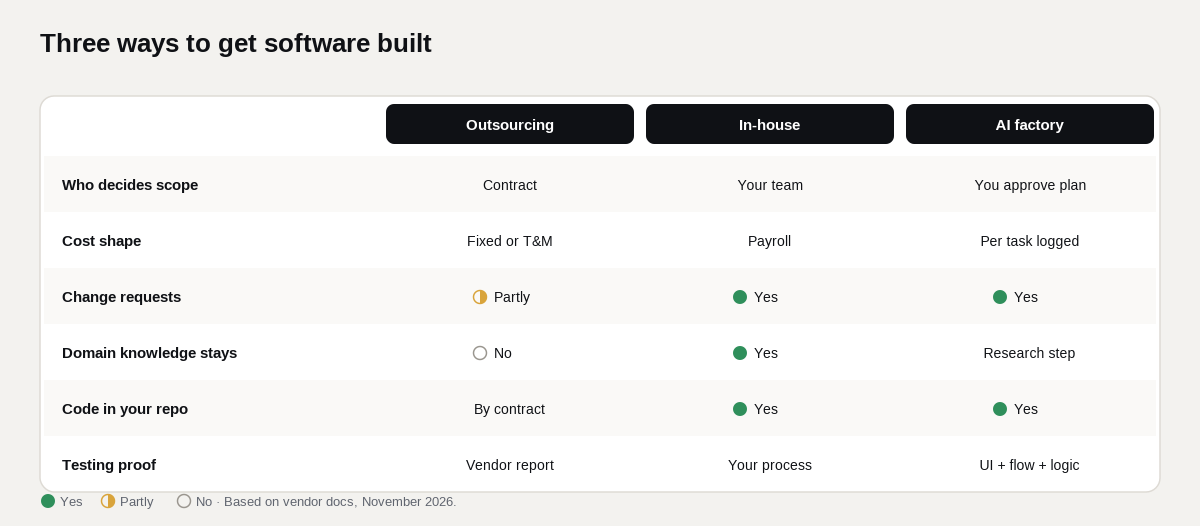
The middle rows matter most. AI lowers the effort of writing code for everyone. It does not, by itself, change who holds the domain knowledge, who absorbs a change request, or who owns the repository.
When to choose outsourcing
- You need skills you will not need again. A one-off mobile app, a data migration, or a security audit rarely justifies permanent hires.
- The scope is clear and stable. Fixed price contracts work when the spec is detailed up front and few changes are expected.
- You want someone else to carry delivery risk. A good vendor manages staffing, holidays and turnover for you.
- You want to pay for results, not effort. Deloitte reports outcome-based delivery models "have increased in adoption in favor of results-driven relationships." That fits work you can define by its result.
- Speed of staffing matters more than long-term knowledge. A vendor can start before you could finish hiring.
What changes with AI: ask the vendor how they use it. If agents write much of the code, the effort billed on a time-and-material invoice should reflect that. Ask who reviews AI-written code, how user flows are tested, and whether you see cost per task. Deloitte notes that limited AI benefits so far come down to governance and contracting, so put these questions in the contract.
When to choose in-house
- The software is your product or your edge. Knowledge of your customers and rules should stay inside.
- Requirements change constantly. Each change is a conversation, not a contract amendment.
- You need tight control over data and security, with your own people deciding where code and data live.
- You want to build long-term capability. Deloitte reports insourcing on the rise and Global In-house Centers "regaining momentum."
- Your team already uses AI tools well. If your developers trust and verify agent output, each hire covers more ground.
What changes with AI: in-house teams can now take on work they once had to outsource. But the DORA findings are a warning. AI can raise throughput while hurting stability. More code, faster, still needs review, tests and a release process someone owns.
Where an AI software factory fits
Many organizations end up mixed: a core team in-house, vendors for peaks and specialist work. An AI software factory gives a third option for a slice of that work, usually business apps with a clear purpose, such as the claims intake portal, a permit tracker or a field-service app.
Coding agents automate the developer. Devfab automates the development lifecycle. Here is how it maps to the trade-offs above:
- Domain knowledge. Devfab's Researcher runs before the Planner. It maps the domain (key terms such as first notice of loss, best practices and competing products), then suggests a prototype. You don't depend on one vendor's memory.
- Control. A person approves the plan. Human in the loop is the default mode, so your own staff stay the decision-makers.
- Change without breakage. ChainFlow maps which functions and APIs call each other and what is deployed, so a change to the claim form shows its links to fraud checks, notifications and payouts before agents edit.
- Proof of testing. The QA agent runs UI and flow tests (screens, buttons and journeys clicked end to end) plus logic tests.
- Ownership. The code lives in your own GitHub account or organization, and Deploy ships to your own server.
- Predictable cost. Cost is logged after each run, per task and per project.
Honest limits: Devfab is in Beta, with a smaller community and fewer integrations than mature platforms. It is not an editor for hands-on coding, and it needs a GitHub account. For deep research projects or software that is your core product, an in-house team still leads. Agencies can also run Devfab on behalf of clients; see Software agency vs AI software factory.
FAQ
Is it cheaper to outsource software development or keep it in-house?
It depends on how steady the work is. Outsourcing turns a fixed payroll cost into a contract cost, and fixed price deals cap the bill but make change requests hard. In-house costs more to set up but every change is cheap to ask for. AI agents lower the effort on both sides, so compare who keeps the savings.
Does AI make outsourcing less necessary?
For some work, yes. If agents can research, plan, build and test a well-defined app while your own staff approve the plan, you may not need an outside team for it. Deloitte's 2024 survey also reports insourcing on the rise, while third-party outsourcing spend keeps growing too.
What should I ask an outsourcing vendor about AI?
Ask which AI tools they use and on what data, who reviews AI-written code, how they test user flows, whether the code lives in your own repository, and whether you see cost per task. Deloitte found most executives already get AI inside outsourced services, but with limited measured benefit.
Where does an AI software factory fit between outsourcing and in-house?
It is a third option for some projects. Like outsourcing, the delivery line is run for you. Like in-house, the plan is approved by your own people, the code sits in your own GitHub account, and the app runs on your own server. It suits well-scoped business apps more than deep research work.
Read next
- What is an AI software factory?
- In-house developers vs AI agents
- Freelancer vs agency vs AI software factory
- How agencies should price AI-built work
Keep the decisions in-house. Let agents run the delivery line. Try Beta
Sources (checked November 2026): Deloitte: Global Outsourcing Survey 2024; Google Cloud: Announcing the 2025 DORA report; Microsoft Learn archive: Moving to Software Factories (2004).
Frequently asked questions
Is it cheaper to outsource software development or keep it in-house?
It depends on how steady the work is. Outsourcing turns a fixed payroll cost into a contract cost, and fixed price deals cap the bill but make change requests hard. In-house costs more to set up but every change is cheap to ask for. AI agents lower the effort on both sides, so compare who keeps the savings.
Does AI make outsourcing less necessary?
For some work, yes. If agents can research, plan, build and test a well-defined app while your own staff approve the plan, you may not need an outside team for it. Deloitte's 2024 survey also reports insourcing on the rise, while third-party outsourcing spend keeps growing too.
What should I ask an outsourcing vendor about AI?
Ask which AI tools they use and on what data, who reviews AI-written code, how they test user flows, whether the code lives in your own repository, and whether you see cost per task. Deloitte found most executives already get AI inside outsourced services, but with limited measured benefit.
Where does an AI software factory fit between outsourcing and in-house?
It is a third option for some projects. Like outsourcing, the delivery line is run for you. Like in-house, the plan is approved by your own people, the code sits in your own GitHub account, and the app runs on your own server. It suits well-scoped business apps more than deep research work.