Short answer: Hire a software agency when you need people to discover the problem, own decisions, sign a contract and support the system for years, especially for high-risk software. Use an AI software factory when you can describe the app and approve a plan yourself, and you want code in your own repo, tested, deployed and with cost logged per task.
You need an app built, and you don't have a dev team. The agency quote is a big number with a long list of assumptions. The AI factory pitch says describe it and approve the plan. One option buys experienced people. The other buys a process run by agents. Neither is right for every app, and the wrong pick is expensive either way.
In this guide, you'll learn:
- Definitions
- Side by side
- When to choose a software agency
- When to choose an AI software factory
- Where an AI software factory fits
We start with plain definitions, then the trade-offs.
Definitions
A software agency is a company of people who build software for clients: project managers, analysts, designers, developers and testers. Most agencies sell work in one of two ways. A fixed-price deal fits small and midsize projects with a defined scope, such as a proof of concept, an MVP or a single feature; changes need separate negotiation, and ScienceSoft calls them "hard to near impossible" to make mid-project. A time-and-materials deal suits changing requirements, but the final cost "can go beyond the expected budget", and the client spends more effort managing the work.
Agencies are changing too. An April 2026 review of AI-powered agencies by Airdev (itself an agency) reports that EPAM is moving away from time-and-materials toward outcome-based and fixed-price deals, and that Globant sells "AI Pods" with token-based metered pricing. Its advice: ask where AI is used, what humans still own and who is actually on the team.
An AI software factory is a repeatable production line for software where AI agents run the stages. The term is older than AI: in 2004, Microsoft architects Jack Greenfield and Keith Short described a software factory as a product line of tools, packaged content and guidance for building specific kinds of applications. Augment describes today's version as work moving across "Requirements, Ticket, PR, and Prod" with specialized agents at each handoff, while "humans retain ownership of consequential decisions". Devfab is one: seven agents (Researcher, Planner, Coordinator, Developers, Blueprint, QA agent and Deploy) take a project from idea to deployed app, and a person approves the plan.
Side by side
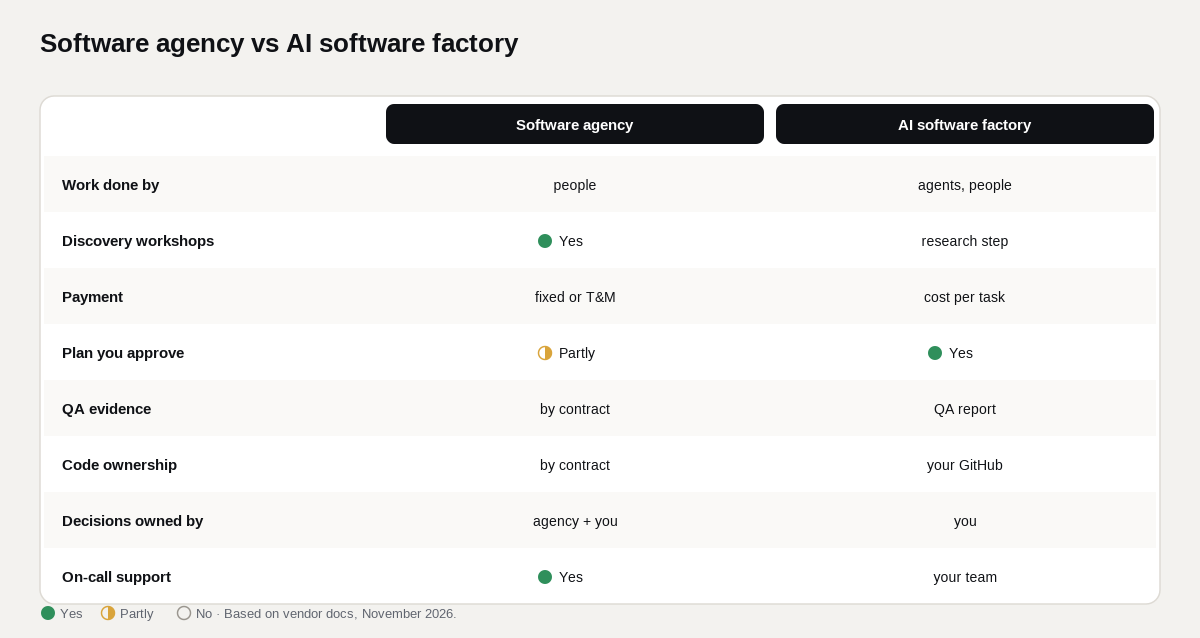
| Aspect | Software agency | AI software factory (Devfab) |
|---|---|---|
| Who does the work | A team of people, often using AI tools | AI agents per stage; people approve and review |
| Who you talk to | An account or project manager | The workspace: research, plan, board, QA report |
| Discovery and workshops | Yes: stakeholders, users, change management | A research step maps the domain; you supply the decisions |
| How you pay | Fixed price or time and materials; some now metered or outcome-based | Predictable cost: logged after each run, per task and per project (Beta) |
| Changing scope | Change requests (fixed price) or a growing bill (time and materials) | Work is split into tickets, with cost logged per task |
| Evidence at handover | Depends on the agency and contract | Approved plan, QA report, blueprints, prototypes, user manuals |
| Testing | Manual and automated QA by the agency's people | QA agent runs UI and flow tests plus logic tests |
| Code ownership | Set by your contract | Your own GitHub account (or your organization's) from day one |
| Accountability | Contract, warranty, named people | You own the decisions; Devfab is a tool in Beta |
| Long-term support | Retainers, on-call, SLAs | Feedback module turns user reports into tickets; your team or partner runs operations |
When to choose a software agency
A human agency is the better choice, and worth its price, when:
- Nobody on your side can own the product. A factory needs someone to describe the app and approve the plan. If you don't have that person, an agency's project manager and business analyst fill the gap.
- The problem itself is unclear. Discovery workshops, interviews with real users, process mapping across departments and change management are people work.
- You need a contract with teeth. Warranties, service levels, liability and named people you can call. Public bodies and large companies often must buy through a vendor contract anyway.
- The system is high-risk. Payments, health data, safety-critical logic or anything that must pass a formal audit needs experienced engineers who own the architecture. Airdev warns that AI-built prototypes differ from software that handles real user load and survives audits.
- It's tangled with legacy systems or hardware. Messy data migrations, on-site devices and undocumented integrations reward people who have done it before.
- You need brand and design work. Visual identity, UX research and content are agency strengths.
- You need someone on call after launch. Incident response and ongoing operations need people.
If several of these apply, start with an agency, and ask how it uses AI in delivery.
When to choose an AI software factory
A factory is the better choice when:
- You can describe the app and judge a plan. A product owner, an operations lead or a founder who knows the workflow is enough.
- The app is a well-understood business app. Booking systems, client portals, work orders, request forms and internal tools have known flows the research step can map.
- You want to see it before you commit. The research step suggests a prototype, and Blueprint produces screens, so you review something concrete early.
- You want the code and the servers to be yours. The repository lives in your own GitHub account, and Deploy ships to your own server, with a custom domain if you want.
- You want cost you can see. Cost is logged after each run, per task and per project, instead of a quote built on assumptions.
- You build many similar apps. Agencies, IT departments and local governments with a queue of small apps benefit from the same process every time.
Where an AI software factory fits
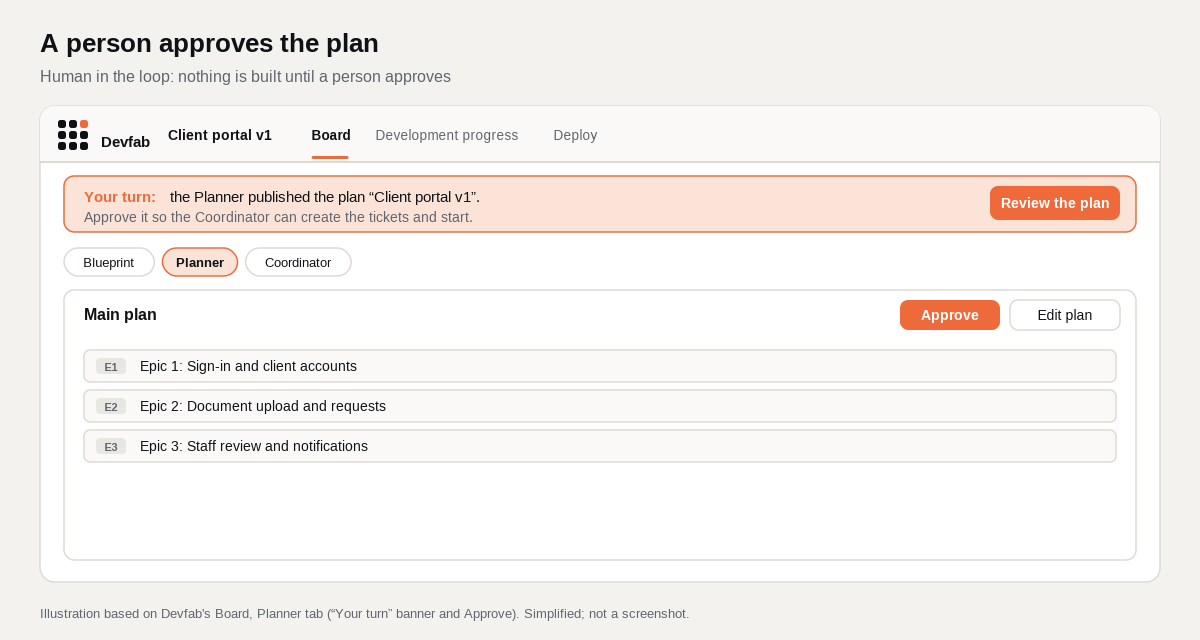
Coding agents automate the developer. Devfab automates the development lifecycle. That includes the parts an agency usually covers: research, planning, testing, deployment and documentation, with a person approving the plan.
What Devfab adds that matters in this comparison:
- Research before the plan. The Researcher learns your industry first: key terms, best practices for that kind of app and competitors, then suggests a prototype.
- ChainFlow. Devfab maps which functions and APIs call each other, so a change to checkout doesn't quietly break payments, inventory or notifications.
- QA agent. A separate agent runs UI and flow tests (screens and user journeys clicked end to end) plus logic tests.
- Team Delivery Report, roles and workspace permissions, so a client or manager can follow the work.
It's not either-or. An agency can run its delivery through a factory and keep what clients value most: discovery, judgment and accountability. Devfab itself is built using Devfab.
Honest limits: Devfab is new and in Beta, with a smaller community and fewer integrations. It is not an editor for hands-on coding, it needs a GitHub account, and it doesn't replace the contract, discovery work or on-call support an agency provides.
FAQ
Is an AI software factory cheaper than a software agency?
It can be for well-defined apps, but we won't put a number on it, because it depends on the project and on how much of your own time goes into describing and reviewing. What a factory like Devfab gives you is predictable cost: cost is logged after each run, per task and per project, so you can see it as the work happens.
When is a software agency the better choice?
When nobody on your side can own product decisions, when the problem needs discovery with stakeholders and users, when you need a contract with accountability and support, and when the system is high-risk, heavily regulated or tangled with legacy systems. Experienced people are worth paying for in those cases.
Can a software agency use an AI software factory?
Yes, and many will. An agency can keep the client relationship, discovery and accountability, and run delivery through a factory: research, an approved plan, agent-built code, QA tests and deployment. The client still gets people to talk to, plus evidence for each delivery.
Who owns the code in each model?
With an agency, ownership is set by your contract, so read the IP clause. With Devfab, the code lives in your own GitHub account or your organization's from the start, and you deploy it to your own server.
Does an AI software factory need people at all?
Yes. In Devfab, Human in the loop is the default: a person approves the plan before any tickets are created, and you can require QA review before a ticket is marked Done. Someone on your side has to describe the app and make the decisions.
Read next
- What is an AI software factory?
- AI software factory vs AI coding tools: which does your team need?
- The AI-native software agency: an operating model for 2027
- How agencies should price AI-built work
- How to run a paid software pilot that converts
- Best AI tools for software outsourcing companies
See the plan before anyone writes code. Try Beta
Sources (checked November 13, 2026): Time and Material vs. Fixed Price (ScienceSoft, updated Feb 24, 2026); The AI-Powered Software Development Agency Landscape (Airdev, Apr 18, 2026); Moving to Software Factories (Microsoft Learn archive, 2004); Software factory (Microsoft .NET), Wikipedia); Beyond AI coding agents: how we built Augment's software factory (Augment, Sep 2026).
Frequently asked questions
Is an AI software factory cheaper than a software agency?
It can be for well-defined apps, but we won't put a number on it, because it depends on the project and on how much of your own time goes into describing and reviewing. What a factory like Devfab gives you is predictable cost: cost is logged after each run, per task and per project, so you can see it as the work happens.
When is a software agency the better choice?
When nobody on your side can own product decisions, when the problem needs discovery with stakeholders and users, when you need a contract with accountability and support, and when the system is high-risk, heavily regulated or tangled with legacy systems. Experienced people are worth paying for in those cases.
Can a software agency use an AI software factory?
Yes, and many will. An agency can keep the client relationship, discovery and accountability, and run delivery through a factory: research, an approved plan, agent-built code, QA tests and deployment. The client still gets people to talk to, plus evidence for each delivery.
Who owns the code in each model?
With an agency, ownership is set by your contract, so read the IP clause. With Devfab, the code lives in your own GitHub account or your organization's from the start, and you deploy it to your own server.
Does an AI software factory need people at all?
Yes. In Devfab, Human in the loop is the default: a person approves the plan before any tickets are created, and you can require QA review before a ticket is marked Done. Someone on your side has to describe the app and make the decisions.