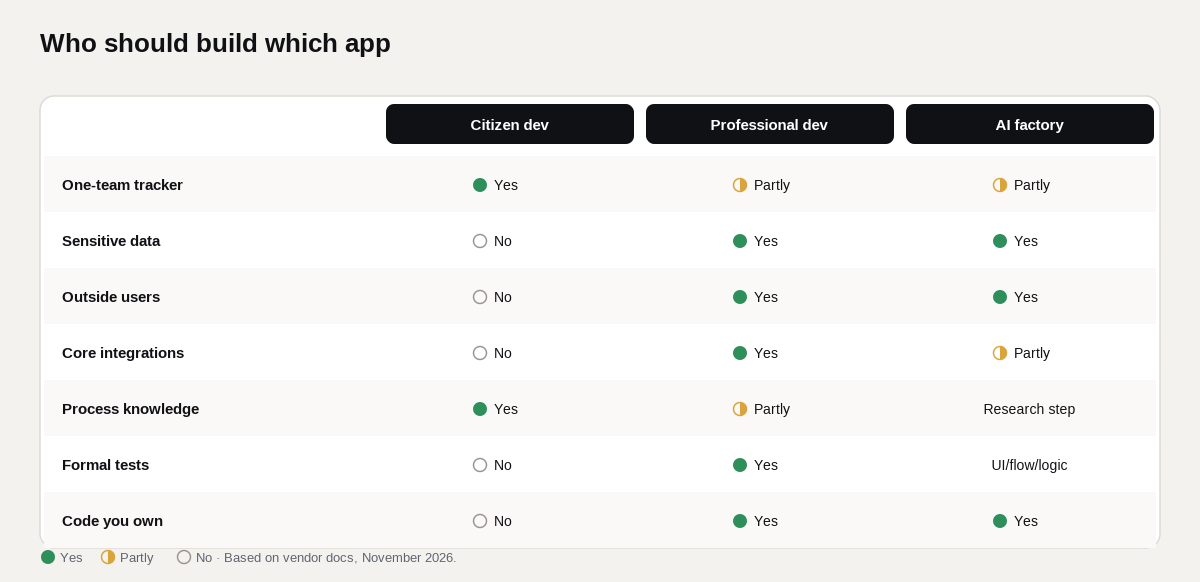
Short answer: Let citizen developers build small apps for their own team on an IT-approved low-code platform: trackers, request forms, simple approvals. Give the work to professional developers when the app handles sensitive data, serves many users or outside customers, needs integrations, or must run for years. Decide by risk and lifespan, not by job title.
You run IT for a school district, a hospital group or a mid-size firm. The backlog is long, and the business is tired of waiting. Someone in operations has already built an app on their own.
Saying no to every one of those apps pushes them into shadow IT. Saying yes to all of them leaves you supporting software nobody tested. The useful question is which apps belong with which builder. This guide gives you a way to sort them, using definitions from IBM, Microsoft, ServiceNow and TechTarget.
In this guide, you'll learn:
- Definitions
- Side-by-side comparison
- When to choose a citizen developer
- When to choose a professional developer
- Where an AI software factory fits
Use the table as your sorting rule and the rest as the reasoning.
Definitions
Citizen developer. TechTarget defines citizen development as "a business process that encourages non-IT-trained employees to become software developers," using "IT-sanctioned low-code/no-code (LCNC) platforms to create business applications" (TechTarget). ServiceNow puts it more simply: "Citizen developers are non-IT employees who create applications or enhance existing systems" (ServiceNow).
Professional developer. ServiceNow says professional developers "typically have formal training in computer science or a related field." They manage the full software lifecycle and complex projects, with a focus on performance, scalability and security (same source).
The tools each one uses. IBM describes no-code as "aimed at business users" and extendable "only through templated feature sets," while low-code is "aimed at professional developers" and can be extended with custom code (IBM). Microsoft draws the same line: low-code is "most often used by IT professionals with some coding skills," no-code by "business users without any knowledge of how coding works" (Microsoft).
In 2026 the line has blurred. Most platforms now build a first version from a prompt. Knack's AI app builder is on all plans (Knack). Quickbase launched Pave, a prompt-first builder, on April 28, 2026 (Quickbase). ServiceNow's Build Agent generates workflows, UI and AI agents from plain language (ServiceNow App Engine). So the real gap is no longer "can this person make an app." It is "can this person own what happens after."
Side-by-side comparison
| Aspect | Citizen developer | Professional developer |
|---|---|---|
| Background | Business role, usually no formal programming training | Formal training in computer science or similar |
| Typical tools | No-code and low-code platforms, AI app builders | Code, repositories, CI, low-code where it fits |
| Best scope | Immediate problems in their own team | Full lifecycle, complex and shared systems |
| Knows the process | Deeply; they do the work every day | Learns it from users and specs |
| Data security | Usually limited understanding (ServiceNow) | Owns security, performance and scale |
| Testing | Clicks through it; formal tests rare | Unit, integration and end-to-end tests |
| Who supports it later | Often the builder alone | A team with on-call and documentation |
| Main risk | Shadow IT, quality gaps without IT oversight | Backlog, distance from the real process |
Sources: ServiceNow; TechTarget; IBM.
When to choose a citizen developer
- The app serves one team and the builder is on it. A school's equipment loan tracker for one library is a good fit. The person who lends the laptops knows every edge case.
- The data is low risk. No health records, payroll or payment data. TechTarget notes citizen development cuts the burden on IT so staff can handle other tasks (TechTarget).
- The platform has guardrails IT controls. ServiceNow says "IT administrators can set up development guardrails to ensure effective governance" (ServiceNow). Airtable's Omni asks for confirmation before deletions and leaves publishing to the user (Airtable support).
- The process changes often. If the form changes every term, the person who owns the form should be able to change the app.
- You need it soon and can throw it away. A pilot that proves a process is worth building properly is a fine citizen project.
When to choose a professional developer
- Sensitive or regulated data. Health, student, payroll or payment data needs someone who owns security. ServiceNow notes citizen developers usually have limited understanding of data security and architecture.
- Many users, or users outside the company. A district-wide equipment portal for parents, students and staff is a product, not a tracker.
- Integrations with core systems. Student information systems, ERPs and identity providers break in ways a visual builder won't show you.
- The app must outlive its builder. If one person leaves and nobody can change the app, you have a liability. Code in a repository with docs and tests survives turnover.
- A client or auditor will ask for proof. Test results, a reviewed plan and a deploy history are hard to produce from a one-person build.
- You keep hitting platform limits. Record caps, app caps or per-user pricing are signs the app has outgrown the builder. Knack Starter, for example, caps records at 20,000 and apps at 3 (Knack pricing).
A handover rule helps. Write it down before anyone builds: "If the app passes N users, touches sensitive data or needs an integration, IT takes ownership." Then the citizen developer becomes the product owner, which is where their process knowledge is worth the most.
Where an AI software factory fits
There is a third option between "let operations build it" and "add it to the engineering backlog." An AI software factory runs the development lifecycle with agents, under a professional team's control.
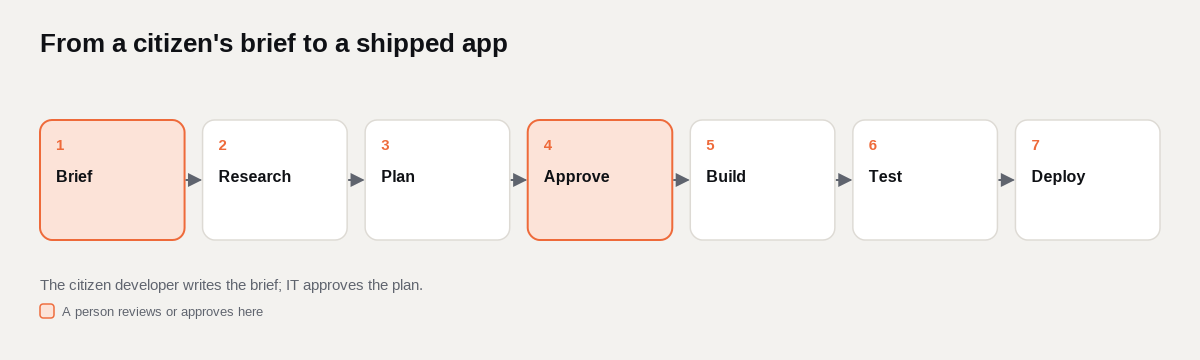
Coding agents automate the developer. Devfab automates the development lifecycle. Here is how it handles the equipment loan app once it outgrows the library:
- The citizen developer writes the brief. In Devfab's "What should we build?" box they describe the process in their own words and attach screenshots of the old app.
- The Researcher maps the domain first. Key terms (asset tag, loan period, damage report), best practices and competing products, then a suggested prototype the librarian can react to.
- A person approves the plan. IT reviews it. Nothing becomes a ticket until someone signs off.
- The QA agent tests what the business cares about. UI and flow tests click through screens and journeys, such as a student borrowing a laptop and a teacher marking it damaged, plus logic tests.
- IT owns the result. Code lives in the district's GitHub, and the app deploys to its own server, with user manuals for staff.
The citizen developer keeps the role they are best at: knowing the process. Professionals keep control of security and release. Devfab is in Beta, has a smaller community and fewer integrations than mature low-code platforms, is not an editor for hands-on coding, and needs a GitHub account. Business staff won't edit a Devfab app the way they edit a no-code app.
FAQ
What is a citizen developer?
An employee outside IT who builds or changes business apps, usually on low-code or no-code platforms that IT has approved. TechTarget describes them as business users who create or change applications without needing IT involvement; ServiceNow says IT must stay involved for projects to succeed.
Will citizen developers replace professional developers?
No. They take on small, well-bounded apps close to their own work. Apps with many users, sensitive data, integrations or long lifespans still need people who own architecture, security and testing, which ServiceNow lists as the professional developer's scope.
What are the risks of citizen development?
Lower quality and security gaps if IT does not oversee the work, plus shadow IT if apps are built outside sanctioned platforms. TechTarget notes a lower-quality product can result without careful IT oversight, and ServiceNow notes citizen developers usually have limited knowledge of data security.
Where do AI app builders fit in this debate?
They lower the bar for both groups. Tools such as Knack, Airtable Omni and Quickbase Pave build a first version from a prompt for business users. AI software factories such as Devfab give professional teams research, an approved plan, tests and deploy as code.
Who should own an app a citizen developer built once it grows?
Agree on a handover point in advance, for example when the app passes a user count, touches payroll or customer data, or needs an integration. At that point IT or a delivery team takes ownership and decides whether to keep it on the platform or rebuild it as code.
Read next
- What is an AI software factory?
- Low-code vs an AI software factory
- Build vs buy internal tools
- Knack alternatives
- How to replace spreadsheets with a custom app
Have a citizen-built app that needs to grow up? Try Beta
Sources (checked November 2026): TechTarget: What is citizen development?; ServiceNow: What is a citizen developer?; IBM: Low-code vs no-code; Microsoft: Low-code vs no-code development platforms; Knack; Knack pricing; Quickbase announces Pave (Apr 28, 2026); ServiceNow App Engine; Airtable support: app quick start.
Frequently asked questions
What is a citizen developer?
An employee outside IT who builds or changes business apps, usually on low-code or no-code platforms that IT has approved. TechTarget describes them as business users who create or change applications without needing IT involvement; ServiceNow says IT must stay involved for projects to succeed.
Will citizen developers replace professional developers?
No. They take on small, well-bounded apps close to their own work. Apps with many users, sensitive data, integrations or long lifespans still need people who own architecture, security and testing, which ServiceNow lists as the professional developer's scope.
What are the risks of citizen development?
Lower quality and security gaps if IT does not oversee the work, plus shadow IT if apps are built outside sanctioned platforms. TechTarget notes a lower-quality product can result without careful IT oversight, and ServiceNow notes citizen developers usually have limited knowledge of data security.
Where do AI app builders fit in this debate?
They lower the bar for both groups. Tools such as Knack, Airtable Omni and Quickbase Pave build a first version from a prompt for business users. AI software factories such as Devfab give professional teams research, an approved plan, tests and deploy as code.
Who should own an app a citizen developer built once it grows?
Agree on a handover point in advance, for example when the app passes a user count, touches payroll or customer data, or needs an integration. At that point IT or a delivery team takes ownership and decides whether to keep it on the platform or rebuild it as code.