Short answer: Build on low-code when business users and IT must keep changing many internal apps under one vendor's governance, connectors and support. Build on AI code generation when the app needs custom logic or design, must run anywhere, and your team can review, test and maintain the code it produces, ideally inside a process that plans and tests each change.
You have a backlog of apps and two very different ways to clear it. One camp says AI writes code now, so why pay for a platform. The other says generated code is just tomorrow's technical debt. Both are right about something. The useful question isn't how the first version gets built. It's who changes the app next year, and what they'll be editing when they do.
In this guide, you'll learn:
- Definitions
- Side by side
- When to choose AI code generation
- When to choose low-code
- Where an AI software factory fits
The sections below go in the order you'd make the call.
Definitions
Low-code. IBM describes low-code as "a rapid application development (RAD) approach that enables automated code generation through visual building blocks," aimed at professional developers and extendable with custom code (IBM). Microsoft adds that "low-code development requires some custom coding" (Microsoft). What you edit is the platform's model: its screens, data tables, workflows and connectors.
AI code generation. Here, an AI model writes ordinary source code from a prompt. G2's analyst puts the split simply: code generators write code from natural-language prompts, while low-code platforms use preset visual components and rule-based settings (G2 Research, Jun 2026). The tools range from AI editors, such as Cursor with its Plan Mode and cloud agents (Cursor docs), to app builders that generate and host a full web app, such as Lovable (Lovable FAQ).
The line is blurring. Both sides now borrow from each other:
- Power Apps lets users "describe what they need in natural language," and its September 2026 update lets AI coding tools build whole model-driven apps, "creating nothing until the user approves the build plan." Microsoft also added guidance to "convert a vibe app to a code app" (Microsoft, Sep 2026).
- OutSystems lets developers use external tools such as Claude Code, OpenAI Codex and Cursor on its platform (OutSystems, Mar 2026).
- Mendix's Studio Pro MCP Server lets external agents use its Maia tools (Mendix docs).
- Retool's new builder writes apps "in React on the frontend and TypeScript on the backend," with a Code tab to inspect and edit them (Retool, Jun 2026).
G2's conclusion: "AI code generation didn't replace low-code; it changed what low-code means" (G2 Research).
Side by side
| Aspect | AI code generation | Low-code platform |
|---|---|---|
| What you edit later | Source files in a Git repository | The platform's visual model, plus some custom code |
| Who usually edits | Developers, helped by AI agents | Business users and IT, helped by AI assistants |
| Where the app runs | Anywhere you deploy the code | The vendor's cloud or a supported self-hosted setup |
| Stack choice | Usually yours; some app builders fix it (Lovable offers no framework or database choice) | Fixed by the platform (for example Dataverse for Power Apps) |
| Governance | Your Git reviews, CI and access rules | Platform-wide policies, such as Power Apps DLP and environment controls |
| Integrations | Whatever you code or connect | Built-in connectors; OutSystems lists 400+ systems |
| Testing | Your test suite, or the tool's own tests if it has them | Platform checks plus your own testing process |
| Moving away | The code goes with you | Usually stays on the platform; some vendors now offer code export paths |
| Pricing model | Per seat, credit or token, plus your own hosting | Per user, per app or per app size, with hosting included |
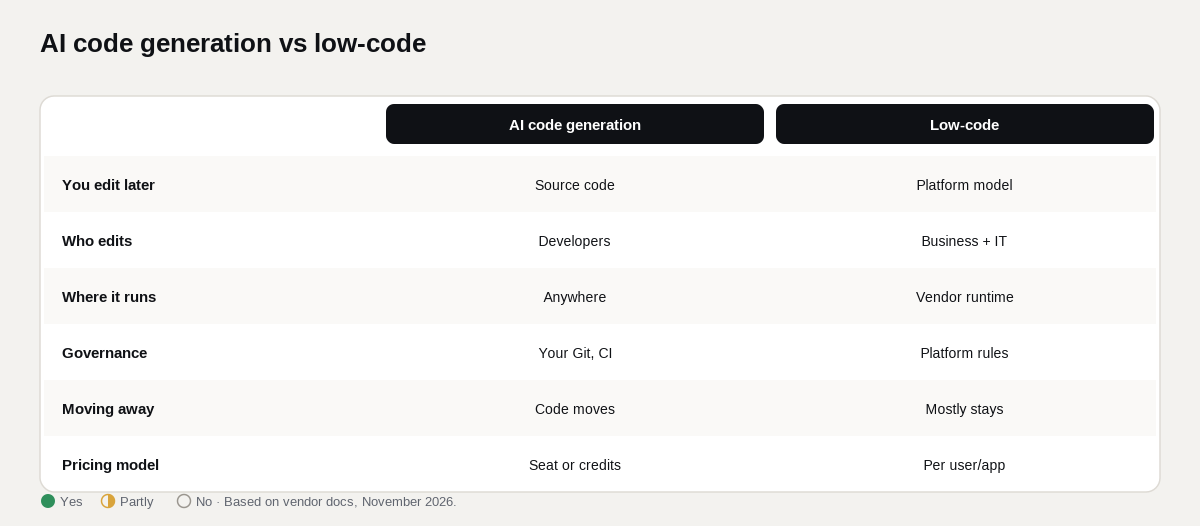
Sources for the table: Lovable FAQ; Power Apps; OutSystems Developer Cloud; Power Platform licensing FAQ.
When to choose AI code generation
AI code generation is the better choice when:
- The app is a product, not a form. Customer-facing apps with their own design, logic and performance needs outgrow preset components. G2 notes AI coding tools suit developers "who want deep customization."
- You must run it anywhere. A client's server, a sovereign cloud or an on-site box. Code has no platform runtime to license.
- You already have developers. They review the output in pull requests, as they would any other code. Cursor's Bugbot, for example, reviews pull requests for bugs and security issues (Cursor Bugbot).
- You want to avoid per-user licensing. Low-code often charges per end user. Power Apps Premium is USD 20 per user per month, paid yearly, as of November 2026 (Power Apps pricing). Generated code has no per-user runtime fee, though you pay for hosting.
- The data is sensitive in ways a builder's terms forbid. Lovable's terms, for example, do not allow protected health information or payment card data (Lovable FAQ). Your own codebase on your own server follows your own rules.
Know the cost. A LeadDev article by Jinen Dedhia, co-founder of the low-code company DronaHQ, warns that "AI-generated code is not always production-ready" and that "more code, in fact, can mean more problems if technical debt isn't kept in check" (LeadDev, Apr 2025). He has a stake in low-code, but the point holds: someone has to test and maintain what the AI writes.
When to choose low-code
Low-code is the better choice when:
- Business users must change apps themselves. Microsoft says no-code and low-code serve business users and IT professionals, not only developers (Microsoft).
- You run dozens of internal apps. Platform-wide governance matters more than any one app. IT can "centralize policies for environments, data loss prevention, access, and auditing" in Power Apps (Power Apps).
- You need vendor compliance. OutSystems lists HIPAA, PCI DSS and FedRAMP requirements plus SOC 2 Type II and ISO certifications (OutSystems Developer Cloud).
- Most of the work is connecting systems. Pre-built connectors and a private gateway to on-prem systems save integration code.
- You want one vendor accountable for uptime, support and upgrades.
The trade-off: you build on the vendor's runtime and pricing. Power Apps premium, on-premises and custom connectors need a standalone license beyond Microsoft 365 rights (Power Platform licensing FAQ). OutSystems publishes no prices and sizes deals by Application Objects and users (OutSystems pricing).
Where an AI software factory fits
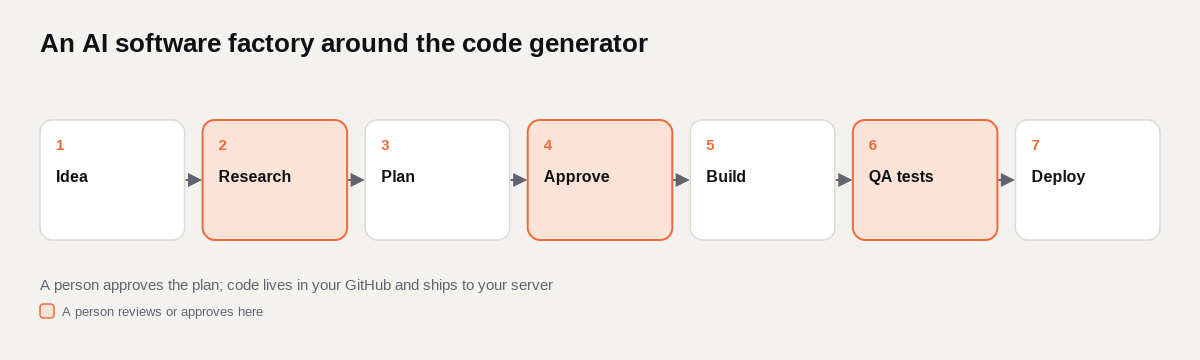
The weak spot of AI code generation is not writing code. It is everything around it: deciding what to build, checking the change didn't break something, testing the screens, and shipping. An AI software factory puts that around the generator.
Coding agents automate the developer. Devfab automates the development lifecycle. Take a permit tracker for a city's building department:
- Research before the plan. Devfab's Researcher maps the domain first (key terms such as variance and inspection hold, best practices, and competitor products), then suggests a prototype.
- A person approves the plan. The Planner publishes it, and the Coordinator creates tickets only after approval.
- ChainFlow. Devfab's code-intelligence layer maps which functions and APIs call each other and what is deployed, so a change to fee rules shows what else it touches before a dev agent makes it. This answers the maintenance worry in the LeadDev piece.
- QA agent. It runs UI and flow tests (screens, buttons and user journeys clicked end to end) plus logic tests.
- Ownership. The code sits in your own GitHub account or your organization's, and Deploy ships it to your own server.
You can choose the model for each agent or keep Devfab's default, and cost is predictable: it is logged after each run, per task and per project.
Honest limits: Devfab is in Beta, with a smaller community and far fewer integrations than an enterprise low-code platform. It does not give business users a visual editor, it is not an editor for hands-on coding, and it needs a GitHub account. Many organizations will keep a low-code platform for internal forms and use a factory for custom apps.
FAQ
Will AI code generation replace low-code?
Not so far. G2 research analyst Adam Crivello wrote in June 2026 that AI code generation "didn't replace low-code; it changed what low-code means." Low-code platforms such as Power Apps, Mendix and OutSystems have added AI app generation and now let outside coding agents work on their apps.
Is AI-generated code harder to maintain than a low-code app?
It can be. A LeadDev article by the co-founder of a low-code company warns that more generated code "can mean more problems if technical debt isn't kept in check." Generated code needs the same reviews, tests and change tracking as hand-written code. A low-code app shifts much of that work to the vendor.
Can I move a low-code app to code later?
Sometimes. Microsoft added guidance in September 2026 for converting a vibe app to a code app in Power Apps, and Retool's new builder writes React and TypeScript you can inspect in a Code tab. Classic low-code models generally stay on the vendor's platform.
Which is cheaper, AI code generation or low-code?
They charge differently. Low-code usually charges per user, per app or per app size, for example Power Apps Premium at USD 20 per user per month paid yearly, as of November 2026. AI code tools charge per seat, per credit or per token, and you pay hosting yourself.
Read next
- What is an AI software factory?
- Low-code vs AI software factory
- AI software factory vs AI coding tools
- Best low-code platforms for enterprises (2026)
- Open-source vs commercial low-code platforms
Want generated code with a plan, tests and a deploy around it? Try Beta
Sources (checked November 2026): IBM: Low-code vs no-code; Microsoft: Low-code vs no-code app development; G2 Research: Will AI code generation replace low-code? (Adam Crivello, Jun 30, 2026); LeadDev: Don't underestimate low-code in an AI world (Jinen Dedhia, Apr 15, 2025); Microsoft Power Apps; Power Apps pricing; Power Platform licensing FAQ; What's new in Power Platform: September 2026; OutSystems Agentic Systems Engineering (Mar 31, 2026); OutSystems Developer Cloud; OutSystems pricing and editions; Mendix: Using Maia with external AI agents; Retool launches a React AI app builder (Jun 2026); Cursor docs; Cursor Bugbot; Lovable FAQ.
Frequently asked questions
Will AI code generation replace low-code?
Not so far. G2 research analyst Adam Crivello wrote in June 2026 that AI code generation "didn't replace low-code; it changed what low-code means." Low-code platforms such as Power Apps, Mendix and OutSystems have added AI app generation and now let outside coding agents work on their apps.
Is AI-generated code harder to maintain than a low-code app?
It can be. A LeadDev article by the co-founder of a low-code company warns that more generated code "can mean more problems if technical debt isn't kept in check." Generated code needs the same reviews, tests and change tracking as hand-written code. A low-code app shifts much of that work to the vendor.
Can I move a low-code app to code later?
Sometimes. Microsoft added guidance in September 2026 for converting a vibe app to a code app in Power Apps, and Retool's new builder writes React and TypeScript you can inspect in a Code tab. Classic low-code models generally stay on the vendor's platform.
Which is cheaper, AI code generation or low-code?
They charge differently. Low-code usually charges per user, per app or per app size, for example Power Apps Premium at USD 20 per user per month paid yearly, as of November 2026. AI code tools charge per seat, per credit or per token, and you pay hosting yourself.