Short answer: Pick Lovable if non-developers will build a web app by chatting, with a fixed stack, a managed backend and shared credits. Pick Replit if you want a full cloud IDE where Agent builds, tests in a real browser and publishes to autoscale, always-on or scheduled hosting, with stronger enterprise controls.
Your ops lead wants an internal tool by describing it. Your one developer wants a real IDE they can drop into. Lovable and Replit both say yes to each of you. They mean different things by it, and that difference shows up later, in testing, hosting and the bill.
In this comparison:
- Lovable and Replit at a glance
- Feature comparison
- Cost model by team size
- Where Lovable wins
- Where Replit wins
Use these sections as your playbook.
Lovable and Replit at a glance
Changes in 2026
- Lovable moved new apps to TanStack Start with server rendering on May 13, 2026. It unified credits into one balance on June 1. From September 9, Free and Pro data may be used for model training unless users opt out.
- Replit launched Agent 4 in March 2026 alongside a reported Series D. Agent 4 combines design and code and runs tasks in parallel: one at a time on Core, up to ten on Pro.
Lovable
Lovable is a browser-based AI app builder. It serves people with no coding experience who describe what they want, and developers who read and edit the code. Typical uses include SaaS products, internal tools, dashboards, CRMs and booking apps.
You work in Build, Plan or Chat mode. Apps run on a built-in backend (managed PostgreSQL, login, file storage) or on Supabase. Publish puts a snapshot online with HTTPS, and a security scan runs on every publish. Lovable chooses the framework, database and model, and it builds web apps only. Git sync works with GitHub, GitLab or Bitbucket, always into a new repository.
Replit
Replit is a cloud development platform with an Agent that "takes action" to set up projects, build apps, check its work and fix problems. It can also produce designs and slides. Plan mode writes a task list you approve before Agent changes code or data. Checkpoints let you roll back.
App Testing lets Agent click through the app in a real browser and fix issues. It covers Full Stack JavaScript and Streamlit Python apps. Publishing offers Autoscale, Reserved VM, Static and Scheduled deployments with custom domains. Agent can query connected services such as BigQuery, Linear, Slack and Notion from chat. Replit can import from GitHub, Bitbucket, Vercel, Figma, Bolt, Lovable and Base44.
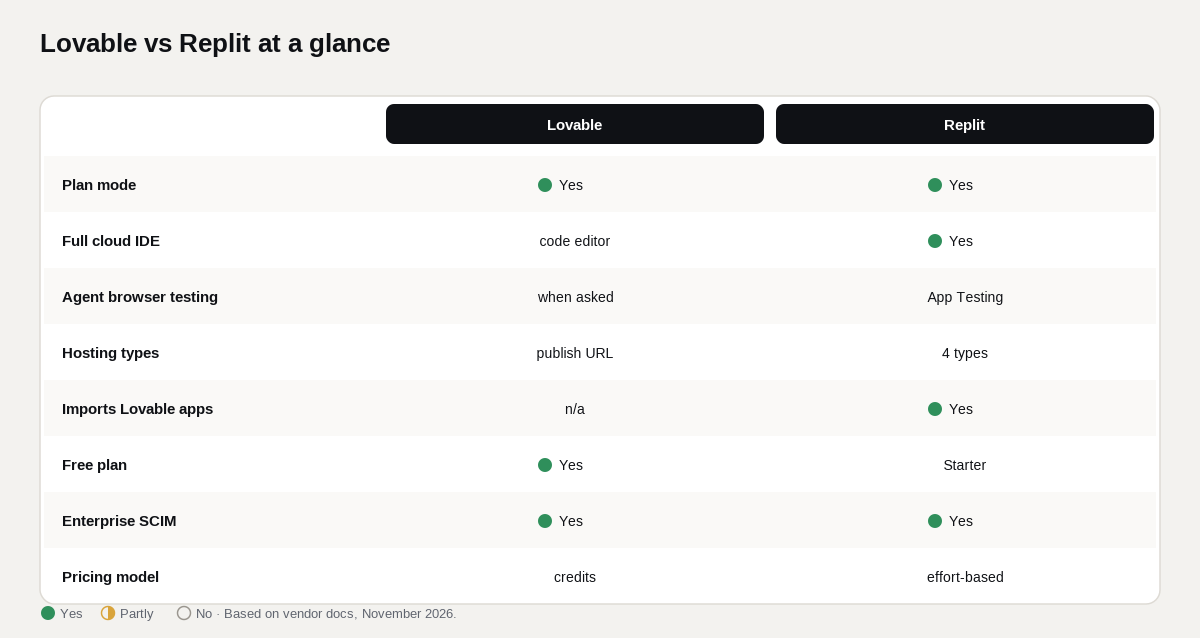
Feature comparison
| Aspect | Lovable | Replit | Source |
|---|---|---|---|
| Where it runs | Web app plus a mobile app for building | Cloud workspace in the browser | Lovable FAQ; Replit Agent |
| Planning / spec | Plan mode writes a plan for approval | Plan mode writes a task list to approve | Lovable FAQ; Replit Agent |
| Agent autonomy | Build mode changes the project directly | Free, Power and Max modes; paid actions need confirmation | Lovable FAQ; Replit Agent |
| Testing | Browser testing and frontend tests when asked; security scans | App Testing clicks through the app in a real browser (JS full stack, Streamlit) | Lovable FAQ; Replit App Testing |
| Deploy / hosting | Publish a snapshot with HTTPS; custom domains on paid plans | Autoscale, Reserved VM, Static and Scheduled deployments | Lovable FAQ; Replit publish |
| Code and export | Git sync into a new repo; ZIP download on paid plans | Imports from GitHub, Bitbucket, Lovable, Bolt and more | Lovable GitHub; Replit import |
| Team / admin | Roles, drafts; SSO from Business; SCIM and audit logs on Enterprise | SAML SSO, SCIM, groups; Enterprise RBAC, private deployments, audit log streaming | Lovable enterprise; Replit Enterprise |
| Model choice | Lovable picks the model | Auto picks per paid task; Enterprise admins control model access | Lovable FAQ; Replit Agent |
| Pricing model | Monthly credits, not seats | Effort-based Agent pricing on Starter, Core, Pro and Enterprise plans | Lovable plans; Replit pricing docs |
Cost model by team size
| Team size | Lovable | Replit |
|---|---|---|
| 1 person | Free plan can build and publish (5 daily build credits, capped at 30 a month); Pro adds monthly credits that roll over | Starter is free, with a Free Mode allowance that resets every five hours plus weekly limits; Core includes monthly credits and one parallel Agent task |
| 5 people | Credits, not seats: collaborators spend the owner workspace's credits; Business adds SSO | Pro: up to 15 collaborators and up to 10 parallel Agent tasks; each paid task's cost is confirmed before it starts |
| 25 people | Enterprise by contract: SCIM, audit logs, publish approval gates | Enterprise (custom): SSO, SCIM, audit logs, single-tenant and private networking options |
Check Lovable's plans page and Replit's pricing page for amounts as of November 2026. Replit notes that Plan mode can incur charges even without changing code. For reference, Devfab (Beta) logs cost after each run, per task and per project.
Where Lovable wins
- The builder isn't a developer. Lovable picks the stack and model, so there are fewer decisions to make.
- Several people shape one app. Roles and per-person drafts let a team edit without stepping on each other.
- You want one simple budget. Credits cover building, hosting, backend and in-app AI, with no seats.
- You need a published web app with security checks. Every publish gets a quick scan.
Where Replit wins
- A developer wants to drop into code. Replit is a full cloud IDE with Agent beside it.
- The app needs a specific runtime. Choose autoscale, an always-on VM, static hosting or scheduled jobs.
- You want the agent to test its own work in a browser. App Testing clicks through and fixes issues.
- IT needs control. Enterprise admins can ban public apps, require security scans, pin regions and stream audit logs.
- You're migrating from another builder. Replit imports Lovable, Bolt, Base44, Vercel and Figma projects.
Switching from one to the other
From Lovable to Replit: export the Lovable project to GitHub, open replit.com/import, choose Lovable and select the repository. Code, design, assets, backend logic and database schema come across. Supabase data and secret values don't, so add secrets again and move your data.
From Replit to Lovable: Lovable's Git sync always creates a new repository and cannot link an existing one, so it won't attach to your Replit code. Importing outside code wasn't covered in the Lovable docs we checked.
Where Devfab fits
Lovable and Replit both get you from idea to running app. Agencies and in-house teams often then hit the same wall. A client wants to approve the plan, journeys need testing beyond the happy path, and the app must run on the client's own server.
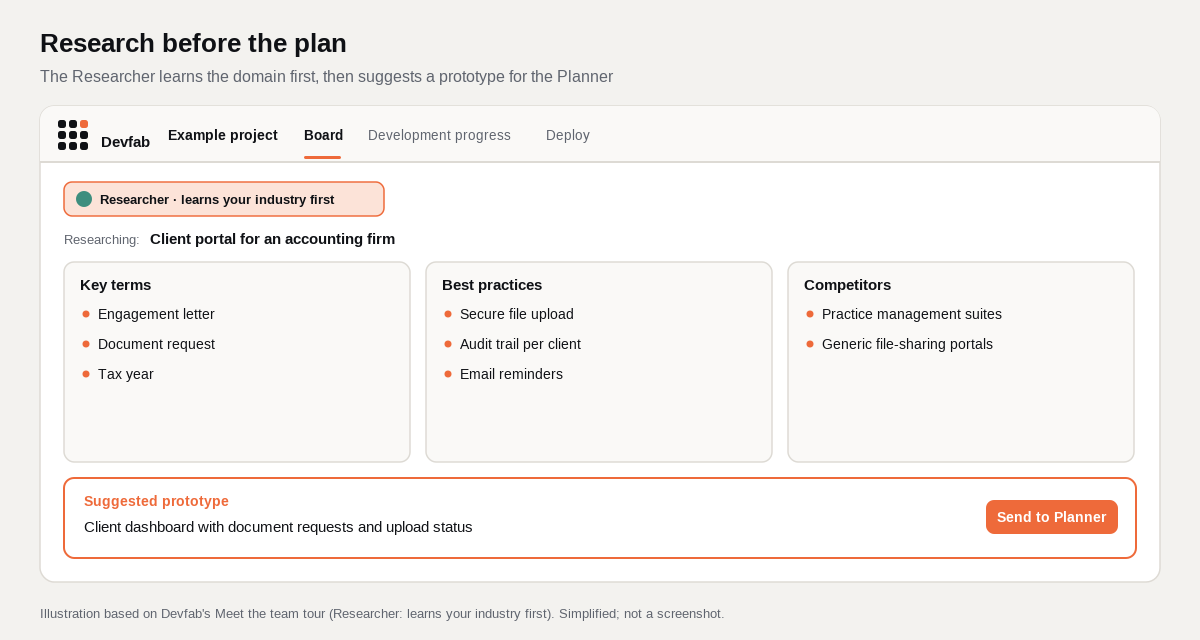
App builders automate the first version. Devfab automates the development lifecycle. Before planning, Devfab's Researcher learns your industry first. It maps key terms, best practices for that kind of app and competitors, then suggests a prototype. A person approves the plan. The QA agent runs UI, flow and logic tests, and Deploy ships to your own server, with code in your own GitHub account.
Honest limits: Devfab is new and in Beta, with a smaller community and fewer integrations than Replit. It is not an IDE for hands-on coding, and it needs a GitHub account. Read How to deploy an AI-built app to your own server.
FAQ
Can I move a Lovable app to Replit?
Yes. Replit's docs describe it: export the Lovable project to GitHub, open replit.com/import, choose Lovable and pick the repository. Code, design, assets, backend logic and database schema come across; Supabase data and secret values do not, so you add those again.
Does Replit test the apps it builds?
Yes, in part. Replit's App Testing lets Agent click through your app in a real browser and fix what it finds. It covers Full Stack JavaScript and Streamlit Python web apps, runs in Power and Max modes, and is charged by effort. Lovable can test in a browser and write frontend tests when asked.
Which is easier for a non-developer?
Lovable. It picks the framework, database and model for you, and its Plan and Chat modes let you discuss changes before anything is built. Replit also has a Plan mode, but it is a full cloud IDE with more choices about agents, hosting and runtime.
Which one gives more control over hosting?
Replit. It offers Autoscale, Reserved VM, Static and Scheduled deployments, and Enterprise admins can require private deployments and pin deployment regions. Lovable publishes a snapshot of the project to a URL with HTTPS, with custom domains on paid plans.
Read next
- What is an AI software factory?
- AI app builder vs AI coding agent: which one do you need?
- Prototype vs MVP vs production app: what's the difference
- How to deploy an AI-built app to your own server
Ready to take a prototype to production? Try Devfab Beta
Sources (checked November 13, 2026): Lovable FAQ; Lovable for Enterprise; Lovable GitHub Git sync; Lovable plans and credits; Lovable subscription plans; Lovable collaboration; Replit Agent overview; Replit pricing and plans (docs); Replit pricing; Replit App Testing; Replit Enterprise; Replit: publish your app; Replit: import from providers; Dealroom: Replit Series D and Agent 4 (Mar 11, 2026).
Frequently asked questions
Can I move a Lovable app to Replit?
Yes. Replit's docs describe it: export the Lovable project to GitHub, open replit.com/import, choose Lovable and pick the repository. Code, design, assets, backend logic and database schema come across; Supabase data and secret values do not, so you add those again.
Does Replit test the apps it builds?
Yes, in part. Replit's App Testing lets Agent click through your app in a real browser and fix what it finds. It covers Full Stack JavaScript and Streamlit Python web apps, runs in Power and Max modes, and is charged by effort. Lovable can test in a browser and write frontend tests when asked.
Which is easier for a non-developer?
Lovable. It picks the framework, database and model for you, and its Plan and Chat modes let you discuss changes before anything is built. Replit also has a Plan mode, but it is a full cloud IDE with more choices about agents, hosting and runtime.
Which one gives more control over hosting?
Replit. It offers Autoscale, Reserved VM, Static and Scheduled deployments, and Enterprise admins can require private deployments and pin deployment regions. Lovable publishes a snapshot of the project to a URL with HTTPS, with custom domains on paid plans.