Short answer: Choose an AI app builder (Lovable, Bolt.new, Replit, v0, Base44) when the goal is a working, hosted app from a description and nobody wants to manage code. Choose an AI coding agent (Copilot, Cursor, Claude Code, Codex, Devin) when a developer owns a codebase and wants tasks done inside it. Many projects need both, in that order.
You heard that AI can build your app, and you don't know which kind of AI to buy. One camp says describe it and click publish. The other says real software needs a developer with an agent in the repo. Both are right about different jobs. Picking the wrong one costs you a rebuild or a stalled project.
In this guide, you'll learn:
- Definitions
- Side by side
- When to choose an AI app builder
- When to choose an AI coding agent
- Where an AI software factory fits
We act as the referee: facts from vendor docs, then a verdict per situation.
Definitions
An AI app builder turns a plain-language prompt into a working app and usually hosts it for you. Bolt "is for everyone", from non-coders who change apps by chatting to developers who edit the code directly. Lovable generates and hosts full-stack web apps and lists SaaS products, internal tools, dashboards and booking apps among common uses. Replit's Agent "takes action" to set up projects, build apps, check its work and fix problems. v0 builds Next.js apps and deploys them to Vercel. Base44 generates the frontend, backend and database and hosts the result.
An AI coding agent works inside a codebase for a developer. GitHub Copilot's agent mode decides which files to change and asks for approval on changes and terminal commands. Cursor calls itself "a coding agent for building ambitious software". Claude Code reads your codebase, edits files, runs commands and opens pull requests from the terminal, IDEs, desktop or browser. OpenAI Codex runs in the ChatGPT apps, a CLI, an IDE extension and the cloud. Devin describes itself as "an autonomous AI software engineer that can write, run and test code".
The simple test: who is driving? With a builder, the person describing the app drives, and the code is a by-product. With a coding agent, a developer drives, and the code is the product.
Side by side
| Aspect | AI app builder | AI coding agent |
|---|---|---|
| Who it's for | Founders, PMs, marketers, designers, plus developers who want speed | Developers and engineering teams |
| Starting point | A prompt, a Figma frame or screenshots (Bolt, v0) | An existing repository, an issue or a ticket |
| Where it runs | In the browser, on the vendor's platform | In your editor, terminal, CI or a cloud sandbox |
| Planning | Plan modes in Lovable, Bolt.new and Replit | Plan modes in Cursor and Claude Code; Copilot's cloud agent writes an implementation plan |
| Testing | Replit's App Testing clicks through the app in a browser; Lovable can test in a browser when asked | Runs your tests and linters; Codex checks its work with computer and browser tools |
| Hosting | Built in (Lovable, Bolt Cloud, Replit, Vercel for v0, Base44) | Up to you and your CI |
| Code and repo | Generated in the builder; GitHub sync in Lovable, Bolt.new, v0 and Base44 (Builder plan and up) | Works in your repo; opens branches and pull requests |
| Model choice | Often picked for you (Lovable, Bolt.new) | Usually yours to pick (Cursor, Copilot by plan); Claude Code uses Claude models |
| Pricing model | Credits or tokens per plan, often including hosting | Seats plus usage or AI credits |
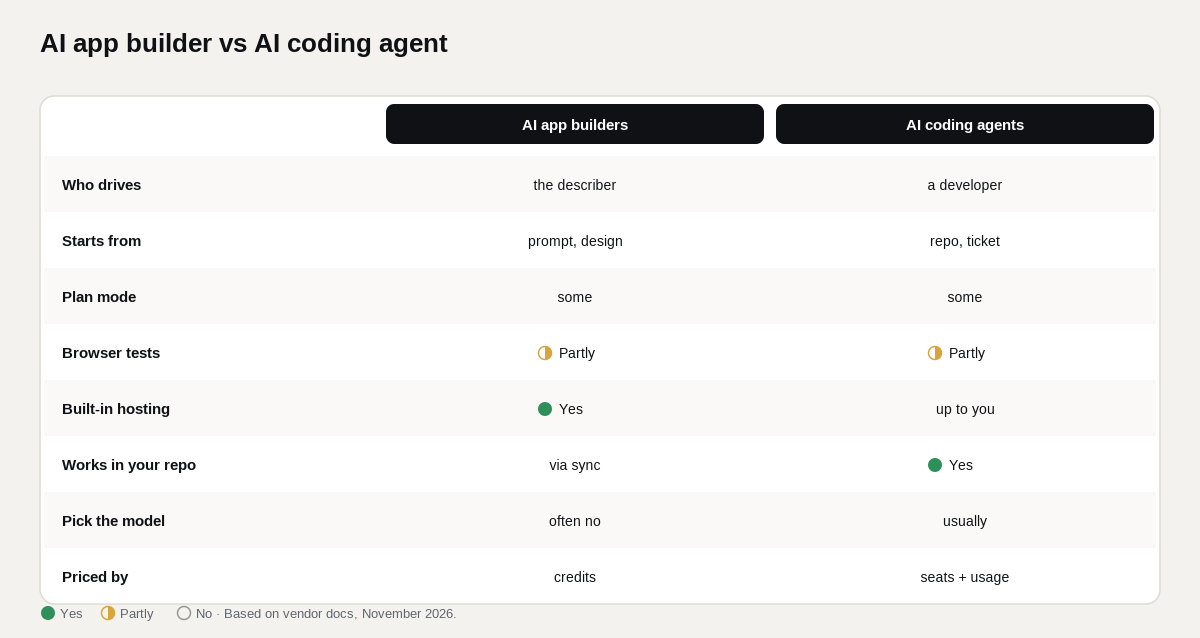
Tools change often; the table reflects vendor docs checked in November 2026.
When to choose an AI app builder
App builders are the better choice when:
- Nobody on the team writes code. Lovable is built for people with no coding experience who build by describing what they want, and Bolt runs entirely in the browser "so you don't have to install anything".
- You need a demo link, not a codebase. Lovable's Publish deploys a snapshot to its own HTTPS URL; Bolt Cloud includes hosting on a free subdomain.
- One bill should cover everything. Lovable's single credit balance covers building, chat, hosting, the built-in backend and in-app AI. Base44 includes auth, database, email and Stripe payments.
- You start from a design. Bolt.new can import a Figma frame, and v0's Design Mode lets you adjust styles in the live preview and write them back to code.
- You are testing whether an idea is worth building. A prototype that answers "do users want this?" has done its job, even if it is later rebuilt.
Know the limits before you commit. Lovable offers no choice of framework, database or model, and its Git sync can't link an existing repository. A Bolt project stays on main. Base44 has no GitHub sync on Free or Starter plans.
When to choose an AI coding agent
Coding agents are the better choice when:
- You already have a codebase. Agents are built to read and change existing code. Copilot's cloud agent can research a repository before it plans; Cursor's Plan Mode researches the codebase and drafts a plan you can edit.
- A developer will review every change. Copilot asks for approval on file changes and terminal commands, and GitHub warns its output can include "incorrect or suboptimal code".
- You control hosting, CI and security. Coding agents work inside your own pipeline instead of a vendor's platform.
- You have a backlog of well-scoped tickets. Cognition lists parallel tickets, migrations, refactors, PR review, unit tests and documentation as good fits for Devin.
- You want to choose the model. Cursor's model table spans several vendors, and Copilot supports models from six vendors depending on plan.
The limit: a coding agent makes a developer faster, but it doesn't plan the product, run user-journey tests across the whole app, or write the user manual unless someone asks it to.
The handoff: builder first, agent second
Many projects start in a builder and move to a coding agent once the app matters. The path runs through GitHub:
- Sync the builder project to GitHub. Lovable creates a new repository and syncs one branch; Bolt auto-commits each non-breaking change; Base44 syncs two ways on Builder plans and up; v0 works on a branch and opens pull requests.
- Point a coding agent at the repo. From here, a developer and an agent take over feature work, refactors and fixes.
- Add what neither tool gave you. An approved plan, tests of real user journeys, deployment to your own server and documentation.
Step 3 is where projects stall. That's the gap a factory fills.
Where an AI software factory fits
Coding agents automate the developer. Devfab automates the development lifecycle. Devfab is an AI software factory: seven agents (Researcher, Planner, Coordinator, Developers, Blueprint, QA agent and Deploy) run a project from idea to deployed app, and a person approves the plan before any tickets are created.
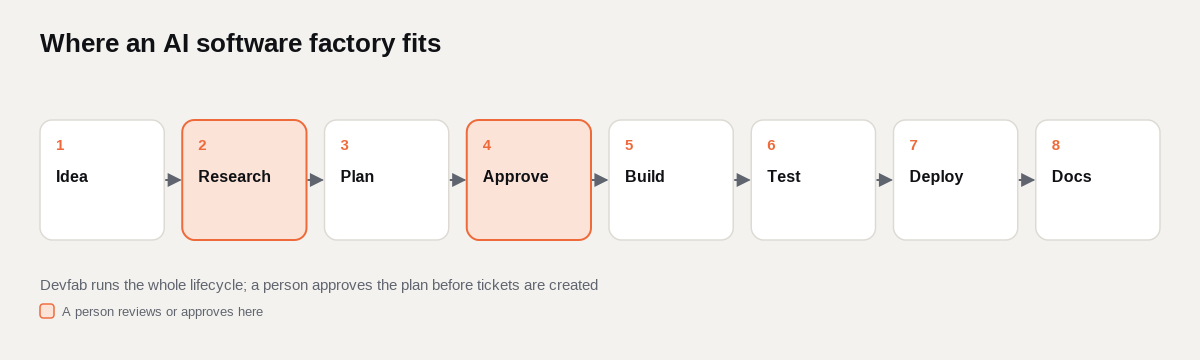
It sits between the two categories:
- Like an app builder, you can start from a description ("Start a new project"), and a non-developer can review the plan and the prototype.
- Like a coding agent, it works in a real repository in your own GitHub account (or your organization's), including existing ones ("Work on an existing project").
- Research before the plan. The Researcher maps the domain (key terms, best practices, competitors) before the Planner writes anything.
- ChainFlow maps which functions and APIs call each other, so a change to checkout doesn't quietly break payments or notifications.
- QA agent runs UI and flow tests plus logic tests, separate from the agents that wrote the code.
Honest limits: Devfab is new and in Beta, with a smaller community and fewer integrations than the tools above. It isn't an editor for hands-on coding, it needs a GitHub account, and for a quick throwaway demo an app builder is the faster route. Cost is predictable: it's logged after each run, per task and per project.
FAQ
What is the difference between an AI app builder and an AI coding agent?
An AI app builder turns a plain-language prompt into a working, hosted app, often for people who don't code. An AI coding agent works inside an existing codebase for a developer: it reads files, edits code, runs commands and opens pull requests. The builder owns the whole small app; the agent works on one task in your repo.
Can a non-developer use an AI coding agent?
They can try, but coding agents are built for developers. They ask you to approve file changes and terminal commands and to review pull requests. Someone who can't judge a code change is better served by an app builder, or by a process where a developer reviews the agent's work.
Can I move from an AI app builder to a coding agent later?
Usually, if the builder syncs code to GitHub. Lovable, Bolt.new, v0 and Base44 (on Builder plans and up) all sync to GitHub, and a coding agent can then work in that repo. Check each builder's limits: Lovable's sync creates a new repository and syncs one branch, and Bolt projects stay on main.
Which is cheaper, an app builder or a coding agent?
They charge differently. App builders mostly sell credits or tokens per plan, and the plan often includes hosting. Coding agents mostly sell seats plus usage or AI credits, and hosting is up to you. Compare the total for your real workload, including hosting and the people who review the work.
Read next
- What is an AI software factory?
- AI software factory vs AI coding tools: which does your team need?
- Lovable vs Cursor
- Replit vs Cursor
- Prototype vs MVP vs production app: what's the difference?
- What is vibe coding, and when does it stop working?
Start from a description, end with a tested app in your own repo. Try Beta
Sources (checked November 13, 2026): Intro to Bolt; Bolt glossary; Bolt Git integration; What is Bolt Cloud?; Lovable FAQ; Lovable GitHub sync; Replit Agent overview; Replit App Testing; v0 introduction; v0 Design Mode; v0 GitHub; What is Base44?; Base44 GitHub sync; Base44 pricing; GitHub Copilot features; About Copilot cloud agent; Copilot supported models; Cursor docs; Cursor Plan Mode; Claude Code overview; Claude Code costs; OpenAI Codex; ChatGPT and Codex docs; Introducing Devin.
Frequently asked questions
What is the difference between an AI app builder and an AI coding agent?
An AI app builder turns a plain-language prompt into a working, hosted app, often for people who don't code. An AI coding agent works inside an existing codebase for a developer: it reads files, edits code, runs commands and opens pull requests. The builder owns the whole small app; the agent works on one task in your repo.
Can a non-developer use an AI coding agent?
They can try, but coding agents are built for developers. They ask you to approve file changes and terminal commands and to review pull requests. Someone who can't judge a code change is better served by an app builder, or by a process where a developer reviews the agent's work.
Can I move from an AI app builder to a coding agent later?
Usually, if the builder syncs code to GitHub. Lovable, Bolt.new, v0 and Base44 (on Builder plans and up) all sync to GitHub, and a coding agent can then work in that repo. Check each builder's limits: Lovable's sync creates a new repository and syncs one branch, and Bolt projects stay on main.
Which is cheaper, an app builder or a coding agent?
They charge differently. App builders mostly sell credits or tokens per plan, and the plan often includes hosting. Coding agents mostly sell seats plus usage or AI credits, and hosting is up to you. Compare the total for your real workload, including hosting and the people who review the work.