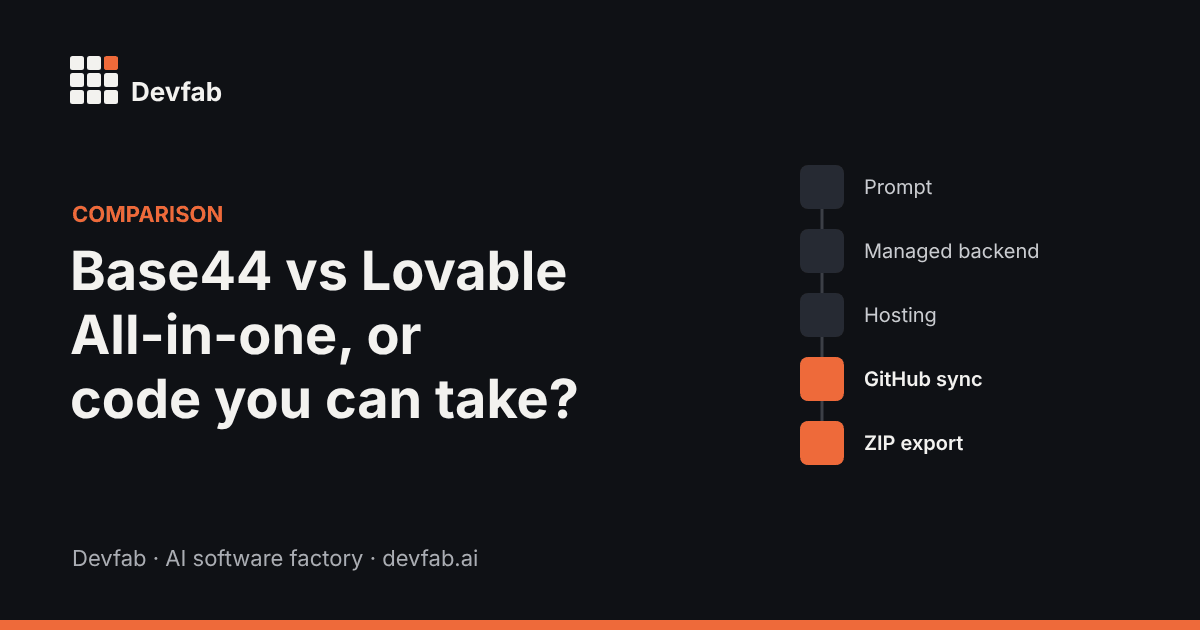
Short answer: Pick Lovable if you want an all-in-one builder that hosts the app, runs the backend and lets non-developers build web apps on shared credits. Pick v0 if your team already uses Next.js and Vercel and wants an agent that works on branches in your existing repo, opens pull requests and lets designers edit visually.
Your designer wants to change the UI without waiting for a developer. Your founder wants a whole app, hosted, for the investor demo. Lovable and v0 both answer "describe it and we'll build it". They differ on where the code lives, who reviews it and what happens on day two.
In this comparison:
The sections below set out the facts for each.
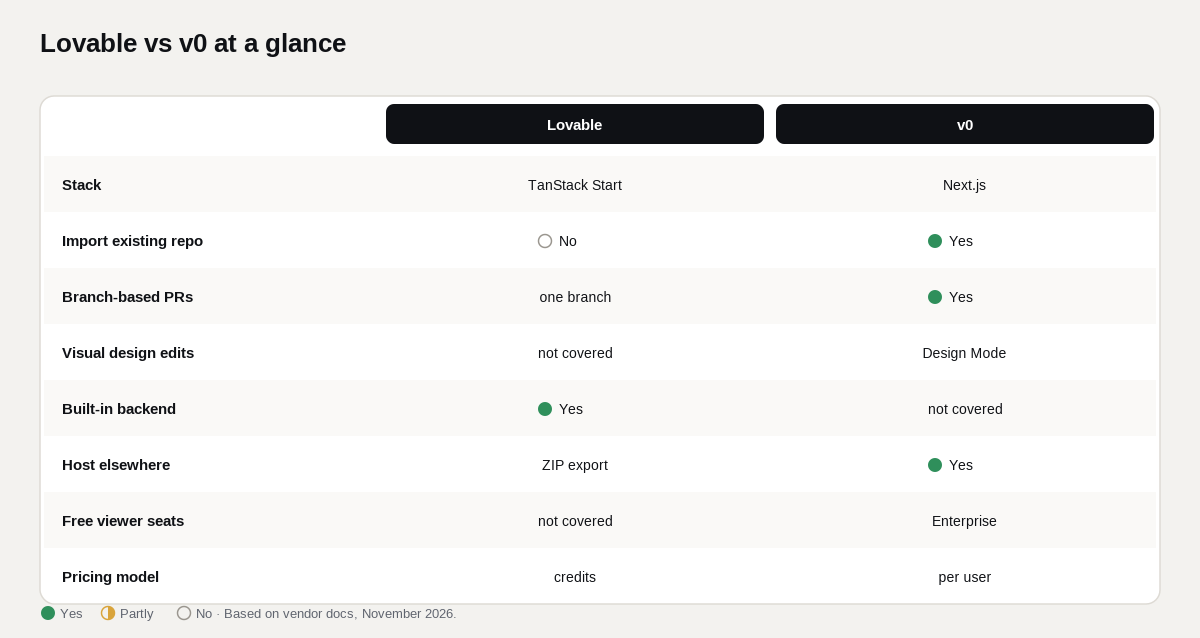
Lovable and v0 at a glance
Changes in 2026
- Lovable moved new apps to TanStack Start with server rendering on May 13, 2026, and unified credits on June 1. From September 9, Free and Pro data may be used for model training unless users opt out.
- v0 now lives at v0.app. Its legacy Premium plan is being phased out and is closed to new users. The current plans are Free, Plus, Business and Enterprise.
Lovable
Lovable is a browser-based AI app builder for people with no coding experience and for developers who edit the generated code. It builds SaaS products, internal tools, dashboards, CRMs and booking apps. Build mode changes the project, Plan mode writes a plan for approval, and Chat mode answers questions.
Lovable bundles everything: a built-in backend with managed PostgreSQL, login and file storage, plus publishing with HTTPS. It picks the framework, database and model, and builds web apps only. Teams get roles and per-person drafts. Git sync always creates a new repository.
v0
v0 is Vercel's AI agent for building Next.js apps and agents. Its audience includes PMs, designers, engineers, data scientists, marketers and founders. The stack is fixed: Next.js, React, TypeScript, Tailwind CSS and shadcn/ui. The agent can search the web, inspect sites, fix errors and use external tools.
Design Mode lets you select elements in the live preview and change styles, and v0 writes the edits back to code. v0 can import an existing repo, work on a branch with per-branch previews, and open and merge pull requests. It "never pushes directly to main". Deploys go to Vercel in one click, but you can export the code and host elsewhere.
Feature comparison
| Aspect | Lovable | v0 | Source |
|---|---|---|---|
| Where it runs | Web app; mobile app for building | Web app at v0.app with live preview and code editor; iOS app | Lovable FAQ; v0 FAQ |
| Planning / spec | Plan mode writes a plan for approval | Not covered in the docs we checked | Lovable FAQ |
| Stack | TanStack Start for new apps; no framework or database choice | Next.js, React, TypeScript, Tailwind, shadcn/ui | Lovable FAQ; v0 FAQ |
| Testing | Browser tests and frontend tests when asked; security scans | Agent fixes errors; output "may be incomplete" | Lovable FAQ; v0 FAQ |
| Deploy / hosting | Publish with HTTPS; built-in backend | One-click deploy to Vercel; previews run server code as in production | Lovable FAQ; v0 intro |
| Code and export | Git sync into a new repo; ZIP on paid plans | Imports existing repos; branch-based PRs; export and host elsewhere | Lovable GitHub; v0 GitHub |
| Team / admin | Viewer, Editor, Admin, Owner roles; SSO from Business; SCIM on Enterprise | Linked Vercel team; Enterprise Viewer and Creator roles and SAML SSO | Lovable collaboration; v0 teams |
| Model choice | Lovable picks the model | In-app AI via Vercel AI Gateway or your own keys | Lovable FAQ; v0 AI models |
| Pricing model | Monthly credits, not seats | Per-user plans with monthly credits plus shared credits; metered by tokens | Lovable plans; v0 pricing |
Cost model by team size
| Team size | Lovable | v0 |
|---|---|---|
| 1 person | Free plan can build and publish (5 daily build credits, capped at 30 a month); Pro adds monthly credits that roll over | Free plan with a daily message limit; Plus is per user with monthly credits and daily login credits |
| 5 people | Credits, not seats: collaborators spend the owner workspace's credits; Business adds SSO | Plus links to a Vercel team; every member is a paid Builder; credits pool across the team |
| 25 people | Enterprise by contract: SCIM, audit logs, publish approval gates | Business (training opt-out by default) or Enterprise, where Viewers don't count as paid seats |
Check Lovable's plans page and v0's pricing page for amounts as of November 2026. v0's FAQ warns that agents can fail repeatedly and use up credits. For reference, Devfab (Beta) logs cost after each run, per task and per project.
Where Lovable wins
- You want everything in one place. Building, hosting, database, login and storage share one credit balance.
- Non-developers do the building. Plan and Chat modes let people talk changes through before anything is built.
- You want a security pass on every release. A quick scan runs on each publish.
- You don't use Vercel or Next.js. Lovable has no dependency on either.
Where v0 wins
- You already have a codebase. v0 imports existing repos and works through branches and pull requests.
- You're on Next.js and Vercel. Previews and one-click deploys fit straight into that setup.
- Designers tweak the UI themselves. Design Mode writes visual changes back to code.
- Large teams include read-only people. On Enterprise, Viewers don't count as paid seats.
Switching from one to the other
From Lovable to v0: sync the Lovable project to GitHub, then import that repository into v0. v0 works on a branch and opens pull requests, so review them as usual. New Lovable apps use TanStack Start, while v0 generates Next.js. How well v0 edits a non-Next.js project was not covered in the docs we checked, so test on a copy first.
From v0 to Lovable: Lovable's Git sync "always creates a new repository and cannot link an existing one," so it can't take over your v0 repo directly.
Where Devfab fits
Both tools are good at the first version of a web app. Agencies and SMEs then need a plan the client approves, journeys tested before release, and an app on the client's own server, not tied to one host.
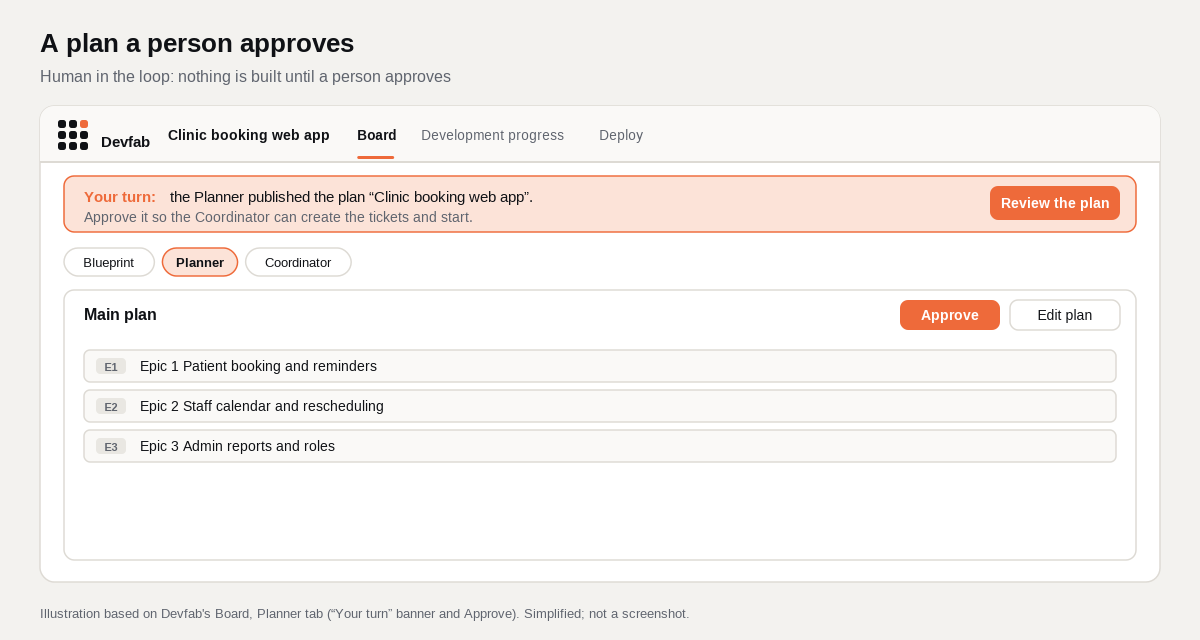
App builders automate the first version. Devfab automates the development lifecycle. The Researcher maps the domain first, and the Planner writes a plan with epics. A person approves it before the Coordinator creates tickets. The QA agent runs UI, flow and logic tests, and Deploy ships to your own server. Code lives in your own GitHub account, and by default Devfab picks the stack that fits, such as Next.js with TypeScript for web apps, or you choose.
Honest limits: Devfab is new and in Beta, with a smaller community and fewer integrations. It is not an editor for hands-on coding, and it needs a GitHub account. See Devfab vs v0.
FAQ
Can v0 work on my existing codebase?
Yes. v0 can import an existing GitHub repository, works on a working branch with per-branch Vercel previews, and opens and merges pull requests. Its docs say it never pushes directly to main. Lovable's Git sync always creates a new repository and cannot link an existing one.
Do I have to host on Vercel if I use v0?
No. v0's FAQ says you can export the code and deploy elsewhere; Vercel is needed only for the full experience, such as one-click deploys and branch previews. Lovable hosts apps itself when you publish, and paid plans can download the codebase as a ZIP.
Which is better for a non-technical founder?
Lovable, in most cases. It bundles hosting, a managed database, login and file storage, picks the stack for you and offers Plan and Chat modes. v0 suits teams that already use Next.js and Vercel and have someone who reviews pull requests.
Who owns the code each tool generates?
v0's FAQ states that Vercel doesn't own the code generated. Lovable lets you sync code to your own GitHub, GitLab or Bitbucket repository and download it on paid plans. In both cases, keep the repository in an account your company controls.
Read next
- What is an AI software factory?
- Devfab vs v0: which fits a team that ships client work?
- AI app builder vs AI coding agent: which one do you need?
- Prototype vs MVP vs production app: what's the difference
Get a plan your client approves, then a tested app. Try Devfab Beta
Sources (checked November 13, 2026): Lovable FAQ; Lovable for Enterprise; Lovable GitHub Git sync; Lovable plans and credits; Lovable subscription plans; Lovable collaboration; v0 docs introduction; v0 FAQs; v0 pricing; v0 GitHub; v0 Design Mode; v0 AI models; v0 teams.
Frequently asked questions
Can v0 work on my existing codebase?
Yes. v0 can import an existing GitHub repository, works on a working branch with per-branch Vercel previews, and opens and merges pull requests. Its docs say it never pushes directly to main. Lovable's Git sync always creates a new repository and cannot link an existing one.
Do I have to host on Vercel if I use v0?
No. v0's FAQ says you can export the code and deploy elsewhere; Vercel is needed only for the full experience, such as one-click deploys and branch previews. Lovable hosts apps itself when you publish, and paid plans can download the codebase as a ZIP.
Which is better for a non-technical founder?
Lovable, in most cases. It bundles hosting, a managed database, login and file storage, picks the stack for you and offers Plan and Chat modes. v0 suits teams that already use Next.js and Vercel and have someone who reviews pull requests.
Who owns the code each tool generates?
v0's FAQ states that Vercel doesn't own the code generated. Lovable lets you sync code to your own GitHub, GitLab or Bitbucket repository and download it on paid plans. In both cases, keep the repository in an account your company controls.