Short answer: Choose low-code (OutSystems, Mendix, Power Apps) when you want a governed platform where business users and IT build many apps under one vendor, with compliance and support included. Choose an AI software factory when you want each project delivered as plain code in your own repository, planned, tested and deployed to your own server.
You run IT for a company that needs more apps than developers. Low-code promised to close that gap years ago. Now AI agents promise the same, and every low-code vendor has added AI too. The labels blur, but the choice still matters: it decides where your apps live and who you depend on to change them.
In this guide, you'll learn:
- Definitions
- Side by side
- When to choose low-code
- When to choose an AI software factory
- Where an AI software factory fits
Use the sections below to match each model to your apps.
Definitions
Low-code. IBM defines low-code as "a rapid application development (RAD) approach that enables automated code generation through visual building blocks". It is "aimed at professional developers" and can be extended with custom code and plugins. Microsoft adds that "low-code development requires some custom coding" and is "most often used by IT professionals with some coding skills". In practice, you build on a platform: its IDE, its data layer, its runtime and its licensing.
In 2026, the big platforms are AI-first too:
- OutSystems Mentor App Generator asks clarifying questions and builds the data model, logic and UI. Mentor in the IDE proposes a plan and applies changes after approval. The output is standard OutSystems Developer Cloud (ODC) apps.
- Mendix Maia Plan turns ideas and user stories into structured app plans, and Maia generates domain models, pages and workflows.
- Power Apps lets users "describe what they need in natural language and generate rich, custom app experiences". Its Plans workspace uses AI agents as requirements analyst, data modeler and solution architect.
AI software factory. The term is older than AI agents. In 2004, Microsoft architects Jack Greenfield and Keith Short described a software factory as "a product line that configures extensible development tools ... with packaged content and guidance, carefully designed for building specific kinds of applications." Today's AI version keeps the production line and adds agents. Augment describes work moving across "Requirements, Ticket, PR, and Prod", with agents at each handoff while "humans retain ownership of consequential decisions."
So low-code and the software factory share a root idea: make app building repeatable. The difference is the output. Low-code gives you apps on a platform. A factory gives you code in your repo.
Side by side
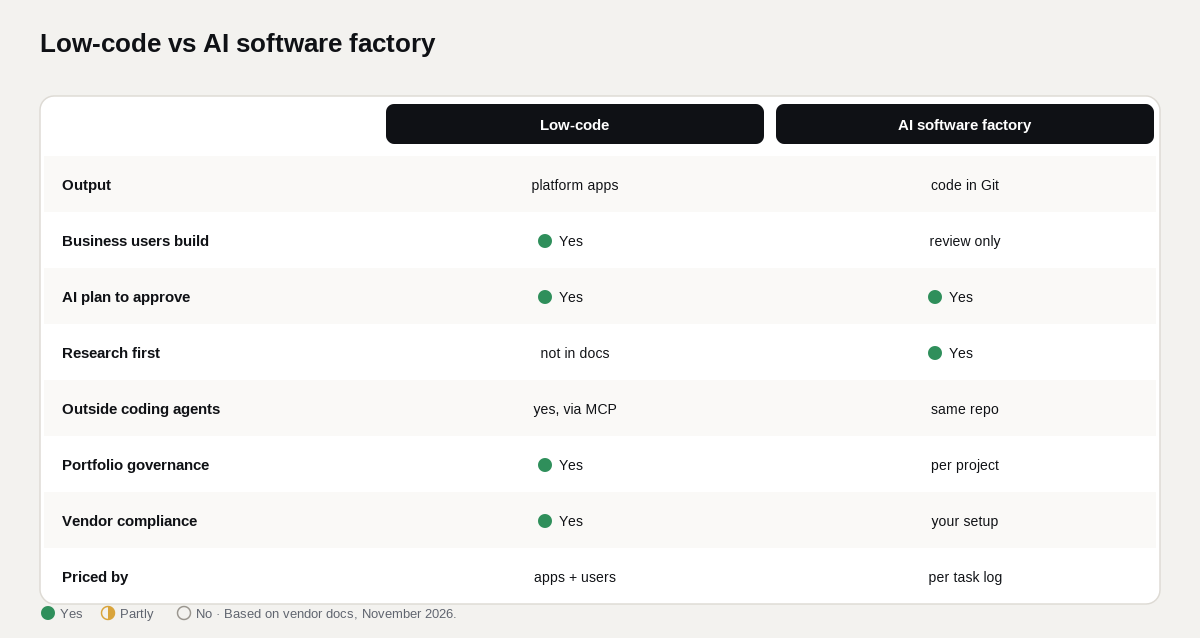
| Aspect | Low-code platform | AI software factory |
|---|---|---|
| What you get | Apps built in the vendor's IDE and model | Ordinary source code in a Git repository |
| Who builds | Pro developers and business users, with AI help | AI agents per stage; people approve the plan and review |
| Where apps run | Vendor cloud or a supported self-hosted setup (OutSystems ODC; Mendix Cloud, Kubernetes, SAP BTP or own servers) | Wherever you deploy the code; Devfab ships to your own server |
| Planning | Mentor proposes a plan for approval; Maia Plan; Power Apps Plans | A research step, then a project plan a person approves |
| Outside coding agents | Allowed in: OutSystems supports Claude Code, Codex and Cursor; Mendix offers MCP for external agents; Power Apps works with Copilot CLI and Claude Code | The agents are the factory; developers can use any editor on the same repo |
| Governance | Strong, platform-wide: OutSystems Enterprise Context Graph; Power Apps DLP and environment policies | Per project: roles, workspace permissions, plan approval, QA review |
| Compliance | OutSystems lists HIPAA, PCI DSS and FedRAMP requirements, SOC 2 Type II and ISO | Depends on where you deploy and how you run it |
| Licensing model | By app objects and users (OutSystems), apps and users (Mendix), per user or per app (Power Apps) | Devfab: predictable cost, logged per task and per project (Beta) |
One trend stands out: low-code platforms are opening their doors to coding agents. Mendix's Studio Pro MCP Server lets external agents use Maia tools, and Mendix Cloud MCP connects assistants such as Claude Code and GitHub Copilot. Power Apps' app-builder skill lets AI code tools build whole model-driven apps, "creating nothing until the user approves the build plan". The platform stays; the way you type into it changes.
When to choose low-code
Low-code is the better choice when:
- You need compliance attestations from the vendor. OutSystems lists HIPAA, PCI DSS and FedRAMP requirements, plus SOC 2 Type II and ISO certifications.
- You run on Microsoft 365. Power Apps stores data in Dataverse, and IT can "centralize policies for environments, data loss prevention, access, and auditing". Some users already have rights through Microsoft 365 licenses.
- You manage a portfolio, not a project. OutSystems' Enterprise Context Graph gives a real-time view of apps, agents, workflows, data and dependencies. Mendix restricts Maia's recommendations to company-approved Marketplace components if you choose.
- Business users must build and change apps themselves, inside guardrails IT controls.
- You want one vendor accountable. Support tiers, uptime commitments and connectors come with the contract: OutSystems advertises "pre-built connections to 400+ systems".
- You are a Siemens or SAP shop. Mendix deploys to SAP BTP and fits Siemens' industrial stack.
Know the trade-offs. Pricing is mostly custom or volume-based: OutSystems has no public prices, and Power Apps premium and custom connectors need standalone licenses. Mendix notes its external-agent policies "bring visibility, but no enforcement" in release 11.12.
When to choose an AI software factory
A factory is the better choice when:
- You want plain code you own. The app is a normal repository in your own GitHub account (or your organization's), not a model on a vendor's platform.
- You deliver software to clients. Agencies hand over code the client can run and maintain anywhere, with an approved plan and a QA report as evidence.
- The app needs a custom stack or UX. By default Devfab picks a stack that fits (for example Next.js and TypeScript for web apps), and you can pick languages.
- You want to see research and a plan before anything is built. The research step maps the domain first, and a person approves the plan before tickets are created.
- You need to deploy on your own servers or a client's, with a custom domain if you want one.
- You already have developers. They keep working in the same repo with their own tools, and the factory handles the lifecycle around them.
The trade-off: a factory doesn't give business users a visual editor to change apps themselves, and you take on hosting and operations wherever you deploy.
Where an AI software factory fits
Coding agents automate the developer. Devfab automates the development lifecycle. Devfab is an AI software factory with seven agents (Researcher, Planner, Coordinator, Developers, Blueprint, QA agent and Deploy) working on a project whose code lives in your own GitHub account.
Three things matter most next to a low-code platform:
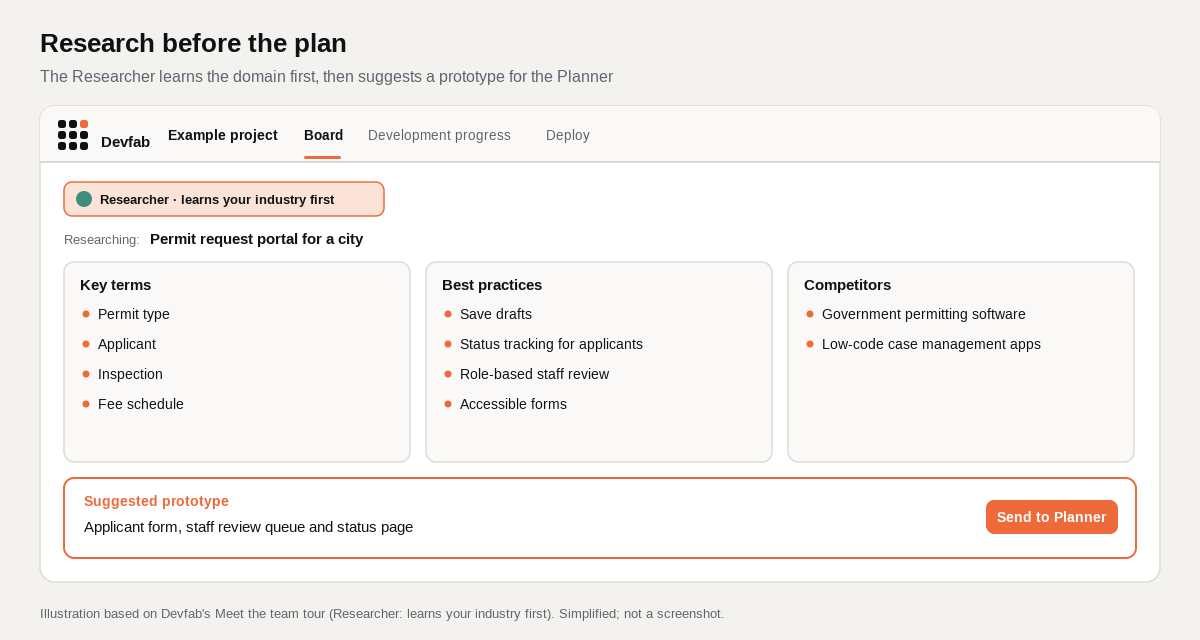
- Research before the plan. The Researcher learns your domain first: key terms, best practices for that kind of app, and competitors, then suggests a prototype. Low-code AI starts from your prompt or user stories.
- ChainFlow. Devfab's code-intelligence layer maps which functions and APIs call each other and what is deployed, so dev agents see the impact of a change before they make it.
- QA agent. It runs UI and flow tests (screens and user journeys clicked end to end) plus logic tests, and you can require "QA agent · review before Done".
Many organizations will run both: low-code for the governed portfolio of internal apps, and a factory for custom apps, client projects or anything that must leave the platform. You can choose the model for each agent or keep Devfab's default, and cost is logged after each run, per task and per project.
Honest limits: Devfab is new and in Beta, with a smaller community and far fewer integrations than an enterprise low-code platform. It is not an editor for hands-on coding, it needs a GitHub account, and it does not offer the vendor compliance attestations listed above.
FAQ
What is the difference between low-code and an AI software factory?
Low-code is a platform you build on: visual building blocks, some custom code, and apps that run on the vendor's runtime and licensing. An AI software factory is a process that delivers software: agents research, plan, code, test and deploy, and the output is ordinary code in your own repository.
Do low-code platforms use AI now?
Yes. OutSystems Mentor generates apps from natural language, Mendix Maia turns user stories into app plans, and Power Apps lets users describe an app in plain language. Mendix, OutSystems and Power Apps also let outside AI coding tools work with their platforms.
Is an AI software factory a replacement for low-code?
Not for every team. Low-code is the better fit when you need a vendor-supported platform with compliance attestations, central governance and business users building alongside IT. A factory fits when you want plain code you own and can run anywhere.
Where did the term software factory come from?
It predates AI agents. In 2004, Microsoft architects Jack Greenfield and Keith Short described a software factory as a product line that configures development tools with packaged content and guidance for building specific kinds of applications. AI factories keep the idea of a repeatable line and add agents at each stage.
Read next
- What is an AI software factory?
- AI software factory vs AI coding tools: which does your team need?
- OutSystems vs Mendix
- Power Apps alternatives
- Mendix alternatives
- What is an AI-native software factory?
Get your next custom app as code you own. Try Beta
Sources (checked November 13, 2026): IBM: Low-code vs no-code; Microsoft: Low-code vs no-code app development; Moving to Software Factories (Microsoft Learn archive, 2004); Augment: Beyond AI coding agents (Sep 2026); OutSystems Agentic Systems Engineering (Mar 31, 2026); Next-gen Mentor in ODC; OutSystems Developer Cloud; OutSystems pricing and editions; Mendix pricing; Mendix release 11.10; Mendix release 11.12; Using Maia with external AI agents; Verdantix: Siemens Realize LIVE Europe 2026: Mendix; Microsoft Power Apps; Power Platform licensing FAQs; What's new in Power Platform: September 2026; The New Stack: Power Apps Plans.
Frequently asked questions
What is the difference between low-code and an AI software factory?
Low-code is a platform you build on: visual building blocks, some custom code, and apps that run on the vendor's runtime and licensing. An AI software factory is a process that delivers software: agents research, plan, code, test and deploy, and the output is ordinary code in your own repository.
Do low-code platforms use AI now?
Yes. OutSystems Mentor generates apps from natural language, Mendix Maia turns user stories into app plans, and Power Apps lets users describe an app in plain language. Mendix, OutSystems and Power Apps also let outside AI coding tools work with their platforms.
Is an AI software factory a replacement for low-code?
Not for every team. Low-code is the better fit when you need a vendor-supported platform with compliance attestations, central governance and business users building alongside IT. A factory fits when you want plain code you own and can run anywhere.
Where did the term software factory come from?
It predates AI agents. In 2004, Microsoft architects Jack Greenfield and Keith Short described a software factory as a product line that configures development tools with packaged content and guidance for building specific kinds of applications. AI factories keep the idea of a repeatable line and add agents at each stage.