Short answer: For a like-for-like enterprise platform, pick OutSystems. If you're a Microsoft shop, Power Apps is the cheaper reach. For internal tools on company data, Retool or Superblocks. If you want to leave platform licensing behind and own the code on your own servers, Devfab is the fit, with more responsibility on your side.
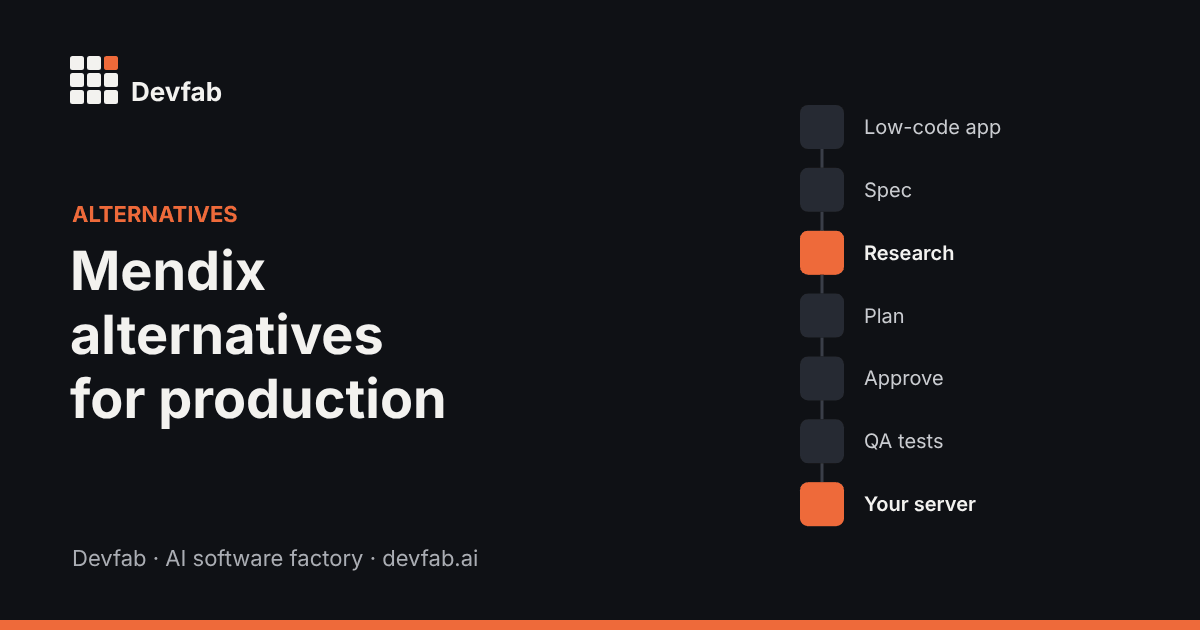
You run a Mendix portfolio, and the renewal is on the table. The license grows with apps and users, and cloud compute is billed on top. Meanwhile, AI coding agents are getting good, and Mendix's own agent bridge still has limits. So the question is fair: stay on the platform, move to another one, or move to code you own?
In this guide, you'll learn:
- Why teams leave Mendix
- How five alternatives compare
- Verdicts and trade-offs per tool
- Where Mendix is still the better choice
Read it in order, or jump to what you need.
Why teams leave Mendix
Status first. Mendix is active and part of Siemens. Mendix 11.12, the first LTS release since 10.24, shipped on June 30, 2026, with Agents Kit 2.0 and a Mendix Cloud MCP that connects assistants such as Claude Code and GitHub Copilot to Mendix Cloud environments.
The switching triggers we found:
- Licensing by app and user, plus compute. As of November 2026, Standard starts at USD 1,090 per month for one app or USD 2,725 per month for unlimited apps; Premium is by quote. Cloud compute is not included in the license price for Standard and Premium.
- The Free plan is for prototypes. It has no support plan, no uptime guarantee and no high availability; Mendix positions it for demos, prototypes and small apps.
- External agents still have limits. In Studio Pro 11.10, the MCP server could not generate pages, and agent instructions "do not enforce restrictions." Mendix says the 11.12 policies "bring visibility, but no enforcement."
- Upgrade work ahead. React is the default client for new projects, and the older Dojo client will be removed in Mendix 12.
- Total cost and skills. Jet Admin's Mendix alternatives guide (a competitor, Sep 2026) tells buyers to add licenses, infrastructure, implementation and long-term support together, and to ask whether an internal team can maintain the app after the partner leaves.
Quick comparison
| Tool | Type | Hosting | AI building | Code ownership | Pricing model |
|---|---|---|---|---|---|
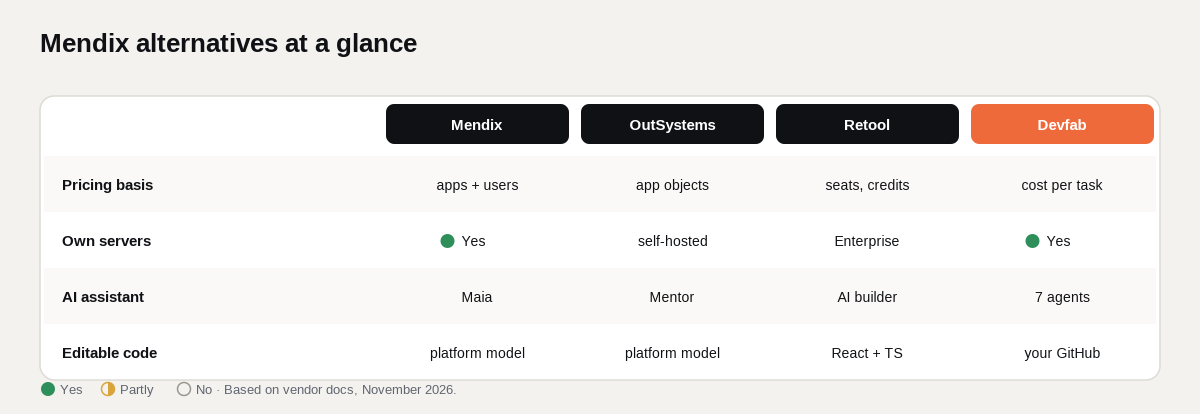
| Mendix (baseline) | Enterprise low-code | Mendix Cloud, Azure, Kubernetes, SAP BTP, own servers | Maia, Maia Plan, MCP for external agents | Platform model | Per app and per user; compute separate |
| OutSystems | Enterprise low-code | ODC on AWS, or self-hosted runtime | Mentor App Generator; external tools supported | Platform model | Custom quote by application objects and users |
| Microsoft Power Apps | Low-code platform | Microsoft cloud | Natural-language apps, Plans, app-builder skill | Platform apps; generative pages emit React | Per user or per app, plus capacity |
| Retool | Internal-tool and AI app builder | Cloud; VPC or on-prem on Enterprise | Prompt-first React builder | Editable React and TypeScript | Per builder and per user, plus AI credits |
| Superblocks | Governed enterprise AI builder | Cloud, Hybrid, Cloud-Prem | Clark AI agent | React you can edit; Git on Enterprise | Agent units plus per published app |
| Devfab | AI software factory | Your own server | Research, plan, build, QA, deploy | Normal codebase in your GitHub | Cost logged per task and per project (Beta) |
The alternatives
1. OutSystems
Verdict: the closest like-for-like move. Best for: large enterprises in banking, healthcare, insurance, manufacturing and government that want one governed platform. Trade-off: you trade one platform license for another, with no public prices. Pricing: free Personal Edition for development; the paid Agentic Systems Platform is a custom quote sized by application objects (screens, tables and API methods), users and add-ons. You pay LLM providers directly for tokens.
- Mentor App Generator asks clarifying questions and builds the data model, logic and UI; Mentor in the IDE proposes a plan and applies changes after approval.
- The Enterprise Context Graph (March 2026) gives a live view of apps, agents, workflows, data and dependencies.
- OutSystems lists HIPAA, PCI DSS and FedRAMP requirements plus SOC 2 Type II, and "pre-built connections to 400+ systems."
- Some Forge components may need to be rebuilt or replaced for OutSystems Developer Cloud.
See OutSystems vs Mendix for the head-to-head.
2. Microsoft Power Apps
Verdict: the practical choice if your organization already runs on Microsoft 365. Best for: line-of-business apps on SharePoint, Dynamics 365, Teams and Dataverse. Trade-off: licensing has many moving parts, and several AI pieces are still preview. Pricing: per-user or per-app licenses, pay-as-you-go via Azure (preview), a free Developer Plan for non-production, and paid Dataverse capacity.
- The "Plans" workspace uses AI agents as requirements analyst, data modeler and solution architect before generating assets.
- The app-builder skill (September 2026) lets AI coding tools build model-driven apps, creating nothing until you approve the build plan.
- Premium, on-premises and custom connectors need a standalone license beyond Microsoft 365 seeded rights.
3. Retool
Verdict: a lighter option when most of your Mendix estate is internal tools. Best for: engineering teams building admin panels and back-office apps on company data. Trade-off: not built for large customer-facing systems; Git source control and self-hosting are Enterprise-only. Pricing: free tier for up to 5 users; per-seat plans with separate builder and user rates; pooled AI credits; Enterprise custom.
- Its AI app builder writes React and TypeScript, and you can edit the code directly.
- Apps inherit central authentication, role-based access and data access policies.
- Enterprise adds VPC, on-prem and air-gapped hosting with SSO and SCIM.
4. Superblocks
Verdict: the pick when security wants the whole stack, including AI inference, in your own cloud. Best for: high-compliance enterprises with many semi-technical builders. Trade-off: no free tier; key controls are Enterprise-only. Pricing: usage-based Governed Agent Units plus a charge per published app; no per-seat builder or end-user fees on the enterprise license.
- Clark generates apps from chat, and builders can extend them by editing the underlying React.
- Superblocks 3.0 (August 2026) runs in-VPC with AWS Bedrock inference and adds security agents and SBOM and CVE scanning per app.
- It lists SOC 2, GDPR and HIPAA-eligible deployments.
5. Devfab
Verdict: the option for teams that want out of platform licensing altogether and will own the code. Best for: IT agencies and enterprise teams moving selected apps to a normal codebase on their own servers. Trade-off: you take on hosting, upkeep and a younger tool. Pricing: predictable cost: cost is logged after each run, per task and per project. Devfab is in Beta.
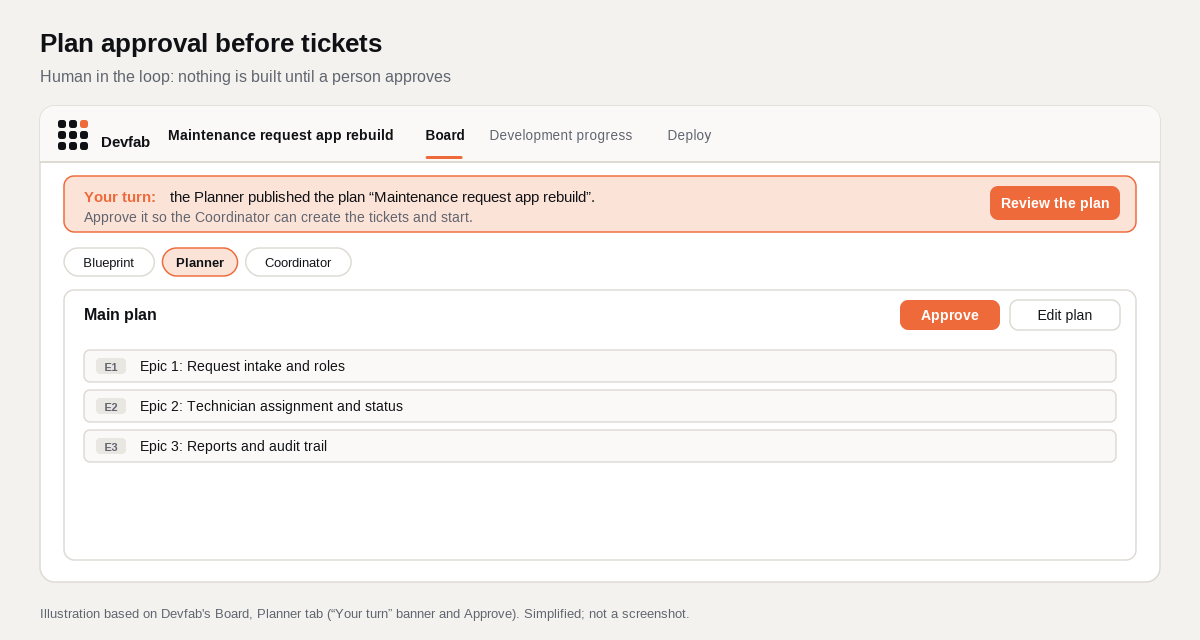
Devfab is an AI software factory. It doesn't replace Mendix's modeler; it replaces the build process. A research step maps the domain first: key terms, best practices for that kind of app, and competitors, then suggests a prototype. The Planner writes the plan, a person approves it, and the Coordinator splits it into tickets for developer agents. They work with ChainFlow, which maps which functions and APIs call each other and what is deployed, so a change to one module doesn't silently break another. The QA agent runs UI and flow tests plus logic tests before work is marked Done. The code lives in your own GitHub account (or your organization's), and you deploy to your own server. You can choose the model for each agent or keep Devfab's default.
Devfab also produces blueprints, sequence flows, prototypes and user manuals, which helps the "who maintains this after the partner leaves" question.
Coding agents automate the developer. Devfab automates the development lifecycle.
Devfab's honest limits:
- It's new and in Beta, with a far smaller community and partner network than Mendix.
- It has fewer integrations, and none of Mendix's Siemens-specific ones.
- It isn't a visual modeler or an editor for hands-on coding.
- It needs a GitHub account, and you are responsible for the servers.
- There's no automatic Mendix-to-code converter. Moving an app means rebuilding it from a spec.
Where Mendix is still the better choice
- Siemens and industrial integration. Siemens positions Mendix as a core part of its Intelligence Center X platform.
- Deployment breadth under one license. Mendix Cloud, Cloud Dedicated, Kubernetes private cloud, SAP BTP, StackIT, a FedRAMP US Government cloud and your own servers.
- Governed portfolios. Maia Plan can recommend only company-approved Marketplace components, and admins restrict invites to approved domains.
- Pricing that ignores developers. Developers and anonymous users aren't charged, which helps large build teams.
- Agents inside apps. Agents Kit 2.0 includes an Agent Editor in Studio Pro, with chat and task agents and token-cost visibility.
How to choose
- Want another enterprise platform with compliance attestations? OutSystems.
- Standardized on Microsoft 365 and Dataverse? Power Apps.
- Mostly internal tools on company data? Retool, or Superblocks if everything must run in your cloud.
- Want to stop paying per app and per user, and own a normal codebase? Devfab. Read What is an AI software factory? and Low-code vs AI software factory.
FAQ
How much does Mendix cost?
As of November 2026, Mendix's pricing page lists a Free plan, Standard from USD 1,090 per month for one app or USD 2,725 per month for unlimited apps, and Premium by quote. Cloud compute is billed separately from the license, and developers are not charged.
What is the closest alternative to Mendix?
OutSystems. Both are enterprise low-code platforms with an AI assistant, governed deployment, compliance attestations and a large partner network. OutSystems prices by custom quote sized by application objects and users.
Can external AI coding agents build Mendix apps?
Partly. Since Mendix 11.10, Studio Pro can act as an MCP server so external agents can use Maia tools, but in 11.10 it could not generate pages. Mendix says agent instructions do not enforce restrictions.
When does a custom codebase beat a low-code platform like Mendix?
When you want no platform license tied to apps and users, full control of the stack, and code any developer can maintain. You then own testing, hosting and upkeep, which tools like Devfab help automate.
Read next
- What is an AI software factory?
- OutSystems vs Mendix
- Low-code vs AI software factory
- Best AI software development platforms for enterprises
Want apps you own, without a per-app license? Try the Devfab Beta
Sources (checked November 13, 2026): Mendix pricing; Mendix 11.12 release (Jun 2026); Mendix 11.10 release (Apr 2026); Mendix 11.0 release (Jun 2025); Using Maia with external AI agents (Mendix docs); Verdantix: Siemens Realize LIVE Europe 2026: Mendix (Jul 2026); Jet Admin: Mendix alternatives (a competitor, Sep 2026); OutSystems pricing and editions; OutSystems Agentic Systems Engineering (Mar 2026); Next-gen Mentor in ODC; OutSystems Developer Cloud; OutSystems FAQs; Microsoft Power Apps; Power Platform licensing FAQ; What's new in Power Platform: September 2026; The New Stack: Power Apps Plans (May 2025); Retool pricing; Retool launches a React AI app builder (Jun 2026); Retool extends governance to vibe-coded apps; Superblocks 3.0 (Aug 2026); Superblocks billing overview; Clark AI docs; The AI-native enterprise tooling stack (Superblocks, Mar 2026).
Frequently asked questions
How much does Mendix cost?
As of November 2026, Mendix's pricing page lists a Free plan, Standard from USD 1,090 per month for one app or USD 2,725 per month for unlimited apps, and Premium by quote. Cloud compute is billed separately from the license, and developers are not charged.
What is the closest alternative to Mendix?
OutSystems. Both are enterprise low-code platforms with an AI assistant, governed deployment, compliance attestations and a large partner network. OutSystems prices by custom quote sized by application objects and users.
Can external AI coding agents build Mendix apps?
Partly. Since Mendix 11.10, Studio Pro can act as an MCP server so external agents can use Maia tools, but in 11.10 it could not generate pages. Mendix says agent instructions do not enforce restrictions.
When does a custom codebase beat a low-code platform like Mendix?
When you want no platform license tied to apps and users, full control of the stack, and code any developer can maintain. You then own testing, hosting and upkeep, which tools like Devfab help automate.