Short answer: Power Apps wins when your company runs on Microsoft 365 and wants apps on Dataverse under tenant governance, with AI that generates whole apps. Appsmith wins when your data sits in PostgreSQL, MongoDB or your own APIs, and you want a free, Apache-2.0 builder you self-host, with no charge for developers.
A logistics team needs a shipment exception dashboard: late trucks, damaged pallets, missing paperwork. The finance director asks why not Power Apps, since the company already pays for Microsoft 365. The engineering lead asks why pay at all, since Appsmith is open source and the data lives in Postgres.
Both questions are fair. The answer depends on where your data and identity already live, and on how much AI you want in the build. This page compares the two using vendor pages checked in November 2026.
In this comparison:
- Power Apps and Appsmith at a glance
- Feature comparison
- Cost model by team size
- Where Power Apps wins
- Where Appsmith wins
The sections settle the argument point by point.
Power Apps and Appsmith at a glance
Power Apps: active, betting on AI building. Users "describe what they need in natural language and generate rich, custom app experiences," and the platform supports "pro code, no code, low code, and generated apps" (Power Apps). The September 2026 update made the app-builder skill generally available, so AI code tools such as GitHub Copilot CLI and Claude Code can build model-driven apps after the user approves a build plan (Power Platform blog). Several AI pieces are still preview. From November 15, 2026, new unmanaged developer environments and new Dataverse for Teams environments can't be created (licensing FAQ).
Appsmith: active, open source, with AI scaled back. Appsmith builds "admin panels, internal tools, and dashboards" on "25+ databases and any API," under Apache-2.0, with about 41,000 GitHub stars (GitHub). Version 2.3 (August 2026) added Ask AI to the Community Edition, and the Appsmith AI datasource was removed on September 30, 2026 (Appsmith 2.3). Appsmith Agents is labeled Legacy and closed to new sign-ups (Appsmith Agents).
Feature comparison
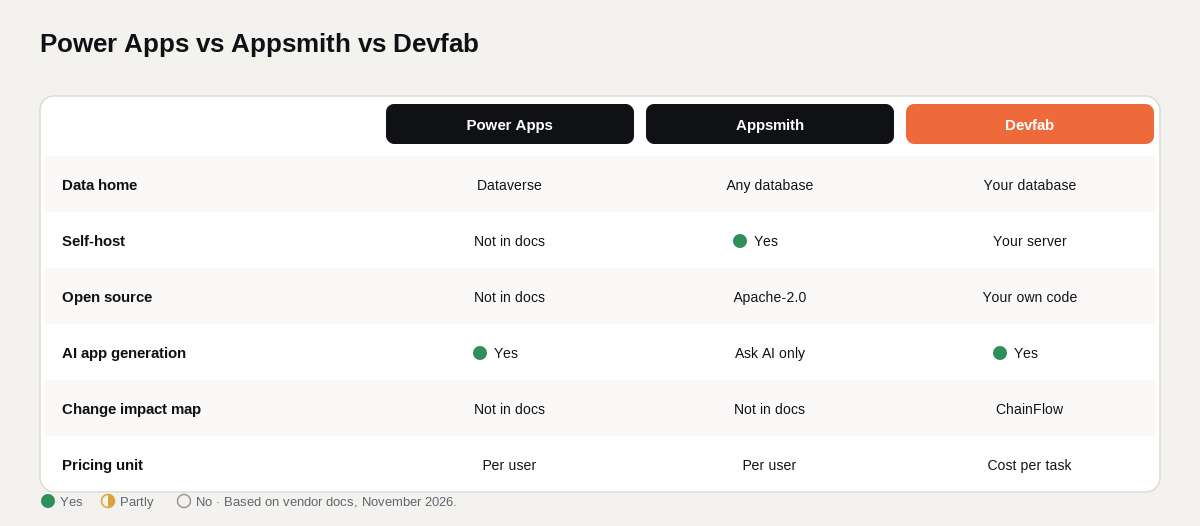
| Aspect | Power Apps | Appsmith | Source |
|---|---|---|---|
| Where it runs | Maker studio in the browser; Microsoft cloud | Appsmith Cloud, or self-host on Docker, Kubernetes or AWS AMI | Power Apps; Appsmith GitHub |
| Data | Microsoft Dataverse; Microsoft connectors | PostgreSQL, MongoDB, MySQL, MS SQL, Redis, Snowflake, REST and GraphQL (per a competitor review) | Power Apps; Superblocks review |
| Planning | "Plans" workspace with AI agents as requirements analyst, data modeler and solution architect | Not covered in the pages we checked | The New Stack |
| AI building | Natural-language apps; generative pages produce React code; app-builder skill for AI code tools | Ask AI for JavaScript and queries; AI datasource removed | Power Platform blog; Appsmith 2.3 |
| Testing | Not covered in the pages we checked | Not covered in the pages we checked | — |
| Code and Git | "Convert a vibe app to a code app" guidance | Git sync with branches, commits and PRs; free tier limited to 3 repos (per a competitor review) | Power Platform blog; Superblocks review |
| Team and admin | Central policies for environments, DLP, access and auditing | OAuth on Free and Business; SAML/OIDC on Enterprise; air-gapped edition as Enterprise add-on | Power Apps; Appsmith pricing |
| Open source | Not covered in the pages we checked | Apache-2.0 | Appsmith GitHub |
| Pricing model | Per user or per user per app; AI uses AI Builder or Copilot Credits; Dataverse capacity extra | Free Community; Business per user; Enterprise flat block of users; developers not charged | Licensing FAQ; Appsmith pricing |
Cost model by team size
| Team size | Power Apps | Appsmith |
|---|---|---|
| 1 person | Developer Plan free (non-production only) | Community free (self-managed), or cloud Free |
| 5 people | Premium USD 20 per user per month, paid yearly | Cloud Free (up to 5 users) or Business USD 15 per user per month |
| 25 people | Premium USD 20 per user per month; USD 12 per user only at a 2,000-seat minimum | Business USD 15 per user per month, or Enterprise USD 2,500 per month for 100 users |
Prices as of November 2026 from Power Apps pricing and Appsmith pricing. Power Apps adds Dataverse capacity at USD 40 per GB per month, paid yearly, and premium, on-premises and custom connectors need a standalone license. Appsmith's self-hosted Community edition has no license fee; you pay for your own servers.
Where Power Apps wins
- Identity and data are already in Microsoft. Entra, SharePoint, Dynamics 365 and Teams are a step away.
- You want AI to build the app, from natural language or from GitHub Copilot CLI and Claude Code through the app-builder skill.
- Business users build alongside IT in one governed workspace with DLP.
- Some users already have rights, since limited Power Apps use is included in some Microsoft 365 licenses.
Where Appsmith wins
- Your data is outside Microsoft, in Postgres, MongoDB, Snowflake or your own APIs.
- You need to self-host and modify the code under a permissive license.
- Developers are many and users are few. Appsmith states "there is no additional charge for developers."
- Budget is tight. Community is free, and cloud Free covers up to 5 users.
Switching from one to the other
There is no import between the two in the pages we checked, so plan a rebuild. Moving to Appsmith, move the data into a database Appsmith supports, then rebuild screens with widgets and queries and connect Git. Moving to Power Apps, model the data in Dataverse, then describe the app in natural language or let GitHub Copilot CLI or Claude Code build a model-driven app with the app-builder skill. If you self-host an Appsmith version older than v1.96, step through v1.99 before upgrading to 2.x (Appsmith 2.1).
Where Devfab fits
Both tools build screens on top of data. Neither, in the pages we checked, maps how a change spreads through connected features or runs a separate QA step on user journeys.
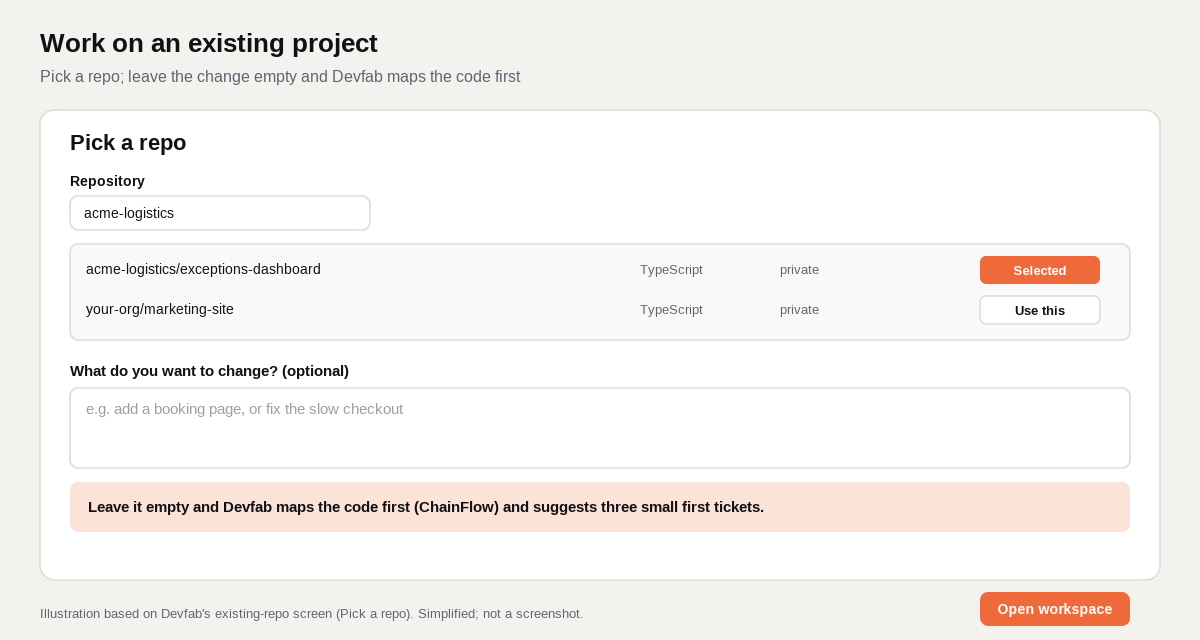
Coding agents automate the developer. Devfab automates the development lifecycle. If the exception dashboard already exists as code in GitHub, choose "Work on an existing project" in Devfab, pick the repo and leave the change box empty: ChainFlow maps which functions and APIs call each other and what is deployed, then suggests three small first tickets. A person approves the plan, and the QA agent runs UI, flow and logic tests before Deploy ships to your own server. Devfab is in Beta, needs a GitHub account and has fewer integrations than either tool. See Devfab vs Power Apps and Devfab vs Appsmith.
FAQ
Is Appsmith a free alternative to Power Apps?
For many internal tools, yes. Appsmith's Community edition is open source under Apache-2.0 and free to self-host, and its cloud Free plan covers up to 5 users. Power Apps has a free Developer Plan, but it is for non-production use; production apps need Premium or per-app licenses.
Can Appsmith connect to Microsoft data like SharePoint or Dataverse?
The pages we checked list Appsmith's native connectors, such as PostgreSQL, MongoDB, MySQL, MS SQL, Redis and Snowflake, plus any REST or GraphQL API. SharePoint and Dataverse connectors are not covered there. Power Apps is built on Dataverse and Microsoft connectors.
Which has more AI features in 2026?
Power Apps. It generates apps from natural language, has a Plans workspace with AI agents, and its app-builder skill lets GitHub Copilot CLI or Claude Code build model-driven apps. Appsmith offers Ask AI for JavaScript and queries, removed its AI datasource in September 2026 and moved its Agents product to Legacy.
Which is better for apps outside the Microsoft ecosystem?
Appsmith. It runs on your own servers through Docker, Kubernetes or an AWS AMI, connects to 25+ databases and any API, and charges nothing for developers. Power Apps fits best when identity, data and governance already sit in Microsoft 365.
Read next
- What is an AI software factory?
- Microsoft Power Apps alternatives
- Retool vs Appsmith
- Superblocks vs Appsmith: which should your team pick?
Need changes that don't break the screens next to them? Try Beta
Sources (checked November 2026): Microsoft Power Apps; Power Apps pricing; Power Platform licensing FAQ (updated Oct 8, 2026); What's new in Power Platform: September 2026; The New Stack: Power Apps Plans (May 19, 2025); appsmithorg/appsmith on GitHub; Appsmith pricing; Appsmith Agents (Legacy); Appsmith 2.1 notice (Jun 5, 2026); Appsmith 2.3 release (Aug 14, 2026); Superblocks: Appsmith review (competitor, Sep 15, 2026).
Frequently asked questions
Is Appsmith a free alternative to Power Apps?
For many internal tools, yes. Appsmith's Community edition is open source under Apache-2.0 and free to self-host, and its cloud Free plan covers up to 5 users. Power Apps has a free Developer Plan, but it is for non-production use; production apps need Premium or per-app licenses.
Can Appsmith connect to Microsoft data like SharePoint or Dataverse?
The pages we checked list Appsmith's native connectors, such as PostgreSQL, MongoDB, MySQL, MS SQL, Redis and Snowflake, plus any REST or GraphQL API. SharePoint and Dataverse connectors are not covered there. Power Apps is built on Dataverse and Microsoft connectors.
Which has more AI features in 2026?
Power Apps. It generates apps from natural language, has a Plans workspace with AI agents, and its app-builder skill lets GitHub Copilot CLI or Claude Code build model-driven apps. Appsmith offers Ask AI for JavaScript and queries, removed its AI datasource in September 2026 and moved its Agents product to Legacy.
Which is better for apps outside the Microsoft ecosystem?
Appsmith. It runs on your own servers through Docker, Kubernetes or an AWS AMI, connects to 25+ databases and any API, and charges nothing for developers. Power Apps fits best when identity, data and governance already sit in Microsoft 365.