Short answer: Superblocks wins for enterprises whose security team wants AI app building, inference included, inside their own AWS, GCP or Azure account, with security agents reviewing every change and no per-seat fees. Appsmith wins for teams that want a free, Apache-2.0 builder they self-host and modify, priced per user with developers free.
Your operations team wants a field-service dispatch board. Half the company has started vibe-coding prototypes in chat tools, and security wants it stopped. One vendor promises governed AI building. The other promises open source you control. Both say they are the safe choice.
Their pricing models are so different that a wrong pick shows up on the invoice before it shows up in the app. This page sorts the claims with vendor pages checked in November 2026. One note: some Appsmith facts come from a review published by Superblocks, a competitor, and we label them.
In this comparison:
- Superblocks and Appsmith at a glance
- Feature comparison
- Cost model by team size
- Where Superblocks wins
- Where Appsmith wins
Here's how they compare.
Superblocks and Appsmith at a glance
Superblocks: Superblocks 3.0 shipped on August 3, 2026, with an AWS strategic partnership, in-VPC deployment with Bedrock inference, security agents and a Smart Router that sends sub-tasks to different models (Superblocks 3.0). It is "built for both builders and the teams that govern them at scale" (Superblocks 2.0). Builders chat with the Clark agent to generate an app, refine it visually and extend it by "editing the underlying React framework" (Clark docs). One inconsistency: the Clark docs page still says Clark "is currently in private beta," which conflicts with later announcements.
Appsmith: active, with its AI side scaled back. Appsmith is an open-source platform for admin panels, internal tools and dashboards on "25+ databases and any API," licensed Apache-2.0 with about 41,000 GitHub stars (GitHub). The Appsmith AI datasource was removed on September 30, 2026 (Appsmith 2.3), and Appsmith Agents is labeled Legacy, with no new sign-ups (Appsmith Agents).
Feature comparison
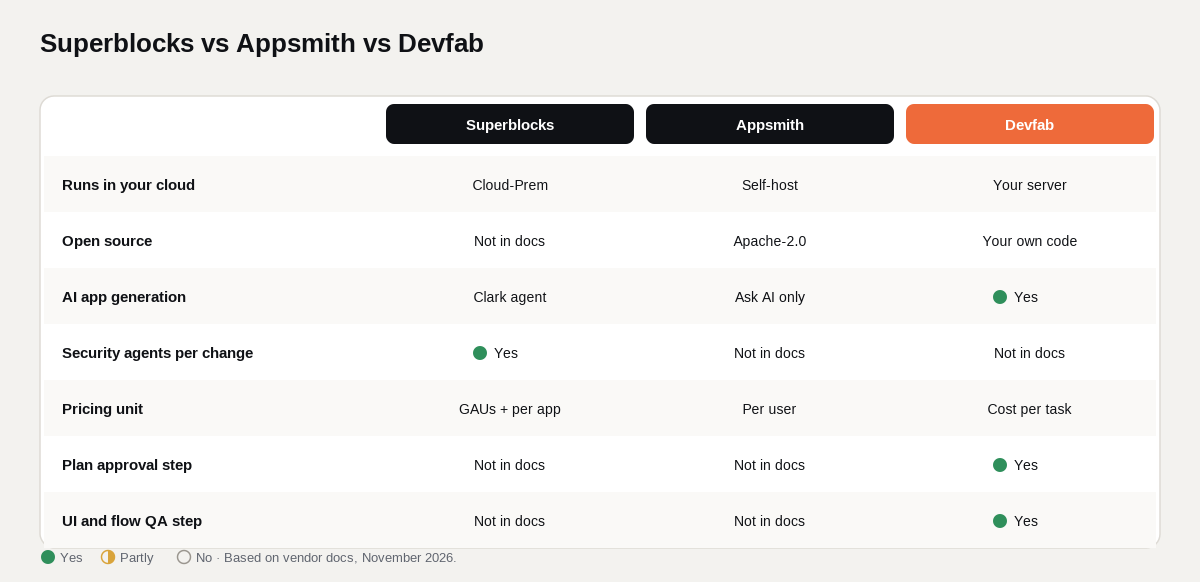
| Aspect | Superblocks | Appsmith | Source |
|---|---|---|---|
| Where it runs | Superblocks Cloud, Hybrid, or Cloud-Prem in your AWS, GCP or Azure account | Appsmith Cloud, or self-host on Docker, Kubernetes or AWS AMI | Superblocks stack post; Appsmith GitHub |
| AI building | Clark agent generates apps from chat; Builder MCP works from Claude, Slack, Cursor or ChatGPT | Ask AI for JavaScript and queries; AI datasource removed | Superblocks 3.0; Appsmith 2.3 |
| Planning and context | Clark remembers code policies, design systems, audit rules and data mappings | Not covered in the pages we checked | Superblocks 2.0 |
| Security review | Security agents and deterministic scanners on each change; SBOM and CVE scanning per app | Not covered in the pages we checked | Superblocks 3.0 |
| Testing | Not covered in the pages we checked | Not covered in the pages we checked | — |
| Code and Git | GitHub, GitLab, Bitbucket and Azure DevOps | Git sync with branches and PRs; free tier limited to 3 repos (Superblocks review) | Superblocks stack post; Superblocks review of Appsmith |
| Team and admin | RBAC, SSO, always-on audit logging; SOC 2, GDPR, HIPAA-eligible | OAuth on Free and Business; SAML/OIDC on Enterprise | Superblocks stack post; Appsmith pricing |
| Model choice | Approved models from Bedrock, Vertex AI, Azure AI, Snowflake Cortex, Databricks | The pricing page lists no AI features on any plan | Superblocks 2.0; Appsmith pricing |
| Pricing model | Governed Agent Units plus a charge per published app; no per-seat fees on enterprise license | Free Community; Business per user; developers not charged | Superblocks billing; Appsmith pricing |
Cost model by team size
| Team size | Superblocks | Appsmith |
|---|---|---|
| 1 person | No free tier, per a competitor review; Teams self-serve plans use an org-wide GAU pool | Community free (self-managed) or cloud Free (up to 5 users) |
| 5 people | Teams self-serve: GAU pool with packs, auto-refills and per-user spend limits | Business USD 15 per user per month |
| 25 people | Enterprise dollar-commit contract; no per-seat builder or end-user fees | Business per user, or Enterprise USD 2,500 per month for 100 users |
Appsmith prices as of November 2026 from Appsmith pricing. The Superblocks pricing page shows no plan prices, so we describe the model from its billing and self-serve docs. A competitor review notes that GAU refills mean the base subscription may not cap the invoice (Jet Admin).
Where Superblocks wins
- Everything must stay in your cloud, including AI inference, through Cloud-Prem and Bedrock.
- Security reviews each change. Security agents, Custom Policy Agents, a private package registry and per-app SBOMs.
- Many semi-technical builders, one policy layer, with no per-seat fees on the enterprise license.
- You are consolidating prototypes from Claude, ChatGPT, Lovable or Replit into one IT-approved path.
Where Appsmith wins
- You want open source. Apache-2.0, free to self-host and modify.
- Budget is tight. Community is free, cloud Free covers up to 5 users, and developers are not charged.
- You build many CRUD screens on PostgreSQL, MongoDB, MySQL, Snowflake or REST and GraphQL APIs.
- You want predictable seat pricing instead of usage units. Note that some G2 reviewers, quoted in Superblocks' review, say Appsmith "can be slow or buggy at times."
Switching from one to the other
The pages we checked describe no direct importer between these two products. Superblocks 3.0 imports prototypes from chat tools, app builders and raw code, so a team moving from Appsmith can bring screens over as code or rebuild them with Clark, then connect the same databases. Moving from Superblocks to Appsmith means rebuilding screens on Appsmith's canvas against the same data sources and connecting Git. Self-hosted Appsmith instances older than v1.96 must step through v1.99 before upgrading to 2.x (Appsmith 2.1).
Where Devfab fits
Superblocks governs many internal builders. Appsmith gives developers a free canvas. Neither, in the pages we checked, starts with research on the domain, asks a person to approve a project plan, or runs a QA step on user journeys.
Coding agents automate the developer. Devfab automates the development lifecycle. For the dispatch board, Devfab's Researcher maps terms like work orders, technician skills and service windows before the Planner writes a plan. A person approves it, the QA agent runs UI, flow and logic tests, and Deploy ships plain code to your own server. Devfab is in Beta and has fewer integrations than either tool. Compare Devfab vs Superblocks and Devfab vs Appsmith.
FAQ
Is Superblocks open source like Appsmith?
Appsmith is open source under Apache-2.0, and its Community edition is free to self-host. Superblocks is a commercial platform. It can run inside your own AWS, GCP or Azure account through its Cloud-Prem option, but the pages we checked do not describe an open-source edition.
How much does Superblocks cost compared with Appsmith?
Superblocks does not show plan prices; it bills Governed Agent Units for AI work plus a charge per published app, with no per-seat builder or end-user fees on the enterprise license. Appsmith lists Business at USD 15 per user per month and Enterprise at USD 2,500 per month for 100 users, as of November 2026.
Which has better AI app generation?
Superblocks puts AI at the center: its Clark agent generates an app from chat, keeps memory of code policies and design systems, and security agents review each change. Appsmith offers Ask AI for JavaScript and queries, removed its AI datasource in September 2026 and moved its Agents product to Legacy.
Can I move vibe-coded prototypes into either tool?
Superblocks 3.0 can import prototypes from Claude, ChatGPT, Lovable, Replit and raw code. The Appsmith pages we checked do not describe a prototype import; you would rebuild screens on its canvas against your data sources.
Read next
- What is an AI software factory?
- Superblocks alternatives for teams that ship to production
- Retool vs Superblocks
- Power Apps vs Appsmith: which should your team pick?
Want the dispatch board as code you own? Try Beta
Sources (checked November 2026): Superblocks 3.0 (Aug 3, 2026); Superblocks 2.0 (Apr 15, 2026); Superblocks: the AI-native enterprise tooling stack (Mar 17, 2026); Superblocks Clark AI docs; Superblocks billing overview; Superblocks self-serve plan; Superblocks pricing; Jet Admin: Superblocks review (competitor, Sep 30, 2026); appsmithorg/appsmith on GitHub; Appsmith pricing; Appsmith Agents (Legacy); Appsmith 2.1 notice (Jun 5, 2026); Appsmith 2.3 release (Aug 14, 2026); Superblocks: Appsmith review (competitor, Sep 15, 2026).
Frequently asked questions
Is Superblocks open source like Appsmith?
Appsmith is open source under Apache-2.0, and its Community edition is free to self-host. Superblocks is a commercial platform. It can run inside your own AWS, GCP or Azure account through its Cloud-Prem option, but the pages we checked do not describe an open-source edition.
How much does Superblocks cost compared with Appsmith?
Superblocks does not show plan prices; it bills Governed Agent Units for AI work plus a charge per published app, with no per-seat builder or end-user fees on the enterprise license. Appsmith lists Business at USD 15 per user per month and Enterprise at USD 2,500 per month for 100 users, as of November 2026.
Which has better AI app generation?
Superblocks puts AI at the center: its Clark agent generates an app from chat, keeps memory of code policies and design systems, and security agents review each change. Appsmith offers Ask AI for JavaScript and queries, removed its AI datasource in September 2026 and moved its Agents product to Legacy.
Can I move vibe-coded prototypes into either tool?
Superblocks 3.0 can import prototypes from Claude, ChatGPT, Lovable, Replit and raw code. The Appsmith pages we checked do not describe a prototype import; you would rebuild screens on its canvas against your data sources.