Short answer: Power Apps wins when your organization runs on Microsoft 365, Dataverse and Entra and wants apps under existing tenant governance, with published per-user prices. OutSystems wins when you need a separate enterprise platform for many interdependent apps and AI agents, with on-premises or sovereign deployment and compliance such as HIPAA, PCI DSS and FedRAMP.
An insurer wants a claims intake portal, and two camps form in the IT meeting. One says: we already pay Microsoft, so build it in Power Apps. The other says: claims are core business, so put them on a platform built for it. Both camps are partly right.
The decision is less about features than about where your apps will live for the next decade. This page compares both platforms using vendor pages checked in November 2026.
In this comparison:
- Power Apps and OutSystems at a glance
- Feature comparison
- Cost model by team size
- Where Power Apps wins
- Where OutSystems wins
Each section takes one side of the argument.
Power Apps and OutSystems at a glance
Power Apps: active, with AI building now generally available. Microsoft's September 2026 feature update made the "app-builder skill" for vibe-coding model-driven apps generally available. It lets AI code tools such as GitHub Copilot CLI and Claude Code build whole model-driven apps, creating nothing until the user approves the build plan (Power Platform blog). The same post labels the skill both GA and preview in different places. Two licensing changes also landed: from November 15, 2026, new unmanaged developer environments and new Dataverse for Teams environments can't be created, and included AI Builder credits on attended RPA licenses were removed on November 1, 2026 (licensing FAQ).
Power Apps is for business users, developers and IT working in one workspace, with apps on Microsoft Dataverse (Power Apps).
OutSystems: active, repositioned around agents. On March 31, 2026, OutSystems announced "Agentic Systems Engineering," an Enterprise Context Graph and next-gen Mentor, generally available in OutSystems Developer Cloud (ODC). It also opened the platform to external tools such as Claude Code, OpenAI Codex and Cursor (OutSystems). OutSystems targets banking, healthcare, insurance, manufacturing and government, from professional developers to business users (OutSystems FAQs).
Feature comparison
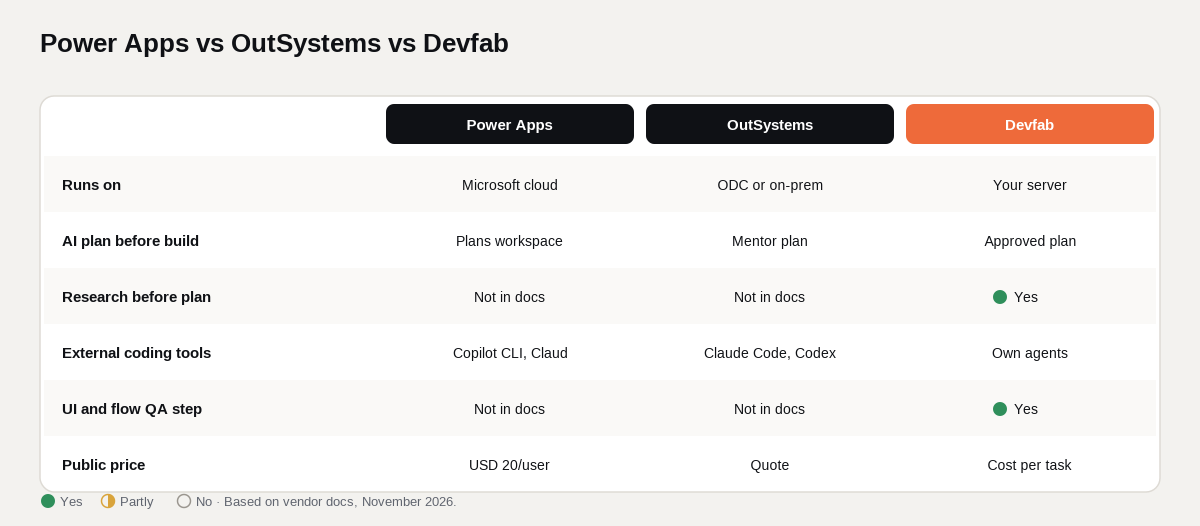
| Aspect | Power Apps | OutSystems | Source |
|---|---|---|---|
| Where it runs | Maker studio in the browser; Microsoft cloud with Dataverse | ODC managed PaaS on AWS; self-hosted model; on-prem, private and sovereign cloud options | Power Apps; ODC; OutSystems pricing |
| Planning | "Plans" workspace: AI agents act as requirements analyst, data modeler and solution architect | Mentor App Generator asks clarifying questions; Mentor in IDE proposes a plan and applies changes after approval | The New Stack; Next-gen Mentor |
| AI building | Natural-language app generation; generative pages produce React code | Mentor builds data model, logic and UI as standard ODC apps | Power Apps; Next-gen Mentor |
| External coding tools | GitHub Copilot CLI and Claude Code via the app-builder skill; MCP for canvas apps | Claude Code, OpenAI Codex and Cursor within shared context and guardrails | Power Platform blog; OutSystems |
| Agents in apps | Agent feed to oversee agents; Microsoft 365 Copilot embeddable | Agent Workbench with human-in-the-loop, MCP and an agent marketplace | Power Apps; The New Stack |
| Testing | Not covered in the pages we checked | Not covered in the pages we checked | — |
| Integrations | Microsoft connectors; premium, on-prem and custom connectors need a standalone license | 400+ pre-built connections; private gateway to on-prem systems | Licensing FAQ; ODC |
| Governance and compliance | Central policies for environments, DLP, access and auditing | HIPAA, PCI DSS and FedRAMP requirements; SOC 2 Type II and ISO | Power Apps; ODC |
| Pricing model | Per user or per user per app; pay-as-you-go via Azure (preview) | Custom quote by Application Objects, users and add-ons; LLM tokens paid directly to providers | Licensing FAQ; OutSystems pricing |
Cost model by team size
| Team size | Power Apps | OutSystems |
|---|---|---|
| 1 person | Developer Plan free (non-production) | Personal Edition free: development only, up to 100 internal users, no uptime guarantee |
| 5 people | Premium USD 20 per user per month, paid yearly | Agentic Systems Platform by quote, starting with 100 internal users and dev, test and prod runtimes |
| 25 people | Premium USD 20 per user per month; USD 12 per user only at a 2,000-seat minimum | Same quote model, sized by Application Objects (a typical medium app is about 150) and add-ons |
Prices as of November 2026 from Power Apps pricing; Microsoft notes prices vary by country or region. Dataverse capacity is an add-on at USD 40 per GB per month, paid yearly. OutSystems pricing shows no plan prices, so we describe its model.
Where Power Apps wins
- You are standardized on Microsoft. Apps sit inside your tenant's Entra identity, DLP and auditing.
- Your data is in SharePoint, Dynamics 365 or Teams, and Microsoft connectors cover most needs.
- You want a public price. Premium is listed per user, and some Microsoft 365 licenses include limited Power Apps rights.
- Your developers already use GitHub Copilot or Claude Code, which can now build model-driven apps through the app-builder skill.
Where OutSystems wins
- You need on-premises, private or sovereign deployment under one vendor.
- Compliance is the first question. HIPAA, PCI DSS and FedRAMP requirements are covered, with SOC 2 Type II and ISO certifications.
- You run a portfolio of many connected apps and agents. The Enterprise Context Graph tracks apps, agents, workflows, data and dependencies.
- Your systems are not Microsoft. 400+ connectors and a private gateway reach on-prem systems without per-connector licensing tiers.
Switching from one to the other
Neither vendor documents a direct migration path to the other in the pages we checked, so treat it as a rebuild. Moving to OutSystems, Mentor App Generator can take a plain description of the existing Power App and generate a data model, logic and UI to refine. Note that some third-party Forge components may need to be rebuilt for ODC (ODC). Moving to Power Apps, model the data in Dataverse first, then describe screens in natural language or use the Plans workspace. Either way, keep the old app running until users sign off.
Where Devfab fits
Both platforms keep your apps on their runtime and licensing. That suits a long-lived internal portfolio. It suits less well when a client or agency needs one app delivered as plain code that runs anywhere.
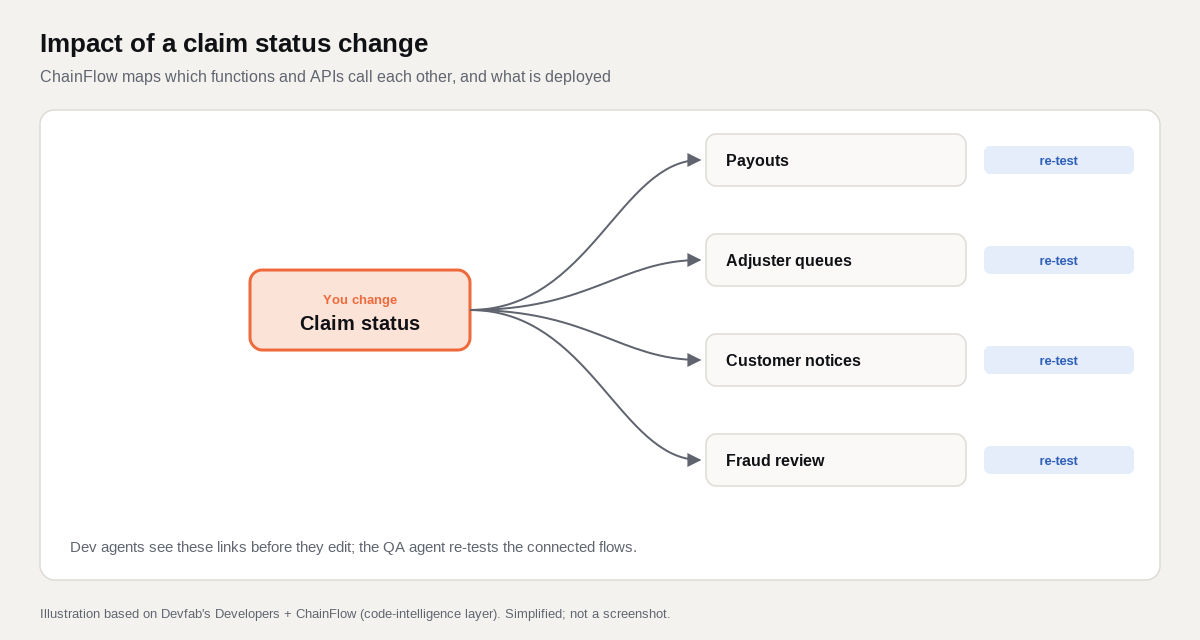
Coding agents automate the developer. Devfab automates the development lifecycle. For the claims portal, Devfab's Researcher maps claims terms, intake best practices and competitors before the Planner writes a plan, and a person approves it. ChainFlow shows dev agents how a change to claim status affects payouts, adjuster queues and customer notices. The QA agent runs UI, flow and logic tests, and Deploy ships to your own server. Devfab is in Beta, with a smaller community and fewer integrations than either platform. See Devfab vs Power Apps and the OutSystems alternatives list.
FAQ
Is Power Apps cheaper than OutSystems?
Power Apps publishes prices: Premium is USD 20 per user per month, paid yearly, as of November 2026, with Dataverse capacity and some connectors extra. OutSystems shows no prices; its paid platform is quoted by sales and sized by Application Objects, users and add-ons. Ask both for a quote at your real user count.
Which is better for professional developers?
OutSystems is built to span professional developers and business users in one governed IDE, with Mentor generating data models, logic and UI and an Enterprise Context Graph tracking dependencies. Power Apps also supports pro code, and since September 2026 lets tools such as GitHub Copilot CLI and Claude Code build model-driven apps.
Can either platform run on-premises?
OutSystems lists managed cloud, on-premises, private cloud and sovereign cloud options, plus a self-hosted model where apps run in your infrastructure. Power Apps runs in Microsoft's cloud with Dataverse; on-premises data is reached through connectors, which need a standalone license.
Do both platforms support AI agents?
Yes, in different ways. OutSystems has Agent Workbench for building and deploying AI agents, with human-in-the-loop and MCP support. Power Apps adds an agent feed so users can oversee agents inside apps, and Microsoft 365 Copilot can be embedded in custom apps.
Read next
- What is an AI software factory?
- Microsoft Power Apps alternatives
- OutSystems vs Mendix
- Power Apps vs Mendix: which should your team pick?
Need one app delivered as code you can run anywhere? Try Beta
Sources (checked November 2026): Microsoft Power Apps; Power Apps pricing; Power Platform licensing FAQ (updated Oct 8, 2026); What's new in Power Platform: September 2026; The New Stack: Power Apps Plans (May 19, 2025); OutSystems: Agentic Systems Engineering (Mar 31, 2026); OutSystems: next-gen Mentor (Mar 31, 2026); OutSystems Developer Cloud; OutSystems pricing and editions; OutSystems FAQs; The New Stack: OutSystems Agent Workbench (Sep 30, 2025).
Frequently asked questions
Is Power Apps cheaper than OutSystems?
Power Apps publishes prices: Premium is USD 20 per user per month, paid yearly, as of November 2026, with Dataverse capacity and some connectors extra. OutSystems shows no prices; its paid platform is quoted by sales and sized by Application Objects, users and add-ons. Ask both for a quote at your real user count.
Which is better for professional developers?
OutSystems is built to span professional developers and business users in one governed IDE, with Mentor generating data models, logic and UI and an Enterprise Context Graph tracking dependencies. Power Apps also supports pro code, and since September 2026 lets tools such as GitHub Copilot CLI and Claude Code build model-driven apps.
Can either platform run on-premises?
OutSystems lists managed cloud, on-premises, private cloud and sovereign cloud options, plus a self-hosted model where apps run in your infrastructure. Power Apps runs in Microsoft's cloud with Dataverse; on-premises data is reached through connectors, which need a standalone license.
Do both platforms support AI agents?
Yes, in different ways. OutSystems has Agent Workbench for building and deploying AI agents, with human-in-the-loop and MCP support. Power Apps adds an agent feed so users can oversee agents inside apps, and Microsoft 365 Copilot can be embedded in custom apps.