Short answer: For a like-for-like enterprise platform with public AI app generation, pick OutSystems or Mendix. If you are a Microsoft shop, pick Power Apps. For many users at a flat price, pick Quickbase; for open source and air-gapped hosting, Budibase. Choose Devfab when you want custom code you own instead of another platform.
You run IT at a company that bought Appian for process automation and case management. It works. But every new app and every new user group raises the bill, the AI features you want sit on higher tiers, and finding people who know the platform is hard. Before the renewal, you want to know what else is out there. This page compares six options, using vendor pages re-checked on November 20, 2026.
In this guide, you'll learn:
- Why teams leave Appian
- Quick comparison
- The alternatives
- Where Appian is still the better choice
- How to choose
Bring this list to the renewal meeting.
Why teams leave Appian
Appian is active and shipping: release 26.3 in March 2026 added multi-agent communication in Agent Studio, the Q2 highlights in July added an MCP Server, and release 26.6 added agent cost controls (Appian Q1 2026; Appian Q2 2026; Appian What's New). People still look elsewhere, for these reasons:
- Pricing scales three ways. Plans are "Priced per user, per month, per app," and the pricing page shows no dollar amounts (Appian pricing).
- AI sits on higher tiers. AI Agents, Composer, DocCenter, AI Skills and Agentic RPA are not on Standard (Appian pricing).
- Some AI is still preview. Composer, which turns requirements into an app plan, is "available as a preview feature" (Appian What's New).
- Cost and learning curve for smaller teams. A competitor's review cites high per-user pricing for smaller businesses, a dated-looking interface, a steep learning curve, and that coding is still sometimes needed (Blaze, Feb 2026).
Quick comparison
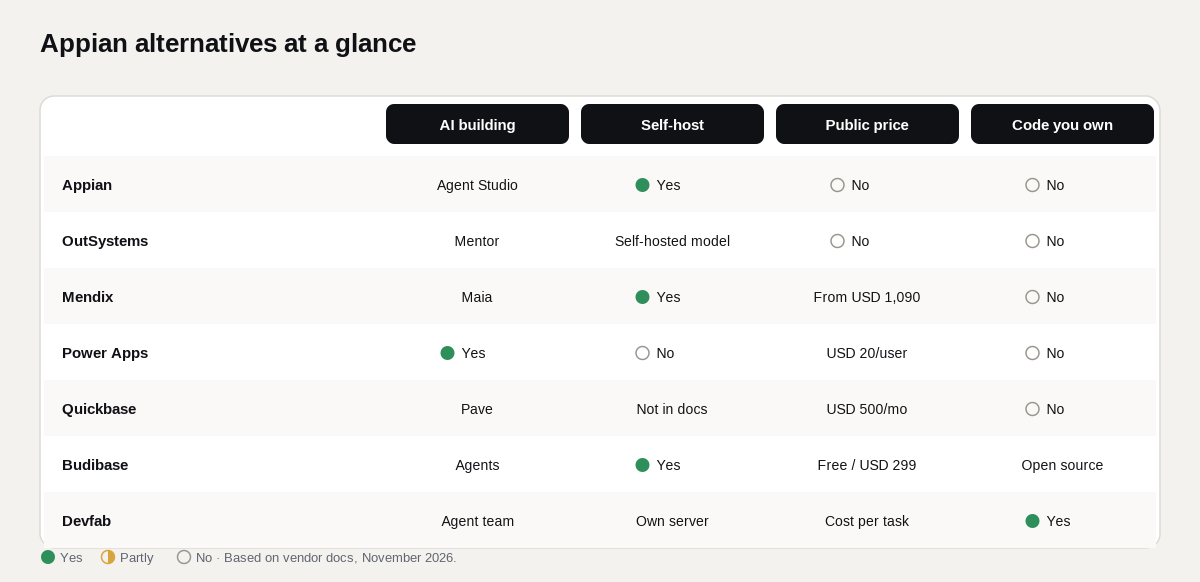
| Tool | Type | AI building | Hosting options | Pricing model | Starting price (Nov 2026) |
|---|---|---|---|---|---|
| Appian (baseline) | Process automation platform | Agent Studio; Composer (preview) | Cloud; self-managed incl. air-gapped AI | Per user, per month, per app | Not shown; free Community Edition |
| OutSystems | Enterprise low-code | Mentor App Generator; Agent Workbench | ODC on AWS; self-hosted model | Quote by Application Objects and users | Not shown; free Personal Edition |
| Mendix | Enterprise low-code | Maia, Maia Plan, Agents Kit | Mendix Cloud, Azure, Kubernetes, SAP BTP, own servers | By number of apps and users | Standard One App from USD 1,090 per month |
| Microsoft Power Apps | Low-code on Microsoft 365 | Natural-language apps; Plans agents | Microsoft cloud | Per user or per app | Premium USD 20 per user per month, paid yearly |
| Quickbase | Operations low-code + Pave | Pave builds from a prompt | Quickbase cloud | Flat platform price | USD 500 per month, billed annually |
| Budibase | Open-source apps, agents, automations | Agents with approval policies | Cloud or self-hosted, incl. air-gapped | Free self-hosted; Cloud subscription | Community USD 0; Cloud from USD 299 per month |
| Devfab | AI software factory | Agents research, plan, build, test, deploy | Your own server | Cost logged per task and per project | Beta |
The alternatives
OutSystems
Verdict: the closest enterprise peer, with mature AI app generation. Best for: large organizations in banking, healthcare, insurance, manufacturing or government. Trade-off: no public prices; Forge components may need rework on ODC. Pricing: free Personal Edition; paid Agentic Systems Platform by quote, sized by Application Objects, users and add-ons (OutSystems pricing).
Mentor App Generator asks clarifying questions and builds the data model, logic and UI; Mentor in the IDE proposes a plan and applies changes after approval (OutSystems Mentor). The Enterprise Context Graph gives a live view of apps, agents, data and dependencies, and developers can bring outside tools such as Claude Code, Codex and Cursor (OutSystems announcement). ODC lists HIPAA, PCI DSS and FedRAMP requirements and 400+ pre-built connections (OutSystems ODC).
Mendix
Verdict: an enterprise platform with published starting prices and the widest hosting choice. Best for: Siemens and SAP customers, and IT teams that want to deploy to their own Kubernetes or servers. Trade-off: agent policies in 11.12 "bring visibility, but no enforcement." Pricing: Free; Standard One App from USD 1,090 per month; Standard Unlimited Apps from USD 2,725 per month; Premium by quote, as of November 2026 (Mendix pricing).
Maia Plan turns ideas and user stories into structured app plans, and Maia generates domain models, pages and workflows (Mendix 11.10). Studio Pro can act as an MCP server so outside agents use Maia tools (Mendix docs). Mendix 11.12 (June 30, 2026) is the first LTS since 10.24 and adds Agents Kit 2.0 (Mendix 11.12). Developers and anonymous users are not charged.
Microsoft Power Apps
Verdict: the default if your company runs on Microsoft 365 and Dataverse. Best for: business users and IT building together inside Microsoft's governance. Trade-off: premium connectors, Dataverse capacity and AI credits add cost; several AI pieces are still preview. Pricing: Developer Plan free; Premium USD 20 per user per month, paid yearly; Dataverse capacity add-on USD 40 per GB per month, as of November 2026 (Power Apps pricing).
Users "describe what they need in natural language and generate rich, custom app experiences" (Power Apps). The September 2026 update made the app-builder skill GA, which lets outside AI coding tools build model-driven apps and creates nothing until a person approves the build plan (Power Platform blog). IT can centralize policies for environments, data loss prevention and auditing.
Quickbase
Verdict: a lighter, cheaper platform for operational apps with many users. Best for: field, construction and manufacturing teams that need governed data apps. Trade-off: not built for long-running case management or RPA like Appian. Pricing: entry tier USD 500 per month billed annually, with no user limit; Pave from free, Launch USD 20 per month, as of November 2026 (Quickbase pricing; Pave pricing).
Quickbase includes Automations, Sync, API, customizable roles and a developer sandbox. Pave, launched April 28, 2026, builds the data model, roles, workflows and hosting from a prompt and lists 350+ connectors (Quickbase Pave). Pave's custom agents and API access are still "coming soon."
Budibase
Verdict: the open-source pick for regulated IT teams that self-host. Best for: public sector, finance and utilities teams that need air-gapped deployment. Trade-off: Cloud action allowances are hard monthly limits. Pricing: Community (self-managed) USD 0; Cloud from USD 299 per month; Enterprise custom, as of November 2026 (Budibase pricing).
Budibase 4.0 (November 10, 2026) gives agents their own instructions, tools and escalation logic, with Approval Policies deciding when a person must step in, plus agent audit logs (Budibase 4.0). It self-hosts on Docker, Kubernetes and more, and lists ISO 27001 and Iron Bank container images (Budibase).
Devfab
Verdict: the choice when you would rather own a normal codebase than license another platform. Best for: IT teams and agencies replacing one process app at a time with custom software. Trade-off: no process modeler, RPA or case management studio; in Beta. Pricing: predictable cost; cost is logged after each run, per task and per project.
See Where Devfab fits and the head-to-head in Devfab vs Appian.
Where Appian is still the better choice
- Long-running, audited business processes. Process HQ, Case Management Studio and RPA bots live on one governed platform (Appian pricing).
- AI inside the process with guardrails. Agent Studio shows the exact steps an agent took, and an AI Guardrails tab screens for prompt injection, toxic content and PII leaks (Appian Q2 2026).
- Model control. Connect your own Azure OpenAI accounts, route through a custom LLM gateway, or disable model families per environment.
- Air-gapped AI with a vendor SLA. AI can run fully self-managed on air-gapped infrastructure, and the cloud SLA is listed at 99.8–99.99%.
- Document-heavy work. DocCenter compliance-check agents arrived in release 26.6.
Where Devfab fits
Low-code platforms give you a governed place to build many apps. Devfab gives you a team of agents that builds one app at a time as ordinary code you own. Coding agents automate the developer. Devfab automates the development lifecycle.
Take a permit tracker running on a process platform today. In Devfab you describe it, and the Researcher maps permit types, inspection steps, fee rules and what similar systems do, then suggests a prototype. The Planner writes a plan and a person approves it. Developer agents build it with ChainFlow, which maps which functions and APIs call each other, so a change to fee calculation shows its effect on invoices and applicant notices. The QA agent runs UI and flow tests plus logic tests, and Deploy ships the app to your own server, with the code in your own GitHub account.
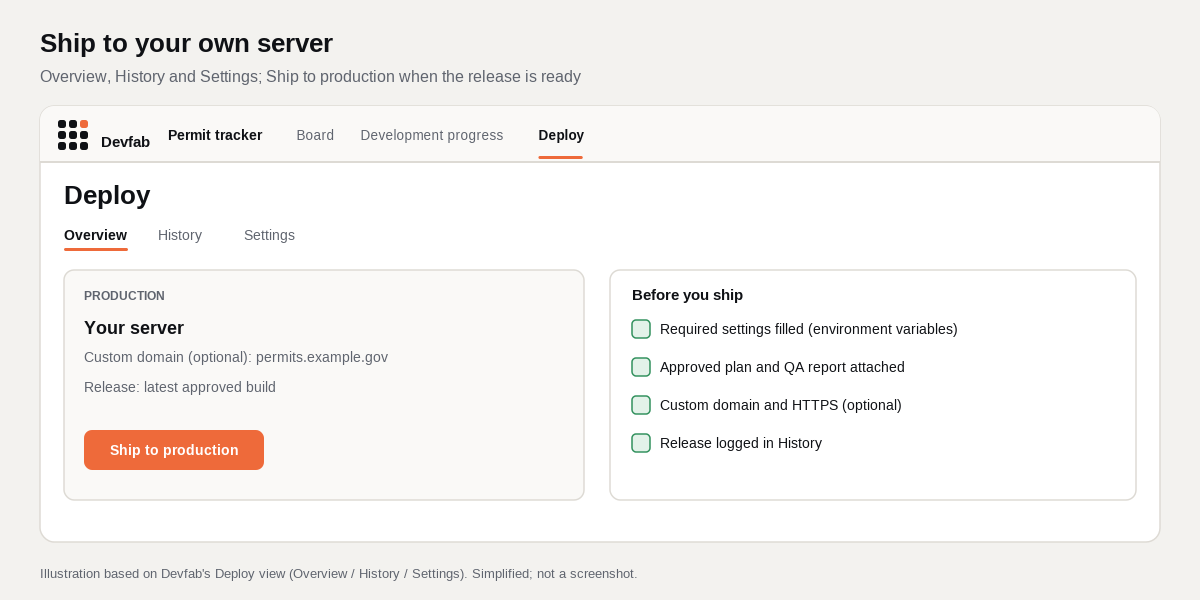
Honest limits: Devfab is in Beta, has a smaller community and far fewer integrations than these platforms, has no process modeler or RPA, is not an editor for hands-on coding, and needs a GitHub account. You also run the server, which is more responsibility than a managed platform.
How to choose
- Replace Appian with a peer enterprise platform: OutSystems or Mendix.
- Standardized on Microsoft 365: Power Apps.
- Many users, simpler operational apps, flat price: Quickbase.
- Open source, self-hosted or air-gapped: Budibase.
- Want code you own, one app at a time: Devfab.
- Deep process automation, case management and RPA are the core: stay on Appian and negotiate.
FAQ
How much does Appian cost?
Appian's pricing page shows no dollar amounts. It lists three plans, Standard, Advanced and Premium, priced per user, per month, per app, each with a monthly quota of AI Actions. A free Community Edition instance is available. You need a quote from Appian for real numbers.
What is the cheapest Appian alternative?
Budibase's self-hosted Community plan is free with unlimited users and apps, and you bring your own AI key. Among paid options, Microsoft Power Apps Premium is USD 20 per user per month paid yearly, as of November 2026, and Quickbase's entry tier is USD 500 per month with no user limit.
Which Appian alternative is best for regulated industries?
OutSystems lists HIPAA, PCI DSS and FedRAMP requirements with SOC 2 Type II, and targets banking, healthcare, insurance and government. Budibase is built for regulated enterprises and can run air-gapped. Appian itself also supports fully self-managed, air-gapped AI.
Can I move my Appian apps to another platform?
Not directly in the docs we checked. Low-code apps are built from each vendor's own models, so moving means rebuilding the process, data model and screens. Start with one process, document its rules and roles, and rebuild it on the new platform before moving the rest.
Read next
- What is an AI software factory?
- Devfab vs Appian
- Appian vs OutSystems
- Appian vs Mendix
- Best low-code platforms for enterprises
Replace one process app with code you own. Try Beta
Sources (checked November 2026): Appian pricing; Appian What's New; Appian Q1 2026 release highlights; Appian Q2 2026 product highlights; Blaze: Appian reviews (competitor, updated Feb 19, 2026); OutSystems pricing and editions; OutSystems ODC; OutSystems next-gen Mentor; OutSystems Agentic Systems Engineering announcement; Mendix pricing; Mendix 11.10 release; Mendix 11.12 release; Mendix docs: Maia with external agents; Power Apps; Power Apps pricing; Power Platform September 2026 update; Quickbase pricing; Quickbase Pave; Quickbase Pave pricing; Budibase; Budibase pricing; Budibase 4.0 (Nov 10, 2026).
Frequently asked questions
How much does Appian cost?
Appian's pricing page shows no dollar amounts. It lists three plans, Standard, Advanced and Premium, priced per user, per month, per app, each with a monthly quota of AI Actions. A free Community Edition instance is available. You need a quote from Appian for real numbers.
What is the cheapest Appian alternative?
Budibase's self-hosted Community plan is free with unlimited users and apps, and you bring your own AI key. Among paid options, Microsoft Power Apps Premium is USD 20 per user per month paid yearly, as of November 2026, and Quickbase's entry tier is USD 500 per month with no user limit.
Which Appian alternative is best for regulated industries?
OutSystems lists HIPAA, PCI DSS and FedRAMP requirements with SOC 2 Type II, and targets banking, healthcare, insurance and government. Budibase is built for regulated enterprises and can run air-gapped. Appian itself also supports fully self-managed, air-gapped AI.
Can I move my Appian apps to another platform?
Not directly in the docs we checked. Low-code apps are built from each vendor's own models, so moving means rebuilding the process, data model and screens. Start with one process, document its rules and roles, and rebuild it on the new platform before moving the rest.