Short answer: Tabnine wins when code must never leave your network: it runs in your VPC, on-premises or fully air-gapped, though Tricentis now owns it. Amazon Q Developer wins only for teams already holding Pro seats who need AWS-account-aware help until April 30, 2027, when AWS ends support and moves users to Kiro.
Your security team said no to most AI coding tools. Two made the shortlist: Tabnine for its private deployment, Q Developer because you already trust AWS. Then both vendors changed in the same year. One was acquired. The other is being retired.
Some will tell you to wait. Others say pick the safer of two moving targets now. This page sorts the facts, using pages checked on November 20, 2026.
In this comparison:
- Tabnine and Amazon Q Developer at a glance
- Feature comparison
- Where Tabnine wins
- Where Amazon Q Developer wins
- Switching from one to the other
Status first, then features, then the exits.
Tabnine and Amazon Q Developer at a glance
Tabnine was acquired by Tricentis. Tricentis announced on July 30, 2026 that it acquired Tabnine, with terms undisclosed, and that Tabnine's Enterprise Context Engine will join the Tricentis Agentic Quality Engineering Platform (Tricentis). The only stated customer commitment is that "Existing customers will continue to receive support for the products they use today." BERI flags roadmap risk for the standalone and air-gapped assistant and notes that Tricentis shut down its acquired Flood.io product in 2024 (BERI).
Tabnine is a privacy-focused assistant and agent platform. It runs in VS Code, JetBrains IDEs, Android Studio, Eclipse, Visual Studio 2022/2026 and the Tabnine CLI, and can be deployed as SaaS, VPC, on-premises or air-gapped (DEV Community review, Jun 2026). It is aimed at organizations whose IT blocks SaaS AI, such as defense, finance, healthcare and government.
Amazon Q Developer is being retired. AWS says the IDE plugins and paid subscriptions reach end of support on April 30, 2027, with Kiro as the target. New subscriptions and Free Tier accounts were blocked from May 15, 2026 (AWS DevOps blog). The console surface became "AWS assistant" on November 5, 2026 (AWS What's New).
Q Developer is AWS's coding assistant for VS Code, JetBrains, Visual Studio and Eclipse (preview), with a CLI agent and GitHub and GitLab integrations (AWS).
Feature comparison
| Aspect | Tabnine | Amazon Q Developer | Source |
|---|---|---|---|
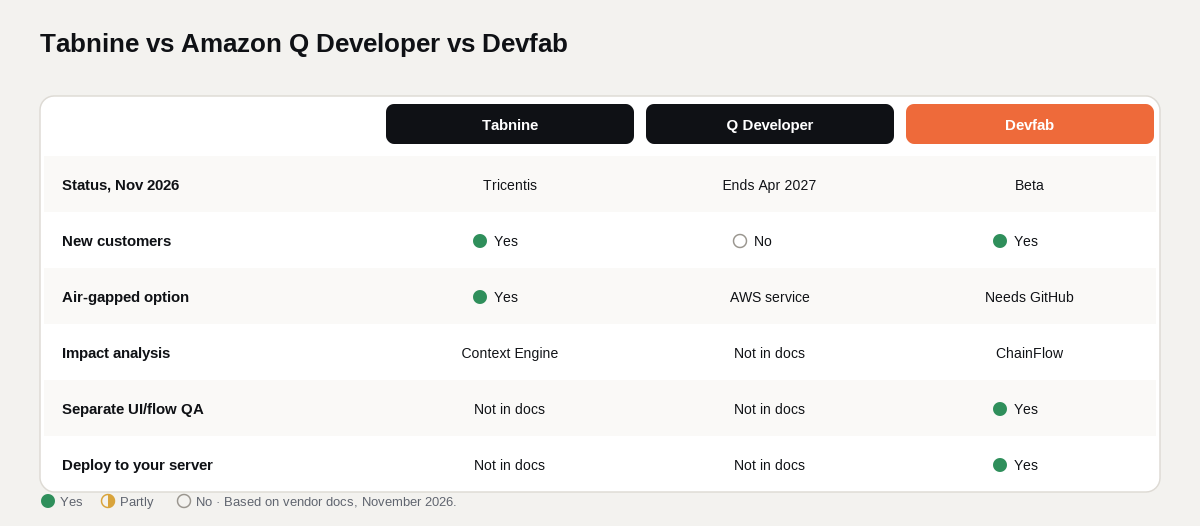
| Status (Nov 2026) | Owned by Tricentis since Jul 30, 2026; no public roadmap for the standalone assistant | End of support Apr 30, 2027; new sign-ups blocked | Tricentis; AWS blog |
| Where it runs | VS Code, JetBrains, Android Studio, Eclipse, Visual Studio, Tabnine CLI | VS Code, JetBrains, Visual Studio, Eclipse (preview), CLI, GitHub, GitLab | DEV review; Q build page |
| Deployment | SaaS, VPC, on-premises, air-gapped | AWS-hosted service | DEV review; Q pricing |
| Planning and agents | Agentic tier: agents, CLI with Plan mode, skills, subagents; agents implement Jira issues | IDE agent plans multi-file features; assign GitHub issues to Q | Tabnine pricing; Q build page |
| Code context | Enterprise Context Engine: knowledge graph of code, docs, tickets and APIs for impact analysis | Can query your AWS resources | SD Times; Q build page |
| Review and testing | Agents validate code against an issue's requirements | Security scans; automated PR reviews incl. IaC misconfigurations | Tabnine pricing; Q build page |
| Deploy and hosting | Not covered in the pages we checked | Not covered in the pages we checked | — |
| Model choice | Self-Managed Models (bring your own) on the agentic tier since Apr 2026 | Newest coding models go only to Kiro | DEV review; AWS blog |
| Pricing model | Per-seat annual subscription; no free tier | Free Tier and per-user Pro Tier, existing customers only | DEV review; Q pricing |
Cost model by team size
| Team size | Tabnine | Amazon Q Developer | Devfab |
|---|---|---|---|
| 1 person | Per-seat annual subscription; trial only, no free tier | Free Tier USD 0, existing accounts only | Cost logged per task and per project (Beta) |
| 5 people | Code Assistant or Agentic Platform seats, billed annually | Pro USD 19 per user per month, existing subscriptions only | Cost logged per task and per project (Beta) |
| 25 people | Custom Enterprise, including VPC, on-prem or air-gapped | Pro, existing subscriptions can add users until end of support | Cost logged per task and per project (Beta) |
Amazon Q Developer price as of November 2026 from AWS pricing, which shows no end-of-support notice. Tabnine's official pricing page showed no plan prices when checked, so we describe the model only. Devfab is in Beta with predictable cost: cost is logged after each run, per task and per project.
Where Tabnine wins
- No SaaS AI is allowed. Tabnine runs on-premises or fully air-gapped; Q Developer is an AWS service.
- You need impact analysis across code, docs and tickets. The Enterprise Context Engine builds that knowledge graph.
- You must bring your own model. Self-Managed Models arrived in April 2026.
- You can still buy it. New customers can sign up; AWS blocks new Q Developer subscriptions.
- You already use Tricentis for testing and want coding context tied to it.
Where Amazon Q Developer wins
- You already hold Pro seats and need nothing new before April 2027.
- Developers need AWS-aware answers. Q can query AWS resources and call AWS APIs.
- You are finishing a Java upgrade. Transformation works until the end of support date.
- You want a known end date. AWS published one and named Kiro as the path, while Tabnine's long-term roadmap is unstated.
Switching from one to the other
From Q Developer to Tabnine. Your code stays in your Git host. Install Tabnine's IDE plugin and plan the deployment model (SaaS, VPC or on-prem) with Tabnine. Ask in writing how long Tricentis will support the standalone assistant.
From Q Developer to Kiro. This is AWS's own path. Kiro CLI is backward compatible with the q command, but Kiro has no native plugins for Visual Studio or Eclipse (Kiro docs).
From Tabnine to Q Developer. Closed to new customers.
Where Devfab fits
Both tools sit inside the editor and help a developer write and review code. Neither, in the pages we checked, starts a project with domain research, routes a project plan to a person for approval, tests user journeys or ships the app.
Coding agents automate the developer. Devfab automates the development lifecycle. Its ChainFlow layer maps which functions and APIs call each other and what is deployed, so dev agents see the impact of a change before they make it. The QA agent runs UI and flow tests plus logic tests, and Deploy ships to your own server. Devfab is in Beta, with a smaller community and fewer integrations; it is not an editor, and it needs a GitHub account, so it does not suit air-gapped work today. See Devfab vs Amazon Q Developer.
FAQ
Who owns Tabnine now?
Tricentis announced on July 30, 2026 that it acquired Tabnine, without disclosing terms. Tabnine's Enterprise Context Engine will be built into the Tricentis Agentic Quality Engineering Platform. The only stated commitment is that existing customers keep support for the products they use today.
When does Amazon Q Developer end?
AWS says Q Developer IDE plugins and paid subscriptions reach end of support on April 30, 2027, with Kiro as the migration target. New subscriptions and new Free Tier accounts were blocked from May 15, 2026, and the console assistant became AWS assistant on November 5, 2026.
Which one can run fully air-gapped?
Tabnine. It can be deployed as SaaS, in your own VPC, on-premises or fully air-gapped. Analysts have flagged roadmap risk for the air-gapped assistant after the Tricentis deal, so ask about the support term in your contract.
How much do Tabnine and Amazon Q Developer cost?
Amazon Q Developer Pro is USD 19 per user per month on AWS's pricing page, as of November 2026, but only existing subscriptions can add users. Tabnine is a per-seat annual subscription with Code Assistant and Agentic tiers; its official pricing page showed no prices when we checked, so ask Tabnine for a quote.
Read next
Choosing between two tools in transition? Look at the whole delivery line. Try Beta
Sources (checked November 2026): Tricentis acquires Tabnine; Business Wire: Tricentis acquires Tabnine; BERI: Tricentis bought Tabnine's Context Engine, not your IDE; SD Times: Tabnine fills the organizational context gap; DEV Community: Tabnine review 2026; Tabnine pricing; AWS DevOps blog: Amazon Q Developer end of support; AWS What's New: AWS assistant rename; Amazon Q Developer pricing; Amazon Q Developer agentic coding; Kiro: Migrating from Q Developer.
Frequently asked questions
Who owns Tabnine now?
Tricentis announced on July 30, 2026 that it acquired Tabnine, without disclosing terms. Tabnine's Enterprise Context Engine will be built into the Tricentis Agentic Quality Engineering Platform. The only stated commitment is that existing customers keep support for the products they use today.
When does Amazon Q Developer end?
AWS says Q Developer IDE plugins and paid subscriptions reach end of support on April 30, 2027, with Kiro as the migration target. New subscriptions and new Free Tier accounts were blocked from May 15, 2026, and the console assistant became AWS assistant on November 5, 2026.
Which one can run fully air-gapped?
Tabnine. It can be deployed as SaaS, in your own VPC, on-premises or fully air-gapped. Analysts have flagged roadmap risk for the air-gapped assistant after the Tricentis deal, so ask about the support term in your contract.
How much do Tabnine and Amazon Q Developer cost?
Amazon Q Developer Pro is USD 19 per user per month on AWS's pricing page, as of November 2026, but only existing subscriptions can add users. Tabnine is a per-seat annual subscription with Code Assistant and Agentic tiers; its official pricing page showed no prices when we checked, so ask Tabnine for a quote.