Short answer: CodeRabbit wins for teams that want a per-seat AI reviewer on every pull request, in the IDE and CLI, plus a beta agent that tests the running app. Qodo wins for organizations with many connected repositories, strict rules to enforce, and a need for on-prem or air-gapped review paid for in pooled credits.
You lead engineering at a logistics company. Dispatch, billing and the driver app live in three repos. Coding agents now open more pull requests than your seniors can read. Last month a "safe" change to a shipment status field broke the billing export two repos away.
Some on your team want the reviewer everyone already talks about. Others want the one that promises to look across repositories. Here is the case for each, checked against vendor pages in November 2026.
In this comparison:
- CodeRabbit and Qodo at a glance
- Feature comparison
- Cost model by team size
- Where CodeRabbit wins
- Where Qodo wins
Both raised big rounds in 2026, so neither is going away soon.
CodeRabbit and Qodo at a glance
CodeRabbit raised a USD 143M Series C at a USD 1.5B valuation on August 12, 2026, and announced a new "Agentic Change Management" category (CodeRabbit newsroom). It reviews pull requests on GitHub, GitLab, Azure DevOps and Bitbucket, runs in VS Code, Cursor, Windsurf and JetBrains, and has a CLI for pre-commit review that "works with Claude Code, Cursor, Codex, Gemini, and more" (CodeRabbit docs). It reports "20K" customers and "8.5M" repositories (CodeRabbit JA). Its newest piece is Verify, a beta agent that "tests how your application behaves, not only how its code reads" (Verify docs).
Qodo was called CodiumAI until 2024. It raised a USD 70M Series B led by Qumra Capital on March 30, 2026, for USD 120M in total funding (Globes). Its headline is "Code review for agents. Governance for humans." Several review agents check each pull request against a team's rules and the wider codebase. Cross Repo Review flags changes that could break downstream repos, and the new Software Map shows how repos, services and contracts connect (Qodo). On November 18, 2026, the homepage announced Auto Approval Workflows and Agent Session Review.
Both are reviewers. Neither builds, hosts or deploys your application.
Feature comparison
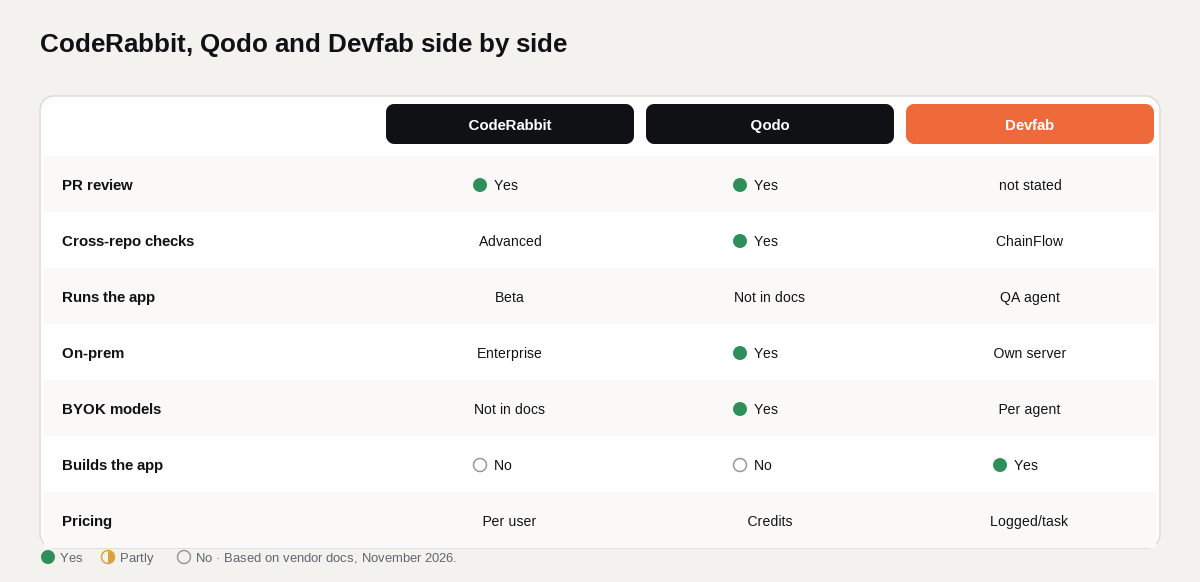
| Aspect | CodeRabbit | Qodo | Source |
|---|---|---|---|
| Git hosts | GitHub, GitLab, Azure DevOps, Bitbucket | GitHub (cloud and Enterprise Server), GitLab (cloud and self-managed), Bitbucket (Cloud and Data Center), Azure DevOps; Gerrit on Enterprise | CodeRabbit docs; Qodo |
| IDE and CLI | VS Code, Cursor, Windsurf, JetBrains; pre-commit CLI | VS Code, JetBrains, Visual Studio; Agentic Toolbox CLI | Same as above |
| Review scope | PR summaries, chat, learnings, autofix, "slop detection", pre-merge checks; blast-radius analysis on Advanced | Multi-agent review against org rules; Cross Repo Review; Wisdom Base context from code, PR history and requirements | CodeRabbit pricing; Qodo |
| Testing | Unit test generation from Team; Verify (beta) runs the app in a sandbox | Review and governance; app testing not covered in the pages we checked | Verify docs; Qodo |
| Security | Scans for vulnerabilities, leaked secrets, vulnerable dependencies | SOC 2 Type II, zero data retention | CodeRabbit docs; Qodo pricing |
| Model choice | Not covered in the pages we checked | BYOK with OpenAI, Anthropic, Azure OpenAI or self-hosted models (Enterprise) | Qodo pricing |
| Hosting | Cloud; self-hosting and chosen regions on Enterprise | Single-tenant SaaS, on-prem or air-gapped | Same as above |
| Admin | SSO, custom roles, audit logs on Enterprise | SSO/SAML, audit logs, governance dashboard | Same as above |
| Pricing model | Per user per month; review cap per developer under fair use | Pooled team credits; Enterprise for 30+ users | Same as above |
Cost model by team size
| Team size | CodeRabbit | Qodo | Devfab |
|---|---|---|---|
| 1 person | Free reviews in the IDE; Essentials USD 24 per user per month | Pro Team, smallest pack: 2,000 credits a month, about 14 reviews | Cost logged per task and per project (Beta) |
| 5 people | Essentials USD 24 or Team USD 48 per user per month | Pro Team, 4,000 or 16,000 credits a month (about 29 or 114 reviews), shared by the team | Cost logged per task and per project (Beta) |
| 25 people | Team USD 48 or Advanced USD 72 per user per month; Enterprise (custom) for SSO and self-hosting | Pro Team with an overage cap, or Enterprise (custom) from 30 users | Cost logged per task and per project (Beta) |
Prices as of November 2026 from CodeRabbit pricing and Qodo pricing. CodeRabbit shows a 20% discount for annual billing and bills extra reviews beyond its fair-use cap on consumption. Qodo Pro Team is USD 0.015 per credit; unused credits expire each month, and overage is billed at the same rate up to a cap you set. Devfab is in Beta and offers predictable cost: cost is logged after each run, per task and per project.
The pricing shapes push in opposite directions. CodeRabbit's cost follows headcount. Qodo's follows review volume. A five-person team doing a handful of reviews a week pays less on credits; a team where everyone opens pull requests all day may find the seat easier to budget.
Where CodeRabbit wins
- You want a published per-seat price you can put in a budget line today.
- You want to test behavior, not only read code. Verify runs the app in a sandbox and reports bugs with screenshots and recordings. It is free during the beta, for web apps and services on CodeRabbit Cloud.
- Developers want review before they push. The CLI runs pre-commit reviews alongside coding agents.
- You want a free starting point. The IDE page offers free AI code reviews in the editor, and the FAQ mentions a free open-source plan (CodeRabbit FAQ).
- Chat-based teams. A Slack and Discord agent is listed in the docs.
Where Qodo wins
- Cross-repo breakage. Cross Repo Review and Software Map target exactly the dispatch-to-billing problem above.
- Air-gapped or on-prem review with zero data retention, for regulated or security-sensitive code.
- Your own models. BYOK with OpenAI, Anthropic, Azure OpenAI or self-hosted models.
- Rules as a product. Rules & Skills Lifecycle turns engineering practices into standards each review enforces.
- Wider Git coverage, including GitHub Enterprise Server, GitLab self-managed, Bitbucket Data Center and Gerrit.
Switching from one to the other
Both install on your Git provider, so the code stays where it is. Run them side by side on one repo for a few sprints before you switch.
From CodeRabbit to Qodo. Start the trial, which needs no credit card. Connect the Git provider and the IDE plugin. Write your review rules into Qodo's rules system rather than relying on learned behavior, and pick a credit pack that matches the number of reviews CodeRabbit ran last month.
From Qodo to CodeRabbit. Start the trial and connect the same repos. Decide which developers need seats. If you relied on Qodo's on-prem deployment, you will need CodeRabbit Enterprise for self-hosting.
Where Devfab fits
A reviewer reads changes after someone has written them. Neither CodeRabbit nor Qodo, in the docs we checked, plans the work, builds the app, or deploys it.
Coding agents automate the developer. Devfab automates the development lifecycle. In Devfab, ChainFlow maps which functions and APIs call each other and what is deployed before dev agents change anything, so a shipment status change shows its effect on billing exports and driver notifications up front. A person approves the plan, and the QA agent runs UI, flow and logic tests on the result.
If your team writes code and needs a review gate, a reviewer is the right purchase. Devfab is in Beta, has a smaller community and fewer integrations, and needs a GitHub account. See Devfab vs CodeRabbit.
FAQ
Is CodeRabbit or Qodo cheaper?
It depends on how many reviews you run. CodeRabbit charges per user: Essentials USD 24, Team USD 48 and Advanced USD 72 per user per month, as of November 2026. Qodo Pro Team is USD 0.015 per credit, pooled across the team, in packs of about 14, 29 or 114 reviews a month. Few reviews favor Qodo; many developers reviewing often may favor a seat.
Can Qodo or CodeRabbit run on-premises?
Both offer self-hosting at the top tier. CodeRabbit lists self-hosting and chosen SaaS regions on Enterprise. Qodo lists single-tenant SaaS and on-prem or air-gapped deployment with zero data retention, and supports Gerrit on Enterprise.
Does CodeRabbit test the running app?
In beta. CodeRabbit Verify generates scenarios for a pull request, runs the app in a sandbox, mostly through a browser, and reports bugs with screenshots and recordings. It is free during the beta and limited to web apps and services on CodeRabbit Cloud.
Is Qodo the same as CodiumAI?
Yes. CodiumAI renamed itself Qodo in 2024. Qodo raised a USD 70 million Series B on March 30, 2026. Its homepage now leads with multi-agent code review and governance rather than the older Qodo Gen and Qodo Merge names.
Read next
- What is an AI software factory?
- Qodo alternatives
- CodeRabbit alternatives
- CodeRabbit vs GitHub Copilot
- AI code review vs human code review
Want impact mapped before the code is written, not after? Try Beta
Sources (checked November 2026): CodeRabbit pricing; CodeRabbit docs; CodeRabbit Verify docs; CodeRabbit FAQ; CodeRabbit homepage (JA); CodeRabbit Series C (Aug 12, 2026); Qodo homepage; Qodo pricing; Globes: Qodo raises USD 70m (Mar 30, 2026); Qodo blog: USD 50M round (Sep 30, 2024).
Frequently asked questions
Is CodeRabbit or Qodo cheaper?
It depends on how many reviews you run. CodeRabbit charges per user: Essentials USD 24, Team USD 48 and Advanced USD 72 per user per month, as of November 2026. Qodo Pro Team is USD 0.015 per credit, pooled across the team, in packs of about 14, 29 or 114 reviews a month. Few reviews favor Qodo; many developers reviewing often may favor a seat.
Can Qodo or CodeRabbit run on-premises?
Both offer self-hosting at the top tier. CodeRabbit lists self-hosting and chosen SaaS regions on Enterprise. Qodo lists single-tenant SaaS and on-prem or air-gapped deployment with zero data retention, and supports Gerrit on Enterprise.
Does CodeRabbit test the running app?
In beta. CodeRabbit Verify generates scenarios for a pull request, runs the app in a sandbox, mostly through a browser, and reports bugs with screenshots and recordings. It is free during the beta and limited to web apps and services on CodeRabbit Cloud.
Is Qodo the same as CodiumAI?
Yes. CodiumAI renamed itself Qodo in 2024. Qodo raised a USD 70 million Series B on March 30, 2026. Its homepage now leads with multi-agent code review and governance rather than the older Qodo Gen and Qodo Merge names.