Short answer: Learn Playwright first; it now has its own test agents and an MCP server. Add Cypress for deep failure debugging, mabl or Tricentis Testim for low-code regression, Momentic for tests stored in your repo, Applitools for visual checks, QA Wolf to outsource coverage, and CodeRabbit for PR review.
You're the QA engineer on a team where developers now ship with coding agents. The number of pull requests went up. Your headcount did not.
Most "best AI testing tools" lists rank vendors. That doesn't help you on a Tuesday afternoon when the suite is red again. This list is sorted by the jobs you actually do: writing tests, keeping them alive, finding why they failed, catching visual breaks, and reviewing changes before they merge. Every fact links to a vendor page or dated review checked in November 2026.
In this guide, you'll learn:
- How we picked and compared
- Quick comparison table
- The tools by job
- Where a dedicated testing tool is the better choice
- How to choose
Skip to the job that hurts most this sprint.
How we picked and compared
We started from the daily work of a QA engineer, not from vendor categories. Five jobs:
- Write tests from a scenario, a requirement or a recording.
- Keep tests alive when the UI changes (self-healing).
- Find out why a test failed, and whether it is flaky.
- Catch visual regressions that functional checks miss.
- Review changes before they merge.
For each tool we read the product pages, docs and pricing pages, plus dated reviews where they exist, and checked them in November 2026. We did not run the tools ourselves. Prices appear only when the official pricing page shows them. We also looked for how each tool connects to coding agents, since that is where much new code now comes from.
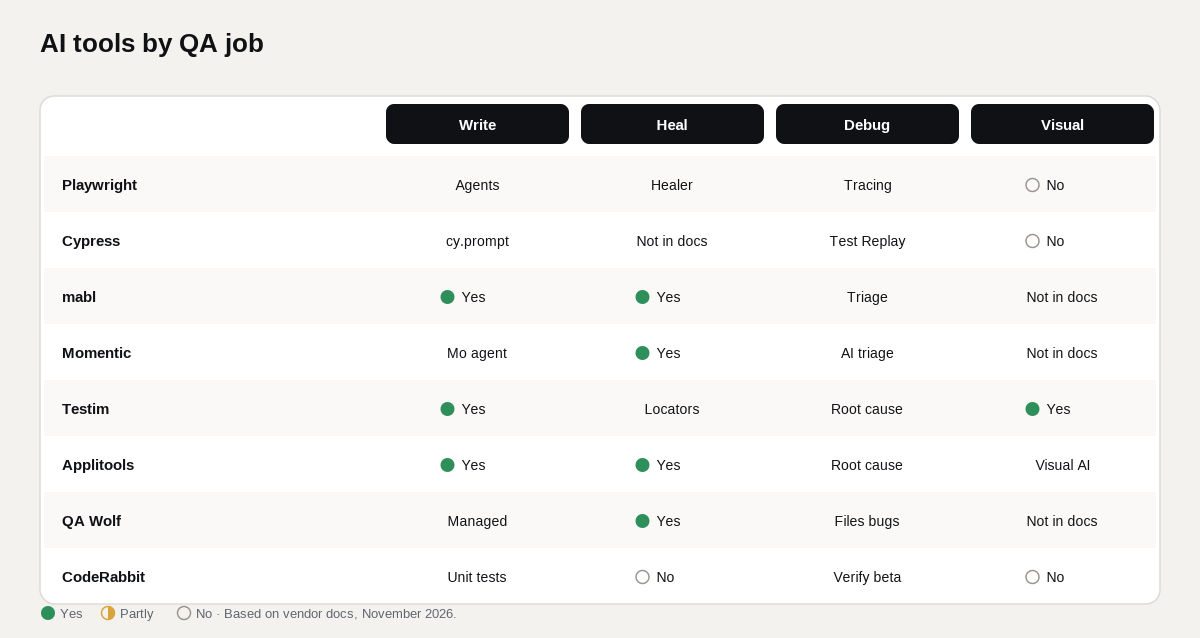
Quick comparison table
| Tool | Main job | AI features | Runs where | Pricing model (as of Nov 2026) |
|---|---|---|---|---|
| Playwright | Write and run E2E tests as code | Planner, Generator, Healer agents; MCP server | Your machine and CI | Free, open source |
| Cypress | Debug and orchestrate runs | cy.prompt, Studio AI, AI Summaries; Cloud MCP | Local, CI, Cypress Cloud | Free app; Cloud from USD 0 |
| mabl | Low-code regression across web, mobile, API | Authoring, auto-healing, failure triage; MCP | Cloud, local and CI runners | Quote-based |
| Momentic | Tests as YAML in your repo | Mo agent explores, writes and heals; MCP | Hosted browsers, emulators, your CI | Usage-based, from USD 0 |
| Tricentis Testim | Stable UI locators, Salesforce | Self-healing locators, Agentic Test Automation | SaaS grid, local, any Selenium grid | Quote-based |
| Applitools | Visual regression | Visual AI, deterministic model, MCP server | SaaS, dedicated cloud, on-prem | Per page; no public prices |
| QA Wolf | Outsourced E2E coverage | Agents plan, write, run, maintain; MCP | QA Wolf cloud | USD 1 per web run |
| CodeRabbit | PR review | Review, autofix, Verify (beta) | Git hosts, IDE, CLI | From USD 24 per user per month |
| Devfab | QA as one step of a full build | QA agent: UI, flow and logic tests | Devfab workspace | Cost logged per task (Beta) |
The tools by job
Playwright
Best for: QA engineers who write code and want full control of tests at no license cost. Limits: a framework, not a managed service; you host runs, CI and maintenance yourself (Playwright test agents). Pricing: free and open source; no paid tier on playwright.dev (Playwright).
- One API for Chromium, Firefox and WebKit, in TypeScript, Python, .NET and Java, on Linux, macOS and Windows (Playwright).
- Built-in test agents: Planner explores the app and writes a Markdown plan, Generator turns it into tests, and Healer repairs failing tests or skips them if it thinks the feature is broken (Playwright test agents).
- Agent loops are supported for VS Code, Claude Code, Codex and OpenCode (same source).
- Playwright MCP drives the browser through accessibility snapshots, so no vision model is needed (Playwright MCP).
- Tracing captures DOM snapshots, network, console and screenshots for each step, and runs are parallel by default (Playwright).
The Healer's "skip if broken" behavior deserves a policy: decide who reviews skipped tests before they pile up.
Cypress
Best for: QA teams that live in failure debugging, flake hunting and CI orchestration. Limits: cy.prompt works only for end-to-end tests in Chromium browsers, is optimized for English, and counts every execution toward a quota (cy.prompt docs; Cypress pricing). Pricing: the Cypress App is MIT-licensed and free. Cloud Starter is USD 0 with 500 test results and 100 cy.prompt executions a month; Team from USD 67 per month billed annually; Business from USD 267 per month billed annually, as of November 2026 (Cypress pricing).
- cy.prompt turns plain-language steps into Cypress commands; it moved to beta in 15.13.0, and its docs were updated on November 23, 2026 (cy.prompt docs).
- Studio AI turns recorded clicks into editable tests with assertions (Cypress).
- AI Summaries explain failures inside Test Replay on all plans (Cypress pricing).
- Cloud MCP and Cloud CLI let coding agents read CI failures, flake history, UI Coverage and accessibility violations (Cypress).
- cy.prompt can't do multi-element assertions, cy.request(), canvas or iframes yet (cy.prompt docs).
mabl
Best for: QA teams that want one low-code platform for web, mobile, API and AI-feature tests, with a release verdict. Limits: no public pricing; desktop app testing was "coming soon" as of October 2026; accessibility testing is not mentioned on the product pages we opened (mabl pricing; SD Times). Pricing: quote-based; cloud runs use credits from an annual allocation, local and CI Runner runs don't; 14-day free trial (mabl pricing).
- Authors tests from inputs such as Jira requirements, investigates every failure and heals broken steps (mabl).
- The vendor claims adaptive auto-healing cuts maintenance by 85% (same source; a vendor figure, not an independent test).
- The October 2026 agentic testing harness maps a change to its tests, highlights coverage gaps, and integrates with Xray, Zephyr, TestRail and Azure DevOps (SD Times).
- GitHub PR status checks with inline result comments, plus GitLab, Jenkins, Jira and Slack (mabl platform).
- SOC 2 Type II, SSO/SAML, RBAC and SLA-backed support (same source).
Momentic
Best for: QA engineers who want AI-written tests stored as files in the repo and reviewed like code. Limits: monthly usage doesn't roll over, results have a fixed retention window on Free and Scale, and mobile sessions have a length cap outside Enterprise (Momentic pricing). Pricing: Free USD 0 per month with USD 50 of usage; Scale USD 500 per month with USD 500 of usage; steps from USD 0.0125 each; Enterprise custom, as of November 2026 (Momentic pricing).
- Its agent, Mo, explores web, iOS and Android apps to find bugs and turns an approved flow into a YAML test, then opens a pull request (Momentic).
- A separate agent reproduces each functional bug Mo files (same source).
- Mo can test a PR's preview deployment and post a review with a commit check (same source).
- An MCP server and a Claude Code plugin connect it to coding agents (Momentic docs index).
- Built on Playwright, per its own docs index (same source). Its
momenticCLI includes an AI triage command for failures (Momentic).
Tricentis Testim
Best for: QA teams with fragile UI locators, and Salesforce orgs with dynamic Lightning pages. Limits: no public pricing or edition matrix, and no Testim-specific MCP server on the pages we opened (Testim Enterprise). Pricing: quote-based; "Get started free" trial and an Enterprise edition through sales (Testim).
- AI-powered locators "self-heal to improve test stability", and visual validation works at element or page level (Testim).
- Covers cross-browser web, native and hybrid mobile, React Native, Flutter and Salesforce with metadata-based locators (same source).
- Agentic Test Automation creates tests from a written description, and Testim Copilot writes a JavaScript custom step from a description (Testim Copilot).
- Failed tests come with highlighted screenshots, console and network logs, and fix suggestions (Testim).
- Part of Tricentis since its acquisition was announced on February 9, 2022, with qTest and NeoLoad integration (Tricentis).
Applitools
Best for: catching layout, rendering and cross-browser regressions that functional assertions miss. Limits: no public prices, one-year contracts, and Starter is public-cloud only (Applitools pricing). Pricing: per page, where "a page equals a unique validation"; a free account includes 1 user and 100 checkpoints a month (same source).
- Two products: Eyes for visual and functional testing, and Autonomous to create, run and analyze functional, visual and API tests (Applitools).
- Runs use a proprietary Deterministic Language Model paired with Visual AI; LLMs help with authoring and test data (same source).
- Execution includes cross-browser runs and self-healing tests; analysis includes root cause analysis and automated maintenance (same source).
- SDKs for Java, Python, JavaScript, C#, Ruby and more, working with Selenium, Playwright, Appium and Cypress (Applitools FAQ).
- SaaS, dedicated cloud on AWS, Azure or GCP, or on-prem; ISO 27001 and SOC 2 Type II (Applitools).
- The homepage now lists an MCP server, giving "coding agents the eyes to fix UI issues themselves" (same source).
QA Wolf
Best for: teams that want someone else to build and maintain E2E coverage, including mobile and desktop. Limits: flakes are retried (up to 3 attempts), not eliminated; coverage guarantees apply only to managed tiers; per-run billing grows with suite size and frequency (QA Wolf pricing). Pricing: USD 1 per web or Linux Electron test run and USD 2 per mobile or desktop run, no per-seat fees, as of November 2026; managed tiers quoted by sales (same source).
- Agents plan coverage, write tests, pick the tests each PR needs, investigate failures and file bugs to Linear or Jira; broken tests "are fixed automatically as your app changes" (same source).
- Tests are "open-source Playwright and Appium code you can export anytime" (same source).
- Covers web, iOS, Android and Windows, with real-device iPhone and iPad testing (QA Wolf).
- Coverage-as-a-Service includes a guarantee of "80%+ automated coverage" (QA Wolf pricing).
- The vendor's own pricing example puts 50 web tests run daily at about USD 1,083 a month, as of November 2026 (same source).
CodeRabbit
Best for: QA engineers who want a review gate on every PR, especially for agent-written code. Limits: mainly a reviewer; Verify, its runtime testing piece, is beta and web-only; SSO and self-hosting need Enterprise (CodeRabbit Verify; CodeRabbit pricing). Pricing: Essentials USD 24, Team USD 48 and Advanced USD 72 per user per month, Enterprise custom, as of November 2026; 14-day trial (CodeRabbit pricing).
- Works on GitHub, GitLab, Azure DevOps and Bitbucket, in VS Code, Cursor, Windsurf and JetBrains, and from a CLI (CodeRabbit docs).
- Verify generates scenarios for a PR, runs the app in a sandbox, mostly through a browser, and reports bugs with screenshots and recordings; it is free during the beta (CodeRabbit Verify).
- Unit test generation from the Team plan; blast-radius analysis on Advanced (CodeRabbit pricing).
- Security scanning covers code vulnerabilities, leaked secrets and vulnerable dependencies (CodeRabbit docs).
- Raised a USD 143M Series C on August 12, 2026 (CodeRabbit newsroom).
Devfab
Best for: QA leads at agencies or IT teams who want testing built into how an app is planned and built, not bolted on afterwards. Limits: not a testing tool for code you already have; in Beta, smaller community, fewer integrations than mature platforms, not an editor for hands-on coding, needs a GitHub account. Pricing: predictable cost; cost is logged after each run, per task and per project. No public price.
Fair framing first. Every tool above tests or reviews code that already exists. Devfab runs the whole lifecycle, and its QA agent is one step of it. Coding agents automate the developer. Devfab automates the development lifecycle.
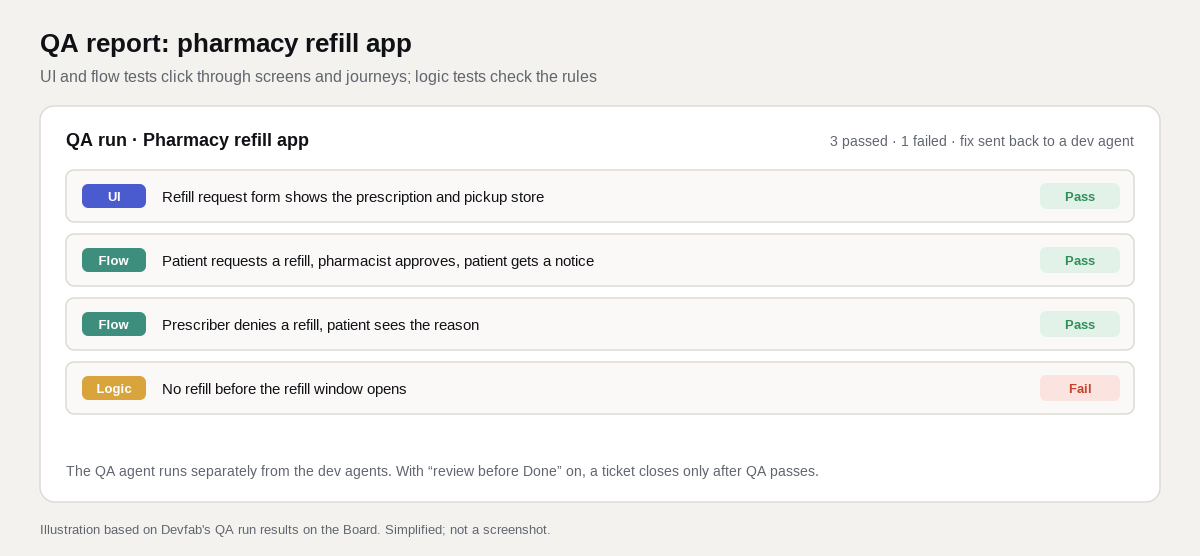
Here is what that means for QA. The Researcher maps the domain before the Planner writes a plan, so test scenarios start from real practices. For a pharmacy refill app, that means terms like refill window and prescriber approval. A person approves the plan. The QA agent then runs UI and flow tests, clicking screens, buttons and user journeys end to end, plus logic tests. The workspace switch "QA agent · review before Done" is where you control that step. On later changes, ChainFlow maps which functions and APIs call each other and what is deployed. A change to refill rules then shows its effect on pharmacist queues, patient notices and pickup slots, which tells you where to point regression checks.
Where a dedicated testing tool is the better choice
- You test an app you didn't build with Devfab. That is most apps, and every tool above fits better.
- You need mobile or desktop coverage. QA Wolf, mabl and Testim list mobile; QA Wolf lists Windows desktop.
- You need visual regression across browsers. Applitools is built for it.
- You need test-case management integrations. mabl connects to Xray, Zephyr, TestRail and Azure DevOps.
- You want tests as code you own forever at no license cost. Playwright and the Cypress App.
How to choose
- Start from your stack, not the vendor. Coding team: Playwright or Cypress. Low-code QA team: mabl or Testim.
- Name the job that hurts. Writing tests: Playwright agents, Momentic or cy.prompt. Healing: mabl, Testim, Momentic. Debugging: Cypress Cloud. Visual: Applitools. Review: CodeRabbit.
- Check where tests live. Momentic and QA Wolf give you files you can keep; mabl, Testim and Applitools keep them on their platforms.
- Model cost at your run volume. Per-run (QA Wolf), per-result (Cypress Cloud), per-step (Momentic) and per-page (Applitools) pricing scale differently.
- Wire it to your coding agents. Most tools here now offer an MCP server; check that yours works with the agent your developers use.
- If you're scoping a new app, put QA in the plan. That is where a software factory such as Devfab fits.
FAQ
What AI tool should a QA engineer learn first?
Playwright, if you write code. It is free, open source, and now ships Planner, Generator and Healer test agents plus an MCP server that coding agents use. Several commercial tools, including QA Wolf and Momentic, build on or export to Playwright, so the skill carries over.
Will AI tools replace QA engineers?
The tools on this list automate writing, running, healing and triaging tests. They don't decide what quality means for your product. Even QA Wolf, which writes and maintains tests for you, sells a managed tier where its own engineers own coverage.
Which AI testing tools have free plans?
Playwright and the Cypress App are free and open source. Cypress Cloud has a free Starter plan, Momentic has a Free plan with USD 50 of usage, Applitools has a free account with 100 checkpoints a month, and QA Wolf gives new teams free runs, all as of November 2026.
How is Devfab's QA agent different from these tools?
The tools on this list test or review code you already have. Devfab runs the whole lifecycle, from research and an approved plan to deploy, and its QA agent is one step of it, running UI, flow and logic tests on the app Devfab builds.
Do I need a separate code review tool if I have E2E tests?
Often yes. Tests check behavior on the paths you wrote; review catches issues in the diff, such as security problems or risky changes, before anything runs. CodeRabbit does review and now adds a beta agent, Verify, that tests running app behavior.
Read next
- What is an AI software factory?
- Playwright vs Cypress
- Devfab vs mabl
- Best AI testing tools for AI-generated code
- What is a QA agent?
Want QA in the plan from the first ticket? Try Beta
Sources (checked November 2026): Playwright; Playwright test agents; Playwright MCP: snapshots; Cypress; Cypress pricing; cy.prompt docs; mabl AI test automation; mabl platform; mabl pricing; SD Times: mabl agentic testing harness (Oct 2026); Momentic; Momentic pricing; Momentic docs index; Tricentis Testim; Testim Copilot; Testim Enterprise; Tricentis acquires Testim (Feb 9, 2022); Applitools; Applitools pricing; Applitools FAQ; QA Wolf; QA Wolf pricing; CodeRabbit docs; CodeRabbit Verify; CodeRabbit pricing; CodeRabbit Series C (Aug 12, 2026).
Frequently asked questions
What AI tool should a QA engineer learn first?
Playwright, if you write code. It is free, open source, and now ships Planner, Generator and Healer test agents plus an MCP server that coding agents use. Several commercial tools, including QA Wolf and Momentic, build on or export to Playwright, so the skill carries over.
Will AI tools replace QA engineers?
The tools on this list automate writing, running, healing and triaging tests. They don't decide what quality means for your product. Even QA Wolf, which writes and maintains tests for you, sells a managed tier where its own engineers own coverage.
Which AI testing tools have free plans?
Playwright and the Cypress App are free and open source. Cypress Cloud has a free Starter plan, Momentic has a Free plan with USD 50 of usage, Applitools has a free account with 100 checkpoints a month, and QA Wolf gives new teams free runs, all as of November 2026.
How is Devfab's QA agent different from these tools?
The tools on this list test or review code you already have. Devfab runs the whole lifecycle, from research and an approved plan to deploy, and its QA agent is one step of it, running UI, flow and logic tests on the app Devfab builds.
Do I need a separate code review tool if I have E2E tests?
Often yes. Tests check behavior on the paths you wrote; review catches issues in the diff, such as security problems or risky changes, before anything runs. CodeRabbit does review and now adds a beta agent, Verify, that tests running app behavior.