Short answer: For federal-grade clouds, Power Apps (GCC), ServiceNow App Engine and Appian state FedRAMP High. OutSystems adds Texas TX-RAMP, and Mendix runs on AWS GovCloud. For resident-facing apps on a small budget, Caspio and Knack charge flat fees with unlimited users. Devfab fits when you want code you own on your own servers.
You're the IT lead for a mid-size city. The clerk's office wants business license renewals online. Animal control wants pet licenses off paper. Every low-code vendor says "built for government," and every one prices it differently.
What matters in government is rarely the demo. It is which compliance program the vendor holds, whether residents count as paid users, who can host it, and what happens when the contract ends. This list compares eight options on those points, using vendor pages opened in November 2026.
In this guide, you'll learn:
- How we picked and compared
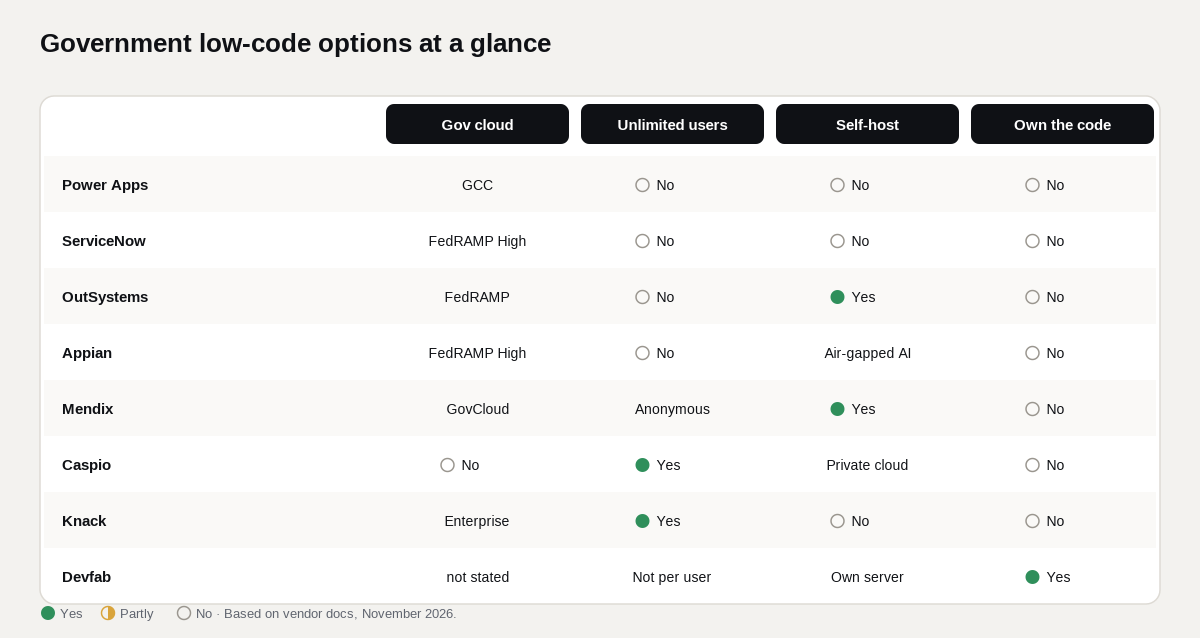
- The eight options in one table
- Each platform's fit and limits
- Where Devfab fits, with limits
- How to choose
Read the table first, then the sections on your shortlist.
How we picked and compared
We chose platforms that name government as a target market or publish a government cloud, plus two flat-priced builders that suit resident-facing apps. We checked each against five questions:
- Compliance program. FedRAMP is federal. State and local buyers may need a state program such as Texas TX-RAMP, or GovRAMP, a nonprofit that "standardizes cloud security for state, local, tribal, and education governments" (GovRAMP). None of the vendor pages we opened stated a GovRAMP status.
- Who counts as a user. Residents filing a renewal are users. Per-user pricing that works for staff can break for the public.
- Hosting. Vendor cloud, government cloud, private cloud, or your own servers.
- Accessibility and data rules. WCAG for public sites; HIPAA or CJIS where they apply.
- Procurement fit. Public prices help with small purchases. For federal awards made on or after October 1, 2025, the micro-purchase threshold rose to USD 15,000 and the simplified acquisition threshold to USD 350,000, though local policies must be updated first (MRSC).
We used vendor docs, pricing pages and dated news. We did not run hands-on tests, and we don't rank by popularity.
Quick comparison table
| Platform | Best for | Government cloud or certification (as stated) | User pricing | Public price (as of Nov 2026) |
|---|---|---|---|---|
| Microsoft Power Apps | Agencies on Microsoft 365 | GCC: FedRAMP High, IL2, CJIS; GCC High: IL4/ITAR | Per user or per app | Premium USD 20 per user per month, paid yearly |
| ServiceNow App Engine | Agencies already on ServiceNow | Government Community Cloud: FedRAMP High, DoD IL-4 | Package quote | Quote only |
| OutSystems | Large custom-app portfolios | FedRAMP authorized via Knox; TX-RAMP | By application objects and users | Quote; free Personal Edition |
| Appian | Case management and long processes | Government Cloud: FedRAMP High, DISA IL5 | Per user, per month, per app | Quote; free Community Edition |
| Mendix | Flexible deployment and reuse | Cloud for Government on AWS GovCloud, FedRAMP authorized (level not stated) | By apps and users | Standard One App from USD 1,090 per month |
| Caspio | Data apps under HIPAA or FERPA | HIPAA, SOC 2 Type II; no GovCloud on pricing page | Unlimited app users | Team USD 300 per month |
| Knack | Small departments and portals | HIPAA and GovCloud-based options on Enterprise | Unlimited users | Starter USD 59 per month |
| Devfab | Custom code you own and host | Not stated; deploys to your own server | Not per user | Cost logged per task and per project (Beta) |
The platforms one by one
Microsoft Power Apps
Best for: cities, counties and agencies already on Microsoft 365 and Entra.
Power Apps US Government is open to "federal, state, local, tribal, and territorial government entities", subject to eligibility checks. GCC meets FedRAMP High, DoD DISA IL2 and CJIS requirements; GCC High targets IL4 and ITAR; DoD (IL5) is only for DoD entities. Customer content at rest stays in US datacenters, and Microsoft admin access is limited to screened US citizens (Microsoft Learn). IT can "centralize policies for environments, data loss prevention, access, and auditing" (Power Apps). In September 2026 the app-builder skill for generating model-driven apps became generally available (Power Platform blog).
Pricing: Premium USD 20 per user per month, paid yearly; USD 12 at a 2,000-seat minimum; a free Developer Plan for non-production; Dataverse capacity USD 40 per GB per month, as of November 2026 (Power Apps pricing).
Limits: premium, on-premises and custom connectors need a standalone licence beyond Microsoft 365 rights. Several AI pieces are still preview (licensing FAQ).
ServiceNow App Engine
Best for: agencies that already run IT or citizen services on ServiceNow.
ServiceNow's state government page lists App Engine and Public Sector Digital Services, and cites a US Government Community Cloud "certified at FedRAMP High and DoD IL-4", plus a National Security Cloud for IL5 data (ServiceNow). Build Agent generates workflows, UI and AI agents from plain language, and since May 6, 2026 its skills work inside Cursor, Windsurf, Claude Code and GitHub Copilot under platform governance (ServiceNow). App Engine Management Center adds deployment approvals and release management. On April 9, 2026, ServiceNow said AI and governance are built into all products and "not a separate purchase" (ServiceNow newsroom).
Pricing: custom quote per package, Foundation or Prime (App Engine pricing).
Limits: Foundation caps you at 15 custom tables and 3 scoped apps. StateRAMP or GovRAMP is not mentioned on the state government page.
OutSystems
Best for: larger governments building many custom apps with a vendor-supported platform.
OutSystems lists government among its target industries (OutSystems FAQ). It achieved FedRAMP authorization through a managed cloud with Knox, aimed at federal agencies, with no impact level stated in the release (Business Wire). For state buyers, it announced Texas TX-RAMP certification on November 3, 2026, so eligible Texas public entities can rely on an existing state-verified assessment (OutSystems blog). Deployment options include managed cloud, on-premises, private cloud and sovereign or regulated cloud, with "pre-built connections to 400+ systems" and a private gateway to on-prem systems (OutSystems pricing; ODC).
Pricing: no plan prices. A free Personal Edition for development; the paid platform is sized by application objects, users and add-ons.
Limits: no public prices, and some Forge components may need rebuilding for OutSystems Developer Cloud.
Appian
Best for: case management, permits, inspections and other long-running processes with audit needs.
Appian Government Cloud obtained FedRAMP High authorization on April 10, 2025 and renewed its DISA IL5 authorization; Appian Cloud has held FedRAMP Moderate since 2015 (Appian). That release targets federal agencies and does not mention state or local government. AI features can run fully self-managed on air-gapped infrastructure (Appian What's New). Customers can connect their own Azure OpenAI accounts, route through an LLM gateway and use AI Guardrails that screen for prompt injection and PII leakage (Appian Q2 2026).
Pricing: "priced per user, per month, per app" across Standard, Advanced and Premium, with no dollar figures; a free Community Edition (Appian pricing).
Limits: AI Agents and Composer are not on Standard. A competitor's review cites high per-user pricing for smaller organizations and a steep learning curve (Blaze).
Mendix
Best for: agencies that want one platform across several hosting targets.
Mendix Cloud for Government is hosted on AWS GovCloud and managed by Siemens Government Technologies. It was reported as FedRAMP authorized in February 2025, level not stated, and aimed at federal agencies (Mendix blog; WashingtonExec). Outside that, apps deploy to Mendix Cloud, Azure, Kubernetes, SAP BTP, StackIT or your own servers (Mendix pricing). Mendix 11.12 LTS shipped on June 30, 2026.
Pricing: Free (no uptime guarantee); Standard One App from USD 1,090 per month; Standard Unlimited Apps from USD 2,725 per month; Premium by quote, as of November 2026. Anonymous users are not charged, which helps public-facing apps.
Limits: AI features are not listed by plan, and agent policies in 11.12 "bring visibility, but no enforcement" (Mendix 11.12).
Caspio
Best for: departments handling health, school or case data that need unlimited users on a flat fee.
Caspio now calls itself "the Compliant AI App Builder" and names government among its regulated industries (Caspio). It is HIPAA, SOC 2 Type II and GDPR certified annually, supports FERPA and WCAG, and runs HIPAA-eligible AI features under signed BAAs. Apps run hosted by Caspio or embed into existing websites and portals, which suits a city site that already exists. Its AI builder, Caspi, creates the data model, screens and roles from a description.
Pricing: Team USD 300 per month (USD 270 billed annually); Business USD 600 per month (USD 540 billed annually); HIPAA/Compliance Edition USD 500 per month on a one-year term; Enterprise custom, as of November 2026. All plans have unlimited app users (Caspio pricing).
Limits: no GovCloud offering on the pricing page; private cloud is mentioned for enterprise needs. Team allows only 5 app authors and 250K records.
Knack
Best for: a single department that needs a database app or resident portal quickly and cheaply.
Knack builds online databases, portals and internal tools, with an AI app builder on every plan (Knack). Portals have secure login, roles, permissions and SSO, and every plan has unlimited users, with no per-seat pricing. The homepage cites HIPAA, GDPR and SOC 2 Type II; HIPAA and GovCloud-based options sit on Enterprise (Knack pricing). It recently launched an MCP server.
Pricing: Starter USD 59 per month (USD 49 billed annually); Pro USD 130 per month (USD 110 billed annually); Corporate from USD 300 per month; Enterprise custom, as of November 2026.
Limits: Starter caps 20,000 records, 3 apps and 1,000 API calls a day. Government-grade hosting means talking to sales.
Devfab, with honest limits
Devfab is not a low-code platform. It is an AI software factory that produces normal source code in your own GitHub account (or your agency's organization) and deploys to your own server. Coding agents automate the developer. Devfab automates the development lifecycle.
For the license renewal portal, that looks like this:
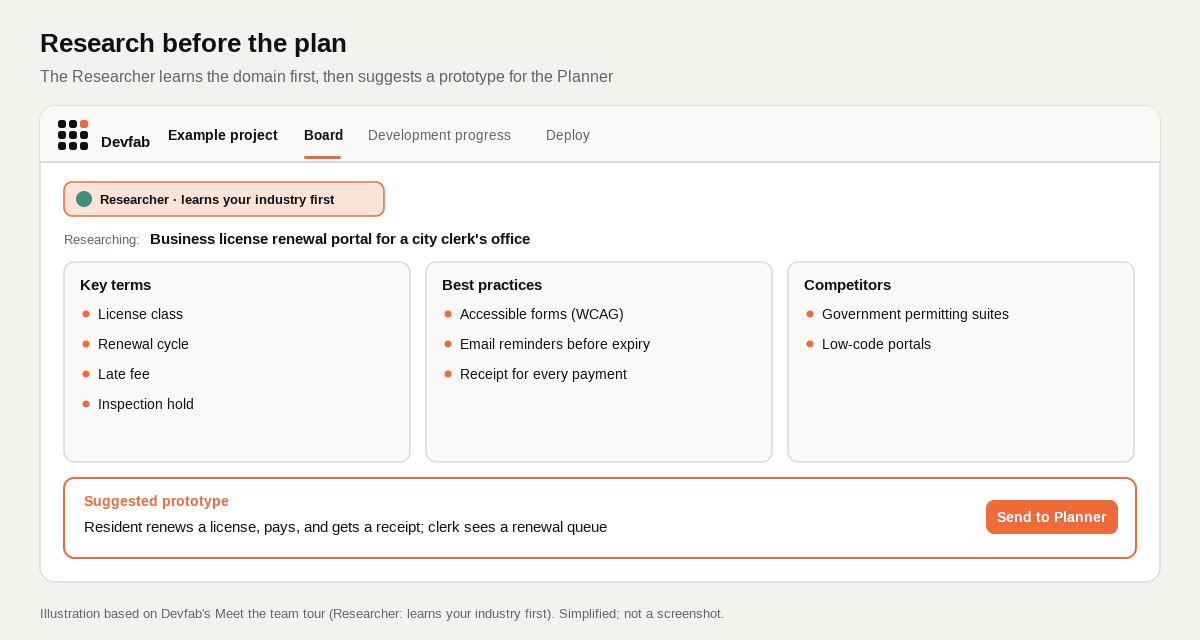
- Research before the plan. The Researcher maps the domain (renewal cycles, late fees, inspections, how other cities run it) and suggests a prototype, so staff see the app before anything is built.
- A person approves the plan. The Planner writes it; your team approves it before the Coordinator creates tickets.
- ChainFlow maps impact. When the fee rules change next year, ChainFlow shows which functions and APIs are connected, so a change to fees also flags receipts, reminders and the clerk's report.
- QA agent. UI and flow tests click screens, buttons and the renewal journey end to end, plus logic tests on fee rules.
- Deploy and docs. Ship to your own server, with blueprints and user manuals for staff.
- Predictable cost. Cost is logged after each run, per task and per project.
Limits: Devfab is in Beta, has a smaller community and fewer integrations than mature platforms, is not an editor for hands-on coding, and needs a GitHub account. It does not state FedRAMP, GovRAMP or TX-RAMP status; compliance of the hosting is in your hands. If your team has no one to run a server, a hosted platform is the safer choice.
Where a low-code platform is the better choice
- You need a FedRAMP High or IL-4/IL5 cloud today. Power Apps GCC, ServiceNow and Appian state it; Devfab doesn't.
- You're already licensed. Microsoft 365 or ServiceNow agencies get governance, identity and support from a contract they already have.
- Business staff will build and change the apps themselves. Caspio, Knack and Power Apps are made for that.
- No one can host or patch a server. A vendor-hosted platform removes that job.
How to choose
- Start with compliance. Federal data: shortlist Power Apps GCC, ServiceNow, Appian, OutSystems or Mendix for Government. Texas: note OutSystems's TX-RAMP. Elsewhere, ask each vendor for its GovRAMP status in writing.
- Count your users honestly. If residents log in, favor unlimited-user plans (Caspio, Knack) or anonymous-user terms (Mendix).
- Match the platform you already run. Microsoft shop: Power Apps. ServiceNow shop: App Engine.
- Decide who maintains it. Business users: Caspio, Knack, Power Apps. A central IT team: OutSystems, Mendix, Appian.
- Decide whether you must own the code. If yes, and you can host it, compare Devfab.
See also Best AI tools for local government IT teams and a worked example, the 311 service request portal.
FAQ
Which low-code platforms have FedRAMP authorization?
From the pages we opened in November 2026: Power Apps US Government (GCC meets FedRAMP High), ServiceNow's Government Community Cloud (FedRAMP High and DoD IL-4), Appian Government Cloud (FedRAMP High), OutSystems (FedRAMP authorized through Knox, level not stated) and Mendix Cloud for Government (reported FedRAMP authorized in 2025, level not stated).
Do state and local governments need FedRAMP?
Not always. FedRAMP is a federal program. Many states use their own or shared programs, such as Texas TX-RAMP or GovRAMP, which verifies cloud products for state, local, tribal and education governments. OutSystems announced TX-RAMP certification in November 2026. None of the vendor pages we opened stated a GovRAMP status.
What is the cheapest low-code platform for a resident-facing app?
Per-user pricing gets expensive when every resident is a user. Caspio and Knack both offer unlimited app users on flat plans: Knack Starter is USD 59 per month and Caspio Team USD 300 per month, as of November 2026. Check record limits, compliance options and whether you need an Enterprise plan for HIPAA or GovCloud.
Can a government agency own the code of a low-code app?
Usually not in the same way as custom code. Low-code apps run on the vendor's platform and licence. If ownership and hosting on your own servers matter more than low-code speed, an approach that produces normal source code in your own repository, such as an AI software factory, is worth comparing.
Is Devfab FedRAMP authorized?
Devfab does not state a FedRAMP or GovRAMP status. It puts the code in your own GitHub account or organization and deploys to your own server, so the hosting and its compliance stay under your control. Devfab is in Beta.
Read next
- What is an AI software factory?
- Best low-code platforms for enterprises
- Devfab vs ServiceNow App Engine
- Devfab vs Caspio
See the app before you sign a contract. Try Beta
Sources (checked November 2026): Power Apps US Government (Microsoft Learn); Power Apps; Power Apps pricing; Power Platform licensing FAQ; Power Platform September 2026 update; ServiceNow for state government; ServiceNow App Engine pricing; ServiceNow Build Agent (May 6, 2026); ServiceNow AI-native packages (Apr 9, 2026); OutSystems FAQs; OutSystems FedRAMP (Business Wire); OutSystems TX-RAMP (Nov 3, 2026); OutSystems pricing; OutSystems Developer Cloud; Appian FedRAMP High (Apr 10, 2025); Appian pricing; Appian What's New; Appian Q2 2026 highlights; Blaze: Appian reviews (Feb 19, 2026); Mendix Cloud for Government; WashingtonExec: Mendix FedRAMP (Feb 2025); Mendix pricing; Mendix 11.12 (Jun 30, 2026); Caspio; Caspio pricing; Knack; Knack pricing; GovRAMP; MRSC: federal thresholds (Nov 2025).
Frequently asked questions
Which low-code platforms have FedRAMP authorization?
From the pages we opened in November 2026: Power Apps US Government (GCC meets FedRAMP High), ServiceNow's Government Community Cloud (FedRAMP High and DoD IL-4), Appian Government Cloud (FedRAMP High), OutSystems (FedRAMP authorized through Knox, level not stated) and Mendix Cloud for Government (reported FedRAMP authorized in 2025, level not stated).
Do state and local governments need FedRAMP?
Not always. FedRAMP is a federal program. Many states use their own or shared programs, such as Texas TX-RAMP or GovRAMP, which verifies cloud products for state, local, tribal and education governments. OutSystems announced TX-RAMP certification in November 2026. None of the vendor pages we opened stated a GovRAMP status.
What is the cheapest low-code platform for a resident-facing app?
Per-user pricing gets expensive when every resident is a user. Caspio and Knack both offer unlimited app users on flat plans: Knack Starter is USD 59 per month and Caspio Team USD 300 per month, as of November 2026. Check record limits, compliance options and whether you need an Enterprise plan for HIPAA or GovCloud.
Can a government agency own the code of a low-code app?
Usually not in the same way as custom code. Low-code apps run on the vendor's platform and licence. If ownership and hosting on your own servers matter more than low-code speed, an approach that produces normal source code in your own repository, such as an AI software factory, is worth comparing.
Is Devfab FedRAMP authorized?
Devfab does not state a FedRAMP or GovRAMP status. It puts the code in your own GitHub account or organization and deploys to your own server, so the hosting and its compliance stay under your control. Devfab is in Beta.