Short answer: For large custom-app portfolios, OutSystems and Mendix lead. Microsoft Power Apps is the default for Microsoft 365 shops, and Appian for regulated processes and case management. Retool suits internal tools on existing data. Quickbase and Zoho Creator suit operations teams on a budget. Devfab fits when you want custom code you own instead.
You own the enterprise app backlog, and every department wants something different. Finance wants approvals, operations wants field apps, and the board wants AI in all of it. Every low-code vendor now says "agentic." The differences that matter sit lower down: where apps run, how you govern them, and how licensing grows as users and apps multiply. This list compares seven platforms on those points, plus one alternative for when low-code isn't the answer.
In this guide, you'll learn:
- How we picked and compared
- Quick comparison table
- The platforms, one by one
- Devfab, with honest limits
- How to choose
Use the table first, then read the sections for your shortlist.
How we picked and compared
We started from platforms that enterprise buyers shortlist most often and kept those with an active 2026 release, enterprise governance features, and an official pricing or editions page. For each one, we read the vendor's product, pricing and release pages and, where useful, a dated third-party review. We did not run hands-on tests; every claim links to its source, and all were checked in November 2026.
We compared each platform on six points:
- AI app building: can it plan and generate apps from requirements?
- Outside agents: can AI coding tools work on its apps?
- Governance: SSO, roles, audit, policies.
- Where apps run: vendor cloud, your cloud, on-premises, air-gapped.
- Integrations: connectors and data access.
- Pricing model: per user, per app, per platform, and whether prices are public.
Quick comparison table
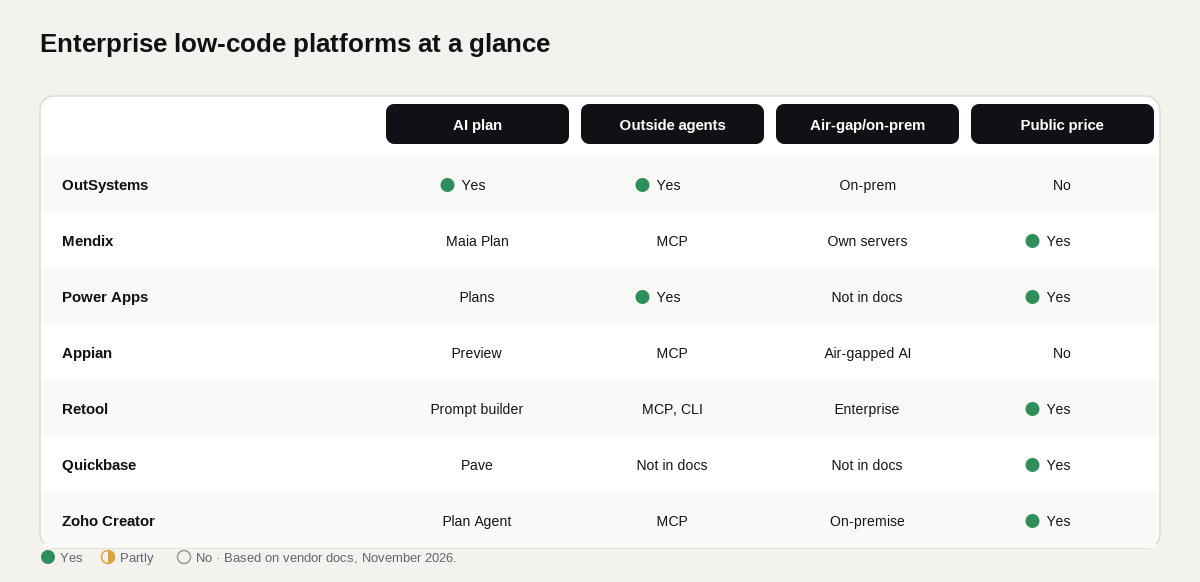
| Platform | Best for | AI app building | Where apps run | Pricing model (Nov 2026) |
|---|---|---|---|---|
| OutSystems | Large portfolios of custom apps and agents | Mentor App Generator; plan approval in the IDE | Managed cloud on AWS, on-premises, private or sovereign cloud | Quote; sized by Application Objects and users |
| Mendix | Industrial and SAP-heavy enterprises | Maia Plan and Maia Make | Mendix Cloud, Azure, Kubernetes, SAP BTP, own servers | Standard One App from USD 1,090 per month; Premium by quote |
| Microsoft Power Apps | Microsoft 365 and Dataverse organizations | Plans workspace; natural-language apps | Microsoft cloud | Premium USD 20 per user per month, paid yearly |
| Appian | Regulated processes and case management | Composer (preview); Agent Studio | Appian cloud or self-managed, including air-gapped AI | Per user, per month, per app; no public prices |
| Retool | Internal tools on existing data | Prompt-first React builder | Retool Cloud, VPC, on-prem, air-gapped (Enterprise) | Team USD 10 per builder and USD 5 per internal user per month, billed annually |
| Quickbase | Operations apps with unlimited users | Pave prompt-to-app builder | Quickbase cloud | From USD 500 per month billed annually (platform price) |
| Zoho Creator | Mid-size firms and Zoho users | Zia with Plan, Build and Test agents | Zoho Cloud, AWS, Azure, GCP, on-premise, hybrid | From USD 8 per user per month billed annually |
| Devfab | Custom apps as code you own | Research, then a plan a person approves | Your own server, from your GitHub repo | Cost logged per task and per project (Beta) |
Prices from each vendor's official pricing page, listed under Sources.
The platforms, one by one
OutSystems
Best for: enterprises running many interdependent apps and AI agents on one governed platform, in banking, healthcare, insurance, manufacturing and government (OutSystems FAQs).
- AI building. Mentor App Generator asks clarifying questions and builds the data model, logic and UI. Mentor in the IDE proposes a plan and applies changes after approval (OutSystems, Mar 2026).
- Context. The Enterprise Context Graph gives a real-time view of apps, agents, workflows, data and dependencies, and outside agents such as Claude Code, Codex and Cursor work "within a shared enterprise context and guardrails" (OutSystems, Mar 2026).
- Hosting. OutSystems Developer Cloud is a managed PaaS on AWS; a self-hosted model runs apps in your infrastructure (OutSystems ODC).
- Integrations and compliance. "Pre-built connections to 400+ systems," a private gateway to on-prem systems, and HIPAA, PCI DSS and FedRAMP requirements with SOC 2 Type II and ISO certifications (same source).
- Pricing. A free Personal Edition for development; the paid platform is by quote, sized by Application Objects (a typical medium app is about 150), users and add-ons (OutSystems pricing).
Limits: no public prices, and some third-party Forge components may need rebuilding for ODC.
Mendix
Best for: Siemens and industrial customers, and enterprises that need one license across many deployment targets.
- AI building. Maia Plan turns ideas and user stories into structured app plans and can recommend only company-approved Marketplace components (Mendix 11.10).
- Outside agents. The Studio Pro MCP Server lets external agents use Maia tools, and Mendix Cloud MCP connects assistants such as Claude Code and GitHub Copilot (Mendix docs; Mendix 11.12).
- Hosting. Mendix Cloud, Mendix on Azure, Kubernetes, SAP BTP, StackIT, your own servers, or Mendix Cloud Dedicated (Mendix pricing).
- Release cadence. Mendix 11.12, released June 30, 2026, is the first LTS since 10.24 and adds Agents Kit 2.0 (Mendix 11.12).
- Pricing. Free plan; Standard One App "starting at" USD 1,090 per month and Unlimited Apps "starting at" USD 2,725 per month; Premium by quote, as of November 2026. Developers and anonymous users are not charged (Mendix pricing).
Limits: Mendix says policies for external agents in 11.12 "bring visibility, but no enforcement," and AI features are not listed by plan.
Microsoft Power Apps
Best for: organizations standardized on Microsoft 365, Dataverse and Entra.
- AI building. Users "describe what they need in natural language," and the Plans workspace uses AI agents as requirements analyst, data modeler and solution architect (Power Apps; The New Stack).
- Outside agents. The app-builder skill lets AI code tools build model-driven apps, "creating nothing until the user approves the build plan" (Microsoft, Sep 2026).
- Governance. IT can "centralize policies for environments, data loss prevention, access, and auditing" (Power Apps).
- Data. Apps use Dataverse; capacity is a paid add-on at USD 40 per GB per month, paid yearly (Power Apps pricing).
- Pricing. Premium USD 20 per user per month, paid yearly; USD 12 per user per month at a 2,000-seat minimum; free Developer Plan, as of November 2026 (same source).
Limits: premium, on-premises and custom connectors need standalone licenses, and several AI building features are still in preview (licensing FAQ).
Appian
Best for: regulated organizations that need auditable processes, case management and RPA on one platform.
- Agents. Agent Studio supports multi-agent communication and an audit view of the exact steps an agent took (Appian Q1 2026).
- Evaluations. A central evaluations experience runs agent test cases in bulk (Appian Q2 2026).
- Model governance. Bring your own Azure OpenAI account, route through a custom LLM gateway, disable model families per environment, and use AI Guardrails for prompt injection and PII leakage (same source).
- Hosting. AI capabilities can run fully self-managed on air-gapped infrastructure (Appian What's New).
- Pricing. Three plans priced "per user, per month, per app," with AI Action quotas; AI Agents and Composer are not on Standard; no dollar amounts shown (Appian pricing).
Limits: Composer is still a preview, and a competitor's review cites high per-user pricing and a steep learning curve (Blaze, Feb 2026).
Retool
Best for: internal tools on top of existing databases and APIs, and governing AI-built apps from other tools.
- AI building. The new builder is "optimized for prompt-first workflows" and writes React and TypeScript you can inspect (Retool, Jun 2026).
- Imports. Apps can come from Lovable, Replit, Cursor, Codex, Kiro or Claude Code and inherit central auth, roles and data policies (Retool newsroom).
- Admin. Custom SSO, SCIM and granular roles are Enterprise features; audit logs start on Business; Git source control is Enterprise only (Retool pricing).
- Hosting. Retool Cloud, your VPC, on-prem or air-gapped on Enterprise (same source).
- Pricing. Free up to 5 users; Team USD 10 per builder and USD 5 per internal user per month; Business USD 50 and USD 15; billed annually, as of November 2026 (same source).
Limits: bring-your-own AI key became Enterprise-only in October 2026, which drew user complaints (Retool Forum).
Quickbase
Best for: operations teams in field work, construction and manufacturing that want unlimited users on a flat platform price.
- Pave. Launched April 28, 2026, Pave builds apps from plain language with data model, roles, workflows and hosting included (Quickbase press release).
- Connectors. Pave lists 350+ connectors, versioning rollback, and "Your data never trains the AI" (Quickbase Pave).
- Core platform. Up to 50 custom apps on the entry tier, Automations, Sync, API and a developer sandbox (Quickbase pricing).
- SSO. Okta, OneLogin, LDAP or SAML on the core platform; Pave SSO is Enterprise only (same sources).
- Pricing. Core from USD 500 per month billed annually, with no user limit; Pave Launch USD 20 per month for 120 credits, as of November 2026 (Quickbase pricing; Pave pricing).
Limits: Pave custom agents and API access are still "coming soon," and audit logs are a paid add-on.
Zoho Creator
Best for: mid-size businesses, especially those already on Zoho, that want low per-user prices and native mobile apps.
- AI building. Zia builds from natural language; a Plan Agent writes a requirements document, and a Build Agent adds modules and workflows with review of each change (Zoho Creator).
- Testing. A Test Agent generates and runs test cases and is described as self-healing broken tests (same source).
- Mobile. Every app gets native iOS and Android versions (same source).
- Hosting. Zoho Cloud, AWS, Azure, GCP, on-premise or hybrid (same source).
- Pricing. Standard USD 8, Professional USD 20 and Enterprise USD 25 per user per month, billed annually, as of November 2026; SAML SSO is an add-on (Zoho Creator pricing).
Limits: Capterra reviewers cite a steeper learning curve beyond simple apps and slow-to-learn Deluge scripting (Capterra).
Devfab, with honest limits
Devfab is not a low-code platform. It is an AI software factory in the Autonomous Software Lifecycle category, and it belongs on this list because many enterprise teams weigh it against low-code for custom apps. Coding agents automate the developer. Devfab automates the development lifecycle.
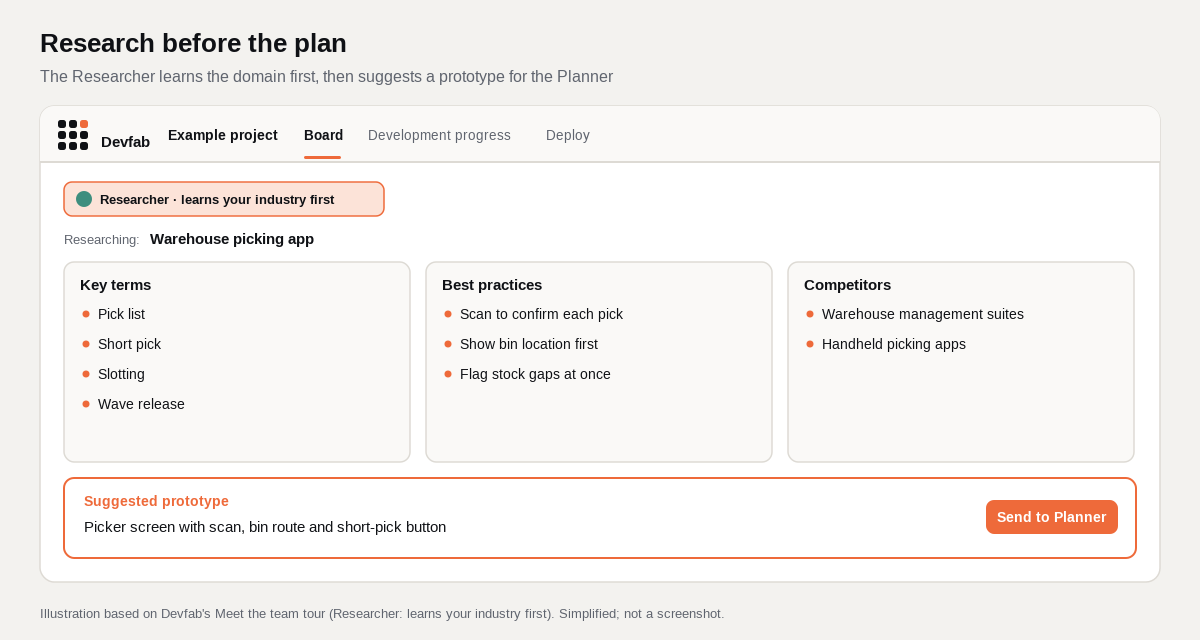
Picture a warehouse picking app for a distribution center:
- Research before the plan. The Researcher maps the domain (pick lists, short picks, slotting, best practices and competitor products) and suggests a prototype.
- A person approves the plan. Human in the loop is the default; the Coordinator creates tickets after approval.
- ChainFlow. It maps which functions and APIs call each other and what is deployed, so changing order release shows its effect on stock counts, carrier labels and notifications.
- QA agent. It runs UI and flow tests (screens, buttons and user journeys clicked end to end) plus logic tests.
- Ownership and cost. Code lives in your own GitHub account or your organization's and deploys to your own server. Cost is predictable: it is logged after each run, per task and per project.
Where a low-code platform is the better choice than Devfab:
- Business users must build and change apps themselves in a visual editor.
- You need vendor compliance attestations such as HIPAA, PCI DSS, FedRAMP or SOC 2 from the platform.
- You run a large portfolio that needs platform-wide governance, connectors and one support contract.
Devfab's limits: it is new and in Beta, with a smaller community and far fewer integrations than these platforms. It is not an editor for hands-on coding, and it needs a GitHub account.
How to choose
- Start with your identity and data platform. Microsoft 365 and Dataverse point to Power Apps. SAP or Siemens point to Mendix. A Zoho estate points to Zoho Creator.
- Then look at the work. Process-heavy, regulated case work fits Appian. Many custom apps and agents fit OutSystems or Mendix. Admin panels on existing databases fit Retool. Field and operations data fits Quickbase.
- Check where apps must run. If air-gapped is a must, shortlist Appian, Retool Enterprise, OutSystems and Mendix, and confirm the details with each vendor.
- Model licensing at your real scale. Per-user pricing (Power Apps, Zoho Creator) and platform pricing (Quickbase) diverge fast as users grow. OutSystems and Appian need a quote.
- Decide what you want to own. If an app must leave the platform someday, or a client must own it, consider an AI software factory for that app. See AI code generation vs low-code.
For head-to-heads, read OutSystems vs Mendix and Power Apps vs OutSystems.
FAQ
What is the best enterprise low-code platform?
It depends on your estate. OutSystems and Mendix are the broadest platforms for large portfolios of custom apps. Power Apps fits Microsoft 365 organizations. Appian leads on regulated processes and case management. Retool fits internal tools on existing databases.
Do enterprise low-code platforms publish prices?
Some do. As of November 2026, Power Apps Premium is USD 20 per user per month paid yearly, Mendix Standard One App starts at USD 1,090 per month, Quickbase starts at USD 500 per month billed annually, and Zoho Creator starts at USD 8 per user per month billed annually. OutSystems and Appian show no prices on their pricing pages.
Which low-code platforms can run on-premises or air-gapped?
OutSystems lists on-premises, private and sovereign cloud options. Mendix deploys to Kubernetes, SAP BTP and your own servers. Appian says its AI can run fully self-managed on air-gapped infrastructure. Retool offers self-hosted and air-gapped deployment on Enterprise. Zoho Creator lists on-premise and hybrid options.
Can enterprise low-code platforms work with AI coding agents?
Yes, increasingly. OutSystems supports external tools such as Claude Code, Codex and Cursor. Mendix offers an MCP server for external agents. Power Apps lets AI code tools build model-driven apps after the user approves a plan. Appian exposes an MCP server, and Retool can build apps through its MCP server or CLI.
When is an AI software factory a better fit than low-code?
When the app must be custom code you own, run on your own or a client's server, and change over time without a platform license. Devfab researches the domain, gets a plan approved by a person, tests UI and flows, and deploys from your own GitHub repository.
Read next
Have a custom app that shouldn't live on a platform? Try Beta
Sources (checked November 2026): OutSystems Agentic Systems Engineering (Mar 31, 2026); OutSystems next-gen Mentor; OutSystems Developer Cloud; OutSystems pricing and editions; OutSystems FAQs; Mendix pricing; Mendix release 11.10; Mendix release 11.12; Mendix: Using Maia with external agents; Microsoft Power Apps; Power Apps pricing; Power Platform licensing FAQ; What's new in Power Platform: September 2026; The New Stack: Power Apps Plans; Appian pricing; Appian What's New; Appian Q1 2026 release highlights; Appian Q2 2026 product highlights; Blaze: Appian reviews (Feb 2026); Retool React AI app builder; Retool newsroom: governance for vibe-coded apps; Retool pricing; Retool Forum: BYOK gating thread (Oct 2026); Quickbase pricing; Quickbase Pave; Quickbase Pave pricing; Quickbase introduces Pave (Apr 28, 2026); Zoho Creator; Zoho Creator pricing; Capterra: Zoho Creator reviews.
Frequently asked questions
What is the best enterprise low-code platform?
It depends on your estate. OutSystems and Mendix are the broadest platforms for large portfolios of custom apps. Power Apps fits Microsoft 365 organizations. Appian leads on regulated processes and case management. Retool fits internal tools on existing databases.
Do enterprise low-code platforms publish prices?
Some do. As of November 2026, Power Apps Premium is USD 20 per user per month paid yearly, Mendix Standard One App starts at USD 1,090 per month, Quickbase starts at USD 500 per month billed annually, and Zoho Creator starts at USD 8 per user per month billed annually. OutSystems and Appian show no prices on their pricing pages.
Which low-code platforms can run on-premises or air-gapped?
OutSystems lists on-premises, private and sovereign cloud options. Mendix deploys to Kubernetes, SAP BTP and your own servers. Appian says its AI can run fully self-managed on air-gapped infrastructure. Retool offers self-hosted and air-gapped deployment on Enterprise. Zoho Creator lists on-premise and hybrid options.
Can enterprise low-code platforms work with AI coding agents?
Yes, increasingly. OutSystems supports external tools such as Claude Code, Codex and Cursor. Mendix offers an MCP server for external agents. Power Apps lets AI code tools build model-driven apps after the user approves a plan. Appian exposes an MCP server, and Retool can build apps through its MCP server or CLI.
When is an AI software factory a better fit than low-code?
When the app must be custom code you own, run on your own or a client's server, and change over time without a platform license. Devfab researches the domain, gets a plan approved by a person, tests UI and flows, and deploys from your own GitHub repository.